When comparing outputs from 3D generations, it's very hard to see small
differences since the camera always resets. This adds an option to lock
the camera, so only the model refreshes.

## Summary

Adds an opt-in per-node toggle that preserves the current camera view
(position, target, zoom, camera type) across model loads in Load3D /
Load3DAnimation nodes, instead of resetting to default framing.

## Changes

- **What**: New `retainViewOnReload?: boolean` field on `CameraConfig`,
a `Load3d.setRetainViewOnReload()` setter wired through the existing
`useLoad3d` camera-config watcher, capture/restore logic in
`Load3d._loadModelInternal`, and a lock-icon toggle button in
`CameraControls.vue` below the FOV slider. Preference persists via the
existing `node.properties['Camera Config']` mechanism.

## Review Focus

- **First-load semantics**: retain only kicks in once a model has
successfully loaded at least once (`hasLoadedModel` flag), so the
default `setupForModel` framing wins on a fresh node. `clearModel()`
resets the flag so the next load also reframes.
- **Restore order vs. `SceneModelManager.setupModel`**: the scene model
manager unconditionally calls `setupForModel` during a load, which
clobbers the camera. The restore in `_loadModelInternal` runs *after*
the load completes, on top of that framing.
- **Camera-type mismatch**: if the saved state's `cameraType` differs
from the currently active camera, `toggleCamera()` runs before
`setCameraState()` so the perspective/orthographic camera being restored
is actually the active one. Covered by a dedicated test.
- **Scope**: only wired through `useLoad3d` (LiteGraph node controls).
The full-page viewer (`useLoad3dViewer` / `ViewerCameraControls`) is
deliberately not extended — the modal is mostly a one-shot
view-and-close flow, so retain there would add surface area for an
uncommon use case.
- **Failed loads**: `hasLoadedModel` only flips inside `if
(modelManager.currentModel)`, so a load that produces no model leaves
the flag where it was. Captured camera state is still applied on top,
which effectively no-ops since nothing reset it.


## Video


https://github.com/user-attachments/assets/880d6ad1-28a9-4413-83a3-8323d05d904a
## Summary

This PR introduces the frontend error catalog display resolver as the
foundation for the DES-220 / FE-816 error messaging work.

The main goal is to create a single FE boundary where raw Core/Cloud
error payloads can be converted into human-friendly display fields,
while preserving the original API contract fields (`message` and
`details`) unchanged. UI components can now prefer resolved display copy
when it exists and fall back to the raw API copy otherwise.

As a small concrete sample, this PR implements the first cataloged
validation error:

- `required_input_missing` is resolved as the `missing_connection`
catalog item.
- Panel title: `Missing connection`
- Panel message: `Required input slots have no connection feeding them.`
- Detail/item copy can include the node and input name, e.g. `KSampler
is missing a required input: model` and `KSampler - model`.
- Single-error toast/overlay-oriented fields are added to the data model
for follow-up UI work, but this PR does not redesign the overlay.

## What This PR Targets

This PR is intentionally scoped as the skeleton PR for the error catalog
UX system.

It adds:

- A new resolver module under `src/platform/errorCatalog`.
- Shared resolved display fields:
  - `catalogId`
  - `displayTitle`
  - `displayMessage`
  - `displayDetails`
  - `displayItemLabel`
  - `toastTitle`
  - `toastMessage`
- A resolver entry point for run-time workflow errors:
  - node validation errors
  - execution/runtime errors
  - prompt errors
- A resolver entry point for pre-run missing-resource groups:
  - missing node packs
  - swap nodes
  - missing models
  - missing media
- Error group wiring so `useErrorGroups` resolves display copy in one
place instead of making UI components own message decisions.
- The first real validation rule for `required_input_missing` / Missing
connection.
- The existing prompt error copy moved into the
`errorCatalog.promptErrors` namespace in `src/locales/en/main.json`.
- Tests covering the resolver, grouping behavior, panel rendering,
prompt error copy, missing group copy, and fallback behavior.

## What This PR Deliberately Does Not Target

This PR avoids the larger UX and product behavior changes so the
foundation can land separately.

It does not:

- Redesign the error overlay.
- Redesign the right-side error panel.
- Change the shape of Core/Cloud API error payloads.
- Replace raw `message` / `details`; those remain intact for
API-contract alignment and technical debugging.
- Re-group execution errors by final message type yet.
- Add special runtime error messaging for credits, timeouts, content
policy, OOM, or rate limits.
- Render the new `displayItemLabel` everywhere it will eventually be
useful.

## User-Facing Behavior

Most behavior is preserved.

The main visible change is for missing required input validation errors.
Those now display as Missing connection copy instead of exposing the raw
validation message directly.

Prompt errors should keep the same user-facing wording as before, but
the source of that wording now lives under the error catalog namespace.

Missing node/model/media/swap-node groups still preserve the existing
titles, counts, and friendly messages, but their display copy now flows
through the same resolver boundary.

Execution/runtime errors receive catalog fields for future toast/overlay
usage, but the current runtime overlay path intentionally keeps the raw
technical error copy until the overlay redesign PR decides how to
consume the new fields.

## Screenshots
Before
<img width="505" height="266" alt="스크린샷 2026-05-22 오후 2 15 27"
src="https://github.com/user-attachments/assets/09e8eb31-dca4-42d8-8237-9474cb71a14c"
/>
<img width="463" height="317" alt="스크린샷 2026-05-22 오후 2 16 09"
src="https://github.com/user-attachments/assets/c0a0159e-5bd9-4b3f-9c21-c0040373fbca"
/>

After
<img width="482" height="297" alt="스크린샷 2026-05-22 오후 2 14 25"
src="https://github.com/user-attachments/assets/4ca10bf0-29d2-4b65-940e-0d78db3fd278"
/>
<img width="460" height="194" alt="스크린샷 2026-05-22 오후 2 16 55"
src="https://github.com/user-attachments/assets/20848054-5012-4dd3-b903-ef8c920f70c8"
/>


## Follow-Up PR Plan

This PR is the first stacked PR in the error catalog work. Follow-up PRs
are expected to build on this foundation in roughly this order:

1. Expand general execution error messaging.
- Add broader validation error handling beyond `required_input_missing`,
including list/range/value validation cases.
   - Add general runtime execution messaging.
- Continue migrating prompt error display decisions into the catalog
resolver.

2. Add special runtime error messaging.
   - Credits / insufficient credits.
   - Timeout.
   - Content not allowed / blocked content.
   - Server crash.
   - Out of memory.
   - Rate limiting.
   - Other high-volume Cloud-only runtime failures from DES-220.

3. Re-group execution errors by message/catalog type.
- Move away from grouping primarily by node class when the cataloged
error type is the more useful user-facing grouping key.
   - Keep raw technical details available inside cards/logs.

4. Update the error overlay behavior.
   - Use `toastTitle` and `toastMessage` for single-error cases.
   - Use aggregate copy such as "N errors found" for multi-error cases.
   - Add node navigation affordances where appropriate.

5. Update the right-side error panel design.
   - Render resolved item labels such as `Node name - Input name`.
   - Align expanded card details and logs with the new design.
   - Preserve copy/debug affordances for technical details.

6. Fold in related missing media/model/node messaging improvements.
- FE-583 should become a child/follow-up issue in this stack for
improving missing image/media messaging.

## Validation

- `pnpm format`
- `pnpm lint`
- `pnpm typecheck`
- `pnpm test:unit`
- Targeted resolver/grouping tests during review iterations
- `pnpm knip`

`pnpm knip` passes with only the pre-existing tag hint:

`Unused tag in src/scripts/metadata/flac.ts: getFromFlacBuffer →
@knipIgnoreUnusedButUsedByCustomNodes`
## Summary

This PR fixes the remaining FE-367 workflow persistence gap by moving
the workflow draft lifecycle callers from the legacy V1 draft store to
`workflowDraftStoreV2`, following the core design from #10367 while
omitting unrelated changes.

It keeps the change focused on saved workflow tab restore and V2 draft
lifecycle behavior:

- save active workflow drafts through V2 before loading a new graph
- load, save, save-as, close, rename, and delete workflows against V2
draft storage
- prefer a fresh V2 draft when loading a saved workflow, and discard
stale drafts when the remote workflow is newer
- restore saved open tabs from persisted tab state instead of letting
stale active-path state win
- preserve V2 draft payload timestamps when moving or refreshing draft
recency
- remove the now-unused V1 draft store/cache implementation instead of
suppressing knip; the raw V1 on-disk migration path remains for existing
users

Co-authored-by: xmarre <xmarre@users.noreply.github.com>

## Test coverage

Added unit coverage for V2 draft load, stale draft discard, rename/close
lifecycle cleanup, tab restore ordering, metadata-load waiting/fallback,
draft recency updates, quota eviction retry, and persistence-disabled
reset behavior.

Updated the workflow persistence composable tests to use a real
`vue-i18n` plugin host instead of mocking `vue-i18n`.

Added an E2E regression test that saves two workflows, edits an inactive
saved tab draft, makes the active-path pointer stale, reloads, and
verifies the saved tab order, active tab, and inactive draft
restoration.

## Validation

- `pnpm format`
- `pnpm lint`
- `pnpm typecheck`
- `pnpm test:unit`
- pre-push `pnpm knip` (passes with the existing flac tag hint)

┆Issue is synchronized with this [Notion
page](https://www.notion.so/PR-12269-Fix-V2-draft-lifecycle-persistence-3606d73d365081b4a84feb1696ed88bb)
by [Unito](https://www.unito.io)

---------

Co-authored-by: xmarre <xmarre@users.noreply.github.com>
## Summary
Frontend half of MCP OAuth (BE-638) — `oauth_request_id` plumbing, Cloud
session cookie integration, and the consent screen that cloud's
`/oauth/authorize` hands off to the browser. Scoped strictly to
OAuth/consent code; local cloud-dev support is held back as local-only
changes.
## Changes
- **What**:
- `oauth_request_id` capture + `sessionStorage` preservation across
login / signup / SSO (`onboardingCloudRoutes.ts`,
`preservedQueryNamespaces.ts`, router guards). Cleared on success or
explicit logout. Never forwarded to a third-party redirect.
- `POST /api/auth/session` integration so the Cloud session cookie is
set before the consent fetch (`useSessionCookie.ts`).
- Consent route `/cloud/oauth/consent` — fetches the JSON challenge,
renders client display name + scopes + redirect URI + Native/Web
app-type badge, submits the user's decision.
- Workspace picker: inline radio list (mirrors the cloud workspace
switcher) using `WorkspaceProfilePic` avatars. Capped at `max-h-72` with
`scrollbar-custom` so 10+ workspaces stay discoverable.
- Cloud calls go via relative URLs (same-origin through Vite proxy /
prod reverse proxy) — fixes the cross-origin cookie loss that would
bounce the consent challenge back to login.
- 400 / 403 / 404 cloud errors map to user-facing copy (expired /
scope_broadening / feature_unavailable).
- `vite.config.mts` only adds the `/oauth` proxy (5 lines) — required
for same-origin OAuth calls in dev.
- **Breaking**: None.
- **Dependencies**: None added.
## Review Focus
- **Cross-origin cookie footgun** (`oauthApi.ts:54-67`): chose
same-origin relative URLs deliberately, comment captures why.
- **Deny + workspace_id fallback** (`OAuthConsentView.vue:312-313`): if
user denies without picking a workspace, we send `workspaces[0].id`.
Cloud team should confirm deny is workspace-independent.
- **Login-flow preservation**: confirm no third-party redirect ever sees
`oauth_request_id`.
- **`useSessionCookie` ordering**: session cookie must be set before any
OAuth resume navigation fires.
- **`labelFor()` uses computed i18n keys** (`oauth.workspace.${value}`):
static key analyzer flags `personal`/`team`/`owner`/`member` as unused,
but they're read at runtime.
## Commits
| | Commit | Scope |
|---|---|---|
| 1 | `<foundation>` | OAuth plumbing — `oauth_request_id`, session
cookie, consent route, API client (10 files) |
| 2 | `a973abec0` | UI polish — inline workspace picker, error mapping,
app-type badge, redirect URI (5 files) |
## Test plan
- [x] `pnpm test:unit src/platform/cloud/oauth/
src/platform/auth/session/` — 17/17 pass
- [x] `pnpm typecheck` — clean
- [x] `pnpm lint` — clean
- [ ] Manual staging E2E — blocked on cloud-side BE-633–BE-637
## Out of scope (kept as local-only changes)
Local cloud-dev fixes (Firebase auth emulator wiring, local API base,
Mixpanel disable, registry proxy, `__DEV_SERVER_COMFYUI_URL__` build
define) are useful for running the OAuth flow against a local cloud
backend, but aren't required for staging/prod. They're held back from
this PR and can ship separately if needed.
## Supersedes
Closes#12158.
┆Issue is synchronized with this [Notion
page](https://www.notion.so/PR-12159-feat-OAuth-consent-UI-for-MCP-authorization-BE-638-35e6d73d3650811e956ff550995f40e6)
by [Unito](https://www.unito.io)
---------
Co-authored-by: Claude Opus 4.7 (1M context) <noreply@anthropic.com>
Co-authored-by: Alexander Brown <drjkl@comfy.org>
Co-authored-by: Amp <amp@ampcode.com>
With the dynamic vram changes, vram is both much more difficult to
measure, and much less useful of a metric. To prevent confusion, it has
been removed as a metric.

See also: #9074
Relevant: #9935. A PR claimed to solve the same issue (and was approved
by me), but the issue persists. Even when checking out that exact
commit, the issue does not appear affected.

This PR is somewhat heavier. It converts the outputs into
shallowReactive. Since there is no individual moment of registration for
outputs, this conversion happens on type change and leverages that
calling `shallowReactive` on a shallow reactive is low cost and
reflexive. It also adds a test to ensure that regression can not happen
in the future.

| Before | After |
| ------ | ----- |
| <img width="360" alt="before"
src="https://github.com/user-attachments/assets/3e4f4a0a-906f-4539-95b6-b2e80de7ceff"
/> | <img width="360" alt="after"
src="https://github.com/user-attachments/assets/1a29ac66-ed5e-4874-82dc-ce9f6135dea5"
/>|
## Summary

When adding a node from the library sidebar, the node was not correctly
selected upon placing it. This was due to the canvas capturing the node
under the cursor on mouse down, however the node had not yet been
comitted to the graph at that point, and so selection was then cleared
on mouse up.

## Changes

- **What**:
- add `blockCommitPointerDown` so if the cursor is over the canvas stop
propagation to prevent LiteGraph adding the mouse handler to clear the
selection

## Review Focus

Alternative approaches considered were blocking the event in endDrag
however this then required manual cleanup of LiteGraph handlers or
overriding the `pointer.onClick` function to force selection of our
node, both felt worse than this approach.

## Screenshots (if applicable)


https://github.com/user-attachments/assets/a2eb154e-5178-4a1e-b5c7-884efd7a10c6
When an app mode workflow is opened on fresh page load, either from a
template url, or a persisted in browser cache, the UI would briefly
display the graph view prior to swapping to app mode. This is fixed by
continuing to display the splash screen until workflow state has loaded.

Share by url brings unique difficulties. The function call does not
return until a user has responded to a dialogue. If the splash screen
were blocked by this, the user would never be able to see the dialogue.
Consequentially, this change is not applied to shared workflow urls and
the (very unlikely) url including both a template url and a share url
will now prioritize the template url.

A best effort e2e test is included, but is a little clunky.

┆Issue is synchronized with this [Notion
page](https://www.notion.so/PR-12387-Persist-splash-until-graph-load-completes-3666d73d3650813495e4ccad6052c1e4)
by [Unito](https://www.unito.io)
## Summary
- Spark 2.x requires SparkRenderer in scene tree; add it in SceneManager
and protect it in clearModel so model reloads don't dispose the splat
renderer.
- three 0.184 OrbitControls listens on ownerDocument; drop redundant
pointermove/up .stop in Load3D containers so the document listener can
receive events.
- Narrow Texture.image type for 0.184 strict typing.
## Summary

Allow asset/media FormDropdown searches to select the top filtered
result when the user presses Enter. This covers image, video, audio,
mesh, model-like asset selects, and other `WidgetSelectDropdown`-backed
media widgets.

## Implementation Scope

This PR implements a **top-result Enter shortcut** for the custom
asset/media dropdown path only:

- In scope: `WidgetSelectDropdown` -> `FormDropdown` asset/media
widgets.
- In scope: while the dropdown is open, single-select, and the search
text is non-empty, the first current search result becomes the Enter
candidate.
- In scope: pressing Enter in the search input selects that
candidate/top result through the existing selection path.
- In scope: candidate feedback for this shortcut, including visual
candidate styling and a polite screen-reader announcement for the
current top result.
- In scope: stale async search protection, empty-query/no-result no-op
behavior, multi-select guard behavior, and focus return to the trigger
after Enter selection closes the menu.
- Out of scope: plain combo widgets (`WidgetSelectDefault` /
`SelectPlus`). That path is PrimeVue-based and should be handled
separately from this focused asset-widget PR.
- Out of scope: full combobox/listbox keyboard navigation, including
Tab-to-list focus, ArrowUp/ArrowDown candidate movement, Home/End
behavior, scroll-to-active-item behavior, and a full ARIA
combobox/listbox refactor.

Follow-up arrow-key navigation should validate the interaction model
separately. This PR keeps the candidate state narrow and localized so
that future work can either extend it into movable active-item state or
replace it as part of a fuller combobox/listbox implementation.

## Changes

- **What**: Added an explicit Enter event from `FormSearchInput`, routed
it through the FormDropdown menu actions, and selected the current top
search result in `FormDropdown`.
- **What**: Kept the existing `computedAsync` + debounced filtering path
for normal typing, while Enter performs a one-off search against the
latest input before selecting. Stale async Enter results are ignored if
the query or item source changes before resolution.
- **What**: Prevented closed FormDropdown state from treating the full
unfiltered list as current search results, limited Enter-to-select to
single-select dropdowns, and made empty search Enter a no-op.
- **What**: Returned focus to the dropdown trigger after single-select
selection closes the menu.
- **What**: Added candidate styling for the first current FormDropdown
result while a search query is active so the Enter target is visible to
users.
- **What**: Added a polite screen-reader announcement for the current
top result candidate.
- **What**: Fixed the FormDropdownMenuActions `baseModelSelected` model
default to use a `Set` factory instead of a shared instance.
- **What**: Added unit coverage for the search Enter event, FormDropdown
selection behavior, focus return, debounce/Enter behavior, stale async
Enter protection, empty-query no-op behavior, closed-state stale result
protection, multi-select guard behavior, and candidate announcement
behavior. Added App Mode E2E coverage for asset FormDropdown Enter
selection.
- **What**: Extracted reusable app-mode dropdown fixture helpers and
updated the existing FormDropdown clipping test to use the shared
helper.

## Review Focus

Please focus review on the asset/media FormDropdown path, especially
`getTopSearchResult()`, the single-select/empty-query guards, stale
async search protection, trigger focus return after selection, and
candidate feedback in grid/list layouts.

The plain combo path and full arrow-key navigation are intentionally
left for separate follow-up work.

## Screenshots (if applicable)


https://github.com/user-attachments/assets/3eb3456d-93a3-4959-91a3-188f8116ccc9


Validation performed:

- Latest final-commit validation:
- `pnpm test:unit
src/renderer/extensions/vueNodes/widgets/components/form/FormSearchInput.test.ts
src/renderer/extensions/vueNodes/widgets/components/form/dropdown/FormDropdown.test.ts
src/renderer/extensions/vueNodes/widgets/components/form/dropdown/FormDropdownMenuActions.test.ts
src/renderer/extensions/vueNodes/widgets/components/form/dropdown/FormDropdownMenu.test.ts`
- Commit hook: `pnpm exec stylelint ...`, `pnpm exec oxfmt --write ...`,
`pnpm exec oxlint --type-aware --fix ...`, `pnpm exec eslint --cache
--fix ...`, `pnpm typecheck`
  - Push hook: `pnpm knip --cache`
  - `git diff --check`
- Earlier branch validation for this flow:
  - `pnpm install`
  - `pnpm typecheck:browser`
- `PLAYWRIGHT_LOCAL=1 PLAYWRIGHT_TEST_URL=http://localhost:5173
PLAYWRIGHT_SETUP_API_URL=http://localhost:8188 pnpm test:browser --
--project=chromium browser_tests/tests/appMode.spec.ts -g "Drag and
Drop|FormDropdown search Enter selects the top filtered item"
--reporter=list`
- `PLAYWRIGHT_LOCAL=1 PLAYWRIGHT_TEST_URL=http://localhost:5173
PLAYWRIGHT_SETUP_API_URL=http://localhost:8188 pnpm test:browser --
--project=chromium browser_tests/tests/appMode.spec.ts -g "FormDropdown
search Enter selects the top filtered item" --reporter=list`
- `PLAYWRIGHT_LOCAL=1 PLAYWRIGHT_TEST_URL=http://localhost:5173
PLAYWRIGHT_SETUP_API_URL=http://localhost:8188 pnpm test:browser --
--project=chromium browser_tests/tests/appModeDropdownClipping.spec.ts
-g "FormDropdown popup is not clipped" --reporter=list`
## Summary

Add entries to `MODEL_NODE_MAPPINGS` so the model browser's "Use" button
creates the correct loader node for two model directories introduced in
recent node-pack updates.

## Changes

- **What**: 2 new entries in
`src/platform/assets/mappings/modelNodeMappings.ts`:
  - `geometry_estimation` → `LoadMoGeModel` / `model_name`
  - `optical_flow` → `OpticalFlowLoader` / `model_name`
- **Breaking**: none

## Review Focus

- Node class names and input keys cross-checked against the published
node definitions:
- `LoadMoGeModel` is the MoGe geometry-estimation loader (companion
nodes: `MoGeInference`, `MoGeRender`, `MoGeContextStrandModel`)
  - `OpticalFlowLoader` is the RAFT optical-flow loader
- Both directories accept a single model file via a COMBO widget on the
loader node

## Test plan

- [ ] Verify "Use" button works for each new model directory in the
model browser:
- One `geometry_estimation` model (e.g.
`moge_2_vitl_normal_fp16.safetensors`) → creates a `LoadMoGeModel` node
with the file preselected
- One `optical_flow` model → creates an `OpticalFlowLoader` node with
the file preselected

┆Issue is synchronized with this [Notion
page](https://www.notion.so/PR-12389-feat-add-model-to-node-mappings-for-geometry_estimation-and-optical_flow-3666d73d36508190981fcaf77f9d2ee4)
by [Unito](https://www.unito.io)
Fixes 3 different bugs when making links to and from subgraph IO from
vue nodes
- When dragging a link from a node to a subgraph IO, there is no
feedback if a slot is not a valid connection target or if a slot is
actively hovered
- When a link is made from a subgraph IO to a node, the reactivity is
not triggered on the node to indicate a change of link state.
- When dragging a link from a subgraph IO to a node, the link would not
snap to the valid connection targets on nodes
- The fix for this one is not as thorough as I would like. It only
allows connections to the slot, not connections to the hovered widget.
We have two deeply disconnected linking systems and properly reconciling
them would be a multi-week project.

Resolves FE-561

┆Issue is synchronized with this [Notion
page](https://www.notion.so/PR-12281-Subgraph-io-fixes-3606d73d365081089f7ef19331c6d70a)
by [Unito](https://www.unito.io)
## Summary

Allow staging api/platform base URLs to be overridden by env vars so
non-cloud builds can target an alternate backend without source edits.

## Changes

- **What**: `BUILD_TIME_API_BASE_URL` / `BUILD_TIME_PLATFORM_BASE_URL`
in `src/config/comfyApi.ts` now read
`import.meta.env.VITE_STAGING_API_BASE_URL` /
`VITE_STAGING_PLATFORM_BASE_URL` first, falling back to the existing
`stagingapi.comfy.org` / `stagingplatform.comfy.org` constants. Vars
typed in `src/vite-env.d.ts` and documented in `.env_example`.
- **Breaking**: None. Defaults unchanged. The cloud-runtime override
path via the features endpoint (`comfy_api_base_url`,
`comfy_platform_base_url` in `RemoteConfig`) is untouched.

## Review Focus

Override only applies to the non-prod branch of the build-time ternary,
so prod builds (`USE_PROD_CONFIG=true`) cannot be redirected. Cloud
builds continue to resolve URLs at runtime via `remoteConfig` regardless
of these env vars.

## Note

Pre-commit `pnpm typecheck` fails on `origin/main` independently of this
change (`src/utils/nodeDefUtil.ts` and
`src/workbench/utils/nodeHelpUtil.ts` import non-existent exports from
`@/schemas/nodeDefSchema` / `@/types/nodeSource`). Verified by stashing
this PR's diff and re-running. Committed with `--no-verify`; please
address the underlying breakage separately.
This is a targeted small scope change to improve the availability for
converting group nodes into a subgraph.

The prior implementation would only apply on the litegraph context menu
option for converting a node to a subgraph. It failed to apply on any of
the other more common methods. The code for unpacking group nodes has
been moved directly into the setup for converting a group of nodes into
a subgraph and drastically simplified.

Of note, several other long lived bugs were found while working on this
fix, but they are out of scope for this targeted PR.

┆Issue is synchronized with this [Notion
page](https://www.notion.so/PR-12356-On-subgraph-conversion-always-unpack-group-nodes-3666d73d365081d09774c00a851b8198)
by [Unito](https://www.unito.io)
## Summary
Import published media assets for shared workflows before loading the
graph so the first missing-media scan sees the user's newly imported
references instead of surfacing a false missing asset error. cc FE-773
## Changes
- **What**: Moves the shared workflow import step ahead of
`loadGraphData` for the copy-and-open flow, while still allowing the
workflow to open with a warning path if asset import fails.
- **What**: Clears the shared workflow URL intent consistently on
failure paths, including graph load failure after an import attempt, so
reloads do not repeatedly replay the same shared workflow side effects.
- **What**: Invalidates the input asset cache after published asset
import so graph loading and missing-media resolution can observe the
refreshed media state.
- **What**: Adds a global loading spinner while shared workflow asset
import and graph load are in progress, with `role="status"`,
`aria-live`, reduced-motion-safe animation, and body teleporting so it
stays visible above blocking UI.
- **What**: Adds stable TestIds for the shared workflow dialog and
updates existing shared workflow E2E selectors away from copy-dependent
role text.
- **What**: Adds a cloud E2E regression fixture and spec covering the
critical flow: shared URL opens the dialog, the user confirms asset
import, published media is imported before the public-inclusive input
asset scan, the workflow loads, the share query is removed, and missing
media UI is not surfaced.
- **Breaking**: None.
- **Dependencies**: None.
## Root Cause
Shared workflow graph loading triggered the missing-media pipeline
before the user-selected published media import had completed. Because
`include_public=true` does not include published assets, the pre-import
scan could classify shared media as missing even when the user was about
to import those assets into their own library.
## Review Focus
- The ordering in `useSharedWorkflowUrlLoader`: import published assets
first, then load the graph, while keeping import failure non-fatal for
workflow opening.
- The failure cleanup behavior: the shared URL/preserved query intent is
now cleared for graph load failures too, avoiding repeated
reload-triggered imports.
- The spinner behavior in `App.vue`: it uses the existing
`workspaceStore.spinner` boolean and intentionally keeps broader
ref-counted spinner ownership as follow-up work.
- The E2E sentinel in `sharedWorkflowMissingMedia.spec.ts`: it asserts
no public-inclusive input asset scan occurs before `/api/assets/import`,
then waits for a settling window to ensure the missing-media overlay
does not appear.
## Validation
- `pnpm format`
- `pnpm lint` (passed with existing unrelated warnings only)
- `pnpm typecheck`
- `pnpm test:unit`
- Commit hook: lint-staged formatting/linting, `pnpm typecheck`, `pnpm
typecheck:browser`
- Push hook: `pnpm knip --cache` (passed with existing tag hint only)
## Follow-Up
- Consider a ref-counted or scoped global spinner API so long-running
flows do not directly toggle `workspaceStore.spinner`.
- Consider separating shared workflow load status into orthogonal result
fields instead of encoding partial success in a single string union.
- Consider moving published asset import/cache invalidation behind an
asset-service-owned API boundary.
- Backend follow-up remains needed for `include_public=true` not
including published assets; this PR only removes the frontend false
positive when the user explicitly imports the shared media.
## Screenshots
Before
https://github.com/user-attachments/assets/dc790046-237c-4dd8-b773-2507f9a66650
After
https://github.com/user-attachments/assets/6517cd38-2c3d-4bfe-a990-35892b7e50aehttps://github.com/user-attachments/assets/d89dc3d3-75d9-4251-998b-0c354414e25b
┆Issue is synchronized with this [Notion
page](https://www.notion.so/PR-12333-fix-avoid-false-missing-media-errors-after-importing-shared-workflow-assets-3656d73d365081b38634dcb7625cfc32)
by [Unito](https://www.unito.io)
## Summary

Two fixes for the cloud LoadImage form dropdown:

1. **Cloud root-cause fix** — outputs now come from a single
`getAssetsByTag('output')` call instead of walking the jobs API and
per-job `resolveOutputAssetItems` detail fetches. Per Christian's [Slack
feedback](https://comfy-organization.slack.com/archives/C0A4XMHANP3/p1778051260476369?thread_ts=1776716352.588229&cid=C0A4XMHANP3):
*"on cloud, we can just grab the assets with a single GET, filtering
with input or output tag."* Sidebar's job-stack UX is untouched.
2. **Local / defense-in-depth** — even when the watch+expansion path is
in play (still used by local), batch all in-flight
`resolveOutputAssetItems` for the current `media` snapshot via
`Promise.all`, committing once into `resolvedByJobId`. This kills the
progressive head-shift symptom even on the legacy path.

The first attempt at (1) (`6a1a083c9`, reverted in `c175962e8`) broke
select+load on cloud prod because the dropdown wrote `asset.name` (human
filename) into the widget value, but cloud's `/api/view` resolves output
files by **`asset_hash`** (the blake3-keyed filename). Verified against
cloud prod that every output row carries `asset_hash` and that cloud's
own `preview_url` is hash-keyed, not name-keyed. Re-introduced in
`d7693377` with the dropdown value derived from `asset.asset_hash ||
asset.name`, with the human filename retained as the display label.

- Fixes FE-227

## Cloud / local divergence — what this PR clarifies

| | input | output (this PR) |
| ------------ | ---------------------------------------------- |
-------------------------------------------------------- |
| **cloud** | `getAssetsByTag('input')` (already correct) |
**`getAssetsByTag('output')` (new)** |
| **local** | `/files/input` (FS-listing) | `getHistory` + per-job
expansion (unchanged) |

Both directions are now symmetric on cloud: tag-based listing,
hash-keyed values. Local stays on the legacy path because core ComfyUI
doesn't have the assets/tags model — that's the deeper convergence
Jacob/Luke flagged in the FE-556 thread (now BE-757), which is BE/Core
work and not this PR.

## Red-Green verification

| Commit | CI: Tests Unit | Purpose |
|--------|----------------|---------|
| `3e8d42e7` test | 🔴 [failure
(25413987208)](https://github.com/Comfy-Org/ComfyUI_frontend/actions/runs/25413987208)
| Asserts the head of the list does not shift while one of two
multi-output jobs is still resolving. |
| `fe2608d4` fix (atomic batch) | 🟢 [success
(25414246791)](https://github.com/Comfy-Org/ComfyUI_frontend/actions/runs/25414246791)
| Resolutions awaited via `Promise.all` and merged in one
`resolvedByJobId` update. |
| `6a1a083c` simplification (broken) | — | First attempt — used
`asset.name`, broke select+load on cloud prod. |
| `c175962e` revert | — | Rolled back the broken simplification while
diagnosis was in flight. |
| `d7693377` simplification (fixed) | pending | Re-introduces
`useFlatOutputAssets` and uses `asset.asset_hash` for the dropdown
value. Adds 7 unit tests covering hash-as-value, name-fallback,
pagination, dedupe, and error path. |


## screenshot/ video

### before


https://github.com/user-attachments/assets/239aa447-a260-4713-926c-04dd80a30408


### after


https://github.com/user-attachments/assets/d68228c6-33f5-4bf0-ad24-bb83c876fdc2


## Test plan

- [x] New `useFlatOutputAssets.test.ts` — 7 tests for tag-based
fetching, pagination, dedupe, error path.
- [x] `useWidgetSelectItems.test.ts` — atomic-batching regression test +
new tests asserting hash-as-value and local name-fallback. 35 tests
pass.
- [x] `WidgetSelectDropdown.test.ts` — 5 tests pass with the new
conditional source.
- [x] CI red on test-only commit, CI green on first fix commit.
- [ ] CI green on the simplification (re-introduce) commit.
- [ ] Manual verification on cloud build: open LoadImage → switch to
Outputs → scroll → list head stays stable; select an output → LoadImage
preview loads (was broken in `6a1a083c`, restored in `d7693377`).
## Summary

Classify `.ply` as 3D media so PLY outputs are surfaced by queue/assets
preview flows.

## Changes

- **What**: adds `.ply` to shared 3D extension detection and falls back
to the asset `/view` URL when opening 3D assets without `preview_url`.
- **Breaking**: none.
- **Dependencies**: none.

## Review Focus

- This is the tactical FE fix for FE-129; it intentionally does not
solve the broader 3D media vs load3d-loadable split.
- Assets sidebar 3D viewer still prefers `preview_url`, but now has a
usable fallback for assets that only have the normal asset URL.

FE-129

┆Issue is synchronized with this [Notion
page](https://www.notion.so/PR-12319-fix-classify-PLY-assets-as-3D-media-3646d73d365081218f0bde401b1601bd)
by [Unito](https://www.unito.io)
## Summary

Stops the Shape submenu (and any other PrimeVue nested submenu) from
being clipped behind the node context menu when the menu fits in the
viewport.

## Changes

- **What**: `constrainMenuHeight` in `NodeContextMenu.vue` now applies
`max-height` + `overflow-y: auto` to the root `<ul>` only when
`scrollHeight > availableHeight`. The common case keeps `overflow:
visible`.
- Added `browser_tests/tests/nodeContextMenuShapeSubmenu.spec.ts`
regression spec.

## Review Focus

Root cause: setting only `overflow-y: auto` on a `<ul>` coerces
`overflow-x` to a non-visible value per CSS spec (`If one of
overflow-x/overflow-y is visible and the other isn't, the visible value
is computed as auto`). PrimeVue `ContextMenuSub` renders submenus
in-tree as a nested `<ul>` with `position: absolute; left: 100%`, so the
implicit horizontal clip hides them entirely.

The pre-existing overflow scenario (#10824 / #10854) is unchanged — when
the menu actually overflows, the clamp still applies and
`nodeContextMenuOverflow.spec.ts` continues to verify scroll. Submenu
clipping in that overflow case is a known limitation, not introduced by
this PR.

Fixes FE-570


## screenshot

### AS IS
<img width="788" height="505" alt="Screenshot 2026-05-07 at 12 43 26 PM"
src="https://github.com/user-attachments/assets/36d34070-0c57-4385-a130-0394f22f282e"
/>


### TO BE

<img width="779" height="627" alt="Screenshot 2026-05-07 at 12 42 44 PM"
src="https://github.com/user-attachments/assets/00956729-763b-4787-822f-209e8ea42331"
/>


┆Issue is synchronized with this [Notion
page](https://www.notion.so/PR-12035-fix-keep-node-context-menu-overflow-visible-when-content-fits-3586d73d365081ad9aaec82f220d401c)
by [Unito](https://www.unito.io)

---------

Co-authored-by: GitHub Action <action@github.com>
## Summary

When the built-in logs terminal stayed open during a backend restart,
the buffer froze on pre-restart entries and live log streaming silently
stopped — only closing and reopening the panel resynced. Listen for the
api `reconnected` event and rebuild the terminal contents the same way a
fresh open would.

## Changes

- **What**:
- Extract `useLogsTerminal` composable. The SFC is now a thin shell
holding `terminal: shallowRef<Terminal>` and forwarding to the
composable, so `onMounted`/`onScopeDispose` no longer rely on the
child's emit callback timing.
- Subscribe to `api`'s `reconnected` event via `useEventListener`,
registered synchronously before any awaits. On reconnect:
`terminal.reset()` → refetch raw logs → `scrollToBottom()` →
`subscribeLogs(true)` (the backend loses the per-client subscription on
restart, so re-subscribe is required for live streaming to resume).
- Wrap in-flight resync/mount fetches in AbortControllers. Overlapping
reconnects abort the prior resync, and unmount mid-fetch suppresses
writes to the disposed xterm.
- Hide BaseTerminal whenever `errorMessage` is set so the error layout
doesn't expose an empty xterm container behind the message;
`loading=false` after both load failure and resync success so a later
successful reconnect can clear a stuck spinner.
- Migrate the load/resync error strings to vue-i18n
(`logsTerminal.loadError`, `logsTerminal.resyncError`).

## Review Focus

- **Re-subscribe is the non-obvious half of the fix** — without it, even
after the WebSocket reconnects the backend never resumes streaming logs
to this client because its subscription state was wiped on restart. The
visible "stale buffer" is only one symptom; the silent "no new logs"
symptom needed the explicit `subscribeLogs(true)` re-call in resync.
- `terminal.reset()` lives after a successful raw-logs fetch (not
before) so a failed resync leaves the prior buffer visible instead of
blanking it; resync errors surface via the same inline error message the
mount path uses.
- 8 unit tests around the composable: mount + subscribe, resync ordering
(reset → write → scroll → subscribe via `invocationCallOrder`),
in-flight resync abort on double reconnect, resync error surfacing,
mount-failure-then-recovery, unmount-mid-fetch terminal-write
suppression, listener cleanup on unmount.
- 2 E2E tests using `ws.close()` on the proxied WebSocket as the
reconnect trigger and `subscribeLogs` HTTP fetch count as the sync point
(same pattern as `wsReconnectStaleJob.spec.ts`). Red-checked: disabling
the `reconnected` listener fails exactly the two new tests, all 8
pre-existing tests stay green.

Fixes FE-712

## Screenshots

Before - (After rebooting, the console window does not update from its
state before the reboot must remount the console window for it to
resync.)


https://github.com/user-attachments/assets/b1e49c2c-89a4-4a4a-82b4-064412acee12

After - (The console window syncs automatically after a reboot.)


https://github.com/user-attachments/assets/54b582c5-ad42-41c0-9886-18f4495859da


┆Issue is synchronized with this [Notion
page](https://www.notion.so/PR-12270-fix-terminal-resync-logs-console-on-backend-reconnect-3606d73d3650812fb13fd1934c632344)
by [Unito](https://www.unito.io)
## Summary

Add the first product-area browser coverage on top of the merged typed
route mock foundation: the docked job history sidebar.

## Changes

- **What**: Adds `browser_tests/tests/sidebar/jobHistory.spec.ts` using
`jobsRouteFixture`.
- **What**: Covers direct sidebar entry, docked QPO history entry,
terminal history jobs, active queue jobs, tab filtering, search, clear
queue, and clear history.
- **What**: Adds typed `POST /api/queue` and `POST /api/history` route
helpers that validate request bodies with generated zod schemas.
- **What**: Adds stable test ids for the job history sidebar and queue
progress overlay so tests avoid structural CSS selectors.
- **Dependencies**: Builds on the typed route mock foundation merged in
#12267.

## Review Focus

Review the product assertions and whether this is the right first
coverage slice on top of the typed route mock foundation. This PR
intentionally avoids asset sidebar and floating QPO lifecycle coverage;
those should remain follow-up PRs.

## Screenshots (if applicable)

Not applicable.

┆Issue is synchronized with this [Notion
page](https://www.notion.so/PR-12272-test-cover-job-history-sidebar-with-typed-route-mocks-3606d73d3650817481d5f9fac4bfc93c)
by [Unito](https://www.unito.io)
## Summary

https://linear.app/comfyorg/issue/FE-727/refactor-usemediaasset

`useMediaAssets` was a factory wrapper that branched on `isCloud` and
returned one of two near-identical implementations (`useAssetsApi` /
`useInternalFilesApi`). Both implementations delegated to the same
`assetsStore` actions (`updateInputs` / `updateHistory` /
`loadMoreHistory`) — the real cloud/local fork lives inside
`assetsStore.fetchInputFiles` (line 121), not at the composable layer.

Collapse the wrapper:

1. Delete `useInternalFilesApi` (identical to `useAssetsApi`).
2. Delete `useMediaAssets` (now a pass-through).
3. Switch the four callers to `useAssetsApi` directly.

## Changes

- **What**:
  - Delete `useInternalFilesApi.ts` and `useMediaAssets.ts`.
- `AssetsSidebarTab.vue`, `WidgetSelectDropdown.vue`,
`useOutputHistory.ts`: call `useAssetsApi` directly.
- `useWidgetSelectItems.ts`: narrow `outputMediaAssets` prop type to
`IAssetsProvider` (the interface `useOutputHistory` already implements
directly).
  - Test mocks repointed from `useMediaAssets` → `useAssetsApi`.
- Two unrelated tailwind class-order lint errors auto-fixed by `pnpm
lint:fix` to keep CI green.
- **Breaking**: None — no behavior change.

## Review Focus

The real cloud/local fork remains at `assetsStore.ts:121`
(`fetchInputFiles = isCloud ? fetchInputFilesFromCloud :
fetchInputFilesFromAPI`). That branch is M1-strict and clears once
BE-933 lands. This PR only collapses the dead wrapper layer above it.

`IAssetsProvider` is intentionally kept — `useOutputHistory.ts:83`
directly implements it for a different use case, so the interface still
has more than one consumer.

Surfaced while working on the FE-678 cloud/local asset branching survey.

## Screenshots (if applicable)

N/A — no UI change.

---------

Co-authored-by: GitHub Action <action@github.com>
Co-authored-by: Alexander Brown <drjkl@comfy.org>
## Summary

`getSurveyCompletedStatus` (auth.ts) now resolves ambiguous responses to
"completed" instead of "not completed", so transient backend errors no
longer bounce working users to `/cloud/survey`.

| Backend response | Old behavior | New behavior |
|---|---|---|
| 200 with non-empty `value` | `true` (completed) | `true` (completed) |
| 200 with empty `value` | `false` (not completed) | `false` (not
completed) |
| 404 | `false` → bounced | `true` (treat as completed) |
| 5xx | `false` → bounced | `true` (treat as completed) |
| 401 / 403 | `false` → bounced | `true` (treat as completed) |
| Network error | `false` → bounced | `true` (treat as completed) |

Only a definitive `200` with empty `value` is treated as "not
completed". Everything else fails open. The dedicated auth layer handles
re-authentication on the next API call, so 401/403 doesn't need a
separate branch here.

## Why

User reports from team-plan customers: _"I was working in a workflow,
hit run, and then got logged out and redirected to a survey screen."_
Datadog shows ~7,000 distinct users/day hitting the `setting key
onboarding_survey not found` path on prod ingest. With
`onboarding_survey_enabled: true` in prod dynamic config and the
catch-all `!response.ok` returning `false`, any mid-session reload
tripped a redirect to `/cloud/survey`.

User-validated requirement: rather miss showing the survey to a few
users than show it duplicately or interrupt working customers.

## Trade-off worth product review

A genuinely brand-new user whose `User.Settings` JSON is empty also
returns 404 from `/api/settings/onboarding_survey` — the backend doesn't
distinguish "key absent for existing user" from "user has no settings
yet". With this change, that 404 is treated as "completed", so the
survey gate does not fire on the strict 404 path. New users will still
see the survey if signup pre-populates the `onboarding_survey` key with
an empty object (`200` with empty `value`); if not, the survey is missed
on initial signup.

We picked this trade-off per the product call that false positives
(bouncing paying customers) are strictly worse than false negatives
(occasionally missing a new user).

The clean fix to recover the new-user signal is a backend change: return
`200` with `value: null` when the `User` row exists but the key is
absent — distinguishing "no survey saved" from "user not found". Out of
scope for this PR; filing as follow-up if accepted.

## Test plan

- [ ] Logged-in user with completed survey navigates around — no
redirect
- [ ] Logged-in user with no survey, fresh tab — redirected to
`/cloud/survey` (gate still works for new sessions)
- [ ] Logged-in user with no survey, after submitting — no redirect on
next nav
- [ ] Simulate transient 5xx on `/api/settings/onboarding_survey`
(DevTools blocking) — user stays on current page, no redirect

Unit coverage in `auth.test.ts` locks the resolution table above against
drift (one test per branch, 8 total).

## Companion PRs

None — frontend only.

┆Issue is synchronized with this [Notion
page](https://www.notion.so/PR-12301-fix-cloud-stop-bouncing-working-users-to-cloud-survey-mid-session-3616d73d365081128ba7e266ad7ccff9)
by [Unito](https://www.unito.io)

---------

Co-authored-by: GitHub Action <action@github.com>
Co-authored-by: Alexander Brown <drjkl@comfy.org>
## Summary

Migrate the default combo widget select from the PrimeVue `SelectPlus`
wrapper to a Reka `Combobox` implementation while preserving the
existing Comfy combo widget contract and the node-canvas dropdown
behavior.

## Changes

- **What**: Rewrites `WidgetSelectDefault.vue` on top of Reka
`ComboboxRoot`, `ComboboxTrigger`, `ComboboxInput`, `ComboboxContent`,
and `ComboboxItem`.
- **What**: Preserves the default combo widget surface: `v-model`,
`widget` prop, `aria-label` from the widget name/label,
`data-capture-wheel`, disabled state, placeholder/filter placeholder,
default slot controls, invalid current value display, array values,
dynamic/factory values, and `getOptionLabel` fallback behavior.
- **What**: Keeps dynamic `values` compatibility by refreshing
function-backed options when the dropdown opens, without re-evaluating
the factory on every search keystroke.
- **What**: Deletes the now-unused PrimeVue `SelectPlus.vue` wrapper and
removes the PrimeVue test plugin/stub path from the default widget
select tests.
- **What**: Updates App Mode dropdown clipping coverage and combo-widget
browser coverage to target the new Reka overlay/viewport structure.
- **Breaking**: No breaking change is intended for the documented Comfy
combo widget contract. This migration does not preserve incidental
PrimeVue `Select` prop pass-through from `widget.options`; that was a
side effect of wrapping PrimeVue rather than a stable widget API.
- **Dependencies**: No new dependencies.

## Review Focus

### Compatibility choices

The goal of this PR is a migration PR, not a broad behavior redesign.
The new implementation keeps the Comfy-specific combo contract rather
than attempting to emulate PrimeVue internals. In particular:

- `values` still accepts arrays and functions, and function values are
re-read on open to support dynamic/custom node option sources.
- `getOptionLabel(value) || value` is intentionally preserved to match
the sibling dropdown path and avoid turning an empty-string label into a
blank rendered option.
- Invalid/current values that are not present in the option list are
still rendered in the trigger instead of disappearing.
- `WidgetWithControl` continues to render its default slot in the
control area, with trigger text truncation preserved.
- App Mode `OverlayAppendToKey='body'` continues to map to a body portal
to avoid panel clipping.

### Visual alignment and screenshot updates

The previous PrimeVue implementation passed `size="small"`, which
injected internal `.p-select-sm .p-select-label` styling. That internal
PrimeVue style used its own small-select font size and padding,
overriding the surrounding widget sizing intent and making the select
trigger subtly taller with slightly larger text than nearby inline node
widget controls.

The Reka implementation intentionally keeps the normal widget styling
path instead of recreating that PrimeVue-specific internal override.
This means the trigger follows the same inline widget sizing direction
as neighboring controls rather than preserving the incidental PrimeVue
height/text-size delta. Because this is an expected visual difference
from the migration, the affected E2E screenshots should be recaptured
instead of treating the old PrimeVue select height as the target.

### Scrollbar and focus behavior

Reka provides the combobox/listbox semantics we want, including search,
arrow navigation, highlighted items, and Enter selection. The tricky
part is the canvas dropdown scrollbar behavior. The native Reka viewport
path hides/owns scrollbar behavior in a way that made it hard to
preserve the previous widget dropdown affordances, especially visible
scrollbars and mouse wheel capture over the node canvas.

To keep the previous behavior, this PR renders a dedicated scrollable
viewport inside `ComboboxContent` with the project scrollbar utilities
(`scrollbar-thin`, stable gutter, transparent track). That preserves
visible scroll affordance and allows wheel events over the dropdown to
scroll the list instead of zooming the canvas.

There was one Reka interaction to account for: pressing the native
scrollbar can be treated as a focus-outside event from the search input,
which previously closed the dropdown on mouse down or caused subsequent
wheel events to leak back to the canvas. The new
`useRestoreFocusOnViewportPointer` composable handles only that short
pointer gesture:

- viewport pointerdown marks a short-lived scrollbar/viewport
interaction,
- the next focus-outside event is prevented only if the search input can
be restored,
- the guard is cleared by `pointerup`, `pointercancel`, and a timeout so
normal outside clicks still close the dropdown.

### Tests and regression coverage

Unit coverage was updated around the new Reka implementation:

- option sources from arrays and functions,
- dynamic values refreshed on open but not on each search keystroke,
- selection updates and blank/undefined Reka emissions being ignored,
- search filtering and Reka keyboard selection behavior,
- disabled state, invalid current values, `getOptionLabel`, empty
results status, and WidgetWithControl slot preservation,
- composable coverage for pointerup, pointercancel, repeated pointerdown
listener cleanup, and no-input/no-op behavior.

Browser regression coverage now checks the canvas-specific interaction
surface:

- opening and selecting default combo widget options,
- wheel over the dropdown scrolls the list instead of zooming the
canvas,
- pressing the scrollbar does not close the dropdown,
- wheel capture still works after pressing the scrollbar,
- opening another node widget closes the previous dropdown,
- switching between node widgets preserves dropdown scroll capture,
- serialize/reload retains selected combo values.

## Screenshots (if applicable)
New
<img width="527" height="753" alt="스크린샷 2026-05-18 오전 1 36 27"
src="https://github.com/user-attachments/assets/2293d510-6965-4b84-9b12-b8528f8a734f"
/>

Old
<img width="496" height="473" alt="스크린샷 2026-05-18 오전 1 35 57"
src="https://github.com/user-attachments/assets/47c0e28a-27df-44a6-81a8-14fcc1f3bd8f"
/>

Reka Supports Auto highlight top item on search (Search -> Enter ->
Select 👍)


https://github.com/user-attachments/assets/9d633dfc-c23a-4e7a-8d39-b044c219f1f3

The default combo widget trigger has a small intentional visual delta
from the old PrimeVue path because the Reka implementation does not
recreate PrimeVue's internal `size="small"` label override.


https://github.com/user-attachments/assets/a9053a14-e39e-4d5e-a846-dcf9aeb0caed


## Validation

- `pnpm format`
- `pnpm lint` (passes; existing warning-only lint output remains in
unrelated tests)
- `pnpm typecheck`
- `pnpm typecheck:browser`
- `pnpm test:unit`

- `PLAYWRIGHT_LOCAL=1 PLAYWRIGHT_TEST_URL=http://127.0.0.1:5174 pnpm
exec playwright test
browser_tests/tests/vueNodes/widgets/combo/comboWidget.spec.ts
--project=chromium`

┆Issue is synchronized with this [Notion
page](https://www.notion.so/PR-12288-refactor-migrate-default-combo-widget-select-to-Reka-3616d73d365081fd8742c038a7dc7851)
by [Unito](https://www.unito.io)

---------

Co-authored-by: GitHub Action <action@github.com>
Co-authored-by: github-actions <github-actions@github.com>
## Summary
When a workflow queues a 3D job (Preview3D / Load3D / SaveGLB) and the
user switches to another tab before the job completes, the WS `executed`
payload was silently dropped: `getNodeByExecutionId(app.rootGraph, …)`
resolves against the currently-visible workflow's graph, so the node
isn't found, `onExecuted` never fires, and the workflow JSON never
learns the path of the asset the backend just saved.

Worse, `setNodeOutputsByExecutionId` for top-level execution ids returns
the id verbatim without consulting rootGraph, so the old handler also
wrote the payload into the *active* (wrong) workflow's
`app.nodeOutputs`, polluting it and getting mis-attributed by
`ChangeTracker` snapshot/restore on subsequent tab switches.

This change introduces a single routing point — no new public API, no
new in-memory cache layer — that re-uses three pieces of infrastructure
that already exist independently:

1. `executionStore.jobIdToSessionWorkflowPath` already records which
workflow queued each prompt_id.
2. Each `ComfyWorkflow.ChangeTracker` already snapshots `nodeOutputs` on
`deactivate()` and replays it through the `app.nodeOutputs = …` setter
on `restore()`, which fires `onNodeOutputsUpdated` for every extension.
3. Audio nodes already implement `onNodeOutputsUpdated` to rehydrate
their widget from `nodeOutputs`. They have always been silently broken
in this same scenario (no one noticed because missing audio is less
visible than a missing 3D model); the fix here repairs audio for free as
a side effect.

The new behaviour:

- `app.ts` looks up the node against the active rootGraph *first*. Only
when found do we touch `nodeOutputStore` and call `node.onExecuted`
(existing path, unchanged). Moving the `nodeOutputStore` write inside
`if (node)` is the part that eliminates the cross-workflow pollution
above.
- When the node is not in the active rootGraph, the new
`routeExecutedToInactiveOwner` helper finds the owner workflow via
`jobIdToSessionWorkflowPath`, then writes the payload directly into
`owner.changeTracker.nodeOutputs` — the same field that `restore()`
already drains on tab switch back.
- Preview3D / SaveGLB add `onNodeOutputsUpdated` (mirroring the pattern
audio uses), normalise the path, write `node.properties['Last Time Model
File']` (already workflow-JSON-serialised), and apply it to the viewer.
The legacy `node.onExecuted` chain stays intact for live active-workflow
executions — both paths are idempotent.

## Screenshots (if applicable)
Before


https://github.com/user-attachments/assets/3803af1f-2eb6-41af-87ed-ac885a2eaad6


After


https://github.com/user-attachments/assets/72e1bed9-5f94-414d-ac31-fc925651d11b

┆Issue is synchronized with this [Notion
page](https://www.notion.so/PR-12295-FE-416-route-3D-node-outputs-to-owner-workflow-on-tab-switch-3616d73d3650817b908de48a32b1d6bd)
by [Unito](https://www.unito.io)
## Summary

Model Library sidebar now refreshes automatically when an upload
completes, and the `r` keybinding refreshes the library in addition to
refreshing combo widgets inside graph nodes.

## Changes

- **What**:
- `modelStore`: new `refreshModelFolder(name)` for surgical reset+reload
of one folder, and `refresh()` that re-loads any folders that had been
loaded
- `ModelLibrarySidebarTab.vue`: watches
`assetDownloadStore.lastCompletedDownload` and refreshes the affected
folder; the in-panel refresh button now routes through `refresh()`
- `Comfy.RefreshNodeDefinitions` (`r` key): also calls
`modelStore.refresh()` so the keyboard fallback actually refreshes the
Model Library list

## Review Focus

- Both `modelStore` and `assetsStore` exist; the upload wizard was only
refreshing the latter, which is what caused the bug. Confirm the new
watcher path is the right hook (rather than wiring it inside the wizard)
— chose this so it also covers completions that happen after the wizard
has been closed.
- `refreshModelFolder` falls back to `refresh()` (not raw
`loadModelFolders()`) for unknown folder types, to avoid dropping other
folders' loaded contents.
- Generated tab half of the ticket is intentionally **deferred** until
BE-885 (cursor pagination on `GET /api/jobs`) lands — AC items around
"no duplicates" and "cursor state maintained" depend on it.

Fixes FE-695 (Model Library half).

## Screenshots (if applicable)

N/A — behavior change verified by unit tests.

┆Issue is synchronized with this [Notion
page](https://www.notion.so/PR-12257-fix-model-library-auto-refresh-after-upload-plus-r-key-fallback-3606d73d3650811a8895ef6e3ef2b4b8)
by [Unito](https://www.unito.io)
## Summary
When a Preview3D / Load3D / SaveGLB node lives inside a subgraph, the 3D
viewer correctly displays the model the first time you enter the
subgraph but is blank after exiting and re-entering — even though
`node.properties['Last Time Model File']` is still populated and the
underlying file is on disk.

Fix: introduce a persistent companion to `waitForLoad3d` in
`useLoad3d.ts`:

- `onLoad3dReady(callback)` — registers a callback that fires on *every*
(re-)initialization of the `Load3d` instance for a given node, not just
the first one. Cleared automatically when the node is removed from the
graph (chained into `node.onRemoved` alongside the existing
`pendingCallbacks` cleanup).
- `waitForLoad3d` keeps its original one-shot semantics so callbacks
that install per-node side effects (e.g. wrapping `node.onExecuted`,
setting `sceneWidget.serializeValue`) do not chain on remount.
- When `onLoad3dReady` is registered after a `Load3d` instance already
exists, the callback fires synchronously as well, so the same code path
covers both initial setup and subsequent rehydrations.

Preview3D / Load3D / SaveGLB move the "reapply state from
`node.properties` / `model_file` widget to the Load3d viewer" block from
`waitForLoad3d` to `onLoad3dReady`.
First mount and every subsequent remount now run identical rehydration
code, with `node.properties['Last Time Model File']` (already
workflow-JSON-serialised) as the single source of truth.

## Screenshots (if applicable)
before

https://github.com/user-attachments/assets/e4b0fe6f-c898-4210-b545-7ad6883ed722

after

https://github.com/user-attachments/assets/a4a28490-071d-4694-87a8-5eaa501ac168

┆Issue is synchronized with this [Notion
page](https://www.notion.so/PR-12294-FE-702-rehydrate-3D-viewer-on-subgraph-re-entry-via-persistent-ready-hook-3616d73d3650811e93e7dedb32762711)
by [Unito](https://www.unito.io)
## Summary

Resolve the queue progress node label from queued prompt metadata so
subgraph execution IDs show the correct node name without depending on
the live canvas.

## Changes

- **What**: Store a prompt-scoped `executionId -> { title, type }`
lookup from `p.output` when queueing a job, and use that lookup for the
active job's executing node label.
- **What**: Reuse the same job-scoped node info for the browser tab
title so it stays aligned with the queue overlay.
- **What**: Add unit coverage for root and subgraph execution IDs, and
merge the branch forward to current `main`.

## Review Focus

This keeps the fix scoped to the existing singular `activeJobId` path.
It fixes subgraph labels and avoids the workflow-switching regression
from resolving against `app.rootGraph`, but it does not redesign
concurrent multi-job selection yet.

Longer term, the cleaner solution is still prompt-scoped execution
metadata from the backend rather than frontend reconstruction.

## Screenshots (if applicable)

N/A

---------

Co-authored-by: Alexander Brown <drjkl@comfy.org>
Co-authored-by: Benjamin Lu <benjaminlu1107@gmail.com>
## Summary

On macOS trackpads, several browser default gestures were leaking
through and breaking the workflow:

- **Pinch-zoom on a focused textarea widget** triggered page-level zoom,
pushing `position: fixed` UI (notably `ComfyActionbar`) off-screen until
a reload.
- **Horizontal swipe on a focused textarea widget** triggered browser
back/forward, leaving the workflow.
- **Pinch / horizontal swipe inside the image picker dropdown** had the
same two issues, because PrimeVue `Popover` teleports content to
`document.body` and the `LGraphNode` wheel handler never sees the
events.

Fixes FE-292.

## Why

- **`overscroll-behavior: none` on `html, body`** — horizontal swipe to
back/forward is decided by the browser at gesture start; JS
preventDefault can't reliably beat it. `overscroll-behavior` is the
standards-track signal for opting out, and ComfyUI is a full-screen
editor that never benefits from native overscroll.
- **`useCanvasInteractions` now treats pinch-zoom and
horizontal-dominant wheel as canvas gestures** that override widget
wheel consumption, so the gesture pans/zooms the canvas instead of
falling through to destructive browser defaults. The check is exported
as `isCanvasGestureWheel` for reuse.
- **`FormDropdownMenu` has its own minimal `onWheel`** that only
preventDefaults destructive gestures and deliberately does not forward
to the canvas. The dropdown is its own scroll container and shouldn't
leak interactions into the editor; vertical scrolling stays native.

┆Issue is synchronized with this [Notion
page](https://www.notion.so/PR-12052-fix-stop-trackpad-pinch-swipe-gestures-from-breaking-the-UI-3596d73d3650810aac3fcd8a71b29f9e)
by [Unito](https://www.unito.io)

---------

Co-authored-by: Alexander Brown <drjkl@comfy.org>
## Summary

Follow-up to #12183: move the debounced, searcher-driven search input
out of `src/renderer/...` and into the shared primitives folder, so both
the graph (form dropdown node widget) and the shell UI (templates
dialog, right side panel tabs) can use it without crossing the renderer
layer.

## Changes

- **What**: Renamed and relocated `FormSearchInput` → `AsyncSearchInput`
at `src/components/ui/search-input/AsyncSearchInput.vue`, joining the
existing `SearchInput` / `SearchAutocomplete` siblings.
- **What**: Updated all 9 callers (graph form dropdown, right side panel
tabs, templates dialog) to import from the new path/name. Test file
moved alongside the component.
- **Breaking**: None — pure rename + relocate, behavior is identical.

## Review Focus

- New name reflects the component's distinguishing feature (the async
`searcher` lifecycle: debounce + cancellation + loading state); see
Slack thread.
- Slack thread captured the discussion — splitting from #12183 so the
perf fix can backport cleanly to the release line.

┆Issue is synchronized with this [Notion
page](https://www.notion.so/PR-12185-refactor-promote-FormSearchInput-to-shared-ui-as-AsyncSearchInput-35e6d73d365081c585d8d421ea4353fa)
by [Unito](https://www.unito.io)

Co-authored-by: Christian Byrne <cbyrne@comfy.org>
*PR Created by the Glary-Bot Agent*

---

## Summary

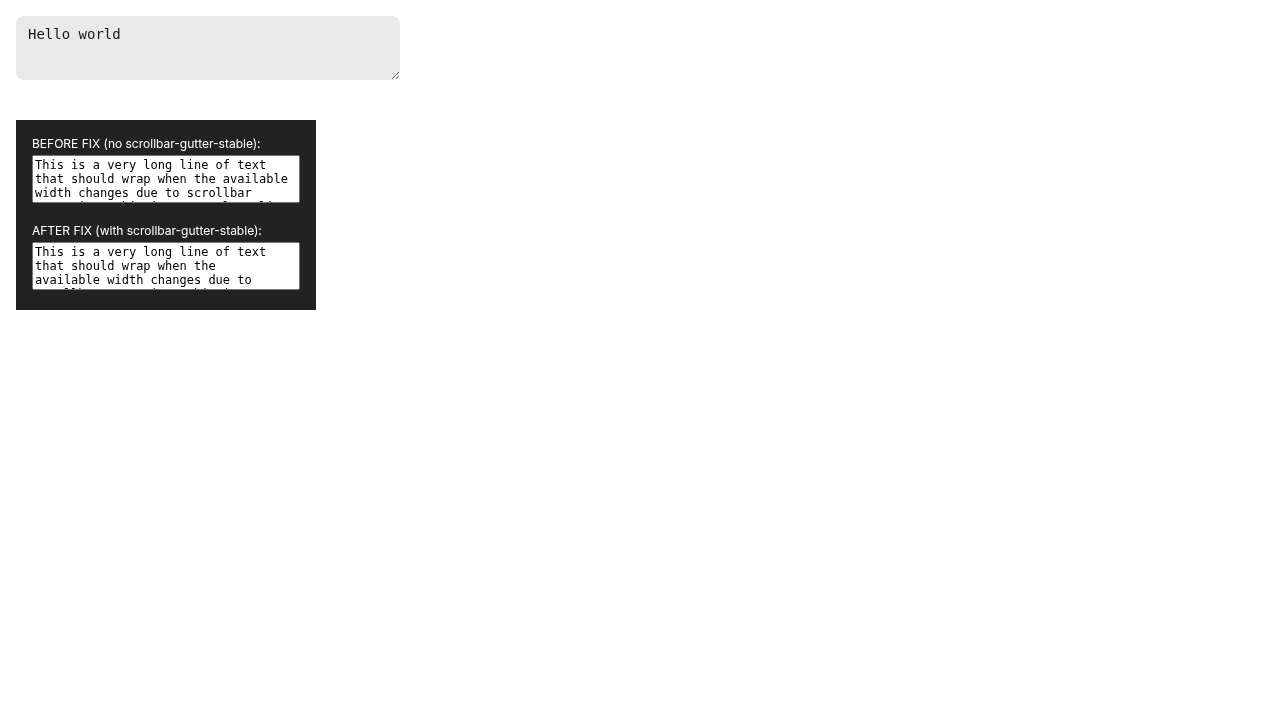
Bump `tailwindcss` and `@tailwindcss/vite` from `^4.2.0` to `^4.3.0` in
the workspace catalog so the new first-class scrollbar utilities
(notably `scrollbar-gutter-stable`) are available — the missing utility
behind the FE-697 workaround. Release notes:
https://tailwindcss.com/blog/tailwindcss-v4-3.

## Changes

- **What**:
- `pnpm-workspace.yaml` catalog: `tailwindcss` and `@tailwindcss/vite` →
`^4.3.0` (lockfile resolves to `4.3.0` for `tailwindcss`,
`@tailwindcss/vite`, `@tailwindcss/node`, and all `@tailwindcss/oxide-*`
native packages).
- Auto-fix 21 lint errors that `eslint-plugin-better-tailwindcss` now
reports because the new utilities have canonical forms:
- `VirtualGrid.vue`: `[scrollbar-gutter:stable]` →
`scrollbar-gutter-stable` (the FE-697 case)
- `VirtualGrid.vue` + `RightSidePanel.vue`: `scrollbar-thin` class-order
fix
    - `TopBarHeader.vue`: `h-6.25 w-6.25` → `size-6.25` (6 button cells)
- `Dialogue.vue`: `translate-x-[-50%] translate-y-[-50%]` →
`translate-[-50%]`
- Minor `-mx-[…]`, `-inset-[…]`, `-ml-[…]` arbitrary-value reorderings
in `NodeSearchFilterBar.vue`, `LGraphNode.vue`,
`CloudNotificationContent.vue`
- All 21 are auto-fixes; all existed on `main` and would have started
failing CI on next merge.
- **Breaking**: None. v4.3 is purely additive; existing config
(CSS-first `@theme`/`@utility`/`@plugin`, custom `lucideStrokePlugin`,
`tailwindcss-primeui`, `@iconify/tailwind4`, `tw-animate-css`) is
unchanged.

## Review Focus

- Confirmed `scrollbar-gutter: stable` compiles into
`dist/assets/index-*.css` from `VirtualGrid.vue` after the
canonicalization.
- Runtime probe via Playwright (preview build) confirmed
`scrollbar-gutter-stable`, `scrollbar-thin`, `tab-4`, and `zoom-100` all
apply.
- `pnpm typecheck`, `pnpm lint`, `pnpm build`, `pnpm knip` all pass.
- `pnpm test:unit`: 10687/10696 pass. 1 failure in `GraphView.test.ts`
("reconnect wiring") confirmed to fail identically on `main` (flaky
`toHaveBeenCalledTimes(1)` getting `3`/`4`) — unrelated to this change.
- Oracle code review: 0 findings.

Refs FE-697.

┆Issue is synchronized with this [Notion
page](https://www.notion.so/PR-12275-chore-upgrade-tailwindcss-to-4-3-3606d73d3650813185cece1c7315e1c2)
by [Unito](https://www.unito.io)

---------

Co-authored-by: Glary-Bot <glary-bot@users.noreply.github.com>
*PR Created by the Glary-Bot Agent*

---

## Summary

Click vs drag is disambiguated by two thresholds: distance
(`Comfy.Pointer.ClickDrift`, 6px) and time
(`Comfy.Pointer.ClickBufferTime`). Distance does the real work — any
intentional drag immediately exceeds 6px on the first move. The time
threshold only matters in the corner case where the pointer is held
still then released without crossing the distance threshold.

The previous 150ms default forces every pointerdown to wait up to 150ms
before drag begins, even when the user is clearly dragging. This is
visible as lag when click+dragging an unselected node, where the wait
stacks on top of selection-state work that runs at drag start
([FE-558](https://linear.app/comfyorg/issue/FE-558/bug-delay-when-clickdragging-an-unselected-node)).

32ms (~2 frames at 60fps) is well below human-perceptible click latency
and still safely above incidental jitter on pointerdown.

## Changes

- `src/platform/settings/constants/coreSettings.ts` —
`Comfy.Pointer.ClickBufferTime`:
  - `defaultValue: 150` → `32`
  - `versionAdded: '1.4.3'` retained, add `versionModified: '1.44.19'`
- Slider `step: 25` → `1` (the old step made `32` unrepresentable on the
slider)
- Tooltip extended with rationale (why distance is the real
disambiguator, why this should be small)
- `src/lib/litegraph/src/CanvasPointer.ts` — Static `bufferTime = 150` →
`32` for consistency with the user-setting default; the runtime
`watchEffect` in `useLitegraphSettings.ts` continues to override at
boot. JSDoc explains the rationale and that the user setting overrides
at runtime.

## Verification

- `pnpm typecheck` clean.
- Litegraph + settings test suites: 998/998 pass.
- `pnpm format` clean (lint-staged enforced on commit).

## Why not just leave it user-overridable?

It already is. But the default is what every user — including ones who
never open settings — experiences. 150ms was never a justified value (no
comment explains it, no benchmark, and 6px distance covers the
disambiguation). Defaults should reflect best UX.

Refs FE-558.

┆Issue is synchronized with this [Notion
page](https://www.notion.so/PR-12032-feat-settings-lower-Comfy-Pointer-ClickBufferTime-default-from-150ms-to-32ms-3586d73d365081f5a29cdc84b4b736e3)
by [Unito](https://www.unito.io)

---------

Co-authored-by: Glary-Bot <glary-bot@users.noreply.github.com>
Co-authored-by: github-actions <github-actions@github.com>
*PR Created by the Glary-Bot Agent*

---

## Summary

- Fixes app mode bug where custom combo inputs (and other widget inputs)
unselect and show "Widget not visible" after refreshing or reopening a
saved app workflow
- Root cause: `resetSelectedToWorkflow()` loads from
`changeTracker.activeState` which may not have linearData yet after
refresh, and `pruneLinearData()` prunes valid entries during graph
loading when nodes aren't yet in the graph
- Two defensive guards: fallback to `initialState` for authoritative
data, and skip pruning during graph loading

## Changes

- `appModeStore.ts`: `resetSelectedToWorkflow()` now falls back to
`initialState.extra.linearData` when `activeState` has none
- `appModeStore.ts`: `pruneLinearData()` skips node-existence checks
when `ChangeTracker.isLoadingGraph` is true
- Unit tests: 4 new tests covering both fix paths (pruning during
loading, fallback to initialState)
- E2E test: Save-as → close → reopen → verify all inputs persist with no
"Widget not visible"

┆Issue is synchronized with this [Notion
page](https://www.notion.so/PR-11422-fix-preserve-app-builder-inputs-through-graph-reconfiguration-3476d73d36508166a563f7df3967665c)
by [Unito](https://www.unito.io)

---------

Co-authored-by: Glary-Bot <glary-bot@users.noreply.github.com>
Co-authored-by: Sisyphus <clio-agent@sisyphuslabs.ai>