 7b1cc3498d
*PR Created by the Glary-Bot Agent* --- Publishes the Comfy Enterprise Customer Agreement (MSA) as a browsable web page at [`/enterprise-msa`](https://comfy.org/enterprise-msa) so prospects can review the template before signing an Order Form. Requested in the `#website-and-docs` thread to make it easier for companies to view ahead of time and easier to share. Uses the same `LegalContentSection` template that already serves [`/affiliates/terms`](https://comfy.org/affiliates/terms), so the visual language matches the existing legal pages and layout choices (sticky TOC, active-section tracking, mobile collapsible TOC) are picked up for free. ## Changes - **New page** `apps/website/src/pages/enterprise-msa.astro` — mirrors the `/affiliates/terms` pattern, English-only, with a preamble paragraph identifying the parties above the TOC. - **`enterprise-msa` i18n block** in `translations.ts` — drives 12 numbered sections (Definitions → Miscellaneous) plus `Exhibit A. Order Form`, verbatim from the executed template dated May 22, 2026. - **Route + locale invariance** — `enterpriseMsa: '/enterprise-msa'` added to `baseRoutes` and to `LOCALE_INVARIANT_ROUTE_KEYS`, so localized variants are not served without a legal review of the translation. Consistent with the existing `termsOfService` / `affiliateTerms` convention documented in `config/routes.ts`. - **Footer discovery** — `Enterprise MSA` link added to the `Company` column of `SiteFooter.vue`, between `Terms of Service` and `Privacy Policy`. This makes the MSA reachable from the `/cloud/enterprise` page (and site-wide) with no changes to the enterprise page itself. - **Test coverage** — new `enterpriseMsaSections.test.ts` guards section IDs, numeric title pattern, page-chrome keys, and the locale-invariant route so a future refactor of `LOCALE_INVARIANT_ROUTE_KEYS` cannot silently start serving an unreviewed translation. ## Verification - `pnpm test:unit` — 162/162 pass (17 files, 7 new tests) - `pnpm typecheck` — 0 errors, 0 warnings on changed files (pre-existing hints untouched) - `pnpm build` — 498 pages built, `/enterprise-msa/index.html` (80 KB) contains all 12 sections + Exhibit A - `oxlint` + `oxfmt` clean on all changed files - Manual QA via `pnpm preview` at 1440×900 desktop and 390×844 mobile (responsive layout inherits from `LegalContentSection`, verified visually) — desktop screenshots attached ## Notes for review - The MSA copy is a verbatim reproduction of the executed `.docx` template shared in Slack. If Legal wants edits, they can happen inline in the `enterprise-msa.*` i18n block — no template restructuring needed. - The effective date is hard-coded to `May 22, 2026` (matches the template file name `GP 5.22.26`); update `enterprise-msa.effective-date` when Legal ships a new template. - The page intentionally does NOT set `noindex` — the MSA is a customer-facing document that should be discoverable via search, matching the user's stated goal of "easier for companies to view ahead of time." cc @michael-poganski — requested by James in the Slack thread for approval to ship. ## Screenshots 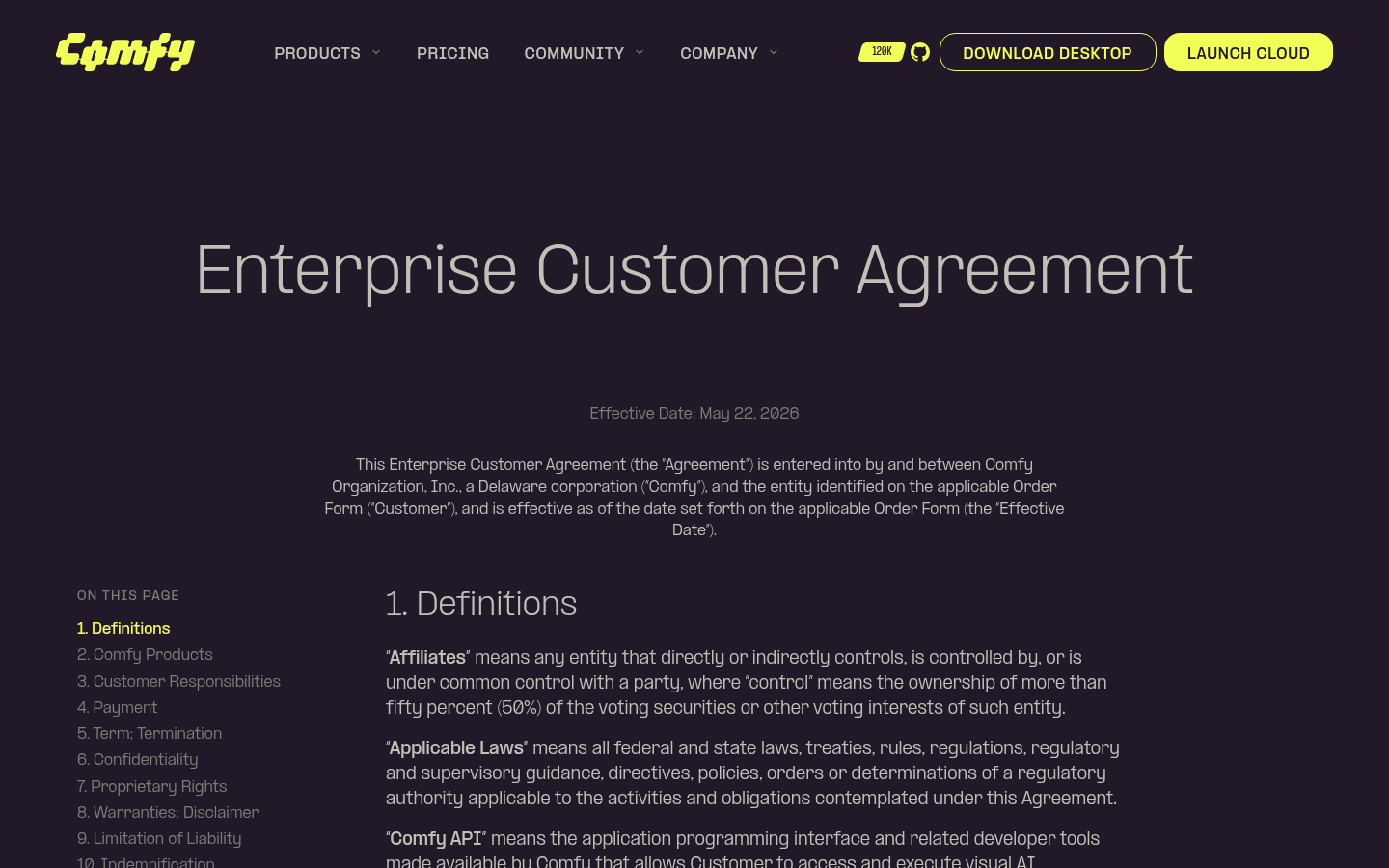 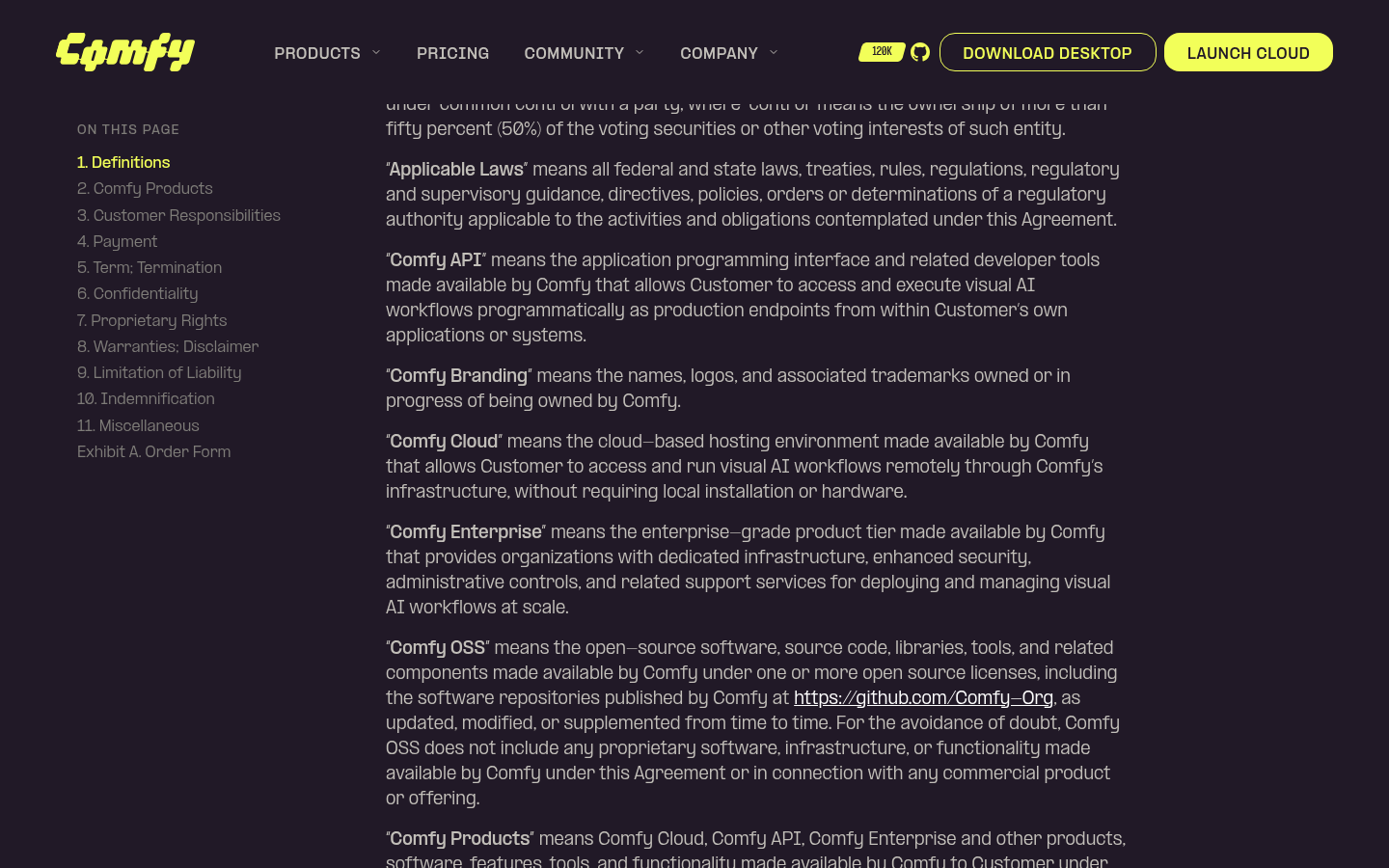 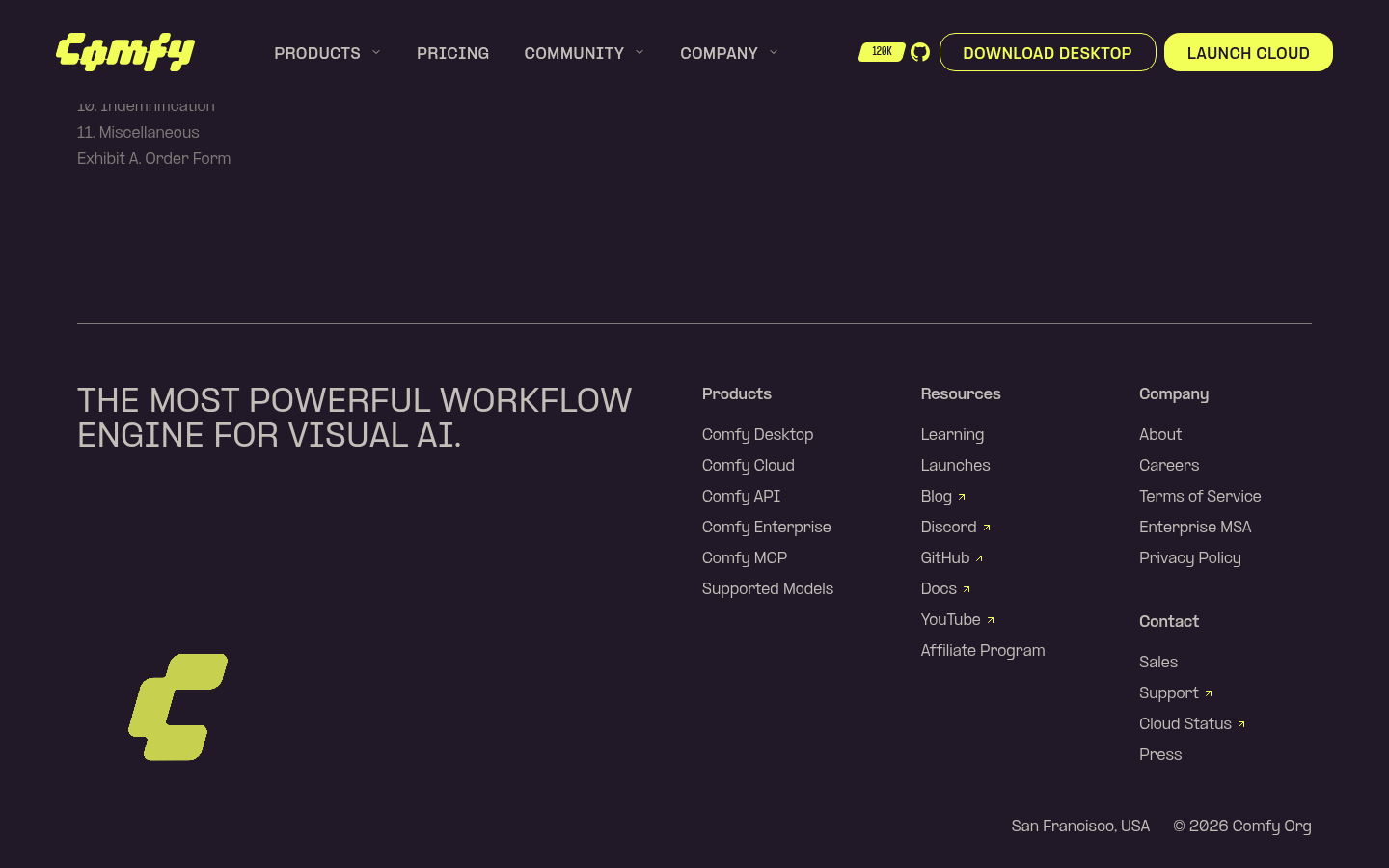  --------- Co-authored-by: Glary-Bot <glary-bot@users.noreply.github.com> Co-authored-by: Michael B <michael@imick.io>




@comfyorg/website
Marketing/brand website built with Astro + Vue.
Ashby careers integration
/careers and /zh-CN/careers are rendered from Ashby's public job board
API at build time. Data flow:
src/pages/careers.astroawaitsfetchRolesForBuild()during the Astro build.src/utils/ashby.tscallsGET https://api.ashbyhq.com/posting-api/job-board/{board}?includeCompensation=false, validates the envelope and each posting with Zod (src/utils/ashby.schema.ts), and maps to the domain type insrc/data/roles.ts.- On any failure (network, HTTP 4xx/5xx, envelope schema drift),
the fetcher falls back to the committed JSON snapshot at
src/data/ashby-roles.snapshot.json. src/utils/ashby.ci.tsemits GitHub Actions annotations and a$GITHUB_STEP_SUMMARYblock so stale fetches are visible on green builds.
Required environment variables
Both are build-time only. Never prefix with PUBLIC_ (Astro would
inline that into the client bundle).
| Name | Purpose | Default (when unset) |
|---|---|---|
WEBSITE_ASHBY_API_KEY |
Ashby API key (Basic auth) | Build uses the committed snapshot |
WEBSITE_ASHBY_JOB_BOARD_NAME |
Ashby public job board slug | Build uses the committed snapshot |
CI wiring (manual step — required)
This repo's .github/workflows/*.yaml changes cannot be pushed by a
GitHub App. A maintainer must apply the following edits once:
.github/workflows/ci-website-build.yaml — pass the env into the
build step and run the unit tests before it:
jobs:
  build:
    runs-on: ubuntu-latest
    steps:
      - uses: actions/checkout@v6
      - name: Setup frontend
        uses: ./.github/actions/setup-frontend

      - name: Run website unit tests
        run: pnpm --filter @comfyorg/website test:unit

      - name: Build website
        env:
          WEBSITE_ASHBY_API_KEY: ${{ secrets.WEBSITE_ASHBY_API_KEY }}
          WEBSITE_ASHBY_JOB_BOARD_NAME: ${{ vars.WEBSITE_ASHBY_JOB_BOARD_NAME || 'comfy-org' }}
        run: pnpm --filter @comfyorg/website build

      - name: Verify API key is not leaked into build output
        env:
          WEBSITE_ASHBY_API_KEY: ${{ secrets.WEBSITE_ASHBY_API_KEY }}
        run: |
          set +x
          if [ -z "${WEBSITE_ASHBY_API_KEY:-}" ]; then
            echo "Secret not available in this run; skipping leak check."
            exit 0
          fi
          # grep -rlF prints only file paths (never match content).
          MATCHES=$(grep -rlF --exclude-dir=node_modules --null \
            -e "$WEBSITE_ASHBY_API_KEY" apps/website/dist/ 2>/dev/null \
            | tr '\0' '\n' || true)
          if [ -n "$MATCHES" ]; then
            echo "::error title=Ashby API key leaked into build output::$MATCHES"
            exit 1
          fi
.github/workflows/ci-vercel-website-preview.yaml — add the
two env vars to the top-level env: block so vercel build (both
deploy-preview and deploy-production jobs) sees them:
env:
  VERCEL_ORG_ID: ${{ secrets.VERCEL_WEBSITE_ORG_ID }}
  VERCEL_PROJECT_ID: ${{ secrets.VERCEL_WEBSITE_PROJECT_ID }}
  VERCEL_TOKEN: ${{ secrets.VERCEL_WEBSITE_TOKEN }}
  VERCEL_SCOPE: comfyui
  WEBSITE_ASHBY_API_KEY: ${{ secrets.WEBSITE_ASHBY_API_KEY }}
  WEBSITE_ASHBY_JOB_BOARD_NAME: ${{ vars.WEBSITE_ASHBY_JOB_BOARD_NAME || 'comfy-org' }}
The secret must also be added to the Vercel project environment
(vercel env add WEBSITE_ASHBY_API_KEY … or via the Vercel UI) so
that vercel build in the preview job has access to it.
Fork PRs do not exercise this path: ci-vercel-website-preview.yaml
receives an empty VERCEL_TOKEN for forks and fails at vercel pull
before the build runs. Fork-safe PR interactions (the preview-URL
comment) are handled by pr-vercel-website-preview.yaml.
Refreshing the snapshot
When a maintainer wants to update the committed snapshot (e.g. after onboarding/offboarding roles):
WEBSITE_ASHBY_API_KEY=… WEBSITE_ASHBY_JOB_BOARD_NAME=comfy-org \
  pnpm --filter @comfyorg/website ashby:refresh-snapshot
git commit apps/website/src/data/ashby-roles.snapshot.json
The script exits non-zero on any non-fresh outcome so stale/empty snapshots can't be accidentally committed.
Cloud nodes integration
/cloud/supported-nodes (and /zh-CN/) lists custom-node packs preinstalled on Comfy Cloud, joined with public metadata from the ComfyUI Custom Node Registry (api.comfy.org). See src/pages/cloud/supported-nodes/AGENTS.md for the build pipeline, source-file map, and key invariants.
Build-time env var: WEBSITE_CLOUD_API_KEY (Cloud /api/object_info auth; the build falls back to the committed snapshot when unset). Must also be set in the Vercel project environment.
Production strictness
src/utils/cloudNodes.build.ts throws when fetchCloudNodesForBuild() returns
{ status: 'stale' } and process.env.VERCEL_ENV === 'production'. This
prevents the production deploy from silently shipping an out-of-date snapshot
when the Cloud API is unreachable or WEBSITE_CLOUD_API_KEY is missing. Preview
and local builds continue to use the committed snapshot with a warning
annotation.
Required GitHub Actions / Vercel secrets
| Name | Where | Purpose |
|---|---|---|
WEBSITE_CLOUD_API_KEY |
GitHub Actions repo secret + Vercel project env | Auth for Cloud /api/object_info. Required for fresh production data. |
The Release: Website workflow uses the GitHub Actions secret to regenerate
apps/website/src/data/cloud-nodes.snapshot.json via
.github/actions/cloud-nodes-pull/action.yaml. The Vercel environment value is
read at build time by vercel build in ci-vercel-website-preview.yaml; the
deploy-production job hard-fails before vercel build --prod if the secret
is missing.
Refreshing the snapshot
To update the committed snapshot manually (e.g. after onboarding new packs to Comfy Cloud):
WEBSITE_CLOUD_API_KEY=… \
  pnpm --filter @comfyorg/website cloud-nodes:refresh-snapshot
git commit apps/website/src/data/cloud-nodes.snapshot.json
The script exits non-zero on any non-fresh outcome so stale/empty snapshots
can't be accidentally committed. Otherwise the Release: Website GitHub
Actions workflow runs the same step on every manual dispatch and opens a PR
with the refreshed snapshot.
HubSpot contact form
The contact page uses HubSpot's hosted form embed for the interest form:
<script
  src="https://js-na2.hsforms.net/forms/embed/developer/244637579.js"
  defer
></script>
<div
  class="hs-form-html"
  data-region="na2"
  data-form-id="94e05eab-1373-47f7-ab5e-d84f9e6aa262"
  data-portal-id="244637579"
></div>
The localized /zh-CN/contact page uses the same portal and script with form
ID 6885750c-02ef-4aa2-ba0d-213be9cccf93.
This keeps submission handling, validation, anti-spam updates, and field
configuration in HubSpot. The local implementation in
src/components/contact/HubspotFormEmbed.vue only loads the hosted script and
renders the documented embed container.
Scripts
pnpm dev— Astro dev serverpnpm build— production build todist/pnpm typecheck—astro checkpnpm test:unit— Vitest unit testspnpm test:e2e— Playwright E2E tests (requirespnpm buildfirst)pnpm ashby:refresh-snapshot— refresh the committed careers snapshotpnpm cloud-nodes:refresh-snapshot— refresh the committed cloud nodes snapshot