 e60ae14bc0
*PR Created by the Glary-Bot Agent* --- ## Summary Disables the Free tier on the public marketing website (`comfy.org/cloud/pricing` and `comfy.org/cloud`) behind a single boolean flag so re-enabling is a one-line change. The Free tier was already removed from the Comfy Cloud sign-up flow; this PR removes the matching promotional surfaces on the marketing site so users hit the paywall directly. ## Changes - **New** `apps/website/src/config/features.ts` — exports `SHOW_FREE_TIER` (currently `false`). Flip to `true` to restore the previous UX. - **`apps/website/src/components/pricing/PriceSection.vue`** — when `SHOW_FREE_TIER` is `false`: - drops the Free plan card from the pricing array - desktop grid collapses from `lg:grid-cols-4` to `lg:grid-cols-3` - Standard plan's "Everything in Free, plus:" intro is replaced with an aria-hidden spacer so the three remaining cards stay vertically aligned - **`apps/website/src/components/product/cloud/PricingSection.vue`** — hides the "Start free. Upgrade when you're ready." tagline on the `/cloud` pricing teaser. - **New** `apps/website/e2e/pricing.spec.ts` — three @smoke tests asserting the paid tiers + Enterprise are visible and that all Free-tier surfaces are absent. All translation strings (`pricing.plan.free.*`, `cloud.pricing.tagline`) are retained so re-enabling requires no copy work. ## Verification - `pnpm typecheck` — clean (0 errors, 0 warnings; pre-existing hint unrelated) - `pnpm lint` / `oxfmt` — clean - `pnpm test:unit` — 30/30 passing - Playwright e2e (desktop project) — `pricing.spec.ts` 3/3 passing, `cloud.spec.ts` 13/13 still passing - Visual: desktop and mobile pricing pages render with balanced 3-column layout; `/cloud` teaser card still proportional. Screenshot below. ## Screenshots 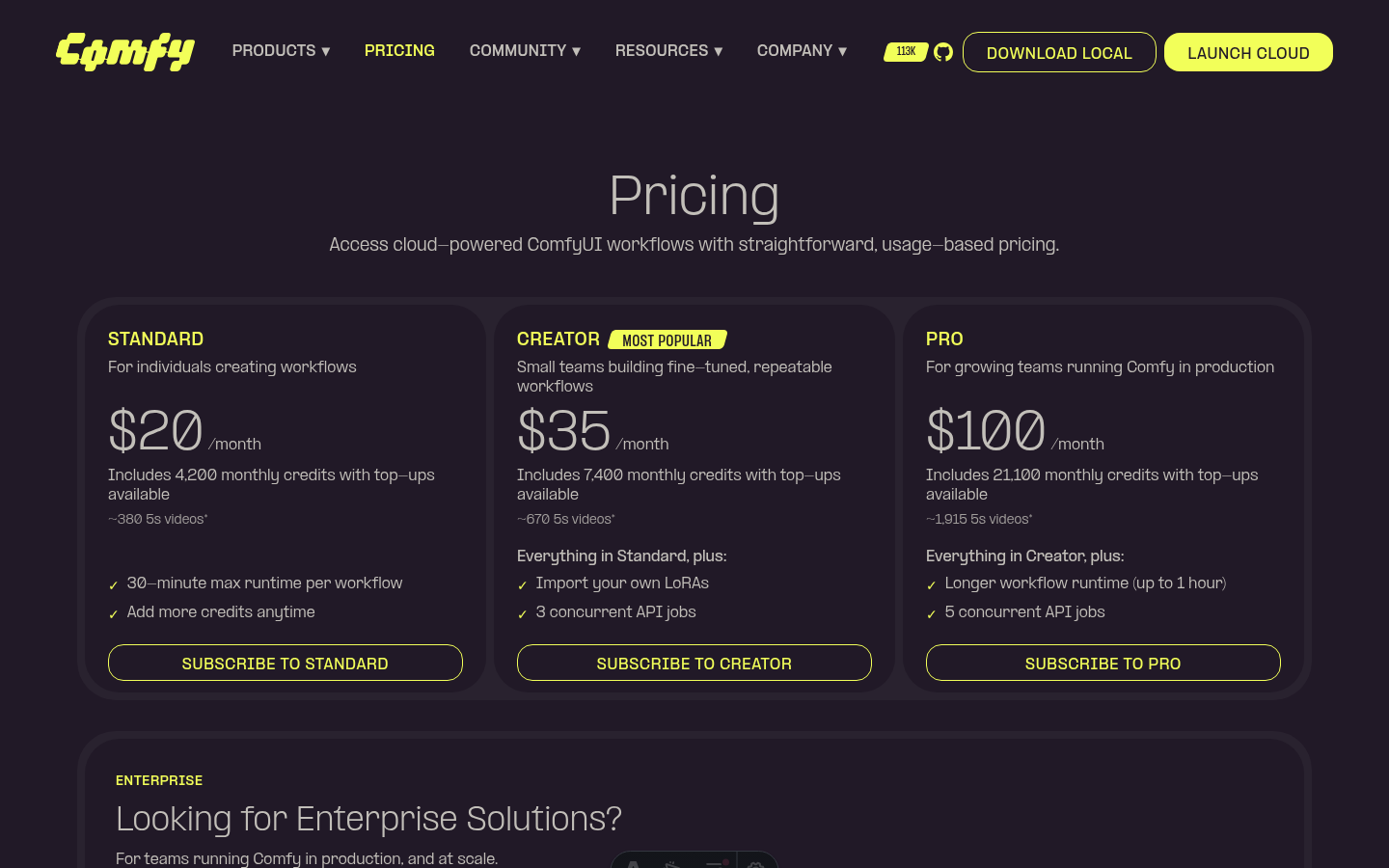 ┆Issue is synchronized with this [Notion page](https://www.notion.so/PR-12165-feat-website-hide-Free-tier-behind-SHOW_FREE_TIER-flag-35e6d73d36508164b4dfcfe9fee6b5e7) by [Unito](https://www.unito.io) --------- Co-authored-by: Glary-Bot <glary-bot@users.noreply.github.com> Co-authored-by: github-actions <github-actions@github.com>

@comfyorg/website
Marketing/brand website built with Astro + Vue.
Ashby careers integration
/careers and /zh-CN/careers are rendered from Ashby's public job board
API at build time. Data flow:
src/pages/careers.astroawaitsfetchRolesForBuild()during the Astro build.src/utils/ashby.tscallsGET https://api.ashbyhq.com/posting-api/job-board/{board}?includeCompensation=false, validates the envelope and each posting with Zod (src/utils/ashby.schema.ts), and maps to the domain type insrc/data/roles.ts.- On any failure (network, HTTP 4xx/5xx, envelope schema drift),
the fetcher falls back to the committed JSON snapshot at
src/data/ashby-roles.snapshot.json. src/utils/ashby.ci.tsemits GitHub Actions annotations and a$GITHUB_STEP_SUMMARYblock so stale fetches are visible on green builds.
Required environment variables
Both are build-time only. Never prefix with PUBLIC_ (Astro would
inline that into the client bundle).
| Name | Purpose | Default (when unset) |
|---|---|---|
WEBSITE_ASHBY_API_KEY |
Ashby API key (Basic auth) | Build uses the committed snapshot |
WEBSITE_ASHBY_JOB_BOARD_NAME |
Ashby public job board slug | Build uses the committed snapshot |
CI wiring (manual step — required)
This repo's .github/workflows/*.yaml changes cannot be pushed by a
GitHub App. A maintainer must apply the following edits once:
.github/workflows/ci-website-build.yaml — pass the env into the
build step and run the unit tests before it:
jobs:
  build:
    runs-on: ubuntu-latest
    steps:
      - uses: actions/checkout@v6
      - name: Setup frontend
        uses: ./.github/actions/setup-frontend

      - name: Run website unit tests
        run: pnpm --filter @comfyorg/website test:unit

      - name: Build website
        env:
          WEBSITE_ASHBY_API_KEY: ${{ secrets.WEBSITE_ASHBY_API_KEY }}
          WEBSITE_ASHBY_JOB_BOARD_NAME: ${{ vars.WEBSITE_ASHBY_JOB_BOARD_NAME || 'comfy-org' }}
        run: pnpm --filter @comfyorg/website build

      - name: Verify API key is not leaked into build output
        env:
          WEBSITE_ASHBY_API_KEY: ${{ secrets.WEBSITE_ASHBY_API_KEY }}
        run: |
          set +x
          if [ -z "${WEBSITE_ASHBY_API_KEY:-}" ]; then
            echo "Secret not available in this run; skipping leak check."
            exit 0
          fi
          # grep -rlF prints only file paths (never match content).
          MATCHES=$(grep -rlF --exclude-dir=node_modules --null \
            -e "$WEBSITE_ASHBY_API_KEY" apps/website/dist/ 2>/dev/null \
            | tr '\0' '\n' || true)
          if [ -n "$MATCHES" ]; then
            echo "::error title=Ashby API key leaked into build output::$MATCHES"
            exit 1
          fi
.github/workflows/ci-vercel-website-preview.yaml — add the
two env vars to the top-level env: block so vercel build (both
deploy-preview and deploy-production jobs) sees them:
env:
  VERCEL_ORG_ID: ${{ secrets.VERCEL_WEBSITE_ORG_ID }}
  VERCEL_PROJECT_ID: ${{ secrets.VERCEL_WEBSITE_PROJECT_ID }}
  VERCEL_TOKEN: ${{ secrets.VERCEL_WEBSITE_TOKEN }}
  VERCEL_SCOPE: comfyui
  WEBSITE_ASHBY_API_KEY: ${{ secrets.WEBSITE_ASHBY_API_KEY }}
  WEBSITE_ASHBY_JOB_BOARD_NAME: ${{ vars.WEBSITE_ASHBY_JOB_BOARD_NAME || 'comfy-org' }}
The secret must also be added to the Vercel project environment
(vercel env add WEBSITE_ASHBY_API_KEY … or via the Vercel UI) so
that vercel build in the preview job has access to it.
Fork PRs do not exercise this path: ci-vercel-website-preview.yaml
receives an empty VERCEL_TOKEN for forks and fails at vercel pull
before the build runs. Fork-safe PR interactions (the preview-URL
comment) are handled by pr-vercel-website-preview.yaml.
Refreshing the snapshot
When a maintainer wants to update the committed snapshot (e.g. after onboarding/offboarding roles):
WEBSITE_ASHBY_API_KEY=… WEBSITE_ASHBY_JOB_BOARD_NAME=comfy-org \
  pnpm --filter @comfyorg/website ashby:refresh-snapshot
git commit apps/website/src/data/ashby-roles.snapshot.json
The script exits non-zero on any non-fresh outcome so stale/empty snapshots can't be accidentally committed.
Cloud nodes integration
/cloud/supported-nodes (and /zh-CN/) lists custom-node packs preinstalled on Comfy Cloud, joined with public metadata from the ComfyUI Custom Node Registry (api.comfy.org). See src/pages/cloud/supported-nodes/AGENTS.md for the build pipeline, source-file map, and key invariants.
Build-time env var: WEBSITE_CLOUD_API_KEY (Cloud /api/object_info auth; the build falls back to the committed snapshot when unset). Must also be set in the Vercel project environment.
HubSpot contact form
The contact page uses HubSpot's hosted form embed for the interest form:
<script
  src="https://js-na2.hsforms.net/forms/embed/developer/244637579.js"
  defer
></script>
<div
  class="hs-form-html"
  data-region="na2"
  data-form-id="94e05eab-1373-47f7-ab5e-d84f9e6aa262"
  data-portal-id="244637579"
></div>
The localized /zh-CN/contact page uses the same portal and script with form
ID 6885750c-02ef-4aa2-ba0d-213be9cccf93.
This keeps submission handling, validation, anti-spam updates, and field
configuration in HubSpot. The local implementation in
src/components/contact/HubspotFormEmbed.vue only loads the hosted script and
renders the documented embed container.
Scripts
pnpm dev— Astro dev serverpnpm build— production build todist/pnpm typecheck—astro checkpnpm test:unit— Vitest unit testspnpm test:e2e— Playwright E2E tests (requirespnpm buildfirst)pnpm ashby:refresh-snapshot— refresh the committed careers snapshotpnpm cloud-nodes:refresh-snapshot— refresh the committed cloud nodes snapshot