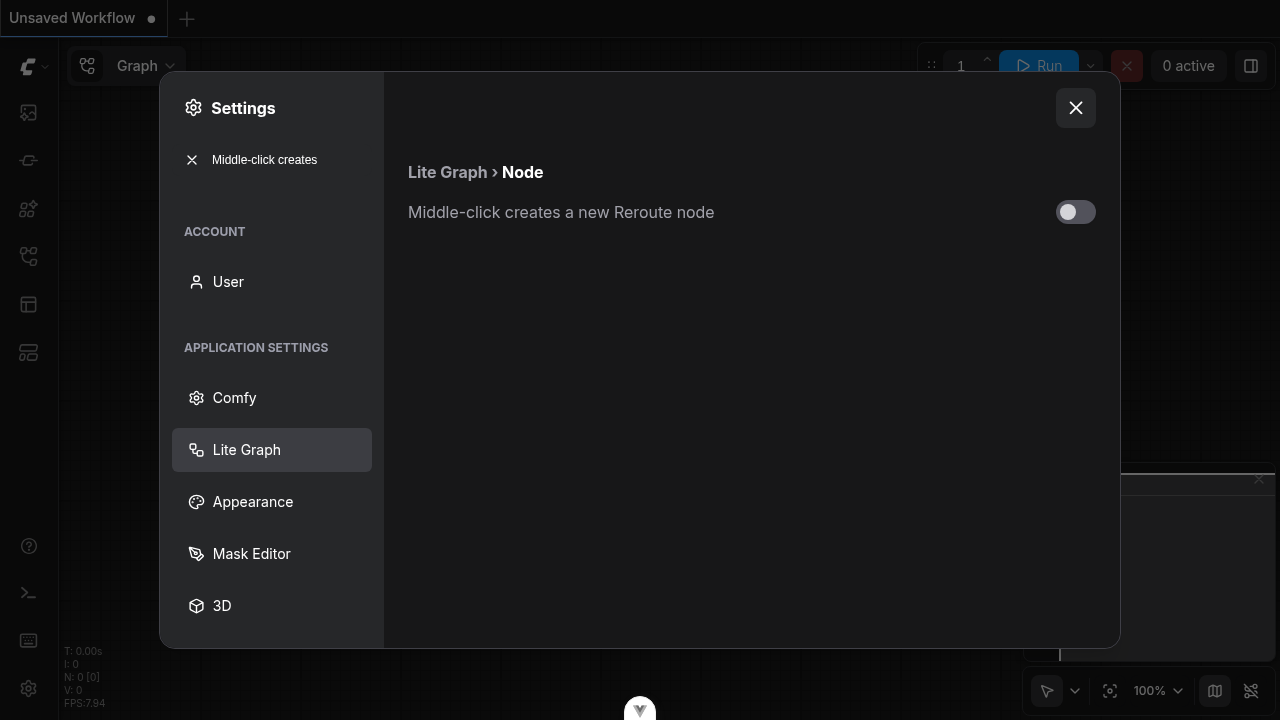
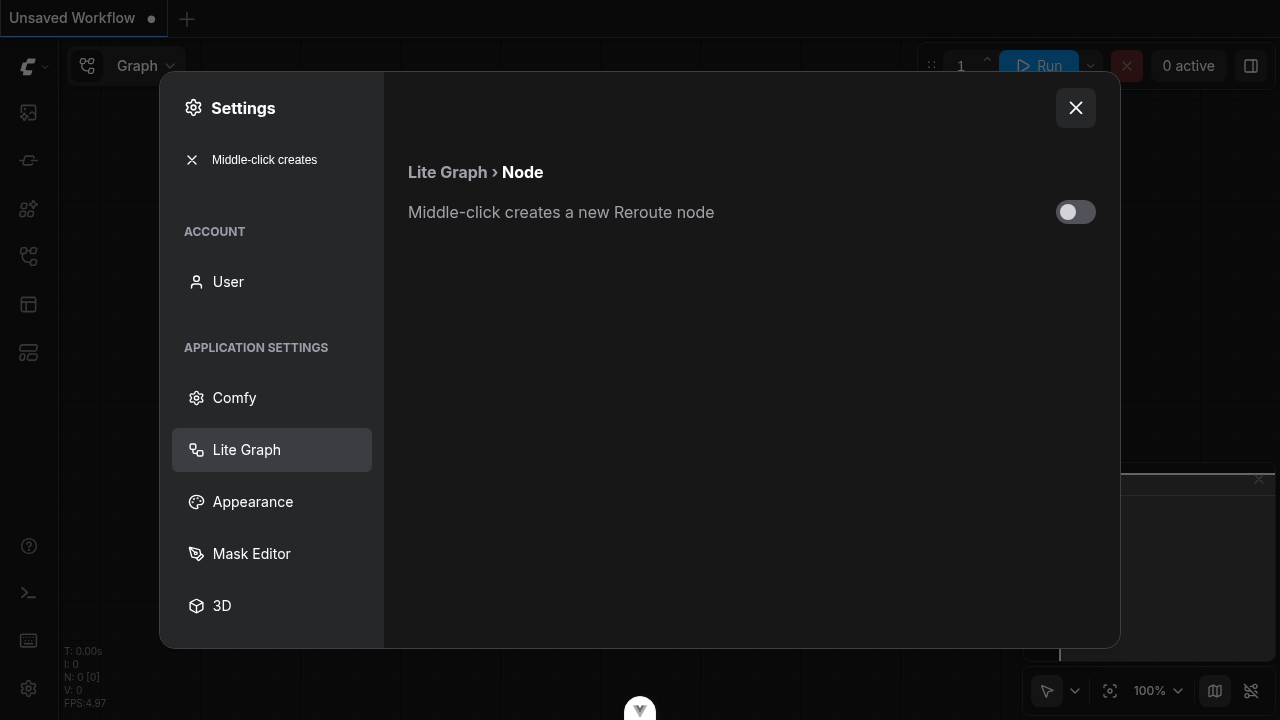
## Summary
Remove the module-level `reportedInactiveCalls: Set<string>` and the
early-return dedup check from `reportInactiveTrackerCall()` in
`src/scripts/changeTracker.ts`. Every invocation now emits
`console.warn` and (on Desktop) `Sentry.captureMessage` unconditionally.
## Why
The dedup was added in #11328 but is unnecessary:
- Every first-party call site already goes through the
`activeWorkflow?.changeTracker` guard, so flooding from in-repo code is
unlikely.
- Repeated identical alerts may actually provide more diagnostic signal
than the first-only approach suppresses.
## Changes
- Drop `reportedInactiveCalls` Set
- Drop the per-`(method, workflowPath)` early-return
- Trim the JSDoc accordingly
No behavior change for callers (`deactivate`, `captureCanvasState`);
only the reporting frequency increases.
## Verification
- `pnpm test:unit -- src/scripts/changeTracker.test.ts` — 16/16 passing
- `pnpm typecheck` — clean
- ESLint / oxfmt — clean
- Fixes#11372
┆Issue is synchronized with this [Notion
page](https://www.notion.so/PR-11833-refactor-remove-dedup-complexity-from-reportInactiveTrackerCall-3546d73d365081fabf57cbf1fa17051f)
by [Unito](https://www.unito.io)
## Summary
Replace `nodeId: string` with canonical `NodeId` type in right-side
panel parameters tab components, eliminating redundant `String()`
conversions at call sites.
## Changes
- `TabNodes.vue`: `isSectionCollapsed` and `setSectionCollapsed` now
accept `NodeId` instead of `string`; callers updated to pass `node.id`
directly (removing `String()` wrapping)
- `TabNormalInputs.vue`: same pattern
## Notes
The other 6 files listed in the issue use `nodeId` parameters that carry
execution IDs (`NodeExecutionId = string`), not graph node IDs (`NodeId
= number | string`). Changing those to `NodeId` would be semantically
incorrect. The two files changed here are the clear-cut cases where
`node.id` (a `NodeId`) was being unnecessarily stringified before being
passed.
## Testing
### Automated
- `pnpm typecheck` — passes
- `pnpm lint` — passes (0 warnings, 0 errors)
- `pnpm format:check` — passes
### E2E Verification Steps
1. Open ComfyUI frontend
2. Load a workflow with multiple nodes
3. Open the right side panel (Parameters tab)
4. Verify node sections collapse/expand correctly per node
5. Verify "Collapse All" / "Expand All" toggle works correctly
6. Repeat with both TabNodes and TabNormalInputs views
Fixes#11843
┆Issue is synchronized with this [Notion
page](https://www.notion.so/PR-12014-chore-11843-replace-bare-string-NodeId-typings-in-parameters-tab-components-3586d73d365081ed84caf560277f0553)
by [Unito](https://www.unito.io)
## Summary
This PR fixes missing-media false positives for annotated media widget
values such as:
```txt
photo.png [output]
clip.mp4 [input]
147257c95a3e957e0deee73a077cfec89da2d906dd086ca70a2b0c897a9591d6e.png [output]
clip.mp4[input] // Cloud compact form
```
The change is intentionally scoped to the missing-media detection
pipeline for:
- `LoadImage`
- `LoadImageMask`
- `LoadVideo`
- `LoadAudio`
It preserves the raw widget value on `MissingMediaCandidate.name` for UI
display, grouping, replacement, and user-facing missing-media rows.
Normalized values are used only as comparison keys during verification.
## Diff Size
`main...HEAD` line diff is currently:
- Production/runtime code: `+478 / -37` (`515` changed lines)
- Unit test code: `+960 / -47` (`1,007` changed lines)
- Total: `+1,438 / -84` (`1,522` changed lines)
The PR looks large mostly because it locks both Cloud and OSS/Core
runtime paths with unit coverage; the production/runtime change is about
one third of the total diff.
## What Changed
- Added missing-media-scoped annotation helpers for detection-only path
normalization.
- Core/OSS recognizes spaced suffixes like `file.png [output]`.
- Cloud also recognizes compact suffixes like `file.png[output]`.
- User-selectable trailing `input` and `output` annotations are
normalized for matching.
- Unknown annotations and middle-of-filename annotations are left
unchanged.
- Added shared file-path helpers in `formatUtil`:
- `joinFilePath(subfolder, filename)`
- `getFilePathSeparatorVariants(filepath)`
- Updated media verification to compare candidates against both raw and
normalized match keys.
- Kept input candidates and generated output candidates in separate
identifier sets so an input asset cannot accidentally satisfy an output
reference with the same name.
- Moved missing-media source loading into `missingMediaAssetResolver` so
`missingMediaScan` remains focused on scan/verification orchestration.
- Updated Cloud generated-media verification to use the Cloud assets API
instead of job history:
- Cloud input candidates use input/public assets.
- Cloud output candidates use `output` tagged assets.
- Kept OSS/Core generated-media verification history-based, matching the
current generated-picker/widget availability model.
## Runtime Verification Paths
### Cloud
Cloud stores generated outputs as asset records. For an annotated output
value, this PR verifies against the `output` asset tag rather than job
history.
```txt
Widget value
"147257...d6e.png [output]"
|
v
Detection keys
"147257...d6e.png [output]"
"147257...d6e.png"
|
v
Cloud asset sources
input candidates -> /api/assets?include_tags=input&include_public=true
output candidates -> /api/assets?include_tags=output&include_public=true
|
v
Match against
asset.name
asset.asset_hash
subfolder/asset.name
subfolder/asset.asset_hash
slash and backslash separator variants
```
Example:
```ts
candidate.name = 'abc123.png [output]'
asset.name = 'ComfyUI_00001_.png'
asset.asset_hash = 'abc123.png'
asset.tags = ['output']
// Result: not missing
```
### OSS / Core
Core widget options for the normal loader nodes are input-folder based.
Annotated output values are resolved by Core through
`folder_paths.get_annotated_filepath()`, but the current generated
picker path is history-backed. This PR keeps OSS generated verification
aligned with that widget availability model instead of treating the full
output folder as the source of truth.
```txt
Widget value
"subfolder/photo.png [output]"
|
v
Detection keys
"subfolder/photo.png [output]"
"subfolder/photo.png"
|
v
OSS generated source
fetchHistoryPage(...)
|
v
History preview_output
filename: "photo.png"
subfolder: "subfolder"
|
v
Generated match keys
"subfolder/photo.png"
"subfolder\\photo.png"
```
This means OSS/Core verification is about whether the generated media is
currently available through the same generated/history-backed path the
widget uses, not a full disk-level executability check across the entire
output directory.
## Why Not Consolidate All Annotated Path Parsers
There are existing annotated-path parsers in image widget, Load3D, and
path creation code. This PR does not replace them.
The helper added here is detection-only: it strips annotations to build
comparison keys for missing-media verification. Parser consolidation
across widget implementations is intentionally left out of scope to keep
this fix narrow.
## Known Follow-Ups / Out Of Scope
- FE-620 tracks the separate video drag-and-drop upload race between
upload completion and missing-media detection.
- Published/shared workflow assets are still not fully represented by
`/api/assets?include_public=true`; that remains a backend/API contract
issue.
- A future backend/API contract that answers “is this workflow media
executable?” would be preferable to stitching together runtime-specific
FE sources.
- OSS/Core full output-folder scanning via `/internal/files/output` was
considered, but that endpoint is internal, shallow (`os.scandir`), and
not the same source currently used by the generated picker flow.
## Validation
- `pnpm test:unit -- missingMediaAssetResolver missingMediaScan
mediaPathDetectionUtil formatUtil`
- touched files `oxfmt`
- touched files `oxlint --fix`
- touched files `eslint --cache --fix --no-warn-ignored`
- `pnpm typecheck`
- pre-commit `pnpm knip --cache`
- pre-push `pnpm knip --cache`
`knip` passes with the existing tag hint:
```txt
Unused tag in src/scripts/metadata/flac.ts: getFromFlacBuffer → @knipIgnoreUnusedButUsedByCustomNodes
```
## Screenshots
Before
https://github.com/user-attachments/assets/50eab565-3160-4a57-a758-87ec2c09071e
After
https://github.com/user-attachments/assets/08adcbbd-c3fc-43f9-b86c-327e4eb5abd8
┆Issue is synchronized with this [Notion
page](https://www.notion.so/PR-12069-fix-handle-annotated-output-media-paths-in-missing-media-scan-3596d73d365081f4afa3d4dd45cad3da)
by [Unito](https://www.unito.io)
*PR Created by the Glary-Bot Agent*
---
## Summary
Sort the canvas right-click "Add Node" context menu by display name
(case-insensitive, natural numeric). Previously, both category submenus
and leaf nodes appeared in node-registration order, making the menu hard
to scan for users browsing for nodes.
This change is scoped specifically to the **smaller right-click
contextual menu**. It does NOT affect the double-click search menu or
the left-side Nodes panel.
## Changes
- `src/lib/litegraph/src/LGraphCanvas.ts` — In `onMenuAdd` →
`inner_onMenuAdded`, sort the deduplicated category submenu entries and
the leaf-node entries by `content` using `localeCompare` with `{
numeric: true, sensitivity: 'base' }`. Categories still appear before
leaf nodes within a level (preserves existing UX).
- `src/lib/litegraph/src/LGraphCanvas.onMenuAdd.test.ts` — New unit
tests that mock `LiteGraph.ContextMenu` and assert: case-insensitive
sort, natural numeric ordering (`Cat1`, `Cat2`, `Cat10`), leaf-node
sorting inside a category, and category-before-leaf placement.
## Verification
- `pnpm vitest run src/lib/litegraph/src/LGraphCanvas.onMenuAdd.test.ts`
— 4/4 pass
- `pnpm typecheck` — clean (ran via pre-commit hook on initial commit)
- `oxfmt` / `oxlint` / `eslint` — clean
- Oracle review against `main` returned 0 critical / 1 warning (test
coverage) / 1 suggestion (numeric sort) — both addressed in this PR.
## Notes
- The sort is applied at the menu-build site rather than inside
`LiteGraphGlobal.getNodeTypesCategories`/`getNodeTypesInCategory` to
keep the change scoped to the menu UX and avoid changing the iteration
order seen by extensions that consume those public methods.
- Per user request, this is opening as a draft PR for self-review +
CodeRabbit feedback in a single follow-up pass; manual browser
verification (right-click screenshots) was deferred to that pass.
- Slack thread context: user reported the contextual menu is "a mess"
for discovering native nodes; alphabetical sorting addresses the
discoverability problem without touching the search-oriented menus.
┆Issue is synchronized with this [Notion
page](https://www.notion.so/PR-12039-feat-sort-right-click-context-menu-categories-alphabetically-3596d73d36508107a87ffec1c353994e)
by [Unito](https://www.unito.io)
---------
Co-authored-by: Glary-Bot <glary-bot@users.noreply.github.com>
Co-authored-by: Alexis Rolland <alexis@comfy.org>
## Summary
Imported assets render as a generic check-check icon instead of a
thumbnail because the OSS `/internal/files/{type}` endpoint returns
annotated filenames (`photo.png [input]`) that the assets-sidebar mapper
passes through verbatim, which breaks extension-based media-type
detection.
## Changes
- **What**: Strip ComfyUI's trailing directory-type annotation (`
[input]`, ` [output]`, `[temp]`) in `mapInputFileToAssetItem` so `name`,
`id`, and the generated `/view?filename=…` URL all use the canonical
on-disk filename. Adds a focused unit test.
- **Breaking**: None.
- **Dependencies**: None.
## Review Focus
### Root cause
ComfyUI core PR
[comfyanonymous/ComfyUI#13078](https://github.com/comfyanonymous/ComfyUI/pull/13078)
(April 2026) changed `/internal/files/{type}` to append the directory
type to each entry:
```python
# api_server/routes/internal/internal_routes.py
return web.json_response(
[f"{entry.name} [{directory_type}]" for entry in sorted_files], status=200
)
```
The annotation is the wire format `LoadImage`-style widgets expect, so
the backend change is correct. The assets-sidebar mapper treated the
response strings as raw filenames. After
[#8914](https://github.com/Comfy-Org/ComfyUI_frontend/pull/8914) changed
`getMediaTypeFromFilename` to default unknown extensions to `'other'`,
every input asset now routes to `MediaOtherTop` and renders as
`icon-[lucide--check-check]`:
```
getMediaTypeFromFilename("photo.png [input]").split('.').pop() === "png [input]" → 'other'
```
The strip happens at data ingestion so every consumer of
`AssetItem.name` (sidebar grid, list, filter, gallery, drag-drop,
delete) gets the canonical filename automatically. OSS-only — Cloud
paths get clean names from the cloud API and are unaffected.
Reproduces locally on stock OSS ComfyUI on `main` of both repos; no
public issue tracker entry.
## Screenshots (if applicable)
Before:
<img width="1091" height="718" alt="image"
src="https://github.com/user-attachments/assets/ff1f070d-da39-4e5a-bc6d-99b7214f7da8"
/>
After:
<img width="1089" height="716" alt="image"
src="https://github.com/user-attachments/assets/7123d9bf-f7dd-4430-b6f7-f6702b70baaa"
/>
┆Issue is synchronized with this [Notion
page](https://www.notion.so/PR-12086-fix-assets-strip-directory-annotation-from-input-filenames-35a6d73d365081e9b9eed7d8630d6f0b)
by [Unito](https://www.unito.io)
*PR Created by the Glary-Bot Agent*
---
## Summary
Disable the `UltralyticsDetectorProvider` model-to-node mapping so the
node falls back to the static combo populated from `/api/object_info`,
restoring pre-#8468 behavior on cloud.
## Why
PR #8468 opted `UltralyticsDetectorProvider` into the cloud asset-widget
path, which exposed a latent mismatch in cloud asset metadata for
nested-directory model folders. The bug has two independent halves, and
a fix that addresses only one will still leave the workflow broken at
execution time:
- **Tag lookup mismatch.** Cloud stores tags as combined values like
`ultralytics/bbox`, while the asset query asks for split tags (`models`
+ `ultralytics`) with exact-match filtering — so the dropdown returns no
results.
- **Submitted value mismatch.** Cloud stores filenames as basenames, but
the node expects subdirectory-prefixed values (e.g.
`bbox/face_yolov8m.pt`) that the static combo path normally produces.
Both halves require cloud-side fixes (asset ingestion + metadata) before
the asset-browser registration can be safely re-enabled. Until then,
removing the registration restores the working static-combo behavior so
users are unblocked.
## Changes
- `src/platform/assets/mappings/modelNodeMappings.ts`: comment out the
`['ultralytics', 'UltralyticsDetectorProvider', 'model_name']` entry
with a note pointing at BE-689 and the re-enablement criteria.
- `src/stores/modelToNodeStore.test.ts`: drop the now-stale ultralytics
expectations from `EXPECTED_DEFAULT_TYPES`, `MOCK_NODE_NAMES`, and the
hierarchical-fallback `it.each` cases.
## Verification
Local quality gates:
- `pnpm typecheck` — clean
- `pnpm lint` — clean (3 pre-existing warnings, 0 errors)
- `pnpm format:check` — clean
- `pnpm knip` — clean (1 pre-existing warning unrelated to this change)
- `pnpm test:unit -- src/stores/modelToNodeStore.test.ts` — 51/51
passing
Manual runtime verification (dev server + Playwright against the live
module):
- `MODEL_NODE_MAPPINGS` no longer contains any entry where `[0] ===
'ultralytics'` or `[1] === 'UltralyticsDetectorProvider'` (84 entries
total, 0 ultralytics).
- `useModelToNodeStore().getNodeProvider('ultralytics')` returns `null`
after `registerDefaults()`, so the asset-widget path is no longer
triggered for this node.
- `getNodeProvider('ultralytics/bbox')` also returns `null`, confirming
hierarchical fallback no longer resolves to the disabled mapping.
- `getNodeProvider('checkpoints')` still resolves to
`CheckpointLoaderSimple`, confirming unrelated mappings are intact.
End-to-end cloud verification (actually exercising the asset-browser
path against cloud-seeded ultralytics metadata) is not possible in the
local sandbox, since the regression depends on the cloud's asset
ingestion data shape. The change is a single mapping-table removal that
reverts to the well-exercised static-combo path covered by the updated
unit tests.
Long-term cloud-side fix is tracked in BE-689.
- Fixes BE-689
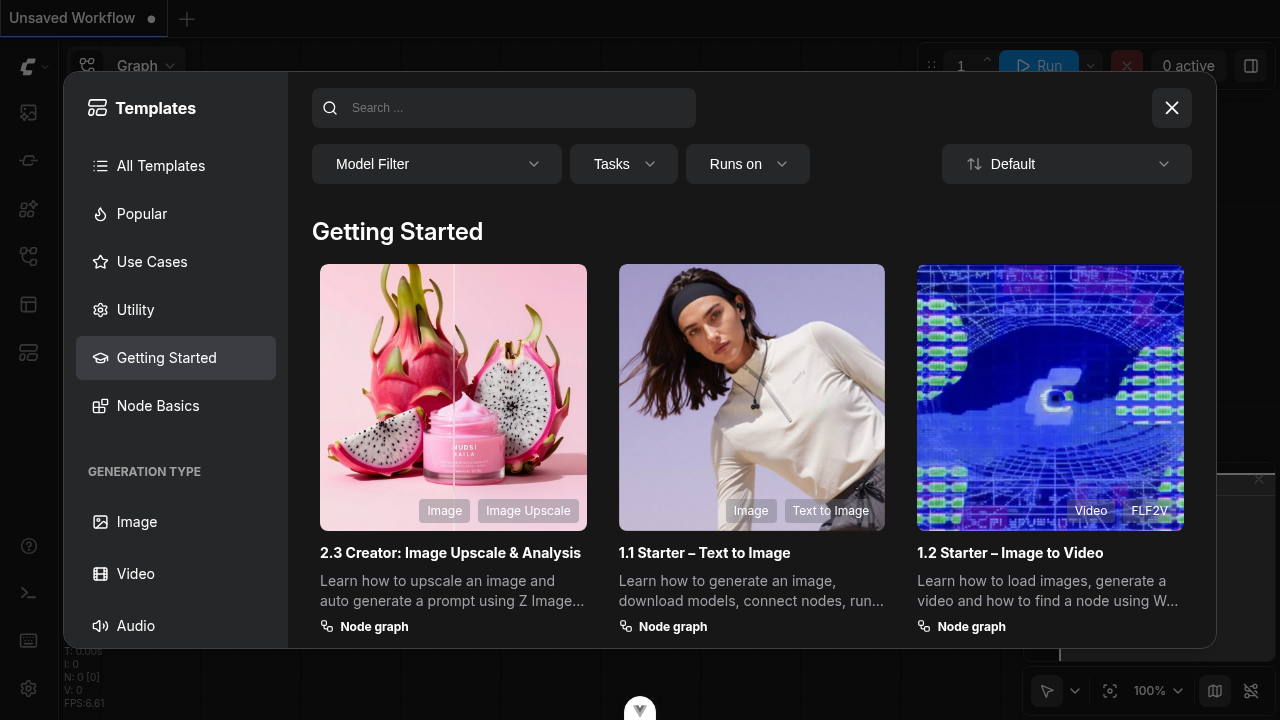
## Screenshots
┆Issue is synchronized with this [Notion
page](https://www.notion.so/PR-12075-fix-disable-ultralytics-asset-browser-registration-35a6d73d36508179b394f0915e69742e)
by [Unito](https://www.unito.io)
Co-authored-by: Glary-Bot <glary-bot@users.noreply.github.com>
## Summary
The help icon (lucide circle-help) next to the credits balance in the
cloud user popover was a bare `<i>` with `v-tooltip` and `cursor-help`.
PrimeVue tooltip on a bare `<i>` did not fire reliably and the icon had
no focus/keyboard semantics, so users saw "no hover action and not
clickable".
Wrap the icon in `<Button variant="muted-textonly" size="icon-sm">`,
matching the existing pattern in `InfoButton.vue` and
`MissingPackGroupRow.vue`. Same change applied to
`CurrentUserPopoverLegacy.vue` and `CurrentUserPopoverWorkspace.vue`,
which shared the broken pattern.
- Fixes FE-617
-
https://comfy-organization.slack.com/archives/C0A4XMHANP3/p1778191473621829
## Red-Green CI Verification
The branch was force-pushed back to the test-only commit so CI could run
against it, then restored to the fix commit.
| Commit | CI: Tests Unit | Outcome |
|--------|---------------|---------|
| `test:` (e7c83abd0) — adds the regression test only |
https://github.com/Comfy-Org/ComfyUI_frontend/actions/runs/25532935842 |
failed — `Unable to find an element by:
[data-testid="credits-info-button"]` |
| `fix:` (64ec4cda4) — wraps the icon in `<Button>` |
https://github.com/Comfy-Org/ComfyUI_frontend/actions/runs/25533224195 |
passed |
<img width="434" height="364" alt="Screenshot 2026-05-08 at 5 32 47 PM"
src="https://github.com/user-attachments/assets/d3088b90-813f-4a0f-ba35-0f040fc79a6a"
/>
## Test Plan
- [x] Component test asserts the icon renders as an interactive
`<button>` with the unified-credits tooltip text as `aria-label`
- [x] Red CI failed with the expected error on the test-only commit
- [x] Green CI passed on the fix commit
- [ ] Manual verification on `pnpm dev:cloud` — hover the help icon next
to the credits balance and confirm the unification tooltip appears
## Summary
The nightly `Release Draft Create` -> `publish_types / Build types` job
has been failing on every run since 1.45.1 ([failed
run](https://github.com/Comfy-Org/ComfyUI_frontend/actions/runs/25531376650)).
Reproduced locally on `main` (`c8c0e5386`).
## Root cause
`pnpm build:types` ends with `FATAL ERROR: Reached heap limit Allocation
failed - JavaScript heap out of memory`. The `vite-plugin-dts` rolled-up
type generation now exceeds Node's default ~4GB heap on the GH runner.
The `TS2742`/`TS4082` warnings printed earlier are non-fatal diagnostics
from the plugin pre-pass — the api-extractor rollup itself completes
once the heap is large enough.
## Fix
Set `NODE_OPTIONS='--max-old-space-size=8192'` in `build:types`,
matching the existing pattern already used by `build` and `build:cloud`
(only one-line change).
## Verification
- `pnpm build:types` exits 0 locally with the change (built in ~40s).
- `dist/index.d.ts` (1.9MB) emitted with the public types intact:
`ComfyExtension`, `ComfyApi`, `ComfyApp`, `ComfyNodeDef`, `InputSpec`,
`DOMWidget`, etc.
- `dist/package.json` correctly produced by `scripts/prepare-types.js`.
- Reverting the change reproduces the OOM crash.
## Test plan
- [ ] Trigger `Release NPM Types` workflow manually (or wait for next
nightly) and confirm `Build types` step succeeds.
┆Issue is synchronized with this [Notion
page](https://www.notion.so/PR-12073-fix-restore-nightly-publish_types-build-35a6d73d3650819e95aecfbd8a66847c)
by [Unito](https://www.unito.io)
## Summary
This PR removes the `/api/assets/hash/:hash` verification path from
missing media/model detection.
I decided to remove this path for two reasons:
1. The Cloud runtime implementation and the OpenAPI/generated FE
contract do not agree on the hash format that this endpoint represents.
In current Cloud data, the dominant asset_hash shape is
<64-hex>.<extension> (for example, abc123....png), while the
OpenAPI/generated FE contract expects a blake3:<hash> style value. That
makes this path either dead code that should never be reached, or, when
it is reached, a request that always returns 400 and only adds
unnecessary noise.
2. Even if the format is reconciled, the Cloud implementation is a
global deduplication-oriented lookup, not an access-aware check for
whether the current workflow can use a resource. In theory, it can
return success for another user's personal asset, so it is the wrong
primitive for missing asset detection.
Because of that, this PR makes the existing asset list/store based
checks the primary verification path and removes the hash-specific
helpers, service method, and tests.
## Known follow-ups
These are known issues that are intentionally not solved in this PR:
1. Published assets are not exposed through
`/api/assets?...include_public=true`. This is a backend issue and can
still cause mismatch between missing-asset detection and resources that
preview/run successfully.
2. Shared workflow import has an ordering issue. The API contract issue
is being hotfixed separately under FE-603.
3. Annotated media paths can still be detected incorrectly.
I will prepare follow-up PRs for these, starting with the annotated
media path issue because that is the most critical frontend-side gap.
## Validation
- `pnpm exec vitest run
src/platform/assets/services/assetService.test.ts
src/platform/missingMedia/missingMediaScan.test.ts
src/platform/missingModel/missingModelScan.test.ts`
- `pnpm lint:unstaged`
- `pnpm typecheck`
- `pnpm knip`
┆Issue is synchronized with this [Notion
page](https://www.notion.so/PR-12061-fix-remove-asset-hash-verification-3596d73d365081a088f8dfc874724c1d)
by [Unito](https://www.unito.io)
*PR Created by the Glary-Bot Agent*
---
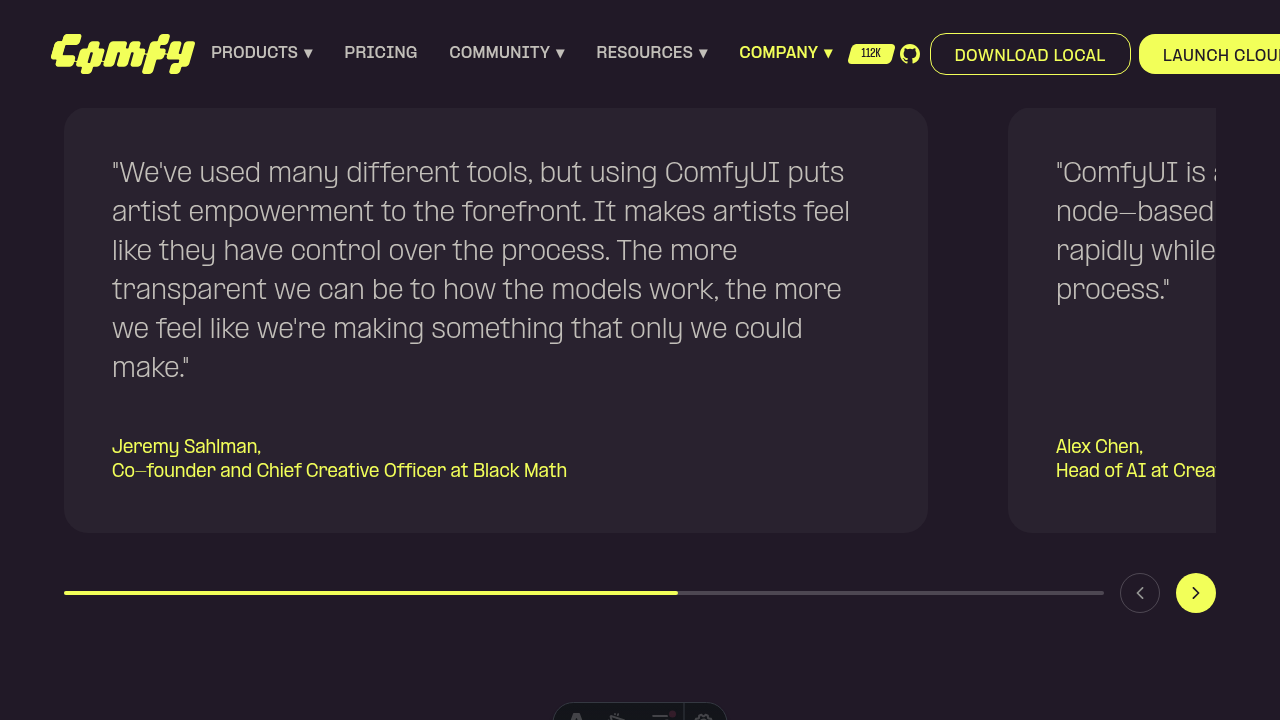
## Summary
The horizontal progress bar in `FeedbackSection.vue` lagged behind the
carousel scroll position because the bar's width was driven reactively
by `useScroll`, but the `transition-all duration-200` utility animated
each width change over 200ms. As scroll continuously emits new target
widths, the bar visibly trailed the scroll position.
Removing the transition makes the bar track scroll synchronously.
## Verification
- Reproduced the lag locally on `/customers`.
- Verified post-fix that `bar.style.width` updates in the same frame as
`scrollLeft` changes (samples at scrollLeft 0 / 944 / 1600 → width 0% /
59% / 100%, with `transitionDuration: 0s`).
- `pnpm exec eslint`, `pnpm exec oxfmt --check`, `pnpm nx typecheck
website`, and `pnpm test:unit` all pass.
## Notes
No regression test added — the customers section components have no
existing unit/E2E coverage in this repo, and standing up a new test
harness for a one-line CSS fix would be disproportionate. Worth
following up on broader carousel coverage as a separate task.
## Screenshot
After fix, scrolled to second slide — progress bar tracks scroll
position synchronously.
## Screenshots
┆Issue is synchronized with this [Notion
page](https://www.notion.so/PR-12059-fix-remove-transition-delay-from-FeedbackSection-progress-bar-3596d73d36508107bc80dc38ea7ab79e)
by [Unito](https://www.unito.io)
Co-authored-by: Glary-Bot <glary-bot@users.noreply.github.com>
*PR Created by the Glary-Bot Agent*
---
## Summary
Fix the video position glitch on `/customers` caused by
`c-projection.webp` loading.
## Root cause
In `HeroSection.vue` the hero `<img>` for `c-projection.webp` had no
`width`/`height` attributes, so the browser reserved no space for it.
When the image finished loading, the layout shifted ~192px, pushing the
`VideoPlayer` below it. `useHeroAnimation` registers a GSAP
`ScrollTrigger` parallax against the video in `onMounted` (before the
image is loaded), so the cached scroll geometry then went stale and the
video visibly glitched.
## Fix
- Add explicit `width="1568"` / `height="1763"` to the `<img>` (the
image's native size) so the browser reserves the correct aspect-ratio'd
space upfront.
- Add `h-auto` so the height attribute doesn't override the responsive
layout.
- Refresh `ScrollTrigger` on the image's `@load` (with `refresh(true)`
so measurements happen after layout has settled) as a defensive measure
for any sub-pixel adjustments.
## Test coverage
Added `apps/website/e2e/customers.spec.ts` with a regression guard that:
1. Asserts the hero `<img>` declares numeric `width`/`height`
attributes.
2. Asserts the unloaded image still reserves vertical space (>100px),
which is the exact property that prevents the video from jumping when
the image finishes loading.
Verified the test fails when the `width`/`height` attributes are removed
and passes with the fix applied.
## Verification
- `pnpm typecheck` clean.
- `pnpm test:unit` (website app) — 30/30 pass.
- `pnpm test:e2e customers.spec.ts --project=desktop` — passes.
- ESLint + oxfmt clean on changed files.
- Manual Playwright verification confirmed the video bounding rect stays
at `top=785, height=628` through the full image load lifecycle.
Reverting the fix in DevTools and re-loading the image reproduces the
original ~192px shift.
## Out of scope
`apps/website/src/components/contact/FormSection.vue` uses the same
`c-projection.webp` pattern (also without `width`/`height`). It runs
`useHeroAnimation` with `parallax: false`, so the symptom is much
smaller — leaving as a follow-up to keep this PR minimal.
- Fixes
[FE-607](https://linear.app/comfyorg/issue/FE-607/bug-video-on-customers-shifts-position-when-c-projectionwebp-finishes)
## Screenshots

┆Issue is synchronized with this [Notion
page](https://www.notion.so/PR-12060-fix-website-prevent-video-glitch-when-c-projection-webp-loads-on-customers-3596d73d365081ebbcb8db25aaa5c451)
by [Unito](https://www.unito.io)
---------
Co-authored-by: Glary-Bot <glary-bot@users.noreply.github.com>
## Summary
Unblock CI due to missing function in mock
```
⎯⎯⎯⎯ Unhandled Rejection ⎯⎯⎯⎯⎯
TypeError: this.load3d.emitModelReady is not a function
❯ src/extensions/core/load3d/Load3DConfiguration.ts:313:19
311| }
312|
313| this.load3d.emitModelReady()
| ^
314| }
315| }
This error originated in "src/extensions/core/load3d/Load3DConfiguration.test.ts" test file. It doesn't mean the error was thrown inside the file itself, but while it was running.
The latest test that might've caused the error is "prefers persisted Scene/Camera/Light Config over settings". It might mean one of the following:
- The error was thrown, while Vitest was running this test.
- If the error occurred after the test had been completed, this was the last documented test before it was thrown.
⎯⎯⎯⎯⎯⎯⎯⎯⎯⎯⎯⎯⎯⎯⎯⎯⎯⎯⎯⎯⎯⎯⎯⎯⎯⎯⎯⎯⎯⎯
Test Files 773 passed (773)
Tests 10417 passed | 8 skipped (10425)
Errors 2 errors
Start at 12:06:06
Duration 446.79s (transform 32.89s, setup 113.26s, import 589.18s, tests 109.19s, environment 228.45s)
```
## Changes
- **What**:
- add `emitModelReady` fn to mock
┆Issue is synchronized with this [Notion
page](https://www.notion.so/PR-12056-test-add-missing-emitModelReady-to-mock-object-3596d73d36508130a087f5c7713e932f)
by [Unito](https://www.unito.io)
## Summary
Follow-up to #11568 and #11785. Keeps the E2E coverage workflow clean
when `CI: Tests E2E` is intentionally skipped and no coverage shard
artifacts are produced.
## Changes
- Detect whether downloaded E2E coverage shard artifacts contain any
`coverage.lcov` files.
- Treat missing coverage shards as an intentionally skipped coverage run
instead of running lcov, Codecov, or Pages deployment on missing files.
┆Issue is synchronized with this [Notion
page](https://www.notion.so/PR-11575-ci-handle-skipped-e2e-workflow-consumers-34b6d73d3650813f92e1d7d6af0bf958)
by [Unito](https://www.unito.io)
## Summary
Align the asset list pagination schema with generated ingest-types
metadata and remove the now-unneeded missing `has_more` fallback branch.
## Changes
- **What**: Reuse `zListAssetsResponse` for `total` and `has_more`, keep
the local loose `AssetItem` shape, and simplify `getAllAssetsByTag()` to
trust the required `has_more` contract.
- **Breaking**: None.
- **Dependencies**: None.
## Review Focus
This is PR 1 of 4 in the missing asset follow-up stack:
1. This PR - Asset schema / pagination cleanup
2. #11900 - Missing asset hash verification utility cleanup
3. #11901 - Browser regression coverage for public input assets
4. #11902 - TanStack Query public-input cache replacement
The key decision is intentionally narrow: pagination metadata now comes
from generated ingest-types, but asset item validation remains locally
loose to avoid changing UI/store synthetic asset shapes in this PR.
`asset_hash` nullability remains unchanged because absent-vs-null hash
semantics are still a backend/API contract follow-up.
Addresses #11894
## Screenshots (if applicable)
N/A
*PR Created by the Glary-Bot Agent*
---
Adds an entry for the new `SaveImageAdvanced` node to
`public/assets/sorted-custom-node-map.json` with the same frequency stat
(1762) as the existing `SaveImage` node, so the new Save Image node
ranks at the top of search results when typing "save" — matching the
original node's behavior.
Context: the new Save Image node ([Notion
spec](https://www.notion.so/comfy-org/Save-Image-94a77c506ce145fc9b8c477c52091a04))
replaces/deprecates the original `SaveImage`. Search ranking uses the
static node frequency map; the new node had no entry and was therefore
ranked at frequency 0. Mirroring the original's stat is the manual-boost
approach discussed in the thread.
## Changes
- `public/assets/sorted-custom-node-map.json`: add `"SaveImageAdvanced":
1762` directly after `"SaveImage": 1762` to preserve descending sort
order.
## Verification
- `pnpm typecheck`, `pnpm lint`, and `pnpm format` all pass via
lint-staged on commit.
- JSON validated and entry placement confirmed (position 4, between
`SaveImage` and `VAEDecode`).
- Review (oracle) ran clean: 0 critical / 0 warning / 0 suggestion.
┆Issue is synchronized with this [Notion
page](https://www.notion.so/PR-11853-feat-boost-SaveImageAdvanced-node-frequency-for-search-ranking-3546d73d36508168b058d9d750fc3c56)
by [Unito](https://www.unito.io)
Co-authored-by: Glary-Bot <glary-bot@users.noreply.github.com>
*PR Created by the Glary-Bot Agent*
---
## Summary
Replaces `right1.webp` with `right1.webm` in the VFX panel of
`UseCaseSection`. `BlobMedia` already auto-detects `.webm` URLs and
mounts a `<video>` element (with the `.webp` as poster), so this single
URL swap is the only change required — matching the pattern used by the
other 4 use-case panels.
## Files changed
- `apps/website/src/components/home/UseCaseSection.vue` — swap
`right1.webp` → `right1.webm`.
## Verification
- `pnpm exec nx run website:typecheck` — clean
- `pnpm exec eslint` on changed file — clean
- `pnpm exec oxfmt --check` — clean
- pre-commit lint-staged hooks — passed
## Reviewer note (Oracle finding)
VFX is the default active panel, so the homepage's initial right-rail
asset moves from ~131 KB `.webp` to ~4.1 MB `.webm`. Behaviorally
consistent with the other 4 panels (which already use `.webm`), but
worth confirming whether `right1.webm` should be re-encoded smaller on
the CDN before promoting this PR out of draft.
┆Issue is synchronized with this [Notion
page](https://www.notion.so/PR-12040-fix-use-webm-video-for-VFX-use-case-right-asset-3596d73d365081829976f37b733840f1)
by [Unito](https://www.unito.io)
---------
Co-authored-by: Glary-Bot <glary-bot@users.noreply.github.com>
Co-authored-by: Amp <amp@ampcode.com>
## Summary
The dirtyClose modal had three buttons (`Cancel | No | Save`) and the
sign-out flow collapsed two distinct outcomes (deny vs. dismiss) into a
single early return — so today clicking "No" *cancels* sign-out instead
of signing out without saving, and clicking "Save" never actually saves
before logging out. This PR drops `Cancel` for `dirtyClose`, gives each
caller a context-specific deny label, and fixes the sign-out 3-state
handling.
- Fixes
[FE-419](https://linear.app/comfyorg/issue/FE-419/unsaved-changes-modal-uses-confusing-button-labels)
## Changes
- **What**:
- `ConfirmationDialogContent.vue`: hide `Cancel` for
`type='dirtyClose'`; add `denyLabel?: string` prop; autofocus `Save`
(preserves work on Enter).
- `dialogService.confirm()`: accept and forward `denyLabel`.
- `useAuthActions.logout`: handle `null` (cancel) / `false` (sign out
anyway, no save) / `true` (save each modified workflow, then logout)
distinctly. Pass `denyLabel: 'Sign out anyway'`.
- `workflowService.closeWorkflow`: pass `denyLabel: 'Close anyway'`.
- i18n: add `auth.signOut.signOutAnyway` and
`sideToolbar.workflowTab.closeAnyway`.
- **Breaking**: none. The `denyLabel` prop is optional and falls back to
`g.no`.
## Review Focus
- The "Save" branch in `useAuthActions.logout` now iterates
`workflowStore.modifiedWorkflows` and awaits
`useWorkflowService().saveWorkflow(workflow)` for each before calling
`authStore.logout()`. The close-tab path
(`workflowService.closeWorkflow`) was already correct — only the
sign-out path needed the same shape.
- `ConfirmationDialogContent` autofocus moves from `Cancel` (gone for
`dirtyClose`) to `Save`. The dialog is still dismissable via ESC /
outside-click, which routes through `dialogComponentProps.onClose →
resolve(null)` — sign-out and close-tab both treat `null` as cancel.
- Out of scope: the native browser `beforeunload` warning
(`UnloadWindowConfirmDialog.vue`) is a separate flow and never reaches
the in-app modal.
## Tests
- Unit (`useAuthActions.test.ts`, new): logout handles `null` / `false`
/ `true` / no-modified-workflows; saves *every* modified workflow before
`authStore.logout`; passes `denyLabel='Sign out anyway'`.
- Unit (`ConfirmationDialogContent.test.ts`): Cancel hidden for
`dirtyClose`; custom `denyLabel` rendered; falls back to `g.no` when
omitted.
- E2E (`workflowTabs.spec.ts`): modified-tab close shows `Close anyway`
(not `No`) and no `Cancel`; clicking `Close anyway` removes the tab; ESC
keeps the tab.
## screenshot
### AS IS
<img width="816" height="379" alt="Screenshot 2026-04-27 at 5 40 19 PM"
src="https://github.com/user-attachments/assets/a8e39403-bf72-455a-8d86-6ceb1f94ac85"
/>
<img width="923" height="396" alt="Screenshot 2026-04-27 at 5 40 38 PM"
src="https://github.com/user-attachments/assets/08031c7c-b3a6-45d7-a4dc-5dcb4e63cfa0"
/>
### TO BE
<img width="1661" height="872" alt="Screenshot 2026-04-27 at 5 43 40 PM"
src="https://github.com/user-attachments/assets/b89d160b-be66-450e-981e-32b1591f6841"
/>
<img width="1488" height="584" alt="Screenshot 2026-04-27 at 5 44 21 PM"
src="https://github.com/user-attachments/assets/b3a141a7-1f3b-4f25-85a9-49529229c28b"
/>
┆Issue is synchronized with this [Notion
page](https://www.notion.so/PR-11669-fix-clarify-unsaved-changes-modal-buttons-and-fix-sign-out-3-state-34f6d73d365081bf8afad8e146b3b990)
by [Unito](https://www.unito.io)
*PR Created by the Glary-Bot Agent*
---
## Summary
PR #10890 routed the legacy action bar feedback button and the Help
Center feedback item to the nightly Typeform survey, but the **default
topbar feedback button** in `WorkflowTabs.vue` still called
`buildFeedbackUrl()` and opened Zendesk. Since `Comfy.UI.TabBarLayout`
defaults to `Default` (not `Legacy`), most Cloud/Nightly users were
clicking the WorkflowTabs button and never reaching the Typeform survey
— explaining the lack of survey responses.
## Changes
- Added a shared `buildFeedbackTypeformUrl(source)` helper in
`platform/support/config.ts` that tags the survey URL with:
- `distribution`: `ccloud` / `oss-nightly` / `oss` (preserves the
build-tagging the old `buildFeedbackUrl()` sent to Zendesk so responses
stay segmented)
- `source`: `topbar` / `action-bar` / `help-center` (identifies which UI
entry point launched the survey)
Tags are passed via the URL fragment (Typeform's hidden-field
convention), so they reach the survey but are never sent to the server
in the request line.
- `WorkflowTabs.vue`: replaced `buildFeedbackUrl()` with
`buildFeedbackTypeformUrl('topbar')`.
- `cloudFeedbackTopbarButton.ts` and `HelpCenterMenuContent.vue`: use
the shared builder with their respective source labels instead of inline
URL literals.
- Removed the now-unused `buildFeedbackUrl()` and
`ZENDESK_FEEDBACK_FORM_ID` (knip-clean). `buildSupportUrl()` is
preserved — `Comfy.ContactSupport` (the Help Center "Help" item) still
routes to Zendesk as before.
- Added unit tests for the builder, the WorkflowTabs feedback button,
the legacy action bar button, and the Help Center feedback item
(covering both the Cloud/Nightly Typeform path and the OSS
`Comfy.ContactSupport` fallback).
## Verification
- `pnpm format`, `pnpm lint`, `pnpm typecheck`, `pnpm knip`: clean (one
pre-existing unrelated lint warning in `useWorkspaceBilling.test.ts`)
- `pnpm test:unit` (impacted scope): 506/506 passing, including 13 new
tests
## Review Focus
- Cloud/Nightly gating in `WorkflowTabs.vue` (`v-if="isCloud ||
isNightly"`) is unchanged and matches PR #10890's gating philosophy.
- The Help Center "Help" item and `Comfy.ContactSupport` command
intentionally still route to Zendesk — feedback ≠ support.
┆Issue is synchronized with this [Notion
page](https://www.notion.so/PR-11863-fix-route-default-topbar-feedback-button-to-Typeform-3556d73d3650815fb446dac33095d4be)
by [Unito](https://www.unito.io)
---------
Co-authored-by: Glary-Bot <glary-bot@users.noreply.github.com>
## Summary
Replace `useMouseInElement` in `CompareSliderThumbnail` with a local
`@mousemove` handler to eliminate ~1s of forced layout per keystroke in
the templates dialog search.
## Changes
- **What**: Profiling the templates dialog search (4× CPU throttle,
cloud distribution) showed a single `getClientRects` block at 977ms
inside Vue's `flushPostFlushCbs → update` path on every keystroke. The
call traces back to VueUse's `useMouseInElement`, which (a) shares a
global `mousemove` listener via `useMouse`, and (b) runs
`el.getBoundingClientRect()` inside a `watch([targetRef, x, y], …, {
immediate: true })`. Every template card with `thumbnailVariant ===
'compareSlider'` mounts one instance — when search filters change and
the page's compareSlider cards re-mount, each instance's `immediate`
watch fires a rect read against freshly-inserted DOM, forcing
synchronous layout of the entire new subtree. With many cards on screen
the costs stack into the ~977ms block. Replaced with a native
`@mousemove` listener bound directly to the slider container; the rect
is read from `event.currentTarget` only when the mouse is actually over
that one card, so the work no longer scales with mounted instance count
and is gated by real pointer activity.
- **Breaking**: None
- **Dependencies**: None
## Review Focus
- UX is unchanged: `sliderPosition` still follows the mouse during hover
and keeps its last value on mouseleave (matches previous behaviour where
`if (!isHovered) return` simply stopped updates without resetting).
- The same `useMouseInElement` pattern still exists in
`src/platform/workflow/sharing/composables/useSliderFromMouse.ts` (used
by `ComfyHubThumbnailStep` in the publish dialog). That path is
single-instance and off the templates hot path, so it's left untouched
to keep this PR scoped — happy to fix it in a follow-up.
- New tests use `userEvent.pointer({ coords })` with a stubbed
`getBoundingClientRect` to lock in the native mousemove path and the
zero-width guard.
## E2E coverage
No `browser_tests/` changes. The `fix:` commit is a defensive clamp
inside `updateSliderPosition`; the overshoot it guards against comes
from subpixel rounding and stale rects observed during hover-in, neither
of which can be deterministically reproduced under Playwright. The perf
change itself is verified via the DevTools profiler (forced-layout block
disappears) — also not assertable as a stable e2e signal across CI
hardware. Both the mousemove-driven slider behavior and the clamp guard
are covered by unit tests in
`src/components/templates/thumbnails/CompareSliderThumbnail.test.ts` (8
cases, including out-of-range pointer coordinates and zero-width
containers).
## Summary
Temporarily patch FE-569 by keeping the affected portaled Reka dropdowns
and menus above their containing PrimeVue dialogs when PrimeVue auto
z-index state has been elevated.
## Changes
- **What**: Added a small compatibility helper,
`usePrimeVueOverlayChildStyle`, that returns an anchor ref plus a
computed inline style for child popover content. The helper finds the
nearest PrimeVue dialog mask (`.p-dialog-mask` / `.p-overlay-mask`) from
the parent surface and, only when found, applies `parent z-index + 1` to
the affected Reka overlay content.
- **What**: Applied that helper at the exact PrimeVue parent surfaces
where the issue was found. This PR does not add a global overlay policy
and does not change every Reka select/dropdown in the app.
- **What**: Added optional `contentStyle`/`selectContentStyle` plumbing
only where needed so the style reaches the actual portaled Reka overlay
root.
- **What**: Added focused unit coverage for the helper contract: no
PrimeVue parent preserves existing stacking, PrimeVue dialog/overlay
masks render child content above the parent, low parent z-index values
respect the Reka floor, and invalid z-index values do not inject an
inline override.
- **Approach**: This is intentionally a minimal, parent-scoped band-aid.
It avoids a global PrimeVue overlay scanner because global sampling can
be polluted by unrelated persistent PrimeVue roots such as Toast and
would turn this fix into a broader layering policy.
- **Approach**: The patch targets the confirmed failure mode: a Reka
child overlay rendering below its owning PrimeVue dialog after PrimeVue
autoZIndex has been elevated. It does not attempt to solve PrimeVue
z-index globally.
- **Lifecycle**: This is temporary migration compatibility. PrimeVue
dialogs and controls are being incrementally migrated to Reka UI, so
`usePrimeVueOverlayChildStyle` and the optional style props added for
FE-569 should be removed once the affected parent surfaces move to Reka.
- **Breaking**: None. New props are optional and no public API contract
is changed.
- **Dependencies**: None.
## Patched Entry Points
This PR pinpoints the six affected user-facing surfaces below. Each
patch is applied from the PrimeVue dialog parent and passed only to the
Reka child overlay content that can render underneath that parent.
https://github.com/user-attachments/assets/d0d1522a-ffc7-4934-9e7a-06b83e20f809
1. **Workflow Template Library filters**
- **How to enter**: click the Templates button in the left sidebar, or
open the Comfy menu and choose **Browse Templates**.
- **Affected elements**: the template filter popovers in
`WorkflowTemplateSelectorDialog`: **Model**, **Use case**, **Runs on**,
and **Sort by**.
- **Patch point**: `WorkflowTemplateSelectorDialog.vue` anchors to the
template dialog content filter area and passes `selectContentStyle` to
the affected `MultiSelect` / `SingleSelect` controls.
https://github.com/user-attachments/assets/3641fa24-da51-4392-a904-9085f8a5a2f4
2. **Manager dialog header controls**
- **How to enter**: open Manager from the top/menu Manager entry when
the new Manager UI is available.
- **Affected elements**: the Manager header controls in `ManagerDialog`:
search mode `SingleSelect`, search autocomplete suggestions, and
**Sort** `SingleSelect`.
- **Patch point**: `ManagerDialog.vue` anchors to the dialog header and
passes `selectContentStyle` to those three Reka overlays.
https://github.com/user-attachments/assets/cf25cc06-f851-48ef-9d9c-9ec2da8afc06
3. **Asset Browser filter bar**
- **How to enter**: open the Asset Browser from an eligible model widget
browse action, the Model Library flow, or another
`useAssetBrowserDialog` caller.
- **Affected elements**: `AssetFilterBar` controls: **File formats**,
**Base models**, **Ownership**, and **Sort by**.
- **Patch point**: `AssetBrowserModal.vue` anchors to the PrimeVue
dialog header and passes the style through `AssetFilterBar` to its
`MultiSelect` / `SingleSelect` controls.
https://github.com/user-attachments/assets/e27bd805-10c0-4b3b-97f3-9e11faa47021
4. **Asset Browser model info panel**
- **How to enter**: open Asset Browser, select an asset, then use the
right-side model info panel.
- **Affected element**: the **Model type** select in `ModelInfoPanel`.
- **Patch point**: `AssetBrowserModal.vue` reuses the same parent-scoped
style and passes it to `ModelInfoPanel` as `selectContentStyle`.
https://github.com/user-attachments/assets/5e9f7ef0-ebd7-4987-ba1b-2137c034086f
5. **Upload Model confirmation step**
- **How to enter**: open Asset Browser, click **Upload**, enter/fetch
model metadata, then proceed to the confirmation step.
- **Affected element**: the **Model type** `SingleSelect` in
`UploadModelConfirmation`.
- **Patch point**: `UploadModelConfirmation.vue` anchors within the
upload dialog content and passes `selectContentStyle` to the model type
selector.
https://github.com/user-attachments/assets/ec145f26-8621-455b-915e-bedee47e1cbd
6. **Settings > Keybinding panel controls**
- **How to enter**: open Settings from the sidebar/menu, then select the
**Keybinding** panel.
- **Affected elements**: the keybinding preset select, the preset
overflow dropdown menu, and the row context menu inside
`KeybindingPanel`.
- **Patch point**: `KeybindingPanel.vue` anchors to the settings dialog
panel and passes `keybindingOverlayContentStyle` only to those Reka
overlay roots.
## Review Focus
- Confirm the patch stays narrowly scoped to the six known PrimeVue
parent + Reka child overlay surfaces above.
- Confirm `contentStyle` reaches the actual portaled Reka overlay
content in each patched path.
- Confirm the fallback behavior preserves existing stacking when no
PrimeVue parent overlay is found; in that case the helper returns an
empty style object and leaves existing Tailwind z-index classes alone.
- Please avoid expanding this into a larger overlay refactor. The goal
is a clean, backport-friendly compatibility patch while the Reka
migration continues.
Validation performed:
- `pnpm exec vitest run src/composables/usePopoverSizing.test.ts`
- `pnpm typecheck`
- `pnpm lint` (passes with existing unrelated warnings only)
- `pnpm format:check`
- commit hook lint-staged checks (`oxfmt`, `stylelint`, `oxlint`,
`eslint --fix`, `pnpm typecheck`)
- pre-push `pnpm knip`
Linear: FE-569
## Bug Screenshots
https://github.com/user-attachments/assets/e73761af-9867-4c50-ab0d-4e32e59011e1https://github.com/user-attachments/assets/145daf4d-3268-428b-9987-1e1afd0b866f
┆Issue is synchronized with this [Notion
page](https://www.notion.so/PR-12038-fix-keep-Reka-overlays-above-PrimeVue-dialogs-3596d73d365081e7af49dbc4d3905962)
by [Unito](https://www.unito.io)
## Root cause
`useAssetBrowser`'s `filteredAssets` computed re-ran
`.map(transformAssetForDisplay)` over the full result set on every tab
switch. `transformAssetForDisplay` allocates fresh `badges`/`stats`
objects, walks `tags`, calls `getAssetBaseModels`, and runs i18n date
formatting per asset — none of which were memoized. Switching All /
Inputs / Outputs forced N transforms per click and produced brand-new
`AssetDisplayItem` references, which also defeated `:key`-based diffing
in `AssetGrid` / `VirtualGrid` and re-rendered every visible card.
## Fix
Memoize `transformAssetForDisplay` at module scope with a
`WeakMap<AssetItem, AssetDisplayItem>`. Unchanged assets reuse the same
display item across tab switches; the GC reclaims entries when assets
are released.
## Before / after (n=200 assets, 6 tab switches: inputs → outputs → all
→ inputs → outputs → all)
| Metric | Before | After |
| ------------------------------- | -----: | ----: |
| `transformAssetForDisplay` runs | 800 | 0 |
| Wall time (Vitest harness) | 13.2 ms | 8.1 ms |
| Reused `AssetDisplayItem` refs | 0 | 200 |
Measured via
`src/platform/assets/composables/useAssetBrowser.perf.test.ts` plus a
temporary `process.stderr.write` harness.
## Red / green
| Commit | Purpose |
| --------- | ------- |
| 7367fdd60 | test: failing perf assertions (transform budget + reused
refs) |
| 021b98ac0 | perf: WeakMap memoization of `transformAssetForDisplay` |
## Test plan
- [x] `pnpm exec vitest run
src/platform/assets/composables/useAssetBrowser` — 42/42 pass (including
2 new perf assertions)
- [x] `pnpm typecheck`
- [x] `pnpm exec eslint` on touched files
- [x] `pnpm exec oxfmt --check` on touched files
Fixes [FE-229
](https://linear.app/comfyorg/issue/FE-229/asset-browser-switching-all-inputs-outputs-tabs-is-slow)Source:
https://comfy-organization.slack.com/archives/C0A4XMHANP3/p1776716352588229
┆Issue is synchronized with this [Notion
page](https://www.notion.so/PR-11491-perf-memoize-asset-display-transform-across-filter-tab-switches-3496d73d36508112822dd6e7b58040fe)
by [Unito](https://www.unito.io)
---------
Co-authored-by: Christian Byrne <cbyrne@comfy.org>
*PR Created by the Glary-Bot Agent*
---
Raises `Comfy.QueueButton.BatchCountLimit` on cloud from `32` to `100`
to match the server-side `MaxQueuedJobsPerUser` cap
(`cloud/infrastructure/dynamicconfig/prod/config.json:3`). The desktop
default was already `100` and is unchanged — collapsing both branches to
the same constant.
Addresses Discord feature request: [Increase queue batch limit from
200](https://discord.com/channels/1218270712402415686/1243609826299220039/1499104231381012641).
## Change
```diff
- defaultValue: isCloud ? 32 : 100,
+ defaultValue: 100,
```
The setting is read dynamically by all batch count UIs
(`BatchCountEdit.vue`, `LinearControls.vue`).
## Why 100 (not 512)
Original ask was 200→512. Investigation showed:
- The actual previous default was `100` (desktop) / `32` (cloud), not
200.
- Cloud enforces `MaxQueuedJobsPerUser = 100` per workspace server-side.
A higher frontend cap can't unlock more queued work — extra prompts just
get rejected with `QUEUE_LIMIT`.
- Frontend submits prompts as N sequential `POST /prompt` calls (no
batched-prompt endpoint), so the UI cap is purely about how many clicks
it takes — not throughput.
- Going from 32 → 100 lets cloud users match the server cap in one click
instead of 4. No new behavior is unlocked.
## Known limitation (pre-existing, not introduced here)
The new max equals the absolute server cap, not the user's remaining
capacity. A user with already-queued work can hit `QUEUE_LIMIT`
mid-batch. The pre-existing 32 limit had the same shape (just at a
smaller scale); deriving the UI max from `cap - outstanding` would
require polling and reactive state and is out of scope for a one-line
setting bump.
## Verification
- `pnpm typecheck` — passes
- `pnpm lint` — 0 errors (1 pre-existing warning in unrelated test file)
- `pnpm test:unit` — `BatchCountEdit.test.ts` (3 tests) +
`src/platform/settings/**` (70 tests) all pass
- **Manual (Playwright)**:
- `settingStore.get('Comfy.QueueButton.BatchCountLimit')` returns `100`
at runtime
- Typing `999` into the batch count widget clamps to `100`
- Increment button is disabled at `100` (max reached)
## Screenshots
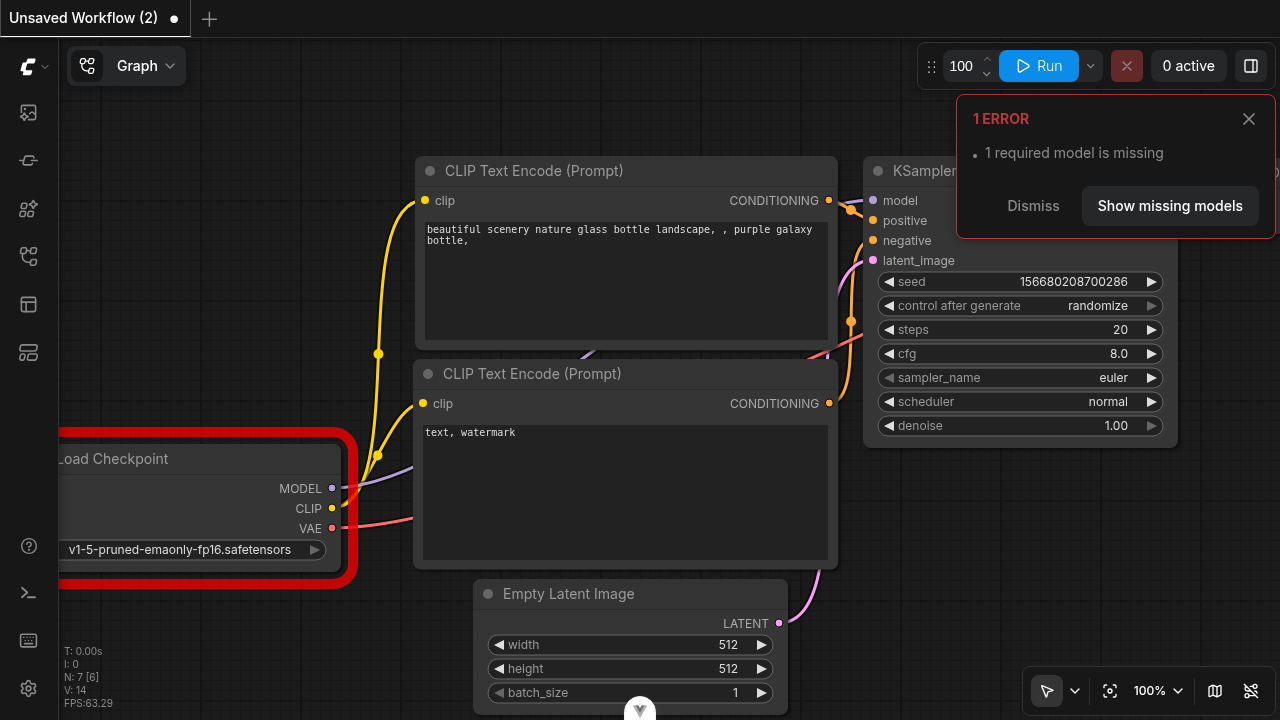
┆Issue is synchronized with this [Notion
page](https://www.notion.so/PR-11876-feat-align-cloud-batch-count-limit-with-server-side-queue-cap-3566d73d3650819b8d01dbf83d1a8e49)
by [Unito](https://www.unito.io)
Co-authored-by: Glary-Bot <glary-bot@users.noreply.github.com>
Replace PrimeVue components in 3D node viewer controls with the
project's Reka UI equivalents across 7 files.
## Changes
| File | Replaced |
|------|---------|
| `AnimationControls.vue` | `Select` × 2 (speed + animation) |
| `ViewerModelControls.vue` | `Select` × 2 (up direction + material
mode) |
| `ViewerCameraControls.vue` | `Select` + `Slider` (camera type + FOV) |
| `ViewerExportControls.vue` | `Select` (export format) |
| `PopupSlider.vue` | `Slider` |
| `ViewerLightControls.vue` | `Slider` |
| `ViewerSceneControls.vue` | `Checkbox` → native `<input
type="checkbox">` |
## Implementation notes
- `Select` uses `@/components/ui/select/*` compound components. Numeric
model values (animation speed index) are stringified at the binding
boundary and converted back on update, matching Reka `SelectRoot`'s
`string`-only `modelValue` contract.
- `Slider` uses `@/components/ui/slider/Slider.vue`. Single-number
`defineModel` values are wrapped in a `computed` array and unwrapped in
the update handler, following the pattern established in
`LightControls.vue`.
- No new Reka UI wrapper components were created — existing ui/select
and ui/slider primitives were used directly.
## Test
https://github.com/user-attachments/assets/afca0fc8-a7b6-49ee-b221-ee5725bd127e
1. AnimationControls.vue
- **Add Load3D node** → Upload an animated GLB file (e.g., a character
model).
- **Node preview top bar:** Play/Pause button, speed dropdown, animation
name dropdown, and progress bar.
2. PopupSlider.vue
- **Hover over Load3D preview:** Icon buttons appear in the left
toolbar.
- **"Light Intensity" button (bulb icon)** → Slider pops up on the
right.
- **"FOV" button (view icon)** → Slider pops up on the right.
3. ViewerCameraControls.vue
- **Load3D node** → Settings panel (top-right) → **"Camera"** tab.
- **Features:** Camera type dropdown (Perspective / Orthographic), FOV
slider (visible in Perspective mode).
4. ViewerExportControls.vue
- **Settings panel** → **"Export"** tab.
- **Features:** Format dropdown (GLB / OBJ / STL), Export button.
5. ViewerLightControls.vue
- **Settings panel** → **"Light"** tab.
- **Features:** Light intensity slider.
6. ViewerModelControls.vue
- **Settings panel** → **"Model"** tab.
- **Features:** "Up direction" dropdown, Material mode dropdown
(Wireframe / Normal, etc.).
7. ViewerSceneControls.vue
- **Settings panel** → **"Scene"** tab.
- **Features:** Background color picker, "Show grid" checkbox, upload
background image button.
<!-- CURSOR_SUMMARY -->
---
> [!NOTE]
> **Medium Risk**
> UI component swap touches multiple interactive viewer controls
(selects/sliders/checkbox), so small binding/typing differences (string
vs number, array slider values) could cause subtle regressions despite
test updates.
>
> **Overview**
> Replaces PrimeVue `Select`, `Slider`, and `Checkbox` usages across
Load3D viewer controls with the project’s Reka UI-based primitives
(`@/components/ui/select/*`, `@/components/ui/slider/Slider.vue`) and a
native checkbox.
>
> Updates v-model wiring to match the new components’ contracts: selects
now bind via string `modelValue` with explicit number casting where
needed, and sliders now wrap single numeric values into `[number]`
arrays with corresponding update handlers. Unit tests are updated to
mock the new UI components and their updated event/value shapes.
>
> <sup>Reviewed by [Cursor Bugbot](https://cursor.com/bugbot) for commit
46f99db256. Bugbot is set up for automated
code reviews on this repo. Configure
[here](https://www.cursor.com/dashboard/bugbot).</sup>
<!-- /CURSOR_SUMMARY -->
┆Issue is synchronized with this [Notion
page](https://www.notion.so/PR-12020-refactor-load3d-replace-PrimeVue-Select-Slider-Checkbox-with-Reka-UI-3586d73d365081f58601d93031016afd)
by [Unito](https://www.unito.io)
## Summary
Reuse the actionbar queue-button page object in the queue mode E2E tests
so dropdown selectors live in one helper.
## Changes
- **What**: Adds queue mode menu/item helpers to
`ComfyActionbar.queueButton` and updates `queueButtonModes.spec.ts` to
use them.
- **Dependencies**: None.
## Review Focus
This is stacked on #11209 and should be reviewed as a test-infra cleanup
only; the behavior covered by the spec is unchanged.
┆Issue is synchronized with this [Notion
page](https://www.notion.so/PR-11927-test-reuse-queue-button-page-object-in-e2e-3566d73d365081918d59c2d587c4c94a)
by [Unito](https://www.unito.io)
## Summary
Make `userStore.initialize()` idempotent and concurrency-safe so the
bootstrap, router-guard, and UserSelectView callers share a single
getUserConfig fetch instead of racing/duplicaitng calls.
## Changes
- **What**:
- cache initialize in a promise so callers all re-use the same result
- remove now redundant is initialized guard
- tests
## Review Focus
- Current user switch/logout uses `window.location.reload()`, no callers
intentionally call initialize to reinit. In future if this changes we
may want to add a parameter to skip the cache or a separate function.
- Failed initializes are not cached to allow callers to retry
- Not practical for e2e tests, the unit tests prove that the requests
are deduped. All a e2e test would do is mock/spy on the network requests
to show multiple requests do not happen - which the unit tests do a
better job of.
┆Issue is synchronized with this [Notion
page](https://www.notion.so/PR-11959-fix-add-guard-to-prevent-user-store-re-initialization-3576d73d3650817db7b0e52cc25f9b7b)
by [Unito](https://www.unito.io)
## Summary
- Defer thumbnail capture until camera state is restored via new
modelReady event so captureThumbnail no longer races with the saved
view, fixing the "snap back to default on hover" regression.
- Repaint the live scene at the end of captureThumbnail so the canvas is
not left with the offscreen mask/normal pass when the render loop is
gated.
- Persist post-fitToViewer model.scale + model.position into the
existing modelConfig.gizmo slot so a refresh reapplies them via the
existing applyGizmoConfigToLoad3d path; rotation stays owned by
upDirection.
┆Issue is synchronized with this [Notion
page](https://www.notion.so/PR-11944-FE-537-fix-load3d-preserve-camera-view-fit-transform-and-first-frame-paint-after-re-3576d73d365081429653ea4740612617)
by [Unito](https://www.unito.io)
Adds targeted behavioral tests for the slimmed `useBrushDrawing`
orchestration composable (Phase E of the brush-drawing refactor).
## Changes
- 5 new tests covering previously untested branches:
- `compositeStroke` receives `isRgb=true` when active layer is `rgb`
- `compositeStroke` receives `isErasing=true` when tool is `eraser`
- Mask canvas opacity is restored after drawing on the mask layer
- `globalCompositeOperation` is set to `destination-out` during
`handleDrawing` when tool is eraser
- `globalCompositeOperation` is set to `destination-out` during
`handleDrawing` when right mouse button is held
## Coverage (useBrushDrawing.ts)
| Metric | Before | After |
|--------|--------|-------|
| Statements | 86.33% | 87.05% |
| Branches | 68.75% | 70.00% |
| Functions | 90.00% | 90.00% |
| Lines | 89.23% | 90.00% |
All 18 tests pass. GPU paths remain `/* c8 ignore */` excluded
(untestable without WebGL).
- Fixes#0
<!-- CURSOR_SUMMARY -->
---
> [!NOTE]
> **Low Risk**
> Low risk: changes are limited to unit tests, adding coverage for
eraser/right-click composition and `drawEnd` GPU compositing/opacity
restoration paths without altering production logic.
>
> **Overview**
> Adds new `useBrushDrawing` test cases to cover previously untested
branches: setting `globalCompositeOperation` to `destination-out` during
`handleDrawing` when erasing (tool or right-click), and verifying
`drawEnd` passes correct `isRgb`/`isErasing` flags to
`gpu.compositeStroke`.
>
> Also asserts mask-layer opacity is restored after `drawEnd`,
increasing behavioral coverage around stroke completion and canvas
visibility cleanup.
>
> <sup>Reviewed by [Cursor Bugbot](https://cursor.com/bugbot) for commit
20c411e6ce. Bugbot is set up for automated
code reviews on this repo. Configure
[here](https://www.cursor.com/dashboard/bugbot).</sup>
<!-- /CURSOR_SUMMARY -->
┆Issue is synchronized with this [Notion
page](https://www.notion.so/PR-12001-test-maskeditor-expand-useBrushDrawing-behavioral-coverage-3586d73d365081388ebcef91c2172c0a)
by [Unito](https://www.unito.io)
## Summary
Add a `@perf` test measuring the cost of entering a subgraph containing
80 interior nodes. Establishes a CI baseline for the synchronous
mount/unmount bottleneck.
## Changes
- **What**: Add `subgraph transition (enter and exit)` perf test to
`performance.spec.ts` and a test workflow asset
(`large-subgraph-80-nodes.json`) with a single subgraph node containing
80 Note nodes.
## Review Focus
This is PR 1 of 2. The test establishes a baseline on main so the
optimization PR (PR 2) can show a CI-proven delta for `taskDurationMs`
and `totalBlockingTimeMs`.
The test:
1. Loads the 80-node subgraph workflow
2. Enters and exits once to warm up
3. Measures a fresh enter transition (start → 80 nodes mounted → layout
settled)
4. Records `taskDurationMs`, `layouts`, and `TBT`
┆Issue is synchronized with this [Notion
page](https://www.notion.so/PR-10480-test-add-perf-test-for-subgraph-transition-bottleneck-32d6d73d3650811b9b6eec03a9591f82)
by [Unito](https://www.unito.io)
---------
Co-authored-by: GitHub Action <action@github.com>
Co-authored-by: Connor Byrne <c.byrne@comfy.org>
## Summary
Preview as Text (`PreviewAny`) nodes were re-executing on every prompt
submission because the rendered preview text was being echoed back to
the backend as input values, mutating the cache signature.
## Changes
- **What**: Set `widget.options.serialize = false` on the three widgets
the `Comfy.PreviewAny` extension adds (`preview_markdown`,
`preview_text`, `previewMode`) so they are excluded from the API prompt
sent to the backend.
## Root cause
The extension was setting `widget.serialize = false`, which only
controls **workflow JSON** persistence (checked in
`LGraphNode.serialize`). The **API prompt** serializer in
`executionUtil.graphToPrompt` checks `widget.options.serialize` instead
— a distinct property documented in litegraph's `WIDGET_SERIALIZATION`
convention.
After `onExecuted` writes the rendered text into the widget value, the
next `graphToPrompt` call serialized that text into
`inputs.preview_text` / `inputs.preview_markdown`. The backend cache
signature in `comfy_execution/caching.py` hashes all keys in
`node["inputs"]`, so the changing text invalidated the cache and forced
a redundant execution every time.
## Review Focus
Two commits, red-green TDD:
1. `test:` failing unit + e2e tests asserting the desired behavior.
2. `fix:` adds `options.serialize = false` to make them pass.
Tests verify the widgets are excluded from the API prompt; e2e
additionally simulates a prior execution populating widget values to
mirror the real bug condition.
┆Issue is synchronized with this [Notion
page](https://www.notion.so/PR-12010-fix-stop-PreviewAny-widgets-from-triggering-re-execution-3586d73d3650810585cdd077f3ac64f5)
by [Unito](https://www.unito.io)
## Changes
Add Playwright E2E tests for queue button modes in the topbar (6 tests):
- Run button visibility in topbar
- Queue mode trigger menu visibility
- Opening the mode menu via trigger click
- Verifying available modes are shown as menu item radios
- Menu closes after selecting a mode
- Run button sends prompt when clicked (via intercepted `/api/prompt`
route)
## Test
```bash
pnpm test:browser:local -- browser_tests/tests/queueButtonModes.spec.ts
```
┆Issue is synchronized with this [Notion
page](https://www.notion.so/PR-11209-test-add-E2E-tests-for-queue-button-modes-3416d73d365081a5bf10f8b9c6bdc2a7)
by [Unito](https://www.unito.io)
---------
Co-authored-by: Benjamin Lu <benjaminlu1107@gmail.com>
*PR Created by the Glary-Bot Agent*
---
## Summary
Adds 22 Playwright E2E tests for the keybinding settings panel
(`KeybindingPanel.vue`), covering all 15 previously-untested functions
identified via coverage analysis.
## Test Groups
| Group | Tests | Functions Covered |
|---|---|---|
| Row Expansion | 2 | `handleRowClick`, `toggleExpanded`, `expandedRows`
|
| Double-Click | 2 | `handleRowDblClick`, `addKeybinding`,
`editKeybinding` |
| Context Menu | 7 | `handleRowContextMenu`, `clearContextMenuTarget`,
`ctxChangeKeybinding`, `ctxAddKeybinding`, `ctxResetToDefault`,
`ctxRemoveKeybinding` |
| Action Buttons | 7 | `editKeybinding`, `resetKeybinding`,
`removeSingleKeybinding`, `handleRemoveAllKeybindings`,
`handleRemoveKeybindingFromMenu` |
| Expanded Row Actions | 2 | `editKeybinding` (expansion),
`removeSingleKeybinding` (expansion) |
| Reset All | 2 | `resetAllKeybindings` (confirm + cancel) |
| Search Filter | 1 | `watch(filters, ...)` clears expansion |
## Flake Prevention Measures
- Deterministic test command
(`TestCommand.KeybindingPanelE2E.NoBinding`) registered via
`app.registerExtension()` for 0-binding scenarios — avoids flaky
pagination-dependent row scanning
- `pressComboOnInput()` asserts input focus before pressing key combos
in the edit dialog
- `saveAndCloseKeybindingDialog()` waits for dialog teardown to complete
before proceeding
- `openContextMenu()` waits for Reka UI menu items to be visible before
interacting
- Resets `Comfy.Keybinding.NewBindings` and
`Comfy.Keybinding.UnsetBindings` in `afterEach`
## Note on Selectors
Some locators use Tailwind utility classes (`.pl-4`,
`.icon-[lucide--chevron-right]`) because the expansion template and
chevron icon in `KeybindingPanel.vue` lack `data-testid` attributes.
Adding test IDs would be a follow-up to this test-only PR.
┆Issue is synchronized with this [Notion
page](https://www.notion.so/PR-11455-test-add-E2E-tests-for-keybinding-settings-panel-coverage-3486d73d365081d7a902fc68091552f2)
by [Unito](https://www.unito.io)
---------
Co-authored-by: Glary-Bot <glary-bot@users.noreply.github.com>
Co-authored-by: Benjamin Lu <benjaminlu1107@gmail.com>
Replace the pre-rendered `.webm` video in the homepage hero section with
an interactive Three.js 3D logo.
## Changes
- Add `three` dependency to the website package and pnpm catalog
- Add `useHeroLogo` composable that sets up the Three.js scene:
- Extruded Comfy "C" logo with stencil-masked image sequence slideshow
- Auto-rotation with drag interaction and cursor tilt
- Graceful degradation if some textures fail to load
- Update `HeroSection.vue` to use the composable instead of a `<video>`
element
- Upload 16 image sequence frames to
`gs://comfy-org-videos/website/homepage/hero-logo-seq/`
<img width="1000" height="648" alt="Kapture 2026-05-05 at 20 54 05"
src="https://github.com/user-attachments/assets/7a7b1634-2da3-4aa2-871a-f64d4d337b39"
/>
@coderabbitai approve
┆Issue is synchronized with this [Notion
page](https://www.notion.so/PR-11964-feat-replace-spin-logo-video-with-Three-js-instance-in-homepage-HeroSection-3576d73d365081bbab0ed19dd121830c)
by [Unito](https://www.unito.io)
---------
Co-authored-by: Amp <amp@ampcode.com>
Co-authored-by: Alexander Brown <drjkl@comfy.org>
## Summary
`assetsStore.updateAssetTags` issues `removeAssetTags` and
`addAssetTags` as two separate network calls. When the remove succeeds
server-side but the subsequent add rejects, the cache rolls back to the
original tags while the server has already dropped the removed tags —
cache and backend diverge until the next refetch.
This adds a compensating action: if remove succeeded and add then fails,
attempt to re-add the just-removed tags so the server returns to its
prior state. If the compensating add also fails, invalidate the category
cache so the next access refetches fresh state.
- Fixes#11694
- Fixes
[FE-473](https://linear.app/comfyorg/issue/FE-473/fix-converge-asset-tag-cache-and-server-on-partial-failure)
## Changes
- `src/stores/assetsStore.ts`: track which tags were already removed
server-side; on add-failure, re-add them; if compensation fails,
invalidate the resolved category cache via `resolveCategory` +
`invalidateCategory`.
- `src/stores/assetsStore.test.ts`: extend the cloud asset-service mock
with `addAssetTags` / `removeAssetTags` and add a `updateAssetTags
partial-failure compensation` describe block:
- re-adds removed tags when add fails so cache and server converge
- invalidates the category cache when compensation also fails
- does not attempt compensation when only the add was attempted (no
remove ran)
## Test plan
- [x] `pnpm exec vitest run src/stores/assetsStore.test.ts` — 42 passed
(39 prior + 3 new)
- [x] `pnpm typecheck`
- [x] `pnpm lint`
- [x] `pnpm knip`
┆Issue is synchronized with this [Notion
page](https://www.notion.so/PR-11695-fix-converge-asset-tag-cache-and-server-on-partial-failure-34f6d73d365081149900f95b6ee4bfa9)
by [Unito](https://www.unito.io)
Primitive nodes do not create their widgets until their
`onAfterGraphConfigured` method is called. Previously, when a
subgraphNode contains a linked widget, any proxyWidgets that do not
resolve to a real widget are pruned at time of configure. Since this
occurs prior to initialization of the primitive, the primitive value
would be de-promoted before the widget could initialize
This is resolved by the minimally disruptive change of allowing proxied
promotions to primitive nodes to be kept so long as the node itself can
be found.
*PR Created by the Glary-Bot Agent*
---
## Summary
The left side of `CloudBannerSection` on `/download` showed an
unintended fade-out: the bottom-left of the banner appeared darker than
the rest of the bar.
## Root cause
`product/local/HeroSection.vue` renders an SVG illustration whose
container has `lg:z-1` and whose SVG element has `overflow-visible`. The
SVG contains a left-edge fade `<rect x="300" y="150" width="250"
height="900" fill="url(#localHeroFadeLeft)" />` that paints outside the
SVG's `viewBox` (`400 200 550 800`) — including upward into the area
occupied by the preceding `CloudBannerSection`.
Because `CloudBannerSection` had `position: static` and `z-auto`, the
positively-stacked illustration painted over the banner's bottom-left,
producing the visible darkening.
## Fix
Establish a stacking context on `CloudBannerSection` (`relative z-20`)
so it always renders above the hero illustration's overflow on every
page that includes the banner (download, api, cloud/enterprise, and
zh-CN equivalents).
This is a minimal, isolated change to the shared component — no logic or
markup structure changes.
## Verification
- Reproduced visually at `lg` breakpoint and confirmed the fade is gone
after the fix.
- Verified `/download`, `/api`, `/cloud/enterprise`, and
`/zh-CN/download` render correctly.
- `pnpm typecheck` and `pnpm typecheck:website` pass (run automatically
by pre-commit hook).
- `oxfmt`, `oxlint`, `eslint`, `stylelint` all pass.
### Before

### After

## Follow-up
Consider adding a Playwright visual regression test for the banner/hero
seam on `/download` to catch future stacking regressions (called out by
review).
## Screenshots
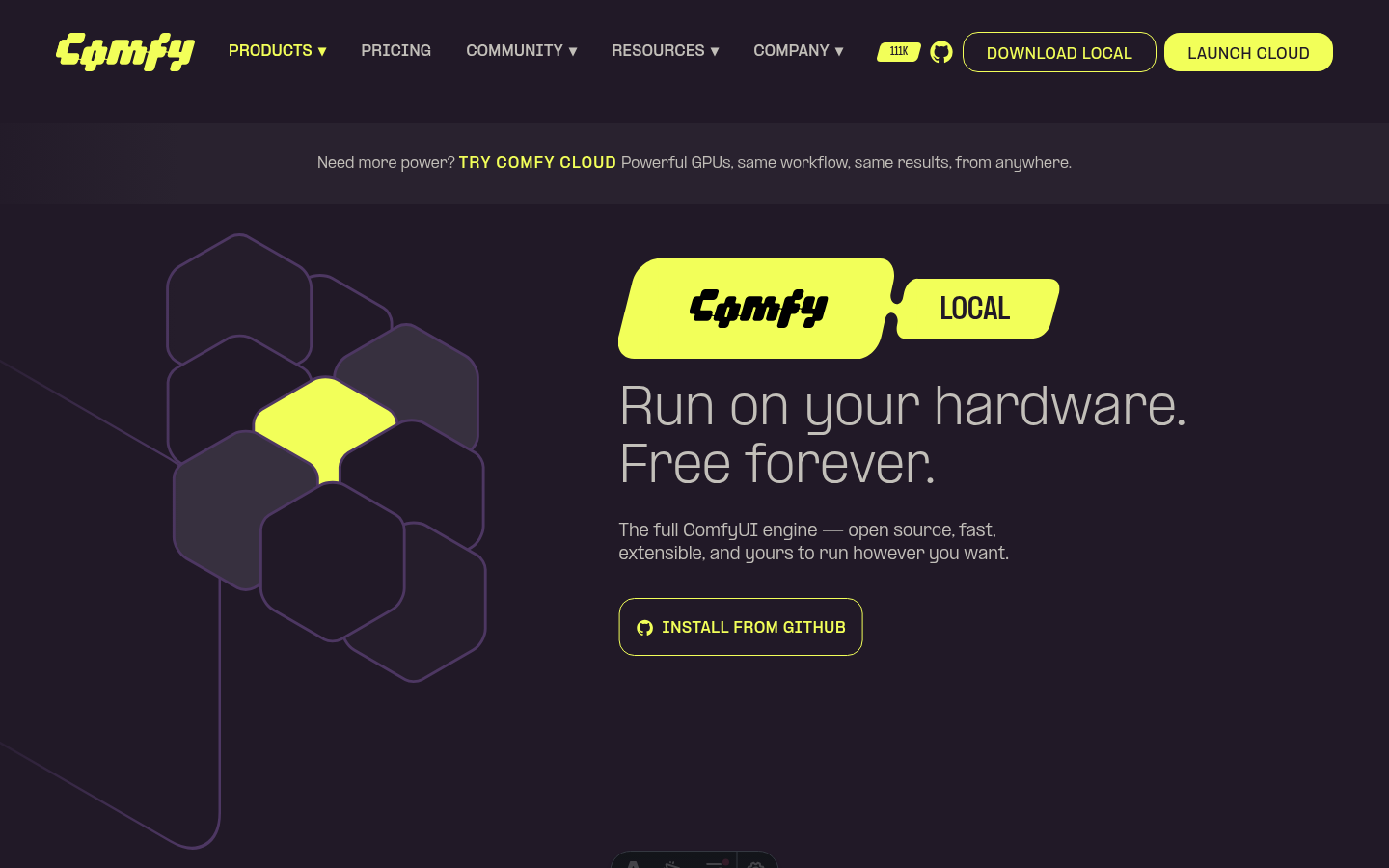
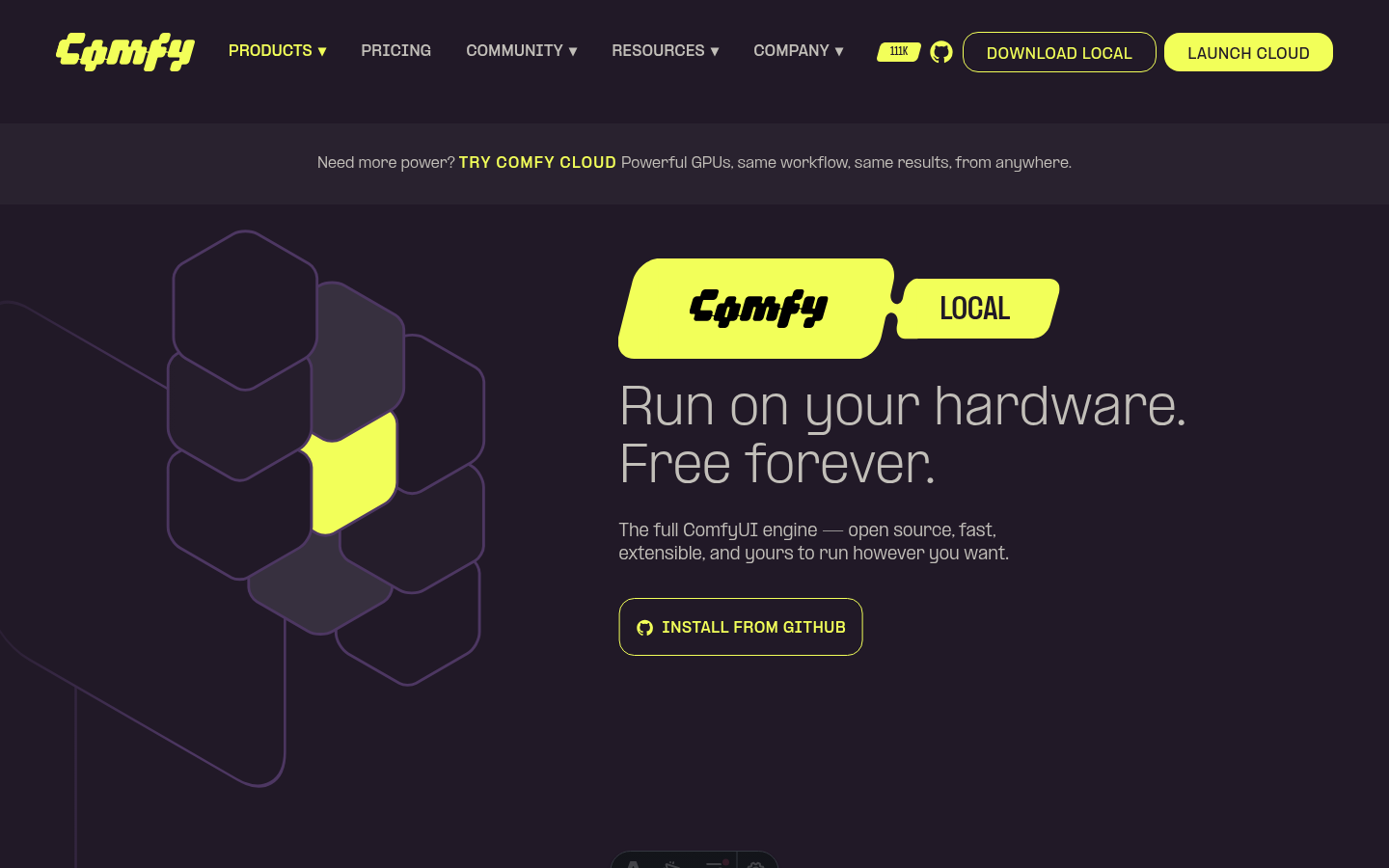
┆Issue is synchronized with this [Notion
page](https://www.notion.so/PR-11974-fix-website-prevent-HeroSection-fade-from-bleeding-into-CloudBannerSection-on-downloa-3576d73d3650813d8924fb54d5f78cee)
by [Unito](https://www.unito.io)
Co-authored-by: Glary-Bot <glary-bot@users.noreply.github.com>
Co-authored-by: Alexander Brown <drjkl@comfy.org>
## Summary
Aligns the `OpenAIGPTImage1` node display name in all 11 non-English
`nodeDefs.json` locale files with the English source-of-truth, which was
already updated to `OpenAI GPT Image 2`.
## Changes
- **What**: Updates `display_name`, the description string, and the
prompt tooltip in `ja`, `ru`, `zh`, `zh-TW`, `ar`, `pt-BR`, `ko`, `fr`,
`es`, `fa`, and `tr` locales from `GPT Image 1` to `GPT Image 2` (and
`GPT Görüntü 1` → `GPT Görüntü 2` in Turkish, `GPT صورة 1` → `GPT صورة
2` in Arabic). Other tooltips already referenced `GPT Image 2` and are
unchanged.
- **Breaking**: None — the registry node id `OpenAIGPTImage1` is
preserved (it is an internal identifier, not user-facing).
## Review Focus
- Translations were updated mechanically — please confirm the
version-number change is acceptable as-is for non-Latin scripts (Arabic,
Persian, Korean, Japanese, Chinese) where the version number was kept as
`2` per the existing pattern.
- The English locale already used `OpenAI GPT Image 2`, so this PR
brings the other locales into sync; no English copy was changed.
┆Issue is synchronized with this [Notion
page](https://www.notion.so/PR-11968-fix-i18n-rename-OpenAI-GPT-Image-1-to-GPT-Image-2-across-locales-3576d73d365081bfa204cbf528d84bf3)
by [Unito](https://www.unito.io)
Co-authored-by: Marwan Ahmed <marwan@Marwans-MacBook-Pro.local>
## Summary
Restores required-input validation highlighting on Vue node input slots.
## Changes
- **What**: Passes validation error state from `NodeSlots` to
`InputSlot` using node locator IDs, including subgraph and nested
subgraph execution IDs.
- **What**: Adds unit coverage for root, one-level subgraph, and nested
subgraph slot error mapping.
- **What**: Adds a Vue Nodes screenshot regression test that asserts the
missing required input slot itself receives the error highlight.
- **Dependencies**: None.
## Review Focus
- Required input errors on Vue-rendered node's slots.
- The new Playwright screenshot expectation will need the `New Browser
Test Expectation` label for Linux baseline generation.
## Screenshots (if applicable)
Before
<img width="499" height="324" alt="스크린샷 2026-05-05 오후 3 00 44"
src="https://github.com/user-attachments/assets/285fdf91-6d7e-480b-99b9-715705f78914"
/>
After
<img width="482" height="356" alt="스크린샷 2026-05-05 오후 3 01 11"
src="https://github.com/user-attachments/assets/51b8db49-eb9c-4155-8aa5-109c0bd7699b"
/>
┆Issue is synchronized with this [Notion
page](https://www.notion.so/PR-11950-fix-highlight-missing-input-slots-on-Vue-nodes-3576d73d365081bd85bfd1ea149d45c5)
by [Unito](https://www.unito.io)
---------
Co-authored-by: github-actions <github-actions@github.com>
## Summary
Fixes the Cloud-only nested subgraph missing-model false positive
covered by the stacked regression test in #11907.
When returning from an outer subgraph to the root graph, the Vue graph
node manager replays `onNodeAdded` for existing graph nodes. The
realtime error-clearing hook handled a subgraph container by recursively
scanning all interior nodes. For nested subgraphs, that also scanned the
nested subgraph container itself.
Nested subgraph container widgets are promoted synthetic views of
interior widgets. Scanning them as real model-loader nodes is wrong: the
container node type is the subgraph UUID, not `UNETLoader`, so Cloud
asset resolution can classify an installed promoted model as missing.
## Changes
- Skip nested subgraph container nodes during parent subgraph replay
scans.
- Keep scanning real active interior leaf nodes.
- Add unit coverage proving the replay scan visits the `UNETLoader` leaf
but not the nested subgraph container.
- Remove the `test.fail()` annotation from the Cloud E2E regression test
added in #11907.
## Stacked PR
This PR is stacked on #11907. After #11907 lands, this branch should be
rebased or retargeted onto `main`.
## Verification
- `pnpm exec vitest run
src/composables/graph/useErrorClearingHooks.test.ts -t "skips nested
subgraph containers during parent subgraph replay scan"`
- `pnpm exec oxfmt --check
src/composables/graph/useErrorClearingHooks.ts
src/composables/graph/useErrorClearingHooks.test.ts
browser_tests/tests/propertiesPanel/errorsTabCloudMissingModels.spec.ts`
- `pnpm exec eslint src/composables/graph/useErrorClearingHooks.ts
src/composables/graph/useErrorClearingHooks.test.ts
browser_tests/tests/propertiesPanel/errorsTabCloudMissingModels.spec.ts`
- `pnpm exec oxlint src/composables/graph/useErrorClearingHooks.ts
src/composables/graph/useErrorClearingHooks.test.ts
browser_tests/tests/propertiesPanel/errorsTabCloudMissingModels.spec.ts
--type-aware`
- `pnpm typecheck`
- `pnpm typecheck:browser`
- `pnpm build:cloud`
- `PLAYWRIGHT_LOCAL=1 PLAYWRIGHT_TEST_URL=http://localhost:8188 pnpm
exec playwright test
browser_tests/tests/propertiesPanel/errorsTabCloudMissingModels.spec.ts
--project=cloud`
- commit hook: `pnpm typecheck`, `pnpm typecheck:browser`
- push hook: `pnpm knip`
┆Issue is synchronized with this [Notion
page](https://www.notion.so/PR-11908-fix-skip-nested-subgraph-containers-in-replay-scan-3566d73d3650819c8687d6ab74add1b9)
by [Unito](https://www.unito.io)
## Summary
Adds a Cloud Playwright regression test for the nested subgraph case
where an installed Lotus diffusion model is incorrectly surfaced as
missing after returning to the root graph.
The fixture keeps the reproduction small: root graph -> subgraph node ->
nested subgraph node -> `UNETLoader` using
`lotus-depth-d-v1-1.safetensors`. The test stubs `/api/assets` through
the shared asset API fixture so that model is explicitly present as a
`diffusion_models` asset.
This test is intentionally written as an XFAIL regression guard. Its
setup and precondition checks are outside the XFAIL section: initial
workflow load must not show the error overlay, the Errors tab must
initially stay hidden, subgraph entry must succeed, root return must
succeed, and the replay scan must run. Only the final `Errors` tab
visibility assertion is expected to fail on current Cloud behavior.
## What a green run means
A green CI run for this PR means the Cloud-only bug was reproduced at
the intended point. The test reaches the root-return replay scan,
verifies that the replay scan ran, and then current Cloud behavior makes
the Errors tab visible even though the Lotus model exists in
`/api/assets`.
If any earlier setup or navigation step fails, or if the root-return
replay scan does not run, the test fails normally because those checks
happen before `test.fail()` is applied.
Locally, removing `test.fail()` produces the expected red result after
the replay-scan precondition passes, with `panel-tab-errors` visible.
The intended post-fix contract is that the replay scan still runs, but
the Errors tab remains hidden.
## Why this is XFAIL
This PR intentionally ships only the regression test, not the production
fix. The final behavioral assertion is annotated with `test.fail()`
because the current Cloud replay path still treats the nested subgraph
promoted model widget as missing.
When the follow-up fix lands, Playwright will report this test as an
unexpected pass until the `test.fail()` annotation is removed. That is
the handoff point for converting this regression guard into a normal
passing E2E test.
## Follow-up
The stacked fix PR is #11908. It updates the replay scan so nested
subgraph container nodes are skipped, then removes the `test.fail()`
annotation from this test.
## Verification
- `pnpm exec oxfmt --check browser_tests/fixtures/assetApiFixture.ts
browser_tests/tests/cloud-asset-default.spec.ts
browser_tests/tests/propertiesPanel/errorsTabCloudMissingModels.spec.ts`
- `pnpm exec oxlint browser_tests/fixtures/assetApiFixture.ts
browser_tests/tests/cloud-asset-default.spec.ts
browser_tests/tests/propertiesPanel/errorsTabCloudMissingModels.spec.ts
--type-aware`
- `pnpm exec eslint browser_tests/fixtures/assetApiFixture.ts
browser_tests/tests/cloud-asset-default.spec.ts
browser_tests/tests/propertiesPanel/errorsTabCloudMissingModels.spec.ts`
- `pnpm typecheck:browser`
- `pnpm typecheck`
- `pnpm lint`
- `PLAYWRIGHT_LOCAL=1 PLAYWRIGHT_TEST_URL=http://localhost:8188 pnpm
exec playwright test
browser_tests/tests/propertiesPanel/errorsTabCloudMissingModels.spec.ts
browser_tests/tests/cloud-asset-default.spec.ts --project=cloud`
- Temporarily removed `test.fail()` locally and verified the test fails
only after the replay-scan precondition passes, with `panel-tab-errors`
visible
┆Issue is synchronized with this [Notion
page](https://www.notion.so/PR-11907-test-add-Playwright-regression-test-for-nested-subgraph-Cloud-missing-model-3566d73d3650810b86d4de916c2852f9)
by [Unito](https://www.unito.io)
*PR Created by the Glary-Bot Agent*
---
## Summary
Adds "comfyui app" / "comfyui web app" / "comfy ui application" keywords
to the titles and meta descriptions of the home, download, and Comfy
Cloud pages (and zh-CN equivalents) to recover organic traffic for those
queries.
## Context
Organic traffic for the query **"comfyui app"** dropped after
`https://docs.comfy.org/interface/app-mode` started outranking the
product/landing pages. The docs page about app-mode converts worse than
the product pages, so we want Google to prefer comfy.org product pages
for that query. The cleanest, lowest-risk lever is on-page SEO metadata.
## Changes
- **What**:
- `apps/website/src/pages/index.astro` → title `ComfyUI App —
Professional Control of Visual AI` + product-focused description.
- `apps/website/src/pages/download.astro` → title `Download the ComfyUI
App — Run Visual AI Locally` + desktop-app description.
- `apps/website/src/pages/cloud/index.astro` → title `Comfy Cloud — The
ComfyUI Web App` + web-app description.
- `apps/website/src/pages/zh-CN/{index,download,cloud/index}.astro` →
localised Chinese titles and descriptions so the zh-CN product pages no
longer fall back to the English `BaseLayout` default.
- `apps/website/src/layouts/BaseLayout.astro` → unchanged net-net
(touched then reverted to neutral copy after review feedback so
non-product / non-localised pages keep their existing, generic
fallback).
- **Breaking**: none. Visual content, routing, and components are
untouched — only `<title>` and `<meta>` tags change.
## Review Focus
- The keyword copy reads naturally (no stuffing) and stays under typical
SERP truncation limits (≤ ~165 chars).
- zh-CN pages get Chinese descriptions — they intentionally don't repeat
the English keywords, since "comfyui app" is an English-language query.
- Pre-existing behaviour preserved: zh-CN pages **without** an explicit
description still inherit the English `BaseLayout` default. Fixing that
fallback for the whole zh-CN tree is out of scope for this PR — happy to
follow up if desired.
## Verification
- `pnpm typecheck` — 0 errors
- `pnpm build` — 39 pages built clean
- `pnpm test:unit` — 23/23 pass
- `pnpm format:check apps/website/src` — clean
- Manually verified rendered `<title>` and `<meta name="description">`
via Playwright on `/`, `/download`, `/cloud`, and the zh-CN equivalents.
## Screenshots
Home page rendered with the new title (visible in browser tab / SERP
preview); visual content unchanged.
## Screenshots

┆Issue is synchronized with this [Notion
page](https://www.notion.so/PR-11834-feat-website-add-comfyui-app-SEO-keywords-to-product-pages-3546d73d3650819da11bd665c2fcfb88)
by [Unito](https://www.unito.io)
---------
Co-authored-by: Glary-Bot <glary-bot@users.noreply.github.com>
## Summary
Add a typed Playwright jobs API mock and migrate the floating queue
overlay browser spec onto it.
## Changes
- replace the backend/seed terminology with `JobsApiMock`,
`jobsApiMockFixture`, `mockJobs()`, and `MockJobRecord`
- keep the mock at the network boundary with `page.route()` for
`/api/jobs`, `/api/jobs/{id}`, and `/api/history`
- remove backend-like query behavior that these browser tests do not
use, including sort handling, workflow filtering, and strict limit
validation
## Why
This keeps jobs coverage fast and profile-independent while avoiding
backend architecture changes for test setup. The fixture now serves only
the response shapes the UI consumes instead of pretending to be a
general in-memory backend.
┆Issue is synchronized with this [Notion
page](https://www.notion.so/PR-11280-test-add-in-memory-jobs-backend-fixture-3436d73d365081bb87e8c9771654496c)
by [Unito](https://www.unito.io)
*PR Created by the Glary-Bot Agent*
---
Removes the placeholder "GROOVE JONES CONTRIBUTORS" author card from the
Groove Jones customer story (`/customers/groove-jones`). The card was
rendering with `TBD` / `待补充` values for the contributor name and role.
## Change
Deletes 3 i18n keys from `apps/website/src/i18n/translations.ts`:
- `customers.detail.groove-jones.topic-10.block.2.label`
- `customers.detail.groove-jones.topic-10.block.2.name`
- `customers.detail.groove-jones.topic-10.block.2.role`
Block types in `ContentSection.vue` are inferred from the presence of
suffix keys (`.role` → `author` block) via `deriveSections` in
`apps/website/src/config/contentSections.ts`. Removing the keys causes
the author card to drop out of the rendered output entirely. The other
two blocks in topic-10 (intro paragraph + Dale Carman blockquote) remain
unchanged.
## Verification
- `pnpm typecheck` — passes
- `pnpm lint` — 0 errors (1 pre-existing warning, unrelated)
- `pnpm format` — applied
- `pnpm knip` — clean (1 pre-existing warning, unrelated)
- Manual: ran `pnpm dev` for the website app, navigated to
`/customers/groove-jones`, confirmed the conclusion section ends
naturally — no `TBD` text, no orphan `CONTRIBUTORS` label, no broken
card.
Code review (Oracle): 0 critical / 0 warning / 0 suggestion.
## Screenshots
┆Issue is synchronized with this [Notion
page](https://www.notion.so/PR-11937-fix-website-remove-placeholder-author-info-for-groove-jones-customer-story-3576d73d36508193b1a0c0c3cd887686)
by [Unito](https://www.unito.io)
Co-authored-by: Glary-Bot <glary-bot@users.noreply.github.com>
## Summary
Use resized preview URLs for floating QPO row thumbnails so the expanded
overlay does not load full-size image assets while the canvas is being
navigated.
Linear: FE-538
## Changes
- **What**: Pass `ResultItemImpl.previewUrl` into `AssetsListItem` for
completed image/video job rows.
- **Dependencies**: None.
## Review Focus
Confirm this only changes the row thumbnail source; full asset viewing
still flows through the existing job/task preview output.
┆Issue is synchronized with this [Notion
page](https://www.notion.so/PR-11946-fix-use-resized-QPO-thumbnails-3576d73d365081b68682d1b7b109af30)
by [Unito](https://www.unito.io)
## Summary
Use ShadCN-style Reka popover primitives for the live queue job list
after the unused legacy queue row implementation is removed in #11621.
This is the first step in migrating popovers toward the ShadCN UI
pattern: local design-system wrappers over Reka UI, rather than ad hoc
direct Reka or PrimeVue popovers at each call site.
## Changes
- **What**: Added the minimal ShadCN-style popover primitives needed by
this fix: `Popover`, `PopoverAnchor`, and `PopoverContent`.
- **What**: Migrated `JobAssetsList` job details from manual fixed
positioning to these popover primitives with viewport collision
handling.
- **What**: Removed the obsolete manual hover-position helper after
`JobAssetsList` stopped using it.
- **Dependencies**: No new dependencies; the primitives wrap the
existing `reka-ui` package.
- Added browser coverage for bottom-row job details clipping in the
queue overlay.
## Review Focus
- This PR is stacked on #11621.
- The live queue surfaces are `JobAssetsList` consumers: expanded queue
progress overlay and job history sidebar.
- The new `src/components/ui/popover` files intentionally seed the
ShadCN-style migration path, but only include the pieces used here to
keep the first PR small.
- Follow-up PRs can add `PopoverTrigger` and migrate existing
PrimeVue/direct-Reka popovers once there is an actual caller.
## Summary
A follow-up PR of
https://github.com/Comfy-Org/ComfyUI_frontend/issues/11107.
## Changes
Add unit test to `editAttention.ts`
- [x] `Extract pure functions to module level`: **Moved**
`incrementWeight`, `findNearestEnclosure`, and `addWeightToParentheses`
out of the `init()` closure and **promoted** them to module-level
functions with `export` to allow for independent testing.
- [x] `Add unit tests for incrementWeight`: **Added** 6 tests covering
edge cases such as normal increment/decrement, NaN input, negative
weights, and floating-point precision.
- [x] `Add unit tests for findNearestEnclosure`: **Added** 7 tests
covering edge cases including simple brackets, no brackets, cursor
outside, nested brackets (inner/outer), empty strings, and missing
closing brackets.
- [x] `Add unit tests for addWeightToParentheses`: **Added** 6 tests
covering scenarios like adding a default 1.0 weight, retaining existing
weights, no changes when brackets are absent, scientific notation
weights, negative weights, and multi-word tokens.
- [x] `Mock app module`: **Used** `vi.mock('@/scripts/app')` to
intercept side effects from `app.registerExtension`, **preventing** the
triggering of ComfyUI extension registration logic during module import.
<!-- CURSOR_SUMMARY -->
---
> [!NOTE]
> **Medium Risk**
> Adjusts token selection/weight-detection logic used during
Ctrl/Cmd+Arrow editing, which could subtly change how prompts are
rewritten in edge cases (nested parens, scientific notation, time-like
text). Adds tests that should reduce regression risk but behavior
changes still warrant verification in the UI.
>
> **Overview**
> Adds a new `vitest` unit test suite for `editAttention` by mocking
`app.registerExtension` side effects and validating `incrementWeight`,
`findNearestEnclosure`, and `addWeightToParentheses` across common and
edge cases.
>
> Refactors those helpers to exported module-level functions and
tightens parsing/selection behavior: `findNearestEnclosure` now handles
the cursor being on an opening `(`, `addWeightToParentheses` improves
trailing weight detection (supports scientific notation/negatives and
avoids misclassifying time-like `12:30`), and the weight-rewrite regex
now matches exponent forms.
>
> <sup>Reviewed by [Cursor Bugbot](https://cursor.com/bugbot) for commit
df20340b49. Bugbot is set up for automated
code reviews on this repo. Configure
[here](https://www.cursor.com/dashboard/bugbot).</sup>
<!-- /CURSOR_SUMMARY -->
┆Issue is synchronized with this [Notion
page](https://www.notion.so/PR-11301-Test-edit-attention-unit-tests-3446d73d365081f29e8dfceefc06f5d3)
by [Unito](https://www.unito.io)
## Summary
Adds 11 tests for \`src/renderer/core/layout/store/layoutStore.ts\`
covering paths previously uncovered by the existing 17-test suite.
Targets the customRef setter machinery, reactive queries, and
link-layout updates that are reachable through the public API.
## Test Coverage
\`getNodeLayoutRef\` setter:
- Setter on a fresh ref triggers \`createNode\`.
- Position-only change triggers \`moveNode\`.
- Size-only change triggers \`resizeNode\`.
- zIndex-only change triggers \`setNodeZIndex\`.
- Setting to \`null\` triggers \`deleteNode\`.
Queries:
- \`getNodesInBounds\` returns reactive node IDs intersecting the
bounds.
- \`queryNodeAtPoint\` returns the top-zIndex node containing the point.
- \`queryNodeAtPoint\` returns \`null\` when no node contains the point.
Link layouts:
- \`updateLinkLayout\` short-circuits when bounds and centerPos
unchanged but still updates the path.
- \`updateLinkLayout\` replaces stored layout when bounds change.
- \`deleteLinkLayout\` removes the link and its segment layouts.
## Testing
\`\`\`bash
pnpm vitest run src/renderer/core/layout/store/layoutStore.test.ts
\`\`\`
┆Issue is synchronized with this [Notion
page](https://app.notion.com/p/PR-11747-test-add-unit-tests-for-layoutStore-setter-and-query-paths-3516d73d365081d9bc1de336ff7258ea)
by [Unito](https://www.unito.io)
… (issue #11092 phase 4b)
## Summary
Part of #11092 — Phase 4b: remove 2 `@ts-expect-error` suppressions from
`CustomizationDialog.vue`.
## Changes
`selectedIcon` ref initialisation and `resetCustomization` assignment
both suppressed a type error on `Array.find()` returning `T |
undefined`.
**Why**
`Array.find()` has no way to statically guarantee a match, so its return
type is always `T | undefined`. Both usages were searching `iconOptions`
— a literal array of 8 entries declared in the same scope — and
TypeScript could not prove that the searched value would always be
found, even though at runtime it always is (the default icon value is
defined from `iconOptions[0]`).
**How**
Added `iconOptions[0]` as a final fallback via `??` in both places.
Because `iconOptions` is a non-empty literal array, `iconOptions[0]` is
provably non-null to TypeScript, which makes the overall expression type
`T` and satisfies the assignment. The explicit generic on `ref<{ name:
string; value: string }>` was also dropped — TypeScript infers the type
correctly from the non-nullable initialiser. In `resetCustomization`,
`||` was replaced with `??` since the values being null-coalesced are
objects (never falsy), making `??` the semantically precise operator for
this case.
<!-- CURSOR_SUMMARY -->
---
> [!NOTE]
> **Low Risk**
> Low risk: UI-only refactor that adds explicit fallbacks for
`Array.find()` results and introduces a small unit test suite; behavior
should remain the same except for safer handling of unexpected icon
values.
>
> **Overview**
> Removes two `@ts-expect-error` suppressions in
`CustomizationDialog.vue` by making `selectedIcon` initialization and
`resetCustomization` use a guaranteed fallback (`iconOptions[0]`) via
`??`, ensuring the selected icon is never `undefined`.
>
> Adds `CustomizationDialog.test.ts` to verify `confirm` emits the
expected icon/color for default, provided initial values, and an invalid
`initialIcon` fallback.
>
> <sup>Reviewed by [Cursor Bugbot](https://cursor.com/bugbot) for commit
f77addf713. Bugbot is set up for automated
code reviews on this repo. Configure
[here](https://www.cursor.com/dashboard/bugbot).</sup>
<!-- /CURSOR_SUMMARY -->
┆Issue is synchronized with this [Notion
page](https://www.notion.so/PR-11339-refactor-remove-ts-expect-error-suppressions-in-CustomizationDialog-3456d73d36508165865ac569e047db2e)
by [Unito](https://www.unito.io)
## Summary
Phase D of the **useBrushDrawing-refactor plan.md**. Extract `WebGPU`
state management from `useBrushDrawing` into a dedicated
`useGPUResources` composable, reducing `useBrushDrawing` from ~1,160
lines to ~230. This is Phase D of the ongoing `useBrushDrawing`
decomposition (Phases A–C landed in previous PRs).
## Changes
- **What**: Split `useBrushDrawing` along a clean boundary — GPU
device/texture lifecycle moves to `useGPUResources`, stroke
orchestration stays in `useBrushDrawing`. Shared reactive state
(`dirtyRect`, `isSavingHistory`, `previewCanvas`) is now owned by
`useGPUResources` and exposed as refs. A pure
`clampDirtyRect` helper is extracted to `gpuUtils.ts`.
- **Dependencies**: No new dependencies
## Tests
Local test - pass
<!-- CURSOR_SUMMARY -->
---
> [!NOTE]
> **Medium Risk**
> Refactors WebGPU initialization, texture management, and readback
paths used during drawing; regressions could affect stroke rendering,
canvas visibility, and undo/redo GPU sync.
>
> **Overview**
> Extracts WebGPU device/texture/renderer lifecycle, watchers (clear,
undo/redo sync, texture recreation), and readback logic out of
`useBrushDrawing` into a new `useGPUResources` composable, with shared
refs (`dirtyRect`, `isSavingHistory`, `previewCanvas`, `hasRenderer`)
now owned by that module.
>
> Updates `useBrushDrawing` to delegate GPU-specific operations
(prepare/render/draw point/composite/readback/cleanup) to
`useGPUResources` while keeping CPU drawing + stroke orchestration, and
adds new pure helpers in `gpuUtils` (`clampDirtyRect`,
`buildStrokePoints`) to centralize dirty-rect clamping and stroke point
resampling.
>
> Adds Vitest coverage for the new helpers, `useGPUResources`
no-op/error behavior when GPU isn’t available, and `useBrushDrawing`
interactions with the extracted GPU API (composition mode selection,
shift-line, history save, and canvas/preview opacity restoration).
>
> <sup>Reviewed by [Cursor Bugbot](https://cursor.com/bugbot) for commit
a9fcd80ab5. Bugbot is set up for automated
code reviews on this repo. Configure
[here](https://www.cursor.com/dashboard/bugbot).</sup>
<!-- /CURSOR_SUMMARY -->
┆Issue is synchronized with this [Notion
page](https://app.notion.com/p/PR-11784-refactor-extract-GPU-lifecycle-into-useGPUResources-phase-D-3526d73d365081108a97c164a0bfa13e)
by [Unito](https://www.unito.io)
## Summary
Render keybinding badges in sentence case (`Ctrl + Shift + A`) instead
of UPPERCASE (`CTRL + SHIFT + A`) by swapping the `uppercase` Tailwind
class for `capitalize` in `KeyComboDisplay.vue`.
`KeyComboImpl.getKeySequences()` already returns labels in their
canonical form (`Ctrl`, `Alt`, `Shift`, plus the raw key). The badge
styling was forcing them all to UPPER, which is what FE-524 calls out.
`text-transform: capitalize` cleanly handles every case: lower modifier,
upper modifier, and single character keys.
- Fixes FE-524
## Before / After
| Before (`uppercase`) | After (`capitalize`) |
| --- | --- |
| <img
src="https://raw.githubusercontent.com/Comfy-Org/ComfyUI_frontend/c6bb96fce/docs/screenshots/fe-524/before.png"
width="480"> | <img
src="https://raw.githubusercontent.com/Comfy-Org/ComfyUI_frontend/c6bb96fce/docs/screenshots/fe-524/after.png"
width="480"> |
## Test plan
- [ ] Open Settings → Keybinding panel and confirm modifier badges
render as `Ctrl`, `Alt`, `Shift` instead of `CTRL`, `ALT`, `SHIFT`
- [ ] Confirm single-letter keys (e.g. `A`, `S`) still render uppercase
- [ ] Edit a keybinding and verify the live preview badges in the dialog
also render in sentence case
## Summary
Use spread pattern when writing `nodeValue.properties['Model Config']`
so future ModelConfig fields are preserved across viewer dialog
cancel/apply.
## Changes
- **What**: Spread existing `Model Config` before applying known keys in
both `restoreInitialState()` and `applyChanges()` in
[useLoad3dViewer.ts](src/composables/useLoad3dViewer.ts). Removes the
hard-coded `showSkeleton: false` override from `applyChanges()` so it
falls through from the existing config.
## Review Focus
The change is intentionally minimal and matches the suggestion in the
upstream issue. Two regression tests added (one each for restore/apply)
verify that an unknown future field on Model Config survives both code
paths.
Fixes#11346
┆Issue is synchronized with this [Notion
page](https://www.notion.so/PR-11838-fix-load3d-preserve-unknown-Model-Config-fields-with-spread-3546d73d3650819686efc4e1a9799ad9)
by [Unito](https://www.unito.io)
## Summary
`fitToViewer()` in `SceneModelManager` resets the model rotation to
`(0,0,0)` as part of its normalize-and-scale flow, but does not reapply
`currentUpDirection` afterward. This causes a state/view mismatch when
the user has previously selected a non-default up-axis (e.g. `+x`,
`-z`): the model snaps back to its raw orientation while the Up
Direction control still shows the previously selected value.
## Changes
- In `fitToViewer()`, clear `originalRotation` (to avoid compounding
with the stale pre-fit base) then reapply `currentUpDirection` if it is
not `'original'`
- Add 5 unit tests covering: no-op when no model, reapplication of
direction, no rotation compounding on repeated calls, zero rotation for
`'original'` direction, and stale `originalRotation` guard
## Testing
### Automated
- `src/extensions/core/load3d/SceneModelManager.test.ts` — 5 new tests
in `describe('fitToViewer')`
- All 48 unit tests pass
### E2E Verification Steps
1. Open the Load3D viewer with any 3D model
2. Change **Up Direction** to any non-default value (e.g. `+x` or `-z`)
— observe model rotates correctly
3. Click **Fit to Viewer** — model should remain in the chosen
up-direction orientation, not snap back to raw orientation
4. Click **Fit to Viewer** again — rotation should remain stable (no
compounding)
5. Change Up Direction back to `original` then click **Fit to Viewer** —
model should return to neutral orientation `(0,0,0)`
## Review Focus
The key invariant: `fitToViewer()` resets `rotation.set(0,0,0)`
explicitly, so we must clear `originalRotation = null` before calling
`setUpDirection`. Otherwise `setUpDirection` restores the stale pre-fit
rotation as a base and then adds the direction offset on top,
compounding incorrectly.
Fixes#11347
<!-- Pipeline-Ticket: pick-issue-3414 -->
┆Issue is synchronized with this [Notion
page](https://app.notion.com/p/PR-11826-fix-load3d-reapply-up-direction-after-fitToViewer-transform-reset-3546d73d36508166b9bcecc9949c4952)
by [Unito](https://www.unito.io)
## Summary
Fixes a bug where models reloaded in wireframe/normal/depth modes would
not restore to their original materials correctly, because the material
snapshot was being taken *after* the mode was applied.
## Changes
- Move `setupModelMaterials(model)` to immediately after
`scene.add(model)` and before `setMaterialMode()` / `setUpDirection()`
in `SceneModelManager.setupModel()`
- Save `materialMode` into `pendingMaterialMode` before calling
`setupModelMaterials()`, since the latter internally calls
`setMaterialMode('original')` which resets `this.materialMode` —
preserving the value ensures the subsequent reapplication guard works
correctly
- Update stale test assertion that reflected the old (incorrect) call
order
- Add regression test: verifies that `originalMaterials` captures the
pre-mutation material and that restoring to `'original'` after a
non-original load gives back the true original mesh material
## Testing
### Automated
- `src/extensions/core/load3d/SceneModelManager.test.ts` — 44 tests, all
pass
- Full load3d test suite — 401 tests, all pass
### E2E Verification Steps
1. Open ComfyUI with a Load3D node
2. Load any GLB/OBJ model
3. Switch Material Mode to **Wireframe** (or Normal/Depth)
4. Load a different model (or reload the same one)
5. Switch Material Mode back to **Original**
6. Verify the model renders with its original diffuse/PBR materials (not
wireframe)
## Review Focus
The key invariant: `setupModelMaterials()` must snapshot mesh materials
in their *unmodified* state. It must run before any `setMaterialMode()`
call that mutates them. The `pendingMaterialMode` variable is needed
because `setupModelMaterials()` internally calls
`setMaterialMode('original')`, which updates `this.materialMode`, making
the subsequent guard `if (this.materialMode !== 'original')` silently
skip reapplication without it.
Fixes#11344
<!-- Pipeline-Ticket: pick-issue-3417 -->
┆Issue is synchronized with this [Notion
page](https://app.notion.com/p/PR-11825-fix-load3d-snapshot-original-materials-before-reapplying-materialMode-3546d73d3650818b9c35fa60c15f17a3)
by [Unito](https://www.unito.io)
## Summary
Preview 3D and Animation nodes were stuck at the LOD from initial page
load because CSS `scale3d` transforms don't affect
`clientWidth`/`clientHeight` — `handleResize()` always received
layout-space dimensions regardless of zoom level. This fix passes
`ds.scale` as the renderer pixel ratio so the 3D scene renders at the
correct visual resolution when the graph is zoomed in or out.
## Changes
- **What**: In `Load3d.handleResize()`, call
`renderer.setPixelRatio(ds.scale)` before `setSize` so pixel density
scales with canvas zoom. A `getZoomScale` callback is threaded through
`Load3DOptions` → `Load3d` constructor → `handleResize`. In `useLoad3d`,
a watcher on `canvasStore.appScalePercentage` triggers `handleResize`
whenever the zoom level changes.
- **What**: Fix `SceneManager.captureScene()` to save and restore the
renderer's logical size and pixel ratio around capture, so exact-pixel
output is unaffected by the current zoom state.
## Review Focus
- `handleResize` now calls `setPixelRatio` before `setSize`. Three.js
renders at `logicalWidth × pixelRatio` physical pixels while CSS
displays it at `logicalWidth` CSS pixels — this is the standard pattern
for HiDPI but here used to match the visual zoom level.
- `captureScene` must reset `pixelRatio` to 1 so `setSize(w, h)`
produces exactly `w×h` pixel output. It saves and restores both logical
size and pixel ratio via `renderer.getSize()` /
`renderer.getPixelRatio()`.
- The zoom watcher is guarded with `getActivePinia()` to avoid errors in
unit tests and non-Pinia contexts.
## Test
before
https://github.com/user-attachments/assets/9778ad54-7cb2-4fdc-b200-65a683ee8e4d
after
https://github.com/user-attachments/assets/acfaaf7a-43c7-495f-b352-5dd2cdaa94db
## Analysis Report
https://linear.app/comfyorg/issue/FE-401/bug-preview-3d-and-animation-nodes-lod-stuck-at-initial-page-load
## More
- Add `debounce` and pixel ratio limit
<!-- CURSOR_SUMMARY -->
---
> [!NOTE]
> **Medium Risk**
> Medium risk because it changes core `Load3d.handleResize()` rendering
behavior (pixel ratio/LOD) and adds a debounced zoom-driven resize
watcher, which could affect performance or visual output across all
Load3D nodes. Capture logic is also refactored to manipulate renderer
size/pixel ratio and camera params, so regressions would show up in
thumbnails/exports.
>
> **Overview**
> Fixes Load3D LOD/render sharpness when the graph canvas is zoomed by
threading a new `getZoomScale` option from `useLoad3d` into `Load3d` and
using it to call `renderer.setPixelRatio()` (clamped) during
`handleResize()`.
>
> Adds a debounced watcher on `canvasStore.appScalePercentage` to
trigger `handleResize()` on zoom changes, and updates
`SceneManager.captureScene()` to temporarily force pixel ratio 1 and
restore renderer size/pixel ratio and camera settings after capture.
Coverage is expanded with new Playwright smoke coverage plus unit tests
for zoom propagation, debouncing, pixel ratio behavior, and capture
state restoration.
>
> <sup>Reviewed by [Cursor Bugbot](https://cursor.com/bugbot) for commit
261940d111. Bugbot is set up for automated
code reviews on this repo. Configure
[here](https://www.cursor.com/dashboard/bugbot).</sup>
<!-- /CURSOR_SUMMARY -->
┆Issue is synchronized with this [Notion
page](https://www.notion.so/PR-11734-fix-load3d-update-renderer-pixel-ratio-on-canvas-zoom-to-fix-LOD-resolution-3516d73d365081e6b3d4cdd05f516489)
by [Unito](https://www.unito.io)
## Summary
Fixes several issues in both Simplified Chinese (zh) and Traditional
Chinese (zh-TW) locale files that were identified through systematic
comparison against the English source.
### Changes
**nodeDefs.json (zh + zh-TW):**
- **CLIPLoader.description**: Added missing model recipes (lumina2, wan,
hidream, omnigen2) to match English source
- **ByteDanceSeedreamNode.display_name**: Updated version from "Seedream
4" to "Seedream 4.5 and 5.0" to match English
- **BriaImageEditNode.display_name**: Added missing "FIBO" model name
**nodeDefs.json (zh only):**
- **APG.inputs.eta.name**: Fixed incorrect translation "预计到达时间" (ETA) ->
kept as "eta" (technical parameter name)
**commands.json (zh + zh-TW):**
- **Comfy_ToggleLinear**: Updated label to match English "Toggle App
Mode"
- **Experimental_ToggleVueNodes**: Rebranded "Vue 节点"/"Vue 節點" to "Nodes
2.0" to match English
**settings.json (zh + zh-TW):**
- **Comfy_VueNodes_Enabled / Comfy_VueNodes_AutoScaleLayout**: Rebranded
"Vue 节点"/"Vue 節點" to "Nodes 2.0"
**main.json (zh + zh-TW):**
- **errorDialog.accessRestrictedMessage / accessRestrictedTitle**: Added
missing Chinese translations
┆Issue is synchronized with this [Notion
page](https://www.notion.so/PR-11930-fix-i18n-correct-zh-and-zh-TW-translations-3566d73d365081ff9b0beb1c1fc7ef1a)
by [Unito](https://www.unito.io)
---------
Co-authored-by: LifetimeVip <lifetimevip@users.noreply.github.com>
## Summary
Add 27 unit tests for MembersPanelContent component covering workspace
views, member management, and billing states.
## Changes
- **What**: New test file for MembersPanelContent with 27 tests across 8
describe blocks (personal workspace, owner view, member view, sorting,
search filtering, pending invites, single seat plan, member count
display)
## Review Focus
- Uses `@testing-library/vue` + `@testing-library/user-event` per
project conventions
- Component stubs (Button, SearchInput, Menu, UserAvatar) for isolation
- Reactive mock refs in `vi.hoisted()` shared across `vi.mock()` calls
┆Issue is synchronized with this [Notion
page](https://www.notion.so/PR-11402-test-add-MembersPanelContent-unit-tests-3476d73d36508107abcbce95b72b3fb7)
by [Unito](https://www.unito.io)
## Summary
Add Playwright e2e tests for the node replacement feature (swap nodes UI
in the errors tab).
## Changes
- **What**: 6 e2e test cases across two describe blocks covering single
and multi-type node replacement flows. Tests verify swap nodes group
visibility, in-place replacement, widget value preservation, Replace All
across multiple types, output connection preservation, and success toast
display. Includes typed mock data for `/api/node_replacements` and two
workflow fixture files with fake missing node types mapped to real core
nodes.
## Review Focus
- Mock setup pattern in `setupNodeReplacement` — enables feature flag
via `page.evaluate` and routes the API endpoint
- Workflow fixture design — uses fake node types (E2E_OldSampler,
E2E_OldUpscaler) that map to real registered types (KSampler,
ImageScaleBy)
- Assertion coverage for link preservation after replacement
┆Issue is synchronized with this [Notion
page](https://www.notion.so/PR-11242-test-add-e2e-tests-for-node-replacement-flows-3426d73d3650811e87d7f0d96fd66433)
by [Unito](https://www.unito.io)
---------
Co-authored-by: Connor Byrne <c.byrne@comfy.org>
## Summary
The Vue node model picker mixes output assets into the dropdown with a
trailing ' [output]' suffix on the value. Forwarding that string to
loadModel as a literal filename under the configured input folder caused
a 404 and the model never rendered. Strip the trailing folder annotation
per call and use the matching folder so picking an output asset loads
correctly while plain values keep the configured folder.
Output assets stored under a subfolder (e.g. 3d/) were exposed in the
Vue node dropdown as just '<filename> [output]', so selection produced
an /api/view URL with empty subfolder and a 404. Read the subfolder from
the asset's OutputAssetMetadata and prefix it onto the annotated path so
the downstream load handler can split it back out and target the correct
folder.
## Screenshots (if applicable)
https://github.com/user-attachments/assets/463d1071-efdc-46a4-b101-8e1c012d19c7
┆Issue is synchronized with this [Notion
page](https://app.notion.com/p/PR-11805-fix-load3d-parse-output-input-temp-annotation-when-loading-3536d73d365081a8ac9cf75d14ae29e6)
by [Unito](https://www.unito.io)
## Summary
Fixed two minor documentation inaccuracies found during comprehensive
documentation audit:
- Corrected outdated "Lodash" reference to "Utility Functions" in unit
testing guide
- Updated package manager command from `npx` to `pnpm dlx` in Playwright
skill documentation
## Changes Made
### Documentation Fixes
#### docs/testing/unit-testing.md:150
- **Before**: `## Mocking Lodash Functions`
- **After**: `## Mocking Utility Functions`
- **Reason**: The section describes mocking `es-toolkit/compat`
functions, not Lodash. The project uses es-toolkit as stated in
AGENTS.md line 158 and docs/guidance/typescript.md line 60.
#### .claude/skills/writing-playwright-tests/SKILL.md:117
- **Before**: `npx playwright show-trace trace.zip`
- **After**: `pnpm dlx playwright show-trace trace.zip`
- **Reason**: Project standardizes on pnpm, explicitly avoiding npx per
AGENTS.md line 42: "use `pnpx` or `pnpm dlx` — never `npx`"
## Audit Summary
Comprehensive audit verified accuracy of:
- ✅ Core documentation (CLAUDE.md, AGENTS.md, README.md)
- ✅ All docs/**/*.md files (40+ files including ADRs, testing guides,
architecture docs)
- ✅ All README files throughout repository (21 files)
- ✅ All .claude/commands/*.md files (8 files)
- ✅ Code examples and API references
- ✅ File structure references (verified src/router.ts, src/i18n.ts,
src/main.ts, config files exist)
- ✅ Package dependencies (es-toolkit ^1.39.9 confirmed)
- ✅ Script commands (pnpm test:unit, pnpm test:browser:local, etc.)
- ✅ External resource links
- ✅ ADR index and dates
All other documentation remains accurate and up-to-date as of
2026-05-04.
## Review Notes
This PR contains only two trivial corrections to terminology/commands.
No functional changes, no code changes, no breaking changes. The
documentation audit found the codebase documentation to be in excellent
condition overall.
Co-authored-by: christian-byrne <72887196+christian-byrne@users.noreply.github.com>
## Summary
The existing \`MixpanelTelemetryProvider.test.ts\` was misnamed: it only
tested \`getExecutionContext\` from \`../../utils/getExecutionContext\`,
never the provider class itself — provider coverage sat at **0%**
despite a 239-line test file living next to it.
This PR:
1. **Renames** the existing test file to
\`src/platform/telemetry/utils/getExecutionContext.test.ts\` (co-located
with the source it actually tests). Updates its relative import to
\`./getExecutionContext\`.
2. **Adds** a fresh
\`src/platform/telemetry/providers/cloud/MixpanelTelemetryProvider.test.ts\`
covering the provider class.
Lifts provider coverage from **0% → 81.1%** lines (functions 73.5%,
branches 88.5%).
## Test Coverage (new tests)
Constructor / initialization:
- Without \`mixpanel_token\`, warns and disables itself; subsequent
\`trackXxx\` calls are no-ops.
- With \`mixpanel_token\`, dynamically imports mixpanel-browser, calls
\`init\`, and after \`loaded()\` fires identifies users via
\`onUserResolved\`.
Queueing semantics:
- Events fired before \`loaded()\` are queued and flushed in order once
Mixpanel reports ready.
Filtering:
- Events listed in the default \`disabledEvents\` set (e.g.
\`workflow_opened\`) are suppressed.
Direct dispatchers (parameterized \`it.each\`):
- 16 \`trackXxx\` methods covered: signup/auth/login, subscription
lifecycle, credit topup events, template lifecycle, workflow
imported/saved, default-view, enter-linear, share-flow, execution
success/error.
- \`trackApiCreditTopupButtonPurchaseClicked\` payload includes
\`credit_amount\`.
- \`trackEmailVerification\` dispatches the matching
\`USER_EMAIL_VERIFY_*\` event for each stage.
- \`trackSubscription\` maps \`'modal_opened'\` and
\`'subscribe_clicked'\` to their distinct events.
- \`trackRunButton\` populates \`RunButtonProperties\` from the
execution context.
- \`trackWorkflowExecution\` consumes the latest \`trigger_source\` from
\`trackRunButton\`, then resets it to \`'unknown'\`.
Survey:
- On \`'submitted'\`, normalized properties are written to
\`Mixpanel.people\`.
- On \`'opened'\`, \`Mixpanel.people\` is not touched.
Topup delegation:
- \`startTopupTracking\`, \`clearTopupTracking\`,
\`checkForCompletedTopup\` all forward to the \`topupTracker\` utility.
## Testing
\`\`\`bash
pnpm vitest run
src/platform/telemetry/providers/cloud/MixpanelTelemetryProvider.test.ts
pnpm vitest run src/platform/telemetry/utils/getExecutionContext.test.ts
\`\`\`
┆Issue is synchronized with this [Notion
page](https://app.notion.com/p/PR-11749-test-rename-misnamed-Mixpanel-test-and-cover-the-actual-provider-class-3516d73d365081609c54f34bd2d8b00d)
by [Unito](https://www.unito.io)
---------
Co-authored-by: Christian Byrne <cbyrne@comfy.org>
## Automated Ingest API Type Update
This PR updates the Ingest API TypeScript types and Zod schemas from the
latest cloud OpenAPI specification.
- Cloud commit: 758732f
- Generated using @hey-api/openapi-ts with Zod plugin
These types cover cloud-only endpoints (workspaces, billing, secrets,
assets, tasks, etc.).
Overlapping endpoints shared with the local ComfyUI Python backend are
excluded.
---------
Co-authored-by: skishore23 <178779+skishore23@users.noreply.github.com>
Co-authored-by: GitHub Action <action@github.com>
Nodes in the 'essentials' category do not have type 'core'. The check
has been updated to instead use the dedicated `isCoreNode` prop.
No tests currently. The existing tests for this code section all mock
out the relevant code path and properly writing a test for this would
take far more time than I can allocate right now.
┆Issue is synchronized with this [Notion
page](https://app.notion.com/p/PR-11809-Fix-core-node-detection-for-missing-nodes-3536d73d3650815aabb2deb54c4ecec4)
by [Unito](https://www.unito.io)
## Summary
Extends the new unsafe Error assertion lint rule from #11845 to also
reject angle-bracket assertions.
## Changes
- **What**: Adds a `TSTypeAssertion` selector alongside the existing
`TSAsExpression` selector and broadens the lint message to cover Error
type assertions generally.
## Review Focus
This is stacked on #11845 and only addresses the lint-rule bypass for
`<Error>value` syntax.
┆Issue is synchronized with this [Notion
page](https://www.notion.so/PR-11909-fix-catch-angle-bracket-Error-assertions-3566d73d365081f58ecfecfa2e948c33)
by [Unito](https://www.unito.io)
---------
Co-authored-by: bymyself <cbyrne@comfy.org>
*PR Created by the Glary-Bot Agent*
---
## Summary
Updates the "Install via GitHub" CTA buttons on the `/download` page to
deep-link to the install instructions section of the ComfyUI README
(`#installing`) instead of the repo root, so users land directly on
setup steps.
## Changes
- `apps/website/src/config/routes.ts`: add `externalLinks.githubInstall
= 'https://github.com/Comfy-Org/ComfyUI#installing'` (separate from
`externalLinks.github`, which is still used by the navbar/footer/star
badge for the generic repo link).
- `apps/website/src/components/product/local/HeroSection.vue`: switch
the secondary CTA next to "Download Local" from `externalLinks.github`
to `externalLinks.githubInstall`.
- `apps/website/src/components/product/local/EcoSystemSection.vue`: same
swap on the ecosystem-section CTA.
The platform-aware `Download Local` button (Windows/macOS installers via
`useDownloadUrl`) and the generic GitHub social/repo links elsewhere on
the site are unchanged.
## Verification
- `pnpm --filter @comfyorg/website typecheck` — 0 errors
- `pnpm --filter @comfyorg/website test:unit` — 23/23 passing
- `pnpm exec eslint` on changed files — clean
- `pnpm exec oxfmt --check` — clean
- Manual via `pnpm dev` + Playwright DOM assertion on `/download`:
- Hero "INSTALL FROM GITHUB" →
`https://github.com/Comfy-Org/ComfyUI#installing` ✓
- EcoSystem "INSTALL FROM GITHUB" →
`https://github.com/Comfy-Org/ComfyUI#installing` ✓
- Other "GitHub" links (nav, footer, star badge) → unchanged at
`https://github.com/Comfy-Org/ComfyUI` ✓
Per request from #website-and-docs: the local download surfaces should
at least link to the ComfyUI install instructions on GitHub. Companion
change to comfy-org/website#227.
## Screenshots
┆Issue is synchronized with this [Notion
page](https://www.notion.so/PR-11852-fix-website-point-Install-via-GitHub-buttons-to-install-docs-anchor-3546d73d365081fe8370cd675ae8f896)
by [Unito](https://www.unito.io)
---------
Co-authored-by: Glary-Bot <glary-bot@users.noreply.github.com>
*PR Created by the Glary-Bot Agent*
---
Synthesizes lessons from the recent `v1.43.16` backport session (PRs
#11856–#11862) into the `.claude/skills/backport-management/` skill.
**Documentation only — no code, no workflow, no automation changes.**
## What's new
### `SKILL.md`
- **Quick Start** expanded from 7 to 12 steps, surfacing the pre-filter
and target-file-existence check that should run BEFORE per-PR triage
- **New gotcha**: *Cherry-Picked Tests Can Reference Files Added By
Earlier Unbackported PRs* — drop the test, document why
- **New gotcha**: *Backport-Only Compatibility Shims* — when a
refactor-style fix's mechanism relies on changes that aren't on the
older branch, a literal cherry-pick can recreate the bug for extensions
still using the old contract. Real example: #11541 + `LGraphNode.vue`
`handleDrop`
- **New section**: *Path Pre-Filter* under Auto-Skip Categories —
auto-skip PRs touching only `apps/website/`, `browser_tests/`,
`.github/`, `packages/design-system/`, generated types, `.claude/`,
`docs/`, or `*.stories.ts`. Removes 30–50% of candidates without reading
their bodies
### `reference/analysis.md`
- **New subsection**: *Verify Target File Existence* — `git cat-file -e`
before cherry-pick to skip PRs targeting features the branch doesn't
ship, faster than letting cherry-pick fail with modify/delete
- **New section**: *Tiered Triage* — **Tier 1** (core editor
must-haves), **Tier 2** (cloud-distribution only), **Tier 3** (skip)
before per-PR Y/N. Surfaces release-engineering decisions a flat
MUST/SHOULD list obscures
### `reference/discovery.md`
- Reconciliation workflow combining Slack bot list + git gap,
subtracting already-backported PRs (extracted via `Backport of #` grep
on the branch)
- Clarifies that no single source is authoritative
### `reference/execution.md`
- **New Step 0**: *Test-Then-Resolve Pre-Pass* — moved the dry-run loop
to the top of the workflow so you classify clean vs conflict before
triggering automation
- **New inline guard**: *Public-API conflict review* in the manual
cherry-pick loop — consult oracle BEFORE pushing if resolution touches
LiteGraph callbacks, `node.*` methods, or extension-API surfaces
- **Per-PR validation block** (typecheck + targeted unit tests + ESLint
+ oxfmt) before push, in addition to wave verification
- **Three new lessons learned** (19–21) covering the above
- **New PR Body Template** for manual cherry-picks — non-negotiable
conflict-resolution section so reviewers don't have to re-derive
resolution logic from the diff six months later
## Why
1. **Path pre-filtering** caught 35 of 61 candidates as `skip` before
any per-PR analysis was needed during the `v1.43.16` session
(`apps/website/`, CI, tests, design-system). The previous flat
MUST/SHOULD/SKIP rubric meant reading every PR.
2. **Oracle review on PR #11856** (#11541 backport) caught a regression
in `LGraphNode.vue:823` where the upstream PR's removal of the legacy
`handled === true` sync-return path would silently break custom nodes
still using the old `onDragDrop` contract — recreating the very
duplicate-node bug the PR was fixing. The skill had no guidance for this
class of issue.
3. **Two separate backports** (#11180, #11541) hit the same
modify/delete conflict pattern: a test file added on `main` by an
earlier unbackported PR. The skill's *Conflict Triage* table covered
modify/delete generally but didn't surface this specific anti-pattern of
smuggling in test scaffolding without its prerequisites.
4. **Discovery sources** — the skill assumed Slack bot + git gap as
inputs but didn't show how to reconcile them with already-backported
PRs, leading to potential double-cherry-picking.
## Verification
- No code, no workflow, no automation changes — skill documentation only
- `git diff --check` clean
- All four edited files render as valid markdown
- Cross-references between SKILL.md and `reference/*.md` files validated
by line-count check
## Out of scope (intentionally not changed)
- The `pr-backport.yaml` GitHub Action — the skill describes this but
doesn't own it
- The Slack bot — described as *Source 1*, not modified
- The PR title convention `[backport TARGET] ...` — kept as-is
(CodeRabbit's auto-skip filter relies on it)
┆Issue is synchronized with this [Notion
page](https://www.notion.so/PR-11868-docs-skill-improve-backport-management-with-tiered-triage-path-pre-filter-and-public-3556d73d3650814faec3df795567bee3)
by [Unito](https://www.unito.io)
---------
Co-authored-by: Glary-Bot <glary-bot@users.noreply.github.com>
Co-authored-by: GitHub Action <action@github.com>
*PR Created by the Glary-Bot Agent*
---
## Step 2 of 2 — GitHub squash-commit incident recovery for #11460
This is the companion to #11629. After #11629 (the revert) merges, this
PR re-applies the original PR #11460 contents on top of the post-revert
`main`, restoring the intended state of the codebase.
### ⚠️ Sequencing — must merge after #11629
Until #11629 is merged, this PR's diff against `main` is empty (because
`main` currently still contains the squashed bug-dump-ingest commit that
#11629 will revert). After #11629 is merged into `main`, GitHub will
recompute the diff and this PR will show a clean re-add of the same 5
`.claude/skills/bug-dump-ingest/` files.
### Verification
The branch was constructed by:
1. Branching from `glary/revert-pr-11460` (the revert branch in #11629).
2. `git checkout FETCH_HEAD -- .claude/skills/bug-dump-ingest/` from
`refs/pull/11460/head` to restore the exact files.
3. Committing them as a single squash-style commit.
I verified that all 5 file blobs are byte-for-byte identical to the
original squash commit `559922eaa5c129767c22275c206c6877931ac15c` by
comparing git object SHAs:
| File | Object SHA |
|---|---|
| `.claude/skills/bug-dump-ingest/SKILL.md` |
`413737835fa1c996291019483effdd39e6da33e5` |
| `.claude/skills/bug-dump-ingest/reference/examples.md` |
`4fc54a4f14b1359de63f558acca0de48c1b65c57` |
| `.claude/skills/bug-dump-ingest/reference/linear-api.md` |
`57986740df2ee02c19b81059f0f1e00e54c2a042` |
| `.claude/skills/bug-dump-ingest/reference/schema.md` |
`84db1a5818c04ee53a94167092ec76dd814992d4` |
| `.claude/skills/bug-dump-ingest/reference/verify-commands.md` |
`a2c99a43a030ccc3769692d3c09be74132645bb4` |
### Notes
- One commit on `refs/pull/11460/head` (an automated lint commit
`76ca1598e`) modified
`src/renderer/extensions/vueNodes/widgets/components/WidgetChart.test.ts`
to remove an `eslint-disable` directive. That change was **not** in the
original squash commit on `main` (verified via `git show --stat`), and
the directive has separately been removed from `main` by an unrelated
commit (#11550), so re-applying that change would now be a no-op. This
repair PR therefore intentionally restores **only the 5 bug-dump-ingest
files**, matching the original squash commit exactly.
- Branch name is `glary/repair-pr-11460` (the `glary/` prefix is
required by the tooling; otherwise equivalent to GitHub's suggested
`repair-pr-11460`).
Refs: #11460, #11629
┆Issue is synchronized with this [Notion
page](https://www.notion.so/PR-11630-Repair-re-add-bug-dump-ingest-skill-11460-GitHub-squash-commit-incident-recovery--34d6d73d365081acbd54c19316561fa9)
by [Unito](https://www.unito.io)
---------
Co-authored-by: Glary-Bot <glary-bot@users.noreply.github.com>
*PR Created by the Glary-Bot Agent*
---
## Step 1 of 2 — GitHub squash-commit incident recovery for #11460
GitHub flagged the squash commit for #11460
(`559922eaa5c129767c22275c206c6877931ac15c`) as affected by the
squash-commit incident that produced non-deterministic merges. This PR
is **step 1 of 2** in the recovery procedure GitHub asked us to follow.
### What this PR does
Reverts `559922eaa5c129767c22275c206c6877931ac15c` (the affected squash
commit for #11460, "feat: add bug-dump-ingest skill") on top of current
`main`.
### Diff
5 files removed, all under `.claude/skills/bug-dump-ingest/`:
- `.claude/skills/bug-dump-ingest/SKILL.md`
- `.claude/skills/bug-dump-ingest/reference/examples.md`
- `.claude/skills/bug-dump-ingest/reference/linear-api.md`
- `.claude/skills/bug-dump-ingest/reference/schema.md`
- `.claude/skills/bug-dump-ingest/reference/verify-commands.md`
`git revert` applied cleanly with no conflicts.
### Recovery procedure
Per GitHub's instructions:
1. **This PR (step 1)** — Revert the affected squash commit. Removes
both the original changes and any unintended changes that the incident
may have introduced.
2. **Next PR (step 2)** — Re-apply the original PR's changes from
`refs/pull/11460/head`, rebased onto post-revert `main`. Will be opened
as a separate "repair" PR.
### Review notes
- This is a pure revert; please confirm the diff is exactly the inverse
of #11460.
- After this PR is merged, the companion repair PR will land the
original changes back on `main` from a clean source ref, restoring the
intended state of the codebase.
- Branch name is `glary/revert-pr-11460` (the `glary/` prefix is
required by the tool that opened this PR — it's otherwise equivalent to
GitHub's suggested `revert-pr-11460`).
- Code review: Oracle reviewed and found 0 issues
(critical/warning/suggestion all 0). Ready to merge.
Refs: #11460
┆Issue is synchronized with this [Notion
page](https://www.notion.so/PR-11629-Revert-feat-add-bug-dump-ingest-skill-11460-GitHub-squash-commit-incident-recove-34d6d73d3650810f9ed3f6068e4f1511)
by [Unito](https://www.unito.io)
Co-authored-by: Glary-Bot <glary-bot@users.noreply.github.com>
## Summary
Per product feedback, scroll-jacking the page to step through
'Industries that create with ComfyUI' categories feels bad on desktop.
This PR removes the desktop scroll override and switches to hover-driven
imagery on lg+, while preserving the existing pin/scrub interaction on
mobile/touch breakpoints.
## Changes
- **What**:
- Gate `usePinScrub` setup to `(max-width: 1023px)` so the pin/scrub
only runs on touch breakpoints; desktop never engages it.
- Wire `@mouseenter` and `@focus` on each category button to update the
active category on desktop. Click still works on both modes via the
existing `scrollToIndex` (which falls through to a direct ref set when
no ScrollTrigger instance is present).
- Pass the same `(max-width: 1023px)` to `useParallax` via its existing
`mediaQuery` option so parallax doesn't run against the no-longer-pinned
section on desktop.
- Apply the section's `lg:h-[calc(100vh+60px)]` unconditionally on lg+
since pin no longer drives it; mobile height is still managed
dynamically by `usePinScrub`'s `cacheLayout`.
- **Breaking**: None.
- **Dependencies**: None.
## Review Focus
- Mobile path inside `usePinScrub.onMounted` is byte-identical to main —
only the early-return condition gained one extra clause
(`!window.matchMedia('(max-width: 1023px)').matches`), which mobile
evaluates to `false` so it falls through to the existing setup.
- `onCategoryHover` early-returns when `isEnabled` is true, making it a
no-op on mobile (where pin is engaged), so a tap doesn't accidentally
fight the scrub.
- `@focus` is wired alongside `@mouseenter` so keyboard tab navigation
also previews the imagery.
- The previous Lenis-on-macOS workaround from this branch is reverted —
it was only needed because the scroll override existed.
## Screenshots (if applicable)
N/A — interaction change. Test on desktop (≥1024px) by hovering category
labels — imagery should swap with no scroll-jacking. Test on mobile
(<1024px) by scrolling the section; pin/scrub should engage as before.
---------
Co-authored-by: Marwan Ahmed <marwan@Marwans-MacBook-Pro.local>
Co-authored-by: GitHub Action <action@github.com>
Co-authored-by: Alexander Brown <drjkl@comfy.org>
## Summary
Refactor E2E tests added in #11210 that repeated full prior-test bodies
as setup, combining duplicate pairs into single tests with named
`test.step()` blocks.
## Changes
- **What**: In
[`browser_tests/tests/keyboardShortcutActions.spec.ts`](../blob/batch-dispatch/cr-11556/browser_tests/tests/keyboardShortcutActions.spec.ts):
- Merge `Ctrl+Z undoes` + `Ctrl+Shift+Z redoes` → single test with two
`test.step()` blocks.
- Merge `Ctrl+, opens settings dialog` + `Escape closes settings dialog`
→ single test with two `test.step()` blocks.
- **What**: In
[`browser_tests/tests/topbarMenuCommands.spec.ts`](../blob/batch-dispatch/cr-11556/browser_tests/tests/topbarMenuCommands.spec.ts):
- Merge `Edit > Undo` + `Edit > Redo` → single test with two
`test.step()` blocks.
The redo step now reuses the post-undo state from its preceding step
instead of re-creating and re-undoing the node, removing the duplicated
setup the reviewer flagged.
## Review Focus
- Naming of combined tests and `test.step()` labels.
- Note: per @AustinMroz's [comment
thread](https://github.com/Comfy-Org/ComfyUI_frontend/pull/11210#discussion_r3113526265),
location 2 in the issue refers to the `Escape closes settings dialog`
test (which duplicated the `Ctrl+,` test body), not the `Delete` test
(which has unique logic). Treated accordingly.
Fixes#11556
┆Issue is synchronized with this [Notion
page](https://www.notion.so/PR-11835-test-combine-duplicated-undo-redo-and-settings-dialog-E2E-tests-with-test-step-3546d73d365081689df3c56bfbb6f4e4)
by [Unito](https://www.unito.io)
## Summary
Replaces all 7 production `as Error` type assertions with proper
`instanceof Error` narrowing or a new `toError()` helper, and adds an
ESLint rule to prevent new ones. First slice of #11429 (the `as Error`
category — 9 total occurrences, 7 production + 2 in a test file left
untouched).
## Changes
- **What**:
- New `src/utils/errorUtil.ts` exporting `toError(value: unknown):
Error` and `getErrorMessage(value: unknown): string | undefined`.
`toError` returns the value unchanged if already an `Error`, otherwise
wraps it (handles strings, `undefined`, JSON-serializable objects, and
circular refs via `String()` fallback).
- Refactored 7 production call sites:
- `src/services/gateway/registrySearchGateway.ts` — `toError(error)` for
`lastError` assignment in fallback loop
- `src/platform/cloud/onboarding/auth.ts` (×2) — `toError(error)` for
`captureApiError` Sentry calls
-
`src/renderer/extensions/vueNodes/widgets/composables/audio/useAudioRecorder.ts`
— `toError(err)` before forwarding to `options.onError`
- `src/extensions/core/load3d/LoaderManager.ts` — replaced `error as
Error & { response?: ... }` cast inside `isNotFoundError` with
`'response' in error` + nested narrowing
- `apps/desktop-ui/src/stores/maintenanceTaskStore.ts` — inline `error
instanceof Error ? error.message : String(error)`
- `apps/desktop-ui/src/components/maintenance/TaskListPanel.vue` —
inline `error instanceof Error ? error.message : undefined`
- New ESLint rule (`no-restricted-syntax` block named
`comfy/no-unsafe-error-assertion`) banning `TSAsExpression
TSTypeReference[typeName.name='Error']` in `src/**` and `apps/*/src/**`,
with test files (`*.test.ts`, `*.spec.ts`) excluded.
- 12 unit tests for the new helpers in `src/utils/errorUtil.test.ts`.
- **Breaking**: none
- **Dependencies**: none
## Review Focus
- The lint rule is scoped to non-test source files. Test files retain
freedom to use `as Error` for fixture construction; only 2 occurrences
exist (in `teamWorkspaceStore.test.ts` and `errorDialog.spec.ts`) and
they're intentional.
- `toError` is duplicated as inline `instanceof` narrowing in
`apps/desktop-ui/` rather than imported, since the desktop-ui workspace
doesn't share `@/utils/` with the main app and adding a path mapping for
one helper felt heavier than two inline guards.
- Remaining `as`-on-DOM categories (HTMLElement ×133, HTMLInputElement
×55, HTMLCanvasElement ×36, KeyboardEvent ×7, Element ×3, MouseEvent ×2,
Event ×2) are intentionally left for follow-up PRs to keep this one
reviewable.
Refs #11429
┆Issue is synchronized with this [Notion
page](https://www.notion.so/PR-11845-refactor-replace-unsafe-as-Error-assertions-with-type-guards-3546d73d36508137a015c4f9e8708f23)
by [Unito](https://www.unito.io)
*PR Created by the Glary-Bot Agent*
---
Removes the "coming soon" badge from the Parallel Job Execution feature
card on the cloud pricing page (`comfy.org/cloud/pricing`).
## Changes
- `apps/website/src/components/pricing/WhatsIncludedSection.vue`: drop
`isComingSoon: true` from feature11 so it renders with the standard
check icon and no badge.
The `isComingSoon` mechanism (clock icon + yellow badge) is preserved in
the component for future use on other features.
## Note
The FAQ copy elsewhere on the site (`cloud.faq.9.a`) still references
"one active job at a time" and "parallel runs soon". That copy will be
updated separately.
## Verification
- `pnpm typecheck` (website): 0 errors
- `pnpm lint`: clean (1 pre-existing warning unrelated to this change)
- `pnpm format:check`: clean
- `pnpm test:unit` (website): 20 passed
- Visual check via Playwright on local dev server (see screenshot)
## Screenshots
┆Issue is synchronized with this [Notion
page](https://app.notion.com/p/PR-11819-fix-remove-coming-soon-badge-from-parallel-job-execution-3546d73d365081d19060f976095d03ac)
by [Unito](https://www.unito.io)
---------
Co-authored-by: Glary-Bot <glary-bot@users.noreply.github.com>
*PR Created by the Glary-Bot Agent*
---
## Summary
Registers a new nightly feature survey for the Queue Progress Overlay
using the existing feature-survey registry (same pattern as the merged
node-search survey, PRs #8175/#8355/#9934).
- New registry entry `queue-progress-overlay` → Typeform `HZ5saxry`,
threshold **16**, 5s display delay.
- `trackFeatureUsed()` wired at the major user-initiated handlers inside
the overlay so the survey triggers regardless of panel location
(floating-right v1 or docked-left v2).
- Run button and other ActionBar items that the overlay pops over from
are deliberately **not** tracked — tracking is scoped to interactions
that originate inside the job panel / queue progress overlay itself.
## Tracked interactions
Both variants share most sub-components, so tracking is instrumented
once at each logical surface:
- **`QueueProgressOverlay.vue`** (v1 container): `viewAllJobs`,
`interruptAll`, `cancelQueuedWorkflows`, `onClearHistoryFromMenu`,
`toggleAssetsSidebar`, `onCancelItem`, `onDeleteItem`, `inspectJobAsset`
- **`QueueOverlayExpanded.vue`**: job tab switches
- **`JobHistorySidebarTab.vue`** (v2 docked): job tab switches,
`clearQueuedWorkflows`, `onClearHistory`, `onCancelItem`,
`onDeleteItem`, `onViewItem`
- **`JobFilterActions.vue`** (shared): workflow filter + sort mode
selections
- **`JobHistoryActionsMenu.vue`** (shared): docked-history toggle +
run-progress-bar toggle
Deliberately **not tracked** to keep the signal clean:
- Hover handlers (ambient preview behaviour)
- Search-box keystrokes (debounced typing)
- Context menu open and menu-item dispatch — menu actions either bubble
through already-tracked terminal handlers (e.g. inspect-asset →
`onViewItem`) or are secondary operations (copy-id, open-workflow,
download). Avoids double-counting per code review feedback.
## How it works (inherits from existing infrastructure)
1. `surveyRegistry.ts` drives `NightlySurveyController` →
`NightlySurveyPopover`, which handles the Typeform embed.
2. Eligibility already gated on `isNightly && !isCloud && !isDesktop`,
once-per-user, 4-day global cooldown across all surveys, and opt-out.
3. Typeform response routing to #C0ALLT6Q3SQ is handled on the Typeform
side.
## Verification
- `pnpm typecheck` ✅
- `pnpm lint` ✅ (no new warnings)
- `pnpm knip` ✅
- `pnpm test:unit` on `src/components/queue`,
`src/components/sidebar/tabs/JobHistorySidebarTab`,
`src/platform/surveys` → **123/123 passing**
- Pre-commit hooks (stylelint, oxfmt, oxlint, eslint, typecheck) all
pass
- Manual: dev server + backend boot cleanly, app loads without new
runtime errors, `localStorage['Comfy.FeatureUsage']` layout verified to
match what `useFeatureUsageTracker` writes
## Notes
- Survey key `queue-progress-overlay` covers both v1 (floating-right)
and v2 (docked-sidebar) per product guidance: _"This should trigger
regardless of the location of the panel (docked from left or floating on
right)."_ Both surfaces are the same product feature — the survey is
intentionally scoped to the whole job-panel experience.
## Screenshots
┆Issue is synchronized with this [Notion
page](https://www.notion.so/PR-11560-feat-add-queue-progress-overlay-feature-survey-34b6d73d3650819a9a50fd67fd9b5941)
by [Unito](https://www.unito.io)
---------
Co-authored-by: Glary-Bot <glary-bot@users.noreply.github.com>
*PR Created by the Glary-Bot Agent*
---
## Summary
Adds the building blocks for a responsive media system on
`apps/website`, motivated by the gallery video blurriness raised in
Slack. Three independent pieces:
1. **`<SiteVideo>` Vue component + URL helper** — emits a `<video>` with
multiple `<source>` tags, designed to pair with assets named
`${name}-${width}.${format}` on `media.comfy.org`.
2. **`scripts/process-videos.sh`** — local-developer `ffmpeg` helper
that produces VP9/WebM + H.264/MP4 variants and a poster JPG. Not wired
into CI; the team uploads to `media.comfy.org` out-of-band.
3. **Marketing image conventions** — shared `MARKETING_FORMATS` /
`MARKETING_WIDTHS` constants and a README documenting how to render
local marketing images via Astro's built-in `<Picture>` from
`astro:assets`.
This PR is **infrastructure only** — no existing pages are modified.
Adoption (e.g. converting `HeroSection`, gallery videos) is a follow-up.
The new files are added to knip's ignore list with the existing "pending
stacked PR" pattern.
## Why this shape
- **No custom `<Picture>` wrapper.** Astro 5 already ships a
`ResponsiveImage` component (name conflict), and Astro's
`LocalImageProps | RemoteImageProps` discriminated union does not
survive a thin wrapper without unsafe `as` casts. Shared constants give
the consistency benefit at lower cost.
- **No CI media-upload step.** The `Release: Website` workflow currently
only refreshes the Ashby snapshot; wiring GCS uploads into it would
require new secrets and team coordination beyond this PR's scope. The
script runs locally and outputs are uploaded to `media.comfy.org` the
same way as today.
- **Single resolution per `<video>`.** `<source media="...">` inside
`<video>` is unreliable across browsers (Safari ignores it). The script
generates multiple widths so callers can pick one per page; JS-based
selection can be layered on later if metrics demand it.
## What's verified
- `pnpm --filter @comfyorg/website test:unit` — 30 pass (7 new for
`buildVideoSources` / `videoKey`)
- `pnpm --filter @comfyorg/website typecheck` — clean
- `pnpm --filter @comfyorg/website build` — 41 pages built clean
- `pnpm knip` — exit 0
- `oxfmt --check` and `oxlint` clean on all changed files
- `bash -n` on `process-videos.sh` clean; usage and missing-deps paths
exercised manually
- Manual: home page and `/gallery` rendered via `astro dev` — both
unchanged with zero console errors (screenshots attached)
## Review feedback addressed
After Oracle review, three follow-up commits land:
- **`SiteVideo` reactivity** — `sources` is now `computed`; the
`<video>` is keyed on the joined source URLs so it remounts when the
source set changes (browsers don't reload on `<source>` mutation).
- **`SiteVideo` accessibility** — `aria-hidden="true"` only when truly
decorative (no `alt` and no `controls`).
- **Shell script robustness** — probes duration with `ffprobe` and falls
back to `t=0` for clips shorter than 1s; enables `nocaseglob` so
`CLIP.MP4` is picked up.
- **Docs** — clarifies when to use `<SiteVideo>` (lightweight
multi-source) vs `<VideoPlayer>` (captions, controls, scrubber).
## Out of scope (follow-ups)
- Converting existing pages (`HeroSection`, customer detail heros,
gallery) to use the new components. Most current images are CDN-hosted
and migrating them is a separate decision.
- Re-encoding the gallery videos at a higher source width to actually
fix the blurriness — that requires the team to run `process-videos.sh`
against the source clips and re-upload.
- Combining `<SiteVideo>`'s multi-source support with `<VideoPlayer>`'s
rich chrome.
## Screenshots

┆Issue is synchronized with this [Notion
page](https://www.notion.so/PR-11869-feat-website-add-responsive-media-tooling-for-marketing-assets-3556d73d3650818899c7f9ed3204c9a5)
by [Unito](https://www.unito.io)
---------
Co-authored-by: Glary-Bot <glary-bot@users.noreply.github.com>
## Summary
Use exact BLAKE3 hash lookups first for missing model/media detection,
and add a separate public-inclusive input asset cache so public input
assets are considered missing-detection candidates without changing the
user-only input assets shown in the UI.
## Changes
- **What**:
- Added `assetService.checkAssetHash()` for `HEAD
/api/assets/hash/{hash}` status-only existence checks.
- Added strict BLAKE3 hash helpers so only `blake3:<64 hex>` media
values and raw 64-hex BLAKE3 model metadata are sent to the hash
endpoint.
- Updated missing media detection to group BLAKE3 candidates by hash,
resolve them through the hash endpoint, and fall back to the legacy
asset list path for invalid/unverifiable/non-hash values.
- Updated missing model detection to use hash lookup for BLAKE3-backed
asset-supported candidates before falling back to the existing node-type
asset matching path.
- Added `assetService.getInputAssetsIncludingPublic()` backed by a
dedicated cache that fetches input assets with `include_public=true` for
missing media fallback checks.
- Kept `assetsStore.inputAssets` user-only for widget/UI display, while
invalidating the public-inclusive missing-detection cache when input
assets may change.
- Added abort handling for paginated asset fetches and shared
public-input cache callers so one aborted caller does not cancel the
shared fetch for other callers.
- Added regression coverage for hash lookup, fallback behavior, abort
paths, public input fallback detection, and cache invalidation.
- **Dependencies**: None.
- **Change size**:
- Production code: 4 files, 400 insertions, 24 deletions, net +376.
- Test code: 4 files, 806 insertions, 59 deletions, net +747.
- Total: 8 files, 1206 insertions, 83 deletions, net +1123.
## Review Focus
- The public-inclusive input asset cache is intentionally separate from
`assetsStore.inputAssets`. The existing store data is user-only and
drives the asset widgets/sidebar, so using it for missing input
detection misses public assets. Making that store public-inclusive would
change UI data semantics; this PR instead keeps the UI dataset unchanged
and adds a missing-detection-specific cache in `assetService`.
- Hash lookup is only used when the workflow exposes a valid BLAKE3
hash. Filename-like values and invalid hash values still use the legacy
fallback path.
- Missing model detection keeps the existing fallback behavior for
non-hash candidates and for hash checks that are invalid or fail
transiently.
- Async model download cache refresh behavior is left unchanged; this PR
avoids coupling model download completion to input asset cache
invalidation.
- No browser/e2e test was added because this changes the missing asset
detection data path, not UI interaction or rendering. The behavioral
coverage is in unit tests for the asset service and the missing
media/model scanners.
## Follow-up Items
- Fix `assetsStore.updateAssetTags()` partial-failure recovery. If
`removeAssetTags()` succeeds and `addAssetTags()` fails, the local model
asset cache can roll back to tags that the backend has already removed;
this should be handled in a focused model asset cache PR.
- Consider extracting shared hash-verification flow used by missing
media and missing model scans after this behavior stabilizes.
- Consider adding a concurrency cap or short-lived request cache for
large workflows with many unique hash lookups.
- Consider splitting `assetService.ts` further, e.g. hash helpers, abort
utilities, and the public-inclusive input asset cache.
- Consider tightening the asset hash service API shape so callers do not
directly depend on HTTP-oriented statuses such as `invalid`.
- Consider adding broader mutation-path coverage for public-inclusive
input cache invalidation once the cache has more consumers.
Linear: FE-534
## Screenshots (if applicable)
Before <false positive / missing image / public asset>
https://github.com/user-attachments/assets/db7ce2a9-b169-4fae-bf9f-98bb93d3ee6d
After
https://github.com/user-attachments/assets/29af9f9e-b536-4fcd-a426-3add40bcb165
┆Issue is synchronized with this [Notion
page](https://www.notion.so/PR-11873-Use-hash-lookup-for-missing-asset-detection-3556d73d36508165babafb16614be0d8)
by [Unito](https://www.unito.io)
Automated refresh of `apps/website/src/data/ashby-roles.snapshot.json`
from the Ashby job board API.
**Flow:**
1. `Release: Website` workflow ran (manual trigger).
2. This PR opens with the regenerated snapshot.
3. `CI: Vercel Website Preview` deploys a preview for review.
4. Merging to `main` triggers the production Vercel deploy.
The snapshot fallback in `apps/website/src/utils/ashby.ts` remains
intact: builds without `WEBSITE_ASHBY_API_KEY` continue to use the
committed snapshot.
Triggered by workflow run `25260868155`.
┆Issue is synchronized with this [Notion
page](https://www.notion.so/PR-11851-chore-website-refresh-Ashby-roles-snapshot-3546d73d365081579f98f13f7b58e611)
by [Unito](https://www.unito.io)
Co-authored-by: christian-byrne <72887196+christian-byrne@users.noreply.github.com>
## Summary
Adds tests for metadata parsers
## Changes
- **What**:
- add test file generation script
- identified & fixed bug in webp exif parsing over-reading
- identified & fix bug in mp3/ogg parser where it would read from a
fixed position instead of relative, causing incorrect reads throwing
RangeError
- added catch in latent + json parsing to resolve errors
┆Issue is synchronized with this [Notion
page](https://www.notion.so/PR-11307-test-add-metadata-parser-coverage-3446d73d36508108ac36dddcec0a54d4)
by [Unito](https://www.unito.io)
---------
Co-authored-by: GitHub Action <action@github.com>
## Summary
Add a new customer story for Groove Jones — Crocs x NFL FOOH holiday
campaign for Dick's Sporting Goods, delivered with Comfy.
## Changes
- **What**:
- New entry in
[`apps/website/src/config/customerStories.ts`](https://github.com/Comfy-Org/ComfyUI_frontend/blob/feat/groove-jones-customer-story/apps/website/src/config/customerStories.ts)
registering slug `groove-jones` with cover image hosted on
`media.comfy.org/website/customers/groove-jones/`.
- Added `customers.story.groove-jones.{category,title,body}` and
`customers.detail.groove-jones.topic-1` … `topic-10` translations (en +
zh-CN) in
[`apps/website/src/i18n/translations.ts`](https://github.com/Comfy-Org/ComfyUI_frontend/blob/feat/groove-jones-customer-story/apps/website/src/i18n/translations.ts).
10 sections matching design sidebar: INTRO, THE OUTPUT, THE PROBLEM, HOW
COMFY SOLVED THE PROBLEM, BRAND-TRAINED LORAS, MULTI-MODEL
ORCHESTRATION, THE PIPELINE, VERSION CONTROL, FINISHING IN NUKE, THE
TAKEAWAY.
- Includes 2 pull quotes (Doug Hogan, Dale Carman), 1 final blockquote +
author card, and 3 inline images.
- Routes `/customers/groove-jones` and `/zh-CN/customers/groove-jones`
are auto-generated by `[slug].astro`.
## Review Focus
- Contributors author card uses `TBD` placeholder names/roles — to be
filled in.
- No `readMoreHref` set yet (no public blog post URL).
- All 4 images uploaded to
`gs://comfy-org-videos/website/customers/groove-jones/` and served via
`media.comfy.org`.
<img width="1000" height="535" alt="Kapture 2026-05-02 at 23 17 04"
src="https://github.com/user-attachments/assets/28654d24-0d49-4303-82ac-b6923cd6bc93"
/>
┆Issue is synchronized with this [Notion
page](https://www.notion.so/PR-11849-feat-add-Groove-Jones-customer-story-3546d73d36508128a64bd6809ad77447)
by [Unito](https://www.unito.io)
Co-authored-by: Amp <amp@ampcode.com>
Fixes#11345
## Summary
`clearModel()` in `SceneModelManager` only traversed and disposed
`THREE.Mesh` instances, leaving `THREE.Points` objects (created by
`handlePLYModeSwitch()` for point-cloud mode) leaking GPU geometry and
material memory on repeated point-cloud loads/clears.
## Changes
- `SceneModelManager.ts`: extend the dispose traversal in `clearModel()`
to also handle `THREE.Points`, mirroring the pattern already used by
`removeAllMainModelsFromScene()`.
- `SceneModelManager.test.ts`: add regression test verifying
`geometry.dispose()` and `material.dispose()` are called for
`THREE.Points` children on `clearModel()`.
┆Issue is synchronized with this [Notion
page](https://www.notion.so/PR-11836-fix-load3d-dispose-THREE-Points-GPU-resources-in-clearModel-3546d73d365081718338e824bc3e737d)
by [Unito](https://www.unito.io)
## Summary
Adds `/llms.txt` at the apex following the [llms.txt
standard](https://llmstxt.org) — a curated, link-based markdown file
that tells LLM-based search agents (ChatGPT search, Perplexity, Claude
search, Google AI Overviews, etc.) what's most important on the site. It
complements `robots.txt` (crawler permissions) and `sitemap-index.xml`
(URL inventory) by giving AI agents a short, prose-friendly index they
can ingest into a context window.
## What's in the file
28 links across 6 sections:
- **Product** (6) — homepage, Local download, Cloud, Cloud pricing, API,
Enterprise
- **Workflows and Gallery** (2) — gallery + community workflows site
- **Customers and Case Studies** (5) — customers index + 4 named studios
(Series Entertainment, Moment Factory, Ubisoft Chord, Open Story
Movement)
- **Developers and Documentation** (4) — docs.comfy.org, ComfyUI repo,
Comfy-Org GitHub org, registry.comfy.org
- **Company** (6) — about, careers, contact, blog, privacy, terms
- **Optional** (5) — `zh-CN` locale variant, long-form enterprise case
studies, blog posts (de-prioritized per spec — agents can skip if
context-limited)
The intro paragraph names the four product surfaces (Local, Cloud, API,
Enterprise), the named customers, and the use-case industries (VFX &
animation, advertising, gaming, eCommerce/fashion) — so an agent that
ingests only the prose still gets the elevator pitch.
## Verification
- All 28 URLs verified live (`HTTP 200`) before commit.
- File is plain markdown — no build step. Astro/Vercel will serve it
from `apps/website/public/llms.txt` exactly as it serves `robots.txt`
(which lives in the same directory and ships at
`https://comfy.org/robots.txt`).
- Will verify on the Vercel preview deploy after this PR opens that
`curl -sI https://<preview>/llms.txt` returns `200` with a sensible
`content-type`. (`robots.txt` currently serves as `text/plain;
charset=utf-8` — `.txt` will likely do the same; that's fine for AI
agents.)
## Decisions
- **No `llms-full.txt` yet.** That variant inlines full prose of key
pages and requires curating substantive content. Deferred to a follow-up
— the marketing-site pages are mostly Vue-rendered hero/feature blocks
rather than long-form prose, so a meaningful `llms-full.txt` would need
either dedicated copy or a build step that flattens i18n strings +
section text. Tracking separately.
- **No comment line in `robots.txt`.** I considered adding a `# AI
agents: see /llms.txt` comment above the `Sitemap:` directive, but
decided against it: (a) the convention is to probe the well-known path
`/llms.txt` directly, not to discover it via robots.txt; (b)
`robots.txt` was just polished in #11823 with a deliberate compact
design and adding a non-standard comment would muddy that; (c) zero
implementations I checked actually parse robots.txt for llms.txt hints.
Easy to add later if needed.
## Context
Third of three follow-ups from the SEO/GEO sweep on 2026-05-02:
1. ~~Comfy-Router: add `X-Content-Type-Options: nosniff` to apex
security headers~~ (separate PR on `Comfy-Org/comfy-router`)
2. ~~Cloudflare: enable "Always Use HTTPS"~~ (dashboard toggle, no PR)
3. **This PR** — add `llms.txt` for GEO discovery
## Testing
- [x] All linked URLs return 200
- [x] File parses as valid markdown
- [ ] Preview deploy serves `/llms.txt` (will verify once preview is up)
┆Issue is synchronized with this [Notion
page](https://app.notion.com/p/PR-11830-feat-website-add-llms-txt-for-GEO-discovery-by-AI-search-agents-3546d73d365081a98c6bfc5301699f64)
by [Unito](https://www.unito.io)
## P0 SEO fix — entire marketing site is currently `noindex`
A deep-audit sweep on **2026-05-02** confirmed that every page on
`comfy.org` (home, `/about`, `/pricing`, `/customers`, `/careers`, …) is
being served with:
```
x-robots-tag: noindex
```
This hides the entire marketing site from Google and other search
engines.
### Root cause
`comfy.org` reaches the Astro marketing site via a Cloudflare Worker
reverse proxy
([`comfy-router`](https://github.com/Comfy-Org/comfy-router)) that does:
```js
fetch('https://website-frontend-comfyui.vercel.app/...')
```
Per Vercel's KB article [Avoiding duplicate-content with vercel.app
URLs](https://vercel.com/kb/guide/avoiding-duplicate-content-with-vercel-app-urls):
> By default, Vercel adds an `X-Robots-Tag: noindex` HTTP header to all
deployments hosted on `vercel.app` URLs. […] This header tells search
engines like Google not to index these deployment URLs.
Because `website-frontend-comfyui.vercel.app` is **not** registered as a
Production custom domain on the Vercel project, Vercel applies that
header — and our Worker faithfully forwards it back to `comfy.org`
clients (and Googlebot).
### Fix
Vercel's documented workaround for proxied `*.vercel.app` setups is to
override the header via `vercel.json` ([blog post by Dan
Denney](https://www.dandenney.com/posts/front-end-dev/fixing-x-robots-nofollow-with-vercel/)):
```json
"headers": [
{
"source": "/(.*)",
"has": [
{ "type": "host", "value": "website-frontend-comfyui.vercel.app" }
],
"headers": [
{ "key": "X-Robots-Tag", "value": "index, follow" }
]
}
]
```
### Why the `has` host filter
Critical scoping detail: without the `has` filter, the override would
also apply to PR-preview deployments at
`comfy-website-preview-pr-N.vercel.app`. We want previews to **stay**
`noindex` to avoid duplicate-content competition with production.
The filter pins the override to the production deployment hostname only.
The hostname matches `WEBSITE_ORIGIN` in `comfy-router/src/index.js`:
```js
const WEBSITE_ORIGIN = 'https://website-frontend-comfyui.vercel.app';
```
### Defense in depth
A parallel PR on `comfy-router` (TBD) will also strip `X-Robots-Tag:
noindex` at the Worker layer, so the public `comfy.org` response is
correct even if a future Vercel project change re-introduces the
upstream header.
### Verification (after merge + Vercel production deploy)
```bash
# Production should no longer be noindex
curl -sI https://comfy.org/ | grep -i x-robots-tag
curl -sI https://comfy.org/about | grep -i x-robots-tag
curl -sI https://comfy.org/pricing | grep -i x-robots-tag
# Expect: empty output, OR "x-robots-tag: index, follow"
# Direct Vercel production hostname
curl -sI https://website-frontend-comfyui.vercel.app/ | grep -i x-robots-tag
# Expect: "x-robots-tag: index, follow"
# Preview deploys must stay noindex (proves the host filter works)
curl -sI https://comfy-website-preview-pr-<N>.vercel.app/ | grep -i x-robots-tag
# Expect: "x-robots-tag: noindex"
```
### Pre-merge state (for the record)
```
$ curl -sI https://comfy.org/ | grep -iE 'x-robots-tag|x-served-by'
x-served-by: vercel-website
x-robots-tag: noindex
```
### Scope
Minimum delta — only `apps/website/vercel.json`. No other files touched.
┆Issue is synchronized with this [Notion
page](https://app.notion.com/p/PR-11831-fix-website-override-X-Robots-Tag-to-index-follow-on-production-deployment-3546d73d365081489b62e6633d25dfe5)
by [Unito](https://www.unito.io)
---------
Co-authored-by: Christian Byrne <christian@comfy.org>
Co-authored-by: GitHub Action <action@github.com>
*PR Created by the Glary-Bot Agent*
---
## Summary
- Adds `browser_tests/tests/queueNotificationBanners.spec.ts` covering
`useQueueNotificationBanners` composable E2E behavior
- Adds `data-testid="queue-notification-banner"` to
`QueueNotificationBannerHost.vue` for stable test targeting
- Registers the new test ID in `TestIds.queue.notificationBanner`
### Test coverage added (7 tests)
| Group | Tests | Behavior |
|---|---|---|
| Queuing lifecycle | 4 | `promptQueueing` → banner appears,
`promptQueued` upgrades to queued, batch plural text, requestId mismatch
doesn't upgrade |
| Auto-dismiss | 1 | Banner disappears after 4s timeout |
| FIFO queue | 1 | Second notification shows after first auto-dismisses
|
| Direct queued | 1 | `promptQueued` without prior `promptQueueing`
shows banner directly |
### Approach
Tests dispatch `promptQueueing`/`promptQueued` custom events directly
via `window.app.api.dispatchCustomEvent()` inside `page.evaluate()`,
matching how `app.ts` triggers these events during real queue
operations. This avoids needing a running execution pipeline while
exercising the full composable → component → DOM rendering chain.
### Verification
- TypeScript: zero errors
- ESLint: clean
- oxlint: clean
- oxfmt: formatted
- Playwright execution requires running ComfyUI backend (not available
in sandbox)
┆Issue is synchronized with this [Notion
page](https://www.notion.so/PR-11366-test-add-queue-notification-banners-lifecycle-browser-tests-3466d73d36508172a7ffd3fe3b4fd925)
by [Unito](https://www.unito.io)
---------
Co-authored-by: Glary-Bot <glary-bot@users.noreply.github.com>
Co-authored-by: Amp <amp@ampcode.com>
## Summary
Adds a unified manual-trigger release flow for the `apps/website`
package
(careers/marketing site at comfy.org), mirroring how main-app releases
work.
**User-facing flow:**
```
workflow_dispatch ──► fresh Ashby pull ──► auto-PR with snapshot bump
│
▼
existing CI / Vercel preview deploy
│
▼
human merges ──► auto prod deploy
```
The careers data on comfy.org comes from Ashby and is fetched at build
time by
`apps/website/src/utils/ashby.ts`. Without `WEBSITE_ASHBY_API_KEY`, the
build
falls back to a committed snapshot at
`apps/website/src/data/ashby-roles.snapshot.json`. That snapshot has
been
going stale because no CI workflow was passing the API key. This PR
fixes
both: a manual refresh workflow + day-to-day secrets wiring.
## Files
**Added**
- `.github/actions/ashby-pull/action.yaml` — composite action that runs
`pnpm --filter @comfyorg/website ashby:refresh-snapshot` with the Ashby
secrets piped in. Uses the existing `setup-frontend` composite for
pnpm/Node setup.
- `.github/workflows/release-website.yaml` — `workflow_dispatch`-only
release workflow. Checks out `main`, refreshes the snapshot via the
composite action, opens a PR labelled `Release:Website` via
`peter-evans/create-pull-request@c0f553fe…` (the same SHA pin used by
`release-version-bump.yaml`).
**Modified**
- `.github/workflows/ci-website-build.yaml` — adds
`WEBSITE_ASHBY_API_KEY`
and `WEBSITE_ASHBY_JOB_BOARD_NAME` env to the `Build website` step.
- `.github/workflows/ci-vercel-website-preview.yaml` — adds the same env
to both `vercel build` steps (preview + production).
## Snapshot fallback preserved
`apps/website/src/utils/ashby.ts` keeps using the committed snapshot
when
the API key is absent (e.g. fork PRs, secret rotation). Verified
locally:
```
$ pnpm --filter @comfyorg/website ashby:refresh-snapshot
Snapshot refresh aborted. Outcome: stale; reason: missing WEBSITE_ASHBY_API_KEY...
```
The release workflow surfaces this as a job failure, which is the
desired
behavior for a manual release trigger.
## Validation
- `yamllint --config-file .yamllint` on all changed YAML — clean
- `./scripts/cicd/check-yaml.sh` — clean
- `pinact run --check` on new files — clean (matches `.pinact.yaml`
policy)
- `pnpm install --frozen-lockfile` — works with `.nvmrc` Node 24
- Husky pre-commit hooks (eslint + typecheck + lint-staged) passed
## Caveats
- **Cannot fully end-to-end test until merged.** `workflow_dispatch`
workflows only run from branches that exist on `main`. The first
manual run can only happen after this PR lands. The pieces that
*can* be tested pre-merge — yamllint, pinact pin validation, and
the existing `CI: Website Build` / `CI: Vercel Website Preview`
workflows now picking up the secret — will run on this PR.
- **`Release:Website` label needs to be created** in the repo before
the auto-PR step will successfully apply it.
`peter-evans/create-pull-request`
will warn but not fail if the label doesn't exist. Suggested color:
`#4f6ef5` (matches `cloud/*` family in `release-branch-create.yaml`).
- The release workflow uses `secrets.PR_GH_TOKEN` (matching
`release-version-bump.yaml`) so the auto-PR can be authored by a
PAT and trigger downstream CI workflows. Without `PR_GH_TOKEN` it
will fall back behavior is up to GitHub Actions defaults — confirm
the secret exists before the first run.
## Context
Came out of work on `comfy-router#22` + `ComfyUI_frontend#11823`
(comfy.org/countdown subpage / website refresh). Discovered the
8+-day-stale snapshot while auditing the website build path.
┆Issue is synchronized with this [Notion
page](https://app.notion.com/p/PR-11829-feat-ci-add-Release-Website-workflow-to-refresh-Ashby-snapshot-3546d73d3650811eb300d8bcb593c652)
by [Unito](https://www.unito.io)
## Summary
Once
[comfy-router#22](https://github.com/Comfy-Org/comfy-router/pull/22)
ships, `comfy.org/sitemap-index.xml` will return a unified index
aggregating both the website (38 URLs) and workflow-templates sitemaps.
This PR:
1. Reverts `Sitemap:` back to `/sitemap-index.xml` (was `/sitemap-0.xml`
in #11802 as a workaround for the 404).
2. Adds explicit allow records for 21 search and AI/LLM crawlers
(GPTBot, ChatGPT-User, OAI-SearchBot, Google-Extended, ClaudeBot,
Claude-Web, anthropic-ai, PerplexityBot, Perplexity-User,
Applebot-Extended, Bytespider, Amazonbot, CCBot, Meta-ExternalAgent,
Meta-ExternalFetcher, Diffbot, etc.).
3. Adds `Disallow:` for `/_astro/`, `/_website/`, `/_vercel/` — Vercel
build artifacts that aren't useful to crawl.
## Why granular UAs
Stacked `User-agent:` records (per [RFC 9309
§2.2](https://datatracker.ietf.org/doc/html/rfc9309#section-2.2)) share
one rule block. Listing each bot explicitly:
- Signals intent to AI bots that look for their UA in robots.txt before
crawling more aggressively.
- Surfaces our crawl policy clearly to anyone inspecting the file.
- Lets us add per-bot Disallows in future without restructuring.
## Merge order
⚠️ **Do NOT merge until comfy-router#22 is deployed to production.**
Until then, `/sitemap-index.xml` returns 404 and this PR would re-break
the issue PR #11802 patched. Verification:
```bash
curl -sI https://comfy.org/sitemap-index.xml
# expect: HTTP/2 200, x-served-by: worker-sitemap-index
```
Once that returns 200, this is safe to merge.
## Verification (after merge + deploy)
```bash
# robots.txt is served and points at the unified index
curl -s https://comfy.org/robots.txt | grep '^Sitemap:'
# → Sitemap: https://comfy.org/sitemap-index.xml
# Each AI crawler can fetch it
for ua in 'GPTBot/1.0' 'ClaudeBot/1.0' 'PerplexityBot/1.0' 'Google-Extended' 'Applebot-Extended'; do
curl -s -o /dev/null -w "$ua → %{http_code}\n" -A "$ua" https://comfy.org/robots.txt
done
# Sitemap is reachable from robots.txt
SITEMAP=$(curl -s https://comfy.org/robots.txt | awk -F': ' '/^Sitemap:/ {print $2}')
curl -s "$SITEMAP" | xmllint --noout - && echo "valid XML"
```
## Linear / closes
- Closes FE-437 (AI crawler rules)
- Updates FE-432 — the robots.txt change in #11802 was a workaround
that's no longer needed once #22 ships
┆Issue is synchronized with this [Notion
page](https://app.notion.com/p/PR-11823-feat-website-point-robots-txt-at-sitemap-index-xml-AI-crawler-rules-3546d73d3650811dbceedd06c00db444)
by [Unito](https://www.unito.io)
## Summary
Replaces the 4-step Cloud onboarding survey with a 7-step flow that
captures both ICP attributes and user persona dimensions. The survey
questions are now populated dynamically from remoteConfig.
## Changes
- **What**: New survey questions — Usage, Familiarity, Role, Team size,
Industry, Making, Source. Role / Team size / Industry are gated to
"Work" usage; Education users see a Student / Educator short list for
Role. Most option lists are randomized per visit (familiarity and team
size stay ordered as ordinals). \`SurveyResponses\` extended with
optional \`usage\`, \`role\`, \`teamSize\`, \`source\` fields.
- **Breaking**: None — \`useCase\` and \`workflowRelationship\` remain
optional in the type and existing telemetry normalization keeps working
unchanged.
## Review Focus
- The \`role\` step has a function-form \`options\` so the list can swap
based on \`usage\`. \`steps\` is a computed that filters by
\`showWhen()\` and resolves the option function — verify reactivity when
\`usage\` changes.
- Changing \`usage\` clears the previously-picked \`role\` via a watcher
to prevent a stale value from carrying over between Work / Education
modes.
- Per-visit shuffle is stable: option lists are passed through
\`randomize()\` once at module load, not on every render.
## Screenshots
https://github.com/user-attachments/assets/3602a388-50dc-401e-ada9-ea9016c5052d
┆Issue is synchronized with this [Notion
page](https://www.notion.so/PR-11628-feat-redesign-cloud-onboarding-survey-for-ICP-and-persona-signal-34d6d73d365081f4a792cfe76a987ffb)
by [Unito](https://www.unito.io)
---------
Co-authored-by: Dante <bunggl@naver.com>
## Summary
- Adds `silentOnNotFound` option to `LoadModelOptions` interface,
threaded through `Load3d.loadModel` → `LoaderManager.loadModel`
- 404 errors (detected via message text or `response.status`) are
silently swallowed when `silentOnNotFound: true`; all other errors still
surface a toast
- Sets `silentOnNotFound: true` for output-folder loads in `load3d.ts`
and `saveMesh.ts` — covers shared workflows opened on a machine that
never ran them
## Test plan
- [x] `LoaderManager.test.ts` — 40 unit tests covering 404 suppression,
non-404 still toasts, stale load handling
- [x] `Load3DConfiguration.test.ts` — 4 unit tests verifying
`silentOnNotFound` propagates correctly through `configureForSaveMesh`
and `configure`
- [x] `load3d.spec.ts` — 2 E2E tests: 404 → no toast, 500 → toast
appears
<!-- CURSOR_SUMMARY -->
---
> [!NOTE]
> **Medium Risk**
> Changes error-handling behavior in the 3D model loading pipeline and
extends method signatures/options; risk is mainly missed call sites or
incorrectly classifying non-404 errors as 404 and hiding real failures.
>
> **Overview**
> Prevents noisy user-facing toasts when an *output* 3D model referenced
by `Preview3D`/`SaveGLB` is missing locally by adding a
`silentOnNotFound` flag and suppressing the "Error loading model" toast
specifically for HTTP 404 failures.
>
> Threads the new `LoadModelOptions` through `Load3d.loadModel` →
`LoaderManager.loadModel` and updates `Load3DConfiguration`/callers to
opt in for output-folder loads, with new unit + Playwright coverage (404
stays silent, non-404 still toasts).
>
> <sup>Reviewed by [Cursor Bugbot](https://cursor.com/bugbot) for commit
049f75ef60. Bugbot is set up for automated
code reviews on this repo. Configure
[here](https://www.cursor.com/dashboard/bugbot).</sup>
<!-- /CURSOR_SUMMARY -->
┆Issue is synchronized with this [Notion
page](https://app.notion.com/p/PR-11807-fix-load3d-suppress-error-toast-on-404-when-loading-output-model-file-3536d73d36508129ac0de1d5b081dcf0)
by [Unito](https://www.unito.io)
## Summary
<!-- One sentence describing what changed and why. -->
robots.txt at [comfy.org](https://comfy.org/) references
/sitemap-index.xml which returns 404. The actual working sitemap is at
/sitemap-0.xml (200, 38 URLs). This blocks search engines from
discovering the sitemap.
## Changes
- **What**: <!-- Core functionality added/modified -->
- Update robots.txt to point to /sitemap-0.xml, OR
## Review Focus
<!-- Critical design decisions or edge cases that need attention -->
<!-- If this PR fixes an issue, uncomment and update the line below -->
<!-- Fixes #ISSUE_NUMBER -->
## Screenshots (if applicable)
<!-- Add screenshots or video recording to help explain your changes -->
┆Issue is synchronized with this [Notion
page](https://app.notion.com/p/PR-11802-update-robots-txt-to-point-to-sitemap-0-xml-3536d73d365081bb9545eb96dd1e8025)
by [Unito](https://www.unito.io)
## Summary
Extract a `.github/actions/changes-filter` composite action and adopt it
across path-gated CI workflows, fixing the docs-only PR stall and
removing duplicated `paths:` / `paths-ignore:` filtering across 8
workflows.
## Background
Docs-only PRs stalled on required status checks because workflows using
`paths-ignore: ['**/*.md']` never created a check run, while branch
protection still required it. Observed on #11776 (the `test` check from
`ci-tests-unit.yaml` never appeared).
The fix pattern: keep the workflow triggered, gate downstream jobs on a
`changes` job whose outputs are computed from a path filter. Skipped
jobs count as passing under branch protection.
## What the action emits
| Output | Meaning |
|---|---|
| `should-run` | Any file outside `apps/`, `docs/`, `.storybook/`,
`**/*.md` changed. |
| `app-website-changes` | Shared deps or `apps/website/**` changed. |
| `app-desktop-changes` | Shared deps or `apps/desktop-ui/**` changed. |
| `app-frontend-changes` | Shared deps or `src/**` changed. |
| `packages-changes` | Shared deps or `packages/**` changed. |
| `storybook-changes` | Shared deps or `.storybook/**` changed. |
| `docs-changes` | `docs/**` or any `**/*.md` changed (deps NOT folded
in). |
| `dependency-changes` | Root `package.json`, `pnpm-lock.yaml`, or
`pnpm-workspace.yaml` changed. |
Shared deps are folded into every `app-*`, `packages-changes`, and
`storybook-changes` output so a lockfile bump correctly invalidates each
granular gate. Outputs default to `'true'` for non-`pull_request` events
to avoid the silent-skip footgun on push / merge_group.
## Workflows migrated
| Workflow | Gate | Notes |
|---|---|---|
| `ci-tests-unit.yaml` | `should-run` | Required check (`test`). Fixes
the original stall. |
| `ci-tests-e2e.yaml` | `should-run` | Required check (`e2e-status`).
Replaces inline filter. |
| `ci-perf-report.yaml` | `should-run` | Removes `paths-ignore`. |
| `ci-website-build.yaml` | `app-website-changes \|\| packages-changes`
| Refactor — not a required check, but moves to job-level gating. Filter
scope broadens from `packages/{design-system}` to all `packages/**`
(strictly safer). |
| `ci-website-e2e.yaml` | `app-website-changes \|\| packages-changes` |
Same restructure; `post-starting-comment` also gated to avoid spurious
"tests are running" when E2E is skipped. |
| `ci-dist-telemetry-scan.yaml` | `should-run` | New gate; was
previously running on every PR including docs-only. |
| `ci-oss-assets-validation.yaml` | `should-run` | Same. |
| `ci-size-data.yaml` | `should-run` | Preserves existing repository
guard on the new `changes` job. |
| `ci-tests-storybook.yaml` | `storybook-changes \|\|
app-frontend-changes \|\| packages-changes` | Gates 4 of 6 jobs.
`deploy-production` (push to main) left ungated;
`update-comment-with-chromatic` cascades naturally. |
## Branch protection (verified)
Required status checks on `main` and `core/**`/`cloud/**`: `test`,
`lint-and-format`, `e2e-status`. Only `test` and `e2e-status` use the
composite — `lint-and-format` correctly stays unfiltered (must run on
docs/apps too). The other 6 migrations are refactor wins (less wasted CI
on docs/apps-only PRs), not stall fixes.
## Changes
- **What**: New `.github/actions/changes-filter` composite + 8 workflow
migrations to consume it.
- **Breaking**: None.
- **Dependencies**: New pin on `dorny/paths-filter@de90cc6` — already
covered by `ci-validate-action-pins`.
## Review Focus
- The `should-run` filter excludes `.storybook/**` (granular
`storybook-changes` covers it instead). Storybook's gate combines all
three: `storybook-changes || app-frontend-changes || packages-changes`.
- Two `dorny/paths-filter` steps inside the composite —
`predicate-quantifier=every` is required for the negated globs in
`should-run` but breaks the multi-pattern OR filters.
- The website filter scope intentionally broadens from
`packages/{design-system,tailwind-utils}/**` to all `packages/**` for
consistency and safety.
Fixes#11776
┆Issue is synchronized with this [Notion
page](https://app.notion.com/p/PR-11785-ci-extract-changes-filter-composite-action-fix-docs-only-PR-stall-3526d73d36508172a1d7fe8c30fa6453)
by [Unito](https://www.unito.io)
---------
Co-authored-by: Amp <amp@ampcode.com>
## Summary
ZIP export toast now reports the total number of files instead of the
number of selected jobs when any selected job has multiple outputs.
## Changes
- **What**: In `downloadMultipleAssetsAsZip`
(`src/platform/assets/composables/useMediaAssetActions.ts`), compute
`fileCount` by summing each asset's `outputCount` metadata (fallback 1)
and pass it to `mediaAsset.selection.exportStarted` instead of
`assets.length`. The existing i18n string already handles `file`/`files`
plural.
- **Tests**: 3 new unit tests in `useMediaAssetActions.test.ts` covering
multi-output, single-output fallback, and mixed selections. The
`useToast` and `useI18n` mocks were lifted to hoisted refs so toast call
args are assertable.
## Review Focus
- Reduce uses `count > 1 ? count : 1`, mirroring the
`hasMultiOutputJobs` gate above so a known `outputCount === 1` is still
counted as 1 file (no double-counting).
- Only `downloadMultipleAssetsAsZip` is touched; OSS individual-download
path and direct-download path are unchanged.
Fixes#11736
┆Issue is synchronized with this [Notion
page](https://app.notion.com/p/PR-11737-fix-report-total-file-count-not-job-count-in-ZIP-export-toast-3516d73d3650811ba78dfdb0a0ae8ea1)
by [Unito](https://www.unito.io)
---------
Co-authored-by: Alexander Brown <drjkl@comfy.org>
## Summary
Fixes two visual bugs in the Desktop app at small window sizes: the
search bar getting pushed/clipped in modal headers, and autocomplete
suggestion dropdowns being cut off by `overflow-hidden` ancestors.
## Changes
- **`SearchAutocomplete.vue`**: Wrap `ComboboxContent` in
`ComboboxPortal` so the suggestions dropdown teleports to `<body>`,
escaping `overflow-hidden` ancestors (fixes z-index clipping in Manager
dialog and other modals using `BaseModalLayout`)
- **`BaseModalLayout.vue`**: Replace `shrink-0` with `min-w-0` on the
header content container so the search bar can shrink at narrow window
sizes instead of overflowing and being clipped by the modal root's
`overflow-hidden`
- **`GraphCanvas.vue`**: Fix dead code where the native drag
(`app-drag`) div was nested inside a `v-if="workflowTabsPosition ===
'Topbar'"` block with its own mutually exclusive condition — move it
before the block and add `pointer-events-auto` so Desktop window
dragging works when tabs are in Sidebar position
## Why no E2E tests
- **`SearchAutocomplete` portal**: The fix is structural (teleport to
`<body>`). A meaningful regression test would require opening the
Manager dialog with a real or mocked extension list — that is a
substantial standalone effort tracked in #11714.
- **`BaseModalLayout` header shrink**: A viewport-resize assertion would
test CSS layout behaviour, not application logic; it would be fragile
and low-value.
- **`GraphCanvas` app-drag**: Desktop/Electron-only.
`-webkit-app-region: drag` cannot be exercised in headless Chromium.
Unit tests for `SearchAutocomplete` cover the new code paths (portal
rendering, suggestion display, item selection).
<!-- CURSOR_SUMMARY -->
---
> [!NOTE]
> **Low Risk**
> Low risk UI-only changes: adjusts layout CSS and combobox rendering
via `ComboboxPortal`, plus adds unit tests; no business logic or data
flow changes.
>
> **Overview**
> Fixes small-window Desktop UI issues where modal-header search inputs
could be clipped and autocomplete dropdowns could be cut off by
`overflow-hidden` ancestors.
>
> `SearchAutocomplete` now renders its suggestions list inside a
`ComboboxPortal` (teleporting the popper content outside clipping
containers) and adds a focused unit test suite covering empty/non-empty
suggestions, selection behavior, and `optionLabel` handling.
>
> `BaseModalLayout` tweaks header flexbox constraints (`min-w-0` on the
header content container) to allow the search bar to shrink instead of
overflowing.
>
> <sup>Reviewed by [Cursor Bugbot](https://cursor.com/bugbot) for commit
fd32d960f9. Bugbot is set up for automated
code reviews on this repo. Configure
[here](https://www.cursor.com/dashboard/bugbot).</sup>
<!-- /CURSOR_SUMMARY -->
---------
Co-authored-by: Benjamin Lu <benjaminlu1107@gmail.com>
## Summary
Reverts #10849 (per-instance promoted widget value storage) and its
companion test-pinning PR #11697. The fix in #10849 caused regressions
in promoted-widget serialization (notably the Z-Image-Turbo template,
see #10146 follow-up). A replacement fix is being developed on
`fix/subgraph-promoted-widget-inline-state` and will land separately.
## Changes
- **Revert #11697** — drops the `it.fails`-marked tests that pin the
#10849 corruption symptom. With #10849 reverted, those markers would
falsely flip to passing.
- **Revert #10849** — removes per-instance `_instanceWidgetValues` map,
`_pendingWidgetsValues` configure-time hydration, the `widgets_values`
write path in `SubgraphNode.serialize()`, the `sourceSerialize` field on
`PromotedWidgetView`, the multi-instance Vitest suite, and the
multi-instance E2E test + asset.
- **Conflict resolution** in
`browser_tests/tests/subgraph/subgraphSerialization.spec.ts`: kept the
restored test coverage from #11579 (which is post-#10849 on main) and
removed only the now-unreachable multi-instance test, its helper, and
its workflow constant. Auto-merge with #11698 (`incrementVersion`) and
#11699 (ID type aliases) was clean.
## Review Focus
- Confirm no other on-main code path has come to depend on
`PromotedWidgetView.sourceSerialize` or
`SubgraphNode._instanceWidgetValues` since #10849 (grep is clean
locally).
- Confirm we want to land this revert before the replacement fix on
`fix/subgraph-promoted-widget-inline-state` is ready — this leaves the
original #10146 (multi-instance widget value collision) unfixed in the
meantime.
- The retained #11579 test coverage now exercises pre-#10849 behavior;
some of those assertions were written expecting the #10849 code path. CI
will surface any that need adjustment.
┆Issue is synchronized with this [Notion
page](https://app.notion.com/p/PR-11790-revert-roll-back-10849-11697-per-instance-promoted-widget-values-3536d73d3650814094abd58b6b712d8d)
by [Unito](https://www.unito.io)
## Summary
A follow-up PR of
https://github.com/Comfy-Org/ComfyUI_frontend/issues/11106.
This PR only focus on `layoutMutations.ts`.
`layoutMutations.ts` is the central API for all node layout mutations in
the Vue renderer. It previously had zero test coverage despite
containing non-trivial logic such as guard clauses, ID normalization,
and z-index scanning. This PR addresses issue #11106 to prevent silent
regressions in node positioning and lifecycle.
## What was tested and how
All tests use the real `layoutStore` singleton (no mocks).
`initializeFromLiteGraph` resets node state before each test, and
results are verified via `getNodeLayoutRef().value`.
| Method | Tests | Logic covered |
| :--- | :--- | :--- |
| `moveNode` | 3 | **Guard** (missing node -> no-op); position written
to store; numeric ID coerced to string |
| `resizeNode` | 2 | **Guard**; size written to store |
| `setNodeZIndex` | 2 | **Guard**; zIndex written to store |
| `createNode` | 1 | Node becomes readable with the provided position
and size |
| `deleteNode` | 2 | **Guard**; node removed from store |
| `batchMoveNodes` | 4 | Empty array -> no-op; multiple nodes updated
**atomically**; existing size preserved; missing nodes skipped while
valid ones still update |
| `bringNodeToFront` | 1 | Target node ends up with a **higher zIndex**
than all other nodes |
## What was not tested and why
| Method | Reason skipped |
| :--- | :--- |
| `createLink` / `deleteLink` | `layoutStore` exposes no public API to
query link existence by ID; methods contain no logic beyond a straight
`applyOperation` call. |
| `createReroute` / `deleteReroute` / `moveReroute` | Same reason as
above. |
| `setSource` / `setActor` | Single-line delegation to `layoutStore`; no
logic to test. |
| Default value behavior in `createNode` | Avoids "change-detector"
tests; asserting hardcoded defaults adds no regression value and would
block valid product changes. |
<!-- CURSOR_SUMMARY -->
---
> [!NOTE]
> **Low Risk**
> Test-only changes; no production logic is modified. Main risk is
potential flakiness due to reliance on singleton store state across
tests.
>
> **Overview**
> Adds a new `layoutMutations.test.ts` Vitest suite that exercises
`useLayoutMutations` against the real `layoutStore` singleton
initialized from LiteGraph data.
>
> Tests cover no-op guard clauses for missing nodes, node ID
normalization, position/size/z-index updates, node create/delete
behavior, `batchMoveNodes` semantics (empty input, skipping missing
nodes, preserving size), and `bringNodeToFront` z-index promotion
relative to other nodes.
>
> <sup>Reviewed by [Cursor Bugbot](https://cursor.com/bugbot) for commit
bb92de0b5b. Bugbot is set up for automated
code reviews on this repo. Configure
[here](https://www.cursor.com/dashboard/bugbot).</sup>
<!-- /CURSOR_SUMMARY -->
┆Issue is synchronized with this [Notion
page](https://www.notion.so/PR-11313-test-add-unit-tests-for-useLayoutMutations-3446d73d36508134a289d6147244e710)
by [Unito](https://www.unito.io)
## Summary
Fix part of the
#https://github.com/Comfy-Org/ComfyUI_frontend/issues/11092
A total of 4 `// @ts-expect-error` directives were removed across 3
files — all caused by PrimeVue's legacy `$el` access pattern (`const
inputElement = inputRef.value.$el`) — by replacing PrimeVue with
Reka-based UI components. 1 corresponding unit test file was added.
## Changes
### `src/components/ui/input/Input.vue`
- **Exposed APIs**: Extended `defineExpose` to include `blur()` and
`setSelectionRange()`. This allows parent components to programmatically
control input behavior without direct DOM manipulation.
### `src/components/ui/textarea/Textarea.vue`
- **Exposed APIs**: Added `focus()` via `defineExpose`.
- **Cleanup**: Removed redundant attribute spreading (`...restAttrs`) to
lean on Vue’s default `$attrs` inheritance, making the component more
predictable.
---
## Refactored Feature Components
### `WidgetMarkdown.vue` (Note/Markdown Widgets)
- **Dependency Swap**: Replaced `primevue/textarea` with local
`Textarea.vue`.
- **Logic Simplification**: Simplified focus logic from
`textareaRef.value?.$el?.focus()` to a typed
`textareaRef.value?.focus()`.
- **Code Style**: Converted arrow functions to function declarations and
removed redundant section comments.
### `PromptDialogContent.vue` (Generic Prompt Dialogs)
- **Component Update**: Replaced PrimeVue `FloatLabel` and `InputText`
with a native `<label>` and local `Input.vue`.
- **Vue 3.5 Adoption**: Implemented **Reactive Destructuring** for
props.
- **Conflict Resolution**: Renamed internal `onConfirm` handler to
`handleConfirm` to prevent collision with destructured props.
### `EditableText.vue` (Node Titles & Sidebar Items)
- **Style Modernization**: Removed `<style scoped>` block in favor of
**Tailwind CSS** utility classes (e.g., `inline`, `w-full`).
- **Clean Implementation**: Replaced PrimeVue PassThrough (`:pt`) logic
with standard `@blur` and `v-bind` attributes.
---
## Testing & Quality Assurance
### Updated Tests
- **Redundancy Removal**: Cleaned up `EditableText.test.ts` and
`WidgetMarkdown.test.ts` by removing unused PrimeVue global
registrations. All 34 existing behavioral tests remain passing.
### New Coverage
- **`PromptDialogContent.test.ts`**: Added 3 new tests to verify:
1. Correct initialization with `defaultValue`.
2. Value persistence when clicking the Confirm button.
3. Form submission via the `Enter` key.
---
## Manual Test Screenshot
All functions have passed testing.
<img width="594" height="530" alt="test5"
src="https://github.com/user-attachments/assets/46a6b3b2-1855-414e-ac78-65668052ce50"
/>
<img width="1190" height="1074" alt="test4"
src="https://github.com/user-attachments/assets/89aa61ab-9401-44c2-9eae-9ca8761df675"
/>
<img width="1154" height="1028" alt="test3"
src="https://github.com/user-attachments/assets/3f63cfdf-8fbd-4dd3-9e42-dbebe4d8d421"
/>
<!-- CURSOR_SUMMARY -->
---
> [!NOTE]
> **Medium Risk**
> Moderate risk because it swaps underlying input/textarea components
and ref handling (focus/blur/selection) in interactive UI paths
(editable labels, prompt dialogs, markdown editor), which could subtly
change keyboard/blur behavior.
>
> **Overview**
> Refactors several Vue components to stop using PrimeVue
`InputText`/`Textarea` (and `$el` access) in favor of the project’s
`Input`/`Textarea` components, updating bindings/events and Tailwind
classes accordingly.
>
> Extends the shared `Input` to expose `blur`, `setSelectionRange`, and
`selectAll`, and updates `Textarea` to expose `focus`, enabling callers
to manage focus/selection without DOM internals.
>
> Adds a new unit test suite for `PromptDialogContent` and simplifies
existing tests by removing PrimeVue plugin/component setup; the groups
e2e test replaces a screenshot assertion with a functional visibility
check for the new title input.
>
> <sup>Reviewed by [Cursor Bugbot](https://cursor.com/bugbot) for commit
9c97314d59. Bugbot is set up for automated
code reviews on this repo. Configure
[here](https://www.cursor.com/dashboard/bugbot).</sup>
<!-- /CURSOR_SUMMARY -->
┆Issue is synchronized with this [Notion
page](https://www.notion.so/PR-11324-refactor-replace-PrimeVue-InputText-Textarea-with-project-UI-components-3456d73d36508109a18bc97a7d0487a7)
by [Unito](https://www.unito.io)
## Summary
Replace `vi.mock('vue-i18n')` stub with a real `createI18n` plugin
instance in `useReconnectingNotification` tests.
## Changes
- **What**: Add `setupComposable()` helper that renders a wrapper
component via `@testing-library/vue` with a real `createI18n` plugin.
Assertions now check translated values
(`'Reconnecting'`/`'Reconnected'`) instead of raw i18n keys. Removes the
brittle `vi.mock('vue-i18n')` stub.
## Review Focus
Straightforward test-only change — the composable requires a component
setup context for `useI18n()`, so we render a thin wrapper via
`@testing-library/vue` with the i18n plugin installed.
Fixes#11153
┆Issue is synchronized with this [Notion
page](https://www.notion.so/PR-11386-test-use-real-vue-i18n-plugin-in-useReconnectingNotification-tests-3476d73d3650814ba70eea6df91c8bbe)
by [Unito](https://www.unito.io)
---------
Co-authored-by: Alexander Brown <drjkl@comfy.org>
## Summary
Extracts the missing-model pipeline orchestration out of `ComfyApp` and
into an app-independent platform module, while tightening the
workflow-flattening type boundary that refresh needs when rescanning the
live LiteGraph graph.
This PR is intentionally refactor-heavy. It is the follow-up to the
earlier missing-model refresh work: instead of keeping refresh-specific
candidate recheck logic beside the UI, this change makes the refresh
path reuse the existing missing-model pipeline and removes the direct
dependency on private `ComfyApp` pipeline methods.
Linear: FE-499
Issues covered by this PR:
- Fixes#11678
- Fixes#11680
- Partially addresses #11679 by removing the missing-model refresh
path's unsafe `graph.serialize() as unknown as ComfyWorkflowJSON` cast
and replacing it with the narrower flattenable workflow contract.
Broader workflow serialization/type-boundary cleanup outside this
missing-model refresh path remains deferred.
## Changes
- **What**:
- Added `src/platform/missingModel/missingModelPipeline.ts` as the
orchestration module for missing-model detection/verification.
- `runMissingModelPipeline(...)` now owns the pipeline previously
embedded in `ComfyApp`:
- candidate scan and enrichment
- active ancestor filtering for muted/bypassed subgraph containers
- pending warning cache updates
- OSS folder path and file-size follow-up work
- cloud asset verification follow-up work
- surfaced missing-model errors via the existing execution error store
- `refreshMissingModelPipeline(...)` handles the refresh-specific flow:
- calls the injected `reloadNodeDefs()` first
- serializes the current live graph
- preserves model metadata by preferring active workflow `models`, then
falling back to current missing-model candidate metadata
- delegates back into the same pipeline used during workflow load
- Kept `ComfyApp` as the compatibility caller instead of the owner of
the pipeline.
- `loadGraphData(...)` now calls `runMissingModelPipeline(...)` with
`graph`, `graphData`, `missingNodeTypes`, and `silent` options.
- `refreshMissingModels(...)` is now a thin wrapper around
`refreshMissingModelPipeline(...)` and keeps the existing default
`silent: true` refresh behavior.
- The new pipeline module does not import `@/scripts/app`; app-owned
data/actions are passed in as inputs.
- Moved the workflow node-flattening helpers out of `workflowSchema.ts`
and into `src/platform/workflow/core/utils/workflowFlattening.ts`.
- This includes `flattenWorkflowNodes`, `buildSubgraphExecutionPaths`,
and `isSubgraphDefinition`.
- The move is intentional: these helpers are not zod schema definitions
or workflow validation logic. They are core workflow traversal utilities
used to flatten root workflow nodes plus nested subgraph definition
nodes into the execution-shaped node list needed by missing-model
scanning.
- The refresh path receives data from `LGraph.serialize()`, whose return
type is serialized LiteGraph data rather than validated
`ComfyWorkflowJSON`. Previously this forced unsafe typing like
`graph.serialize() as unknown as ComfyWorkflowJSON`.
- The new `FlattenableWorkflowGraph` / `FlattenableWorkflowNode`
structural contract describes only what flattening actually needs:
`nodes`, `definitions.subgraphs`, node `id`, `type`, `mode`,
`widgets_values`, and `properties`.
- This lets both normal workflow-load data (`ComfyWorkflowJSON`) and
refresh-time live graph serialization (`LGraph.serialize()`) flow into
the same scan/enrichment path without pretending serialized LiteGraph
output is a fully validated workflow schema document.
- Updated `missingModelScan.ts` to consume that minimal flattenable
workflow shape via `MissingModelWorkflowData`.
- `MissingModelWorkflowData` extends the flattenable workflow contract
with optional workflow-level `models` metadata.
- Removed now-unnecessary casts around execution IDs, flattened nodes,
and `widgets_values` object access.
- Updated `getSelectedModelsMetadata(...)` to accept readonly widget
value arrays so flattened workflow data can stay read-only.
- Reduced the exported surface of the new pipeline module after `knip`
flagged unused exported internal option/store interfaces.
- Kept `workflowSchema.ts` focused on validation schemas. The flattening
helpers are not re-exported from the schema module because they are
internal workflow core utilities, not public schema API.
- **Breaking**: None intended.
- Internal imports were updated to the new core utility path.
- This repo is not exposing these flattening helpers as a public package
API, so the old schema-local helper location is treated as an internal
implementation detail.
- **Dependencies**: None.
## Review Focus
- **Pipeline extraction / dependency direction**:
- Please verify that `missingModelPipeline.ts` stays independent from
`@/scripts/app`.
- `ComfyApp` should remain the caller/adapter, not the owner of
missing-model pipeline orchestration.
- **Workflow flattening type boundary**:
- The main type-cleanup goal is removing the refresh-time
`graph.serialize() as unknown as ComfyWorkflowJSON` lie.
- `LGraph.serialize()` and validated workflow JSON are not the same
contract. The new flattenable workflow contract is deliberately smaller
and structural because the missing-model enrichment path only needs
enough data to flatten nodes and read embedded model metadata.
- This is why the flattening helpers moved from `workflowSchema.ts` to
`workflow/core/utils`: the logic is reusable workflow traversal, not
validation schema.
- **Behavior preservation**:
- The PR is intended to preserve existing user-facing missing-model
behavior while moving ownership out of `app.ts`.
- Existing async follow-up behavior remains intentionally
fire-and-forget:
- cloud asset verification still surfaces after verification completes
- OSS folder paths still update asynchronously before surfacing
confirmed missing models
- file-size metadata fetching remains asynchronous
- More invasive behavior changes, such as adding non-cloud post-fetch
`isMissingCandidateActive(...)` re-verification or redesigning the
fire-and-forget result contract, are intentionally left for follow-up
work because they are not pure extraction.
- **Downloadable model metadata**:
- `missingModels` returned for download metadata now requires both `url`
and `directory`.
- Candidates without a directory still remain in `confirmedCandidates`,
but they are not exposed as downloadable model metadata. This keeps the
returned downloadable list aligned with what the download flow can
actually use.
- **Test ownership**:
- Complex missing-model pipeline behavior tests moved out of
`src/scripts/app.test.ts` and into
`src/platform/missingModel/missingModelPipeline.test.ts`.
- `app.test.ts` now only covers thin delegation for
`app.refreshMissingModels(...)`.
- Workflow flattening tests moved with the helper from schema tests into
`src/platform/workflow/core/utils/workflowFlattening.test.ts`.
- **Deferred follow-ups**:
- Broader function decomposition for cognitive complexity.
- Wider dependency-injection/port cleanup for stores and services beyond
the app boundary.
- Cloud-specific pipeline unit tests, which need a separate `isCloud`
mocking strategy.
- Additional E2E coverage expansion beyond the existing OSS refresh
path.
- More general workflow serialization/type-boundary cleanup outside the
missing-model refresh path.
## Validation
- `pnpm format`
- `pnpm lint`
- Passed. Existing lint output included a pre-existing
`no-misused-spread` warning and icon-name logs, but the command exited
successfully.
- `pnpm typecheck`
- `pnpm test:unit`
- `714 passed`, `9514 passed | 8 skipped`
- Pre-push `pnpm knip`
- Passed after reducing the exported surface of the new pipeline module.
## Screenshots (if applicable)
Not applicable. This PR is a pipeline/type-boundary refactor with no UI
changes.
┆Issue is synchronized with this [Notion
page](https://app.notion.com/p/PR-11751-refactor-extract-missing-model-refresh-pipeline-3516d73d3650816d9245d4b1324b71c9)
by [Unito](https://www.unito.io)
---------
Co-authored-by: DrJKL <DrJKL0424@gmail.com>
Co-authored-by: Alexander Brown <drjkl@comfy.org>
*PR Created by the Glary-Bot Agent*
---
## Summary
Adds new `plum` and `ink` color scales for Comfy Hub branding and
standardizes existing tokens to align with current Figma design system.
### Changes
**Phase 1 — New primitives** (`_palette.css`)
- Added `plum-300/400/500/600` and `ink-100` through `ink-900`
**Phase 2 — Token cleanup** (`style.css`)
- Removed deprecated `slate-100/200/300` primitives (cool blue-grey,
removed from Figma)
- Removed duplicate `graphite-400` (identical hex to slate-100)
- Dark mode: migrated 6 slate/graphite references to muted-foreground,
smoke-700, smoke-800, charcoal-200
- Light mode: replaced 3 `ash-500` references with `smoke-800` per
designer alignment
### Token migration detail
| Dark mode token | Old value | New value | Rationale |
|---|---|---|---|
| `--node-component-header-icon` | slate-300 (#5b5e7d) |
muted-foreground (smoke-800) | Figma `node/foreground-secondary` |
| `--node-component-slot-text` | slate-200 (#9fa2bd) | smoke-700
(#a0a0a0) | Lighter neutral for text contrast |
| `--node-component-surface-highlight` | slate-100 (#9c9eab) | smoke-800
(#8a8a8a) | Neutral grey highlight |
| `--node-component-tooltip-border` | slate-300 (#5b5e7d) | charcoal-200
(#494a50) | Consistent with dark border tokens |
| `--text-secondary` | slate-100 (#9c9eab) | smoke-700 (#a0a0a0) |
Adequate contrast on dark surfaces |
| `--widget-background-highlighted` | graphite-400 (#9c9eab) | smoke-800
(#8a8a8a) | Removed duplicate, neutral replacement |
### Visual note
These changes shift some dark mode colors from cool blue-grey to neutral
grey. This is intentional per the design team. The
`--node-component-surface-highlight` and
`--node-component-tooltip-border` tokens should be QA'd as the designer
noted.
### Not included (Phase 3)
Hub Dark overlay theme will ship separately once the Hub UI work is
ready to validate against.
## Screenshots
┆Issue is synchronized with this [Notion
page](https://www.notion.so/PR-11139-feat-add-plum-ink-color-primitives-and-standardize-design-tokens-33e6d73d365081418e13e0efe6161fb5)
by [Unito](https://www.unito.io)
---------
Co-authored-by: Glary-Bot <glary-bot@users.noreply.github.com>
Co-authored-by: github-actions <github-actions@github.com>
Co-authored-by: Amp <amp@ampcode.com>
## Summary
Adds `.claude/skills/reviewing-unit-tests/SKILL.md`, a project-scoped
agent skill that gives reviewing agents a concrete rubric for evaluating
Vitest unit-test diffs.
## Changes
- **What**: New skill at `.claude/skills/reviewing-unit-tests/SKILL.md`.
Mirrors the structural template of the peer skill
`.claude/skills/writing-playwright-tests/SKILL.md` (frontmatter shape,
table-driven sections, terse prescriptive prose). Description triggers
on PR review of `*.test.ts` files. Codifies: alias-by-renaming
detection, `vi.mocked()` scope rule, unnecessary-cast detection,
divergence checks against `docs/testing/unit-testing.md` /
`store-testing.md` / `component-testing.md` / `vitest-patterns.md`,
redundant `mockClear()` flag, `vue-i18n`-must-not-be-mocked rule (with
`testI18n` reference), bugfix regression-validity check, leading-close
framing flag, testing-library requirement for new component tests.
## Review Focus
- **Retrospective validation against PR #11737** (head SHA
`4573d62450fd12ac6f06e5e491f8af84ccbd27de`, file
`src/platform/assets/composables/useMediaAssetActions.test.ts`).
Mentally running the skill's checklist against that diff flags:
1. ✅ `getToastAddMock` / `getI18nTMock` module-level helpers — caught by
the "Renaming ≠ Restructuring" section + Mocking Smells row
"Module-level helper functions wrapping mocked composable returns".
2. ✅ `as ReturnType<typeof vi.fn>` casts in those helpers — caught by
the "`vi.mocked()` Scope" section + Mocking Smells row on stray casts.
3. ✅ `vi.mock('vue-i18n', ...)` — caught by Mocking Smells row directing
to mount real `createI18n` per `docs/testing/vitest-patterns.md` and the
shared `testI18n` in
`src/components/searchbox/v2/__test__/testUtils.ts`.
4. ✅ `vi.mock('primevue/usetoast', ...)` — explicitly **not** flagged.
The "Distinguish" paragraph after the Mocking Smells table marks
trivially-shaped third-party hooks as acceptable to mock; "Don't Mock
What You Don't Own" applies to behavior-rich APIs, not single-method
composables.
- **Reference style**: links to `docs/testing/*.md` and
`docs/guidance/typescript.md` instead of restating their content, per
the FE-511 acceptance criterion.
- **Open question**: scope. The repo-local skill is the FE-511
deliverable; equivalent prescriptive rules already live in the user's
global `~/.config/amp/AGENTS.md` "Code Review Rigor" section as a
separate artifact. No duplication intended — the skill is the
project-scoped surface a reviewing agent loads when entering this repo.
Closes FE-511
┆Issue is synchronized with this [Notion
page](https://app.notion.com/p/PR-11777-docs-add-reviewing-unit-tests-skill-3526d73d365081848759e6a8fab942f0)
by [Unito](https://www.unito.io)
---------
Co-authored-by: Amp <amp@ampcode.com>
## Summary
Document that `vue-i18n` should not be mocked in tests — mount with a
real `createI18n` plugin instance instead.
## Changes
- **What**: Expanded `docs/testing/vitest-patterns.md` "Don't Mock
`vue-i18n`" section with a concrete code example (covering both
component and composable tests), guidance for asserting on translation
keys with empty messages, and a real-example link to
`src/components/searchbox/v2/__test__/testUtils.ts`. Added a callout at
the top of `docs/testing/unit-testing.md` "Mocking Composables with
Reactive State" cross-linking the new section, since that section
applies to *owned* composables.
## Review Focus
- The previous `vitest-patterns.md` paragraph pointed at a non-existent
`SearchBox.test.ts`; the new link points to the actual shared `testI18n`
helper.
- The "Mocking Composables with Reactive State" pattern should not be
applied to third-party composables like `useI18n` — the callout makes
that explicit.
Surfaced during review of #11737, where the test file mocked `vue-i18n`
and then accumulated structural workarounds (hoisted aliases, helper
functions, type casts) to interact with the mocked `t`. A real
`createI18n` instance avoids the entire ceremony.
┆Issue is synchronized with this [Notion
page](https://app.notion.com/p/PR-11776-docs-prefer-real-createI18n-over-mocking-vue-i18n-in-tests-3526d73d365081d4bc39fbf3c2502e49)
by [Unito](https://www.unito.io)
Co-authored-by: Amp <amp@ampcode.com>
## Summary
Adds PostHog page analytics to the marketing website (`apps/website/`).
## Changes
- **What**: New `posthog.ts` script with
`initPostHog`/`capturePageview`. Wired into `BaseLayout.astro` behind
`import.meta.env.PROD` (mirroring the GTM gate). Pageviews are captured
on every `astro:page-load` so ClientRouter view-transition navigations
are tracked, not just hard reloads.
- **Dependencies**: `posthog-js` (already in the workspace catalog at
`^1.358.1`; previously used by the workbench telemetry provider).
## Review Focus
- API host is set to `https://t.comfy.org` to match
`src/platform/telemetry/providers/cloud/PostHogTelemetryProvider.ts` —
confirm that proxy is OK to share with the website surface.
- Project token is hard-coded inline. It is a public `phc_…` frontend
token (designed to ship to clients); this matches the pattern used for
`gtmId` in the same file. Happy to switch to a `PUBLIC_POSTHOG_KEY` env
var if preferred.
- `person_profiles: 'identified_only'` to avoid creating profiles for
every anonymous visitor — flag if you want full anonymous tracking
instead.
┆Issue is synchronized with this [Notion
page](https://www.notion.so/PR-11735-feat-website-add-PostHog-analytics-3516d73d3650811189c6d64c3af4ded9)
by [Unito](https://www.unito.io)
## Summary
Embed the HubSpot-hosted contact sales form on `/contact` and
`/zh-CN/contact` so HubSpot owns submission handling, validation,
anti-spam/security updates, tracking context, and form configuration.
## Changes
- **What**: Replaces the custom local contact form stub with a HubSpot
embed component using the HubSpot-hosted developer/raw HTML script and
`hs-form-html` container.
- **Localization**: Uses the existing English form ID by default and
switches to the zh-CN form ID for `/zh-CN/contact`.
- **Styling**: Applies HubSpot form CSS custom properties to match the
Comfy contact page colors and `PP Formula` font more closely.
- **Docs**: Updates the website README with the developer embed snippet
and the zh-CN form ID.
- **Dependencies**: None.
## Why Embedded Form
- HubSpot docs say forms should be loaded with the HubSpot-hosted
JavaScript file, and that security, anti-spam, accessibility, and
performance improvements will not propagate if the embed runtime is
copied or self-hosted:
https://developers.hubspot.com/docs/cms/start-building/building-blocks/modules/forms
- The direct form submission endpoint is documented under `v3 legacy`:
https://developers.hubspot.com/docs/api-reference/legacy/marketing/forms/v3-legacy/submit-data-unauthenticated
- HubSpot’s legacy API overview says numeric-versioned APIs are legacy
and will be deprecated in a future release:
https://developers.hubspot.com/docs/api-reference/legacy/overview
## Review Focus
- Confirm the portal ID and form IDs are correct:
- `en`: `94e05eab-1373-47f7-ab5e-d84f9e6aa262`
- `zh-CN`: `6885750c-02ef-4aa2-ba0d-213be9cccf93`
- Check visual fit on `/contact` and `/zh-CN/contact`, especially font,
background, inputs, radio controls, and submit button.
- Confirm the developer/raw HTML embed remains the preferred integration
over a custom Forms API POST.
## Local Checks
- `pnpm exec oxfmt --check
apps/website/src/components/contact/HubspotFormEmbed.vue
apps/website/README.md`
- `pnpm exec eslint
apps/website/src/components/contact/HubspotFormEmbed.vue`
- `pnpm --filter @comfyorg/website typecheck`
- `pnpm --filter @comfyorg/website test:unit`
- `pnpm --filter @comfyorg/website build`
- Commit hooks: stylelint, oxfmt, oxlint, eslint, `pnpm typecheck`,
`pnpm typecheck:website`
- Push hook: `pnpm knip --cache`
Build completed with existing non-fatal environment warnings: Node
`v25.8.1` vs requested `24.x`, unresolved website font paths deferred to
runtime, `transformWithEsbuild` deprecation, and missing Ashby env
falling back to the committed snapshot.
Incredibly, during the taking of these screenshots, I discovered a bug
in macos, where despite the snapshot/record bar not existing, from me
esc'ing out, some of the tooltips persist. Closing and reopening the lid
did not fix this. I didn't see the process in activity monitor.
<img width="1512" height="862" alt="Screenshot 2026-04-29 at 7 09 55 PM"
src="https://github.com/user-attachments/assets/92518795-6845-4b34-8da3-54048b440eb1"
/>
<img width="1512" height="862" alt="Screenshot 2026-04-29 at 7 13 18 PM"
src="https://github.com/user-attachments/assets/f7609e58-898d-413c-975c-b02b70b84e73"
/>
┆Issue is synchronized with this [Notion
page](https://www.notion.so/PR-11723-fix-embed-HubSpot-contact-form-3506d73d365081528bfbe4b024c2a21f)
by [Unito](https://www.unito.io)
---------
Co-authored-by: github-actions <github-actions@github.com>
*PR Created by the Glary-Bot Agent*
---
## Summary
Fixes a false-positive knip failure in the `i18n: Update Core` workflow
that's been blocking version-bump PRs (e.g. #11769, run
[25141091787](https://github.com/Comfy-Org/ComfyUI_frontend/actions/runs/25141091787/job/73690747401)).
## Root cause
1. The `update-locales` job uses `setup-comfyui-server`, which copies
`tools/devtools/*` → `ComfyUI/custom_nodes/ComfyUI_devtools/*` at the
workspace root.
2. The job's final `git push` triggers the husky `.husky/pre-push` hook,
which runs `pnpm knip`.
3. Knip's `project` glob (`**/*.{js,ts,vue}` in `knip.config.ts`) sweeps
the runtime `ComfyUI/` directory; the existing `tools/devtools/web/**`
ignore doesn't cover the copied path, so
`ComfyUI/custom_nodes/ComfyUI_devtools/web/legacyWidget.js` (added in
#11574) is reported as unused → exit 1 → push aborted.
## Why fix the hook (not knip config or workflows)
- **`knip.config.ts` ignore** (`'ComfyUI/**'`): tried first;
`treatConfigHintsAsErrors: true` makes the unused-pattern hint fatal in
normal CI runs where `ComfyUI/` doesn't exist, breaking `ci-lint-format`
everywhere.
- **`HUSKY=0` per workflow step**: works, but bots can't push workflow
file changes without `workflows` scope, and it would need to be repeated
on every CI workflow that pushes.
- **Skip the hook in CI**: the canonical `pnpm knip` check runs in
`.github/actions/lint-format-verify/action.yml` on every PR, so the
pre-push duplicate is pure dev-side guardrail. Gating it on `$CI` (set
to `true` by all GitHub Actions runners) cleanly removes it from every
CI push without affecting local developer workflow.
## Verification
Reproduced the failure locally by mirroring the CI sequence (`cp -r
tools/devtools/* ComfyUI/custom_nodes/ComfyUI_devtools/` then `pnpm
knip:no-cache`):
- Without fix: `[log] Unused files (1)
ComfyUI/custom_nodes/ComfyUI_devtools/web/legacyWidget.js` → exit 1
(matches CI log)
- With `CI=true`, the hook short-circuits at `exit 0` before invoking
knip
- `pnpm knip` on a clean checkout (no `ComfyUI/`) still passes
┆Issue is synchronized with this [Notion
page](https://app.notion.com/p/PR-11772-chore-husky-skip-pre-push-knip-hook-in-CI-3526d73d3650819f9a01d549d122b69c)
by [Unito](https://www.unito.io)
Co-authored-by: Glary-Bot <glary-bot@users.noreply.github.com>
## Summary
Allows the website screenshot update workflow to remove its own trigger
label when a label-triggered run completes.
## Changes
- **What**: Grants the screenshot update job `issues: write`, which is
required for `issues.removeLabel`, and keeps the cleanup scoped to
`Update Website Screenshots`.
- **Dependencies**: None.
## Review Focus
Confirm the workflow permission scope is appropriate and that unexpected
label cleanup failures should fail the workflow instead of being
silently swallowed.
## Validation
- `/Users/ben/go/bin/actionlint
.github/workflows/pr-update-website-screenshots.yaml`
- `/Users/ben/Library/Python/3.9/bin/yamllint --config-file .yamllint
.github/workflows/pr-update-website-screenshots.yaml`
- `git diff --check HEAD~1 HEAD`
No browser e2e regression was added because this change only adjusts
GitHub Actions token permissions and label cleanup behavior; it does not
change shipped app/runtime behavior.
Fixes FE-487
## Summary
Stabilize the website nav GitHub star count in visual-test builds so
snapshot comparisons do not drift as the live GitHub count changes.
## Changes
- **What**: Added `WEBSITE_GITHUB_STARS_OVERRIDE` for build-time
star-count overrides and set it to `111000` in the website E2E and
screenshot-update workflows.
- **Dependencies**: None.
## Review Focus
Confirm the deterministic build-time override is preferable to
screenshot masking, since Playwright masks draw a colored rectangle
whose geometry can also drift when masked content changes size.
## Screenshots (if applicable)
Not included; this keeps visual-test input data stable rather than
changing the UI.
## Summary
Part of the `useBrushDrawing` decomposition plan (PR C). Extracts brush
size/hardness adjustment logic (Alt+drag interaction) into a dedicated
`useBrushAdjustment` composable. No runtime behavior is changed — pure
structural refactor.
## Changes
- **New** `src/composables/maskeditor/useBrushAdjustment.ts` —
encapsulates `startBrushAdjustment` and `handleBrushAdjustment`,
including dead zone filtering, dominant axis suppression, and
size/hardness clamping
- **New** `src/composables/maskeditor/useBrushAdjustment.test.ts` — unit
tests covering: no-op before start, dead zone suppression, size increase
on drag, size/hardness clamping, dominant axis lock
- **Updated** `src/composables/maskeditor/useBrushDrawing.ts` — removes
inlined adjustment state and functions, delegates to
`useBrushAdjustment(initialSettings)`
## Test Functionality
Open ComfyUI and enter the MaskEditor of any image node. On the canvas,
Alt + Right-click Drag:
- Drag Right → Increase brush size - pass
- Drag Left → Decrease brush size - pass
- Drag Up → Increase hardness - pass
- Drag Down → Decrease hardness - pass
https://github.com/user-attachments/assets/273e8383-dab5-4c82-ac7b-0a1534dfd770
<!-- CURSOR_SUMMARY -->
---
> [!NOTE]
> **Medium Risk**
> Touches core pointer-interaction logic for brush tuning and changes
adjustment behavior (removes delta saturation and uses initial values),
which could subtly affect UX even though scope is localized to the mask
editor.
>
> **Overview**
> Extracts the Alt-drag brush size/hardness adjustment logic out of
`useBrushDrawing` into a new `useBrushAdjustment` composable, and wires
`useBrushDrawing` to delegate to it.
>
> The extracted logic now bases adjustments off the captured initial
brush size/hardness and removes prior delta capping (no ±100px
saturation), which changes how large/continuous drags affect the final
values. Adds a Vitest suite covering dead-zone behavior, dominant-axis
suppression, clamping, and the no-op-before-start contract.
>
> <sup>Reviewed by [Cursor Bugbot](https://cursor.com/bugbot) for commit
b2f0ce22d3. Bugbot is set up for automated
code reviews on this repo. Configure
[here](https://www.cursor.com/dashboard/bugbot).</sup>
<!-- /CURSOR_SUMMARY -->
┆Issue is synchronized with this [Notion
page](https://www.notion.so/PR-11544-refactor-extract-useBrushAdjustment-from-useBrushDrawing-34a6d73d365081a48897dd77b04ef56b)
by [Unito](https://www.unito.io)
---------
Co-authored-by: GitHub Action <action@github.com>
## Summary
Add `name` attributes to the signup form's email, password, and
confirm-password inputs so Chrome's password manager recognizes the form
and offers autofill/save.
## Changes
- **What**: Pass `name` through to the underlying `<input>` on the email
field (via `pt:root:name`) and on both password fields (via
`pt:pc-input-text:root:name`). Without `name`, Chrome can't pair the
email with the password and won't surface the save-password /
suggest-strong-password prompts.
## Review Focus
- The PrimeVue passthrough syntax (`pt:root:*` for `InputText`,
`pt:pc-input-text:root:*` for `Password`) lands the attribute on the
actual `<input>` element — verified in DevTools.
- `confirm-password` is not a standard `autocomplete` token; we keep
`autocomplete="new-password"` on both password fields and only
differentiate via `name`.
## Screenshots (if applicable)
https://github.com/user-attachments/assets/e1e25ab5-8496-4c84-b5f1-630f31956c80
┆Issue is synchronized with this [Notion
page](https://www.notion.so/PR-11636-fix-enable-Chrome-password-autofill-on-signup-form-34e6d73d36508180882cc9ebafb58417)
by [Unito](https://www.unito.io)
## Summary
- Tighten the new `useCoreCommands` help command tests to assert the
exact external URL opened for GitHub issues and Discord.
## Testing
```bash
pnpm test:unit -- src/composables/useCoreCommands.test.ts
pnpm format:check src/composables/useCoreCommands.test.ts
```
Also passed pre-commit `pnpm typecheck` and push hook `pnpm knip`.
Stacked on #11748.
┆Issue is synchronized with this [Notion
page](https://app.notion.com/p/PR-11768-test-assert-core-command-help-urls-3516d73d365081de99d0c71f707d0fb4)
by [Unito](https://www.unito.io)
---------
Co-authored-by: dante01yoon <bunggl@naver.com>
## Summary
Add 35 unit tests for `SceneManager`, the largest remaining gap in the
load3d core (452 LOC). Targets only the logic-bearing methods
(background mode dispatch, render-mode switching, aspect-ratio scaling,
capture pipeline, dispose). Renderer-passthrough internals are
intentionally left to E2E. Follow-up to Tier 1 (#11733), Tier 2, Tier
3a, and Tier 3b.
## Changes
- **What**: 35 new tests covering construction (main scene + background
scene + grid + tiled mesh + default color mode), `toggleGrid`,
`setBackgroundColor` (color update, scene-bg cleanup, panorama-demote,
prior-texture dispose), `setBackgroundImage` (empty-path fallback,
loading-start emit, temp/output subfolder rewrite, /api prefix,
tiled-mesh material swap, panorama scene-background promotion,
prior-texture dispose, error-path fallback), `removeBackgroundImage`,
`setBackgroundRenderMode` (no-op same-mode, color-only emit, image
panorama-promote, image tiled-demote), `updateBackgroundSize`
(no-texture/no-mesh/no-map guards, wide vs. tall image scaling),
`handleResize` (image-bg active vs. color-only),
`getCurrentBackgroundInfo`, `captureScene` (returns 3 data URLs +
restores renderer state, restores grid visibility, propagates errors),
and `dispose` (resource cleanup + scene-background null).
## Review Focus
- **Coverage**: `SceneManager.ts` 89.5% lines / 74.2% branches / 89.5%
funcs. Uncovered lines are concentrated in `renderBackground` and the
deep mesh-traversal loop inside `captureScene` — exactly the
renderer-passthrough territory deferred per the Tier 3c plan.
- **`THREE.Material.needsUpdate` is a write-only setter** in THREE.js —
reading returns `undefined`. The "demote panorama → tiled" test asserts
`mat.map === texture` instead of `mat.needsUpdate === true`, with a
comment explaining why.
- **happy-dom canvas `clientWidth`/`clientHeight` default to 0** —
`makeRenderer()` overrides them via `Object.defineProperty` so
production code reading `renderer.domElement.clientWidth` gets the test
value.
- **`THREE.TextureLoader` is mocked via `vi.mock('three', ...)` with
`importOriginal`**, matching the pattern in `RecordingManager.test.ts`
and `HDRIManager.test.ts`. `mockTextureLoad` is hoisted so each test can
resolve/reject the load callback independently.
- **`vi.spyOn(manager, 'setBackgroundColor')` in three places** to
assert internal delegation (empty-path fallback, error fallback,
`removeBackgroundImage`). Defensible because the delegation IS the
documented contract for these methods.
┆Issue is synchronized with this [Notion
page](https://app.notion.com/p/PR-11762-test-load3d-add-unit-tests-for-SceneManager-3516d73d365081628ff4c146defebac1)
by [Unito](https://www.unito.io)
## Summary
Add 19 unit tests for `Load3dService.copyLoad3dState` (the one method
intentionally deferred from Tier 1). Brings `load3dService.ts` from
54.5% to 100% line coverage. Follow-up to Tier 1 (#11733), Tier 2, and
Tier 3a.
## Changes
- **What**: 19 new tests covering every branch of `copyLoad3dState`:
no-source-model fast path, splat fast path (with and without
`originalURL`), mesh path (existing-target-model removal, SkeletonUtils
clone, originalModel/material/upDirection/texture copy, initial
transform on clone, gizmo transform application, gizmo enable/disable
across both source and target prior states, animation copy when
present/absent), background-image vs. background-color dispatch,
light-intensity falsy fallback, perspective-vs-orthographic FOV gating,
and the always-detach + setupForModel gizmo contract.
## Review Focus
- **Coverage**: `load3dService.ts` lines 54.5% → **100%**, branches 50%
→ **90.9%**, funcs 88.9% → **100%**. Remaining uncovered lines are minor
(`loadSkeletonUtils` cache-hit path, a couple of null-map early
returns).
- **Test fixtures use real `THREE.Object3D` and `THREE.Scene`** so
production code's `.position.set(...)`, `.rotation.set(...)`,
`scene.add/remove` calls work without further stubbing.
- **`makeTarget` memoizes the gizmo manager** (`getGizmoManager: () =>
gizmoManager` rather than returning a fresh literal each call).
Production code calls `getGizmoManager()` multiple times; without
memoization, the `detach` and `setupForModel` mocks would be
unobservable from tests.
- **`state` return on `makeTarget`** exposes mutable `modelManager`,
captured `gizmoManager`/`animationManager`, and
`sceneAdded`/`sceneRemoved` arrays so tests can assert post-state
directly without casts through the production-typed `Load3d` interface.
- **Background-image test uses `createMockLGraphNode({ id, properties
})` overrides** rather than mid-test property mutation.
- **Destructuring-default gotcha**: `const { lightsIntensity = 0.8 } =
overrides` applies the default even when `undefined` is passed
explicitly. The "fallback to setLightIntensity(1)" test passes `0`
instead — production code's `intensity || 1` short-circuits the same
way.
┆Issue is synchronized with this [Notion
page](https://app.notion.com/p/PR-11761-test-load3d-add-unit-tests-for-copyLoad3dState-in-load3dService-3516d73d36508142bc72d97b27b0a36b)
by [Unito](https://www.unito.io)
## Summary
Add unit tests for the three remaining small/wrapper modules in the
load3d domain (`EventManager` pub/sub, `ViewHelperManager` ViewHelper
wrapper, and `load3dLazy` lazy-extension loader). Follow-up to Tier 1
(#11733) and Tier 2.
## Changes
- **What**: 28 new unit tests across 3 files covering EventManager
add/remove/emit semantics, ViewHelperManager container DOM creation +
pointer-event interception + animation-finished camera-state emission +
perspective/orthographic zoom snapshotting + dispose ordering, and
load3dLazy extension registration + 3D-node-type recognition +
Load3D-specific `mesh_upload` injection + `beforeRegisterNodeDef` hook
replay for newly registered extensions.
## Review Focus
- **Coverage** (lines/branches/funcs): EventManager 100% / 100% / 100%,
ViewHelperManager 100% / 83.3% / 72.7%, load3dLazy 95.8% / 80% / 100%.
Aggregate: **98.6% / 85.3% / 85.7%**.
- **`vi.mock` factory side-effects only fire once per test file** —
`load3dLazy.test.ts` originally tried to count dynamic imports of
`./load3d` and `./saveMesh` via spies inside the mock factory, but
factories aren't re-invoked across `vi.resetModules()`. Switched to
verifying observable side effects (`enabledExtensions` getter call
counts, `beforeRegisterNodeDef` replay invocations).
- **Snapshot-vs-diff `enabledExtensions` queue** in
`load3dLazy.test.ts`: production code does `before = new
Set(enabledExtensions); await imports; diff =
enabledExtensions.filter(!before.has)`. To exercise the replay branch,
the mock returns `[]` first (for `before`) and `[newExtension]` second
(for the post-import snapshot) via `mockReturnValueOnce` queueing.
- **`MockViewHelper` is defined inside the `vi.mock()` factory** rather
than `vi.hoisted()`, matching the `GizmoManager.test.ts:15-41`
convention (hoisted handles only, classes inside the factory).
- **PointerEvent propagation tests** require the production code's
`event.stopPropagation()` to actually keep events from bubbling to the
parent in happy-dom; the parent listener gets attached and
asserted-not-called.
┆Issue is synchronized with this [Notion
page](https://app.notion.com/p/PR-11760-test-load3d-add-unit-tests-for-EventManager-ViewHelperManager-and-load3dLazy-3516d73d3650814bb2dac3360ab0d2a1)
by [Unito](https://www.unito.io)
## Summary
Add unit tests for the four Tier 2 untested logic modules in the load3d
domain (`LightingManager`, `ControlsManager`, `exportMenuHelper`, and
`ModelExporter`). Follow-up to the Tier 1 PR (#11733).
## Changes
- **What**: 43 new unit tests across 4 files covering light
setup/intensity scaling/HDRI mode/disposal, OrbitControls construction
(including DOM-parent fallback) and camera-state event emission, the
export submenu builder (item structure, submenu opening, format
dispatch, success/error toasts), and the static `ModelExporter` (URL
parsing, direct-URL fast paths for matching extensions, GLB/OBJ/STL
serialization branches, error toast paths).
## Review Focus
- **Coverage** (lines/branches/funcs): LightingManager 100% / 50% /
90.9%, ControlsManager 100% / 100% / 87.5%, exportMenuHelper 100% / 100%
/ 100%, ModelExporter 98.4% / 95.7% / 100%. Aggregate: **99.2% / 93.5% /
95.1%**.
- **`vi.mock(import('@/lib/litegraph/src/litegraph'), ...)` in
`exportMenuHelper.test.ts`** uses the dynamic-import form so
`importOriginal()` is auto-typed. Required because `apiSchema.ts`
transitively imports `LinkMarkerShape` from the same module — replacing
the whole module breaks the build. The mock replaces only
`LiteGraph.ContextMenu` in-place on the real singleton.
- **`MockContextMenu` must be a class**, not an arrow function —
production code does `new LiteGraph.ContextMenu(...)`. Initial
arrow-function mock failed with "is not a constructor".
- **Fake-timer rejection pattern in `ModelExporter.test.ts`**: rejection
assertions are attached *before* `vi.runAllTimersAsync()` (`const
assertion = expect(p).rejects.toThrow(...); await drain; await
assertion`) to avoid unhandled-rejection warnings.
- **Surprising `detectFormatFromURL` behavior**:
`detectFormatFromURL('?filename=cube')` returns `'cube'`, not `null`,
because `'cube'.split('.').pop()` returns the whole basename when no dot
is present. Test documents this rather than asserting an incorrect
expectation.
- **Two unreachable lines left uncovered**: `LightingManager:65` (`?? 1`
fallback in the `setLightIntensity` multiplier lookup — every light is
registered in the map at construction, so the fallback is dead) and
`ModelExporter:21` (a `try/catch` around `URLSearchParams` whose
constructor cannot throw on the inputs the production code passes).
┆Issue is synchronized with this [Notion
page](https://app.notion.com/p/PR-11758-test-load3d-add-unit-tests-for-LightingManager-ControlsManager-exportMenuHelper-and-3516d73d365081cb96fff33672503822)
by [Unito](https://www.unito.io)
## Summary
Adds 8 tests across three new describe blocks for
\`src/composables/useCoreCommands.ts\`:
- **Canvas view**: \`Comfy.Canvas.ResetView\`, \`Comfy.Canvas.ZoomIn\`,
\`Comfy.Canvas.ZoomOut\`.
- **Workflow lifecycle**: \`Comfy.OpenClipspace\`,
\`Comfy.RefreshNodeDefinitions\`.
- **Help**: \`Comfy.Help.OpenComfyUIIssues\`,
\`Comfy.Help.OpenComfyOrgDiscord\`, \`Comfy.Help.AboutComfyUI\`.
Adds \`vi.hoisted\` mocks for \`useTelemetry\`, \`useSettingsDialog\`,
and \`useLitegraphService.resetView\` so they remain isolated from the
existing 15-test suite.
## Why this slice
\`useCoreCommands.ts\` exports 118 distinct command callbacks (1356
LOC). A single coverage-backfill PR for the whole file would be unwieldy
and risk merge conflicts (this file is touched frequently). This PR
covers a coherent slice — view/lifecycle/help commands — and follow-up
PRs can pick off remaining clusters.
## Testing
\`\`\`bash
pnpm vitest run src/composables/useCoreCommands.test.ts
\`\`\`
┆Issue is synchronized with this [Notion
page](https://app.notion.com/p/PR-11748-test-add-unit-tests-for-useCoreCommands-canvas-help-commands-3516d73d365081c384ffcc72c15dfd47)
by [Unito](https://www.unito.io)
When in app mode, widgets can be drawn with size different from the size
of the parent node. Mouse events on legacy canvas widgets require that
the client code query the current state of the node and widget to
determine if any elements are being interacted with. This PR sets the
`widget.width` property when a legacy canvas widget draw operation
occurs so that custom nodes can properly resolve subsequent mouse
events.
At current, no core nodes exist that utilize legacy widgets. As a result
the setup code to test this bug fix is slightly involved.
┆Issue is synchronized with this [Notion
page](https://www.notion.so/PR-11574-Fix-legacy-widget-width-in-app-mode-34b6d73d365081caaa34c6204f8361f6)
by [Unito](https://www.unito.io)
## Summary
Adds 22 new tests for \`src/stores/executionStore.ts\`, raising coverage
from **48.7% → 82.9%** lines (functions 47% → 72.5%). Tests drive each
WebSocket handler by capturing handlers registered through the mocked
\`api.addEventListener\` and dispatching CustomEvents at them.
## Test Coverage
WebSocket handlers (driven through \`bindExecutionEvents\`):
- \`execution_start\` — sets activeJobId, seeds queued job entry, clears
initializing state for the starting job.
- \`execution_cached\` — marks listed nodes; no-op when no active job.
- \`execution_interrupted\` — clears active job state.
- \`executed\` — marks executed node; no-op when no active job.
- \`execution_success\` — clears active job and progress state.
- \`executing\` — clears \`_executingNodeProgress\` and activeJobId on
null detail.
- \`progress\` — sets \`_executingNodeProgress\`.
- \`status\` — reads clientId once and stops listening.
- \`execution_error\` — service-level (no node_id) routes to
\`lastPromptError\`; runtime errors route to \`lastExecutionError\`.
- \`notification\` — marks job as initializing on "Waiting for a
machine"; ignores empty id and unrelated text.
Other:
- \`unbindExecutionEvents\` removes every listener registered.
- \`storeJob\` populates queuedJobs, jobIdToWorkflowId,
jobIdToSessionWorkflowPath.
- \`registerJobWorkflowIdMapping\` ignores empty inputs.
- \`ensureSessionWorkflowPath\` is idempotent and updates on change.
## Testing
\`\`\`bash
pnpm vitest run src/stores/executionStore.test.ts
pnpm vitest run src/stores/executionStore.test.ts --coverage
--coverage.include='src/stores/executionStore.ts'
\`\`\`
┆Issue is synchronized with this [Notion
page](https://app.notion.com/p/PR-11746-test-add-unit-tests-for-executionStore-WebSocket-handlers-3516d73d3650810aa910f5a022fdc17b)
by [Unito](https://www.unito.io)
## Summary
Extends \`src/scripts/pnginfo.test.ts\` with 5 new tests covering the
format-specific delegating wrappers and the safetensors metadata reader.
Lifts pnginfo.ts coverage from **17.6% → 23.2%** lines (the remaining
gap is \`importA1111\`, which needs a refactor before it can be tested
cleanly — left to a follow-up).
## Test Coverage
- \`getPngMetadata\`, \`getFlacMetadata\`, \`getAvifMetadata\` delegate
to their respective \`metadata/*\` modules (mocked).
- \`getLatentMetadata\` returns the \`__metadata__\` object from a
hand-built safetensors header.
- \`getLatentMetadata\` resolves \`undefined\` when the header has no
\`__metadata__\` entry.
## Out of scope
\`importA1111\` (lines 176-542) is a 270-line A1111-prompt →
ComfyUI-graph builder. Testing it requires either heavy LiteGraph mocks
or a refactor that extracts pure parsing helpers from the graph-mutation
code. Tracking separately.
## Testing
\`\`\`bash
pnpm vitest run src/scripts/pnginfo.test.ts
pnpm vitest run src/scripts/pnginfo.test.ts --coverage
--coverage.include='src/scripts/pnginfo.ts'
\`\`\`
┆Issue is synchronized with this [Notion
page](https://app.notion.com/p/PR-11745-test-add-unit-tests-for-pnginfo-wrappers-and-getLatentMetadata-3516d73d365081c080a6c8146aa1bee8)
by [Unito](https://www.unito.io)
## Summary
Adds 12 tests for `src/scripts/metadata/avif.ts`, raising line coverage
from **2.3% → 90.4%** (statements 88.5%, functions 93.3%).
## Test Coverage
Happy paths:
- Workflow JSON extracted from EXIF Exif item (LE)
- Prompt JSON extracted
- Big-endian (MM) EXIF parsing
- Both prompt and workflow present in separate EXIF entries
Negative paths (each yields `{}` without throwing):
- AVIF major brand is not "avif"
- Meta box missing
- iinf has no Exif item
- EXIF entry uses an unrecognized key
- EXIF entry has malformed JSON
- infe version is unsupported (1)
- iloc box missing while iinf has Exif
- Buffer too short for valid header
## Testing
\`\`\`bash
pnpm vitest run src/scripts/metadata/avif.test.ts
pnpm vitest run src/scripts/metadata/avif.test.ts --coverage
--coverage.include='src/scripts/metadata/avif.ts'
\`\`\`
┆Issue is synchronized with this [Notion
page](https://app.notion.com/p/PR-11744-test-add-unit-tests-for-avif-metadata-parser-3516d73d365081c5b29adf7a2b9eff62)
by [Unito](https://www.unito.io)
## Summary
Add unit tests for the four largest untested logic-heavy modules in the
load3d domain (`AnimationManager`, `CameraManager`, `RecordingManager`,
and the `load3dService` façade).
## Changes
- **What**: 78 new unit tests across 4 files covering animation
lifecycle (mixer setup, clip switching, play/pause/seek, dispose),
camera state (perspective↔orthographic toggling, FOV gating, state
round-trip, controls rebinding, resize math, model fitting), recording
lifecycle (MediaRecorder wiring, indicator visibility, chunk handling,
export/clear paths, dispose ordering), and the service singleton
(sync/async map access, viewer cache, `handleViewerClose` apply-changes
flow, `handleViewportRefresh` camera-toggle dance).
## Review Focus
- **Coverage**: AnimationManager 100%, CameraManager 88.8%,
RecordingManager 89.1%, load3dService 54.5% lines / 88.9% functions. The
service gap is concentrated in one method — `copyLoad3dState` (lines
217-333) — which is entangled with 3-4 subsystems and is intentionally
deferred to a follow-up PR.
- **happy-dom shims** in `RecordingManager.test.ts`: `MediaRecorder`,
`HTMLCanvasElement.prototype.captureStream`, and `getContext('2d')` are
all stubbed because happy-dom doesn't provide them.
`THREE.TextureLoader` is also mocked because the constructor eagerly
loads an SVG indicator.
- **Singleton state reset** in `load3dService.test.ts`: the service
holds a module-level `viewerInstances` Map that can't be reached from
outside. Tests track every node they create in a `Set` and drain via
`removeViewer` in `beforeEach`. Cleaner than `vi.resetModules()` (which
would re-import the service and break the singleton identity).
- **One subtle THREE behavior**: `AnimationManager.setAnimationTime`
clamps to `duration`, but `AnimationMixer.setTime(duration)` with
`LoopRepeat` wraps `action.time` back to 0. The clamping is therefore
only observable through the emitted progress event, not via
`action.time` directly — the test asserts via the event.
┆Issue is synchronized with this [Notion
page](https://www.notion.so/PR-11733-test-load3d-add-unit-tests-for-AnimationManager-CameraManager-RecordingManager-and--3516d73d3650812485a0c91065e161f0)
by [Unito](https://www.unito.io)
## Summary
Remove the unused legacy queue job row implementation before changing
the live queue popover behavior.
## Changes
- Deleted `JobGroupsList` and its test.
- Deleted `QueueJobItem` and its Storybook story.
- Deleted `QueueAssetPreview`, which was only used by `QueueJobItem`.
## Review Focus
- This PR is deletion-only.
- `rg` found no remaining references to these components.
- `knip` and `typecheck` pass.
┆Issue is synchronized with this [Notion
page](https://www.notion.so/PR-11621-Remove-unused-queue-job-components-34d6d73d36508164bf32cb581594cd9f)
by [Unito](https://www.unito.io)
---------
Co-authored-by: GitHub Action <action@github.com>
Co-authored-by: Alexander Brown <drjkl@comfy.org>
## Summary
Unifies media asset download actions behind a single
`downloadAssets(assets?)` API to avoid single and multi asset download
path drift.
## Changes
- **What**: Replaces `downloadAsset` and `downloadMultipleAssets` with
`downloadAssets`, preserving no-arg media context fallback and explicit
asset arrays.
- **Dependencies**: None.
## Review Focus
Download behavior for single-card, context-menu, and sidebar bulk
actions should continue to use the same ZIP-export path for cloud
multi-output jobs.
Fixes#11715
## Screenshots (if applicable)
N/A
┆Issue is synchronized with this [Notion
page](https://www.notion.so/PR-11717-refactor-unify-media-asset-downloads-3506d73d3650810d8bcec9c0194e743d)
by [Unito](https://www.unito.io)
---------
Co-authored-by: Alexander Brown <drjkl@comfy.org>
When an output is dragged from the assets panel onto a node, outputs
were being reuploaded. This logic has been simplified to instead
reference the existing asset by resolving the annotated path.
As part of this change, async drop handlers on nodes are also fixed.
Rather than placing obligation of event handling on client code, not
respecting async handlers, or completely ignoring return types, the vue
drop handler will now simply set `app.dragOverNode` and allow the
`document` drop handler to resolve node drag/drop operations without any
of the difficulty from propagation.
┆Issue is synchronized with this [Notion
page](https://www.notion.so/PR-11691-Short-circuit-asset-reuploads-simplify-node-dnd-34f6d73d36508157af86e6cf09229781)
by [Unito](https://www.unito.io)
---------
Co-authored-by: Alexander Brown <drjkl@comfy.org>
## Summary
- Add E2E tests for the `ActionBarButtons` toolbar component (FE-111)
- Add `data-testid="action-bar-buttons"` to the container div for stable
test targeting
- Register `TestIds.topbar.actionBarButtons` in `selectors.ts`
## Changes
- `browser_tests/tests/actionBarButtons.spec.ts` — 6 tests across 5
scenarios: empty state, button rendering, icon rendering, multiple
buttons, click handler, mobile label hiding
- `src/components/topbar/ActionBarButtons.vue` — adds `data-testid` to
container
- `browser_tests/fixtures/selectors.ts` — registers new test ID
<!-- CURSOR_SUMMARY -->
---
> [!NOTE]
> **Low Risk**
> Primarily adds Playwright coverage and a `data-testid` attribute;
runtime behavior is unchanged aside from an extra DOM attribute.
>
> **Overview**
> Adds a new Playwright spec (`actionBarButtons.spec.ts`) that verifies
the ActionBarButtons container empty state, rendering (label/icon),
multiple buttons, click handler execution, and mobile label-hiding
behavior by registering buttons via `window.app!.registerExtension`.
>
> Updates the UI and test selector plumbing by adding
`data-testid="action-bar-buttons"` to `ActionBarButtons.vue` and
exposing it as `TestIds.topbar.actionBarButtons` for stable E2E
targeting.
>
> <sup>Reviewed by [Cursor Bugbot](https://cursor.com/bugbot) for commit
80f90d1f1d. Bugbot is set up for automated
code reviews on this repo. Configure
[here](https://www.cursor.com/dashboard/bugbot).</sup>
<!-- /CURSOR_SUMMARY -->
┆Issue is synchronized with this [Notion
page](https://www.notion.so/PR-11561-test-add-E2E-tests-for-ActionBarButtons-toolbar-component-34b6d73d36508153874fda856a78817f)
by [Unito](https://www.unito.io)
## Summary
<!-- One sentence describing what changed and why. -->
## Changes
- **What**: <!-- Core functionality added/modified -->
- **Breaking**: <!-- Any breaking changes (if none, remove this line)
-->
- **Dependencies**: <!-- New dependencies (if none, remove this line)
-->
## Review Focus
<!-- Critical design decisions or edge cases that need attention -->
<!-- If this PR fixes an issue, uncomment and update the line below -->
<!-- Fixes #ISSUE_NUMBER -->
## Screenshots (if applicable)
<!-- Add screenshots or video recording to help explain your changes -->
┆Issue is synchronized with this [Notion
page](https://www.notion.so/PR-11612-test-add-tests-for-link-related-settings-34c6d73d36508145885bd017162e6fae)
by [Unito](https://www.unito.io)
## Summary
Extends `colorUtil.test.ts` with boundary tests that the existing suite
did not cover: malformed `parseToRgb` inputs, alpha-hex parsing through
`parseToRgb`, negative hue normalization in `hsbToRgb`, the full
`isTransparent` matrix, HSV-vs-HSB equivalence in `toHexFromFormat`, the
bare-hex prefix path, and a non-primary-color round-trip through
`hexToHsva` / `hsvaToHex`.
## Changes
- **What**: Adds 13 Vitest cases across 5 new `describe` blocks
(`parseToRgb edge cases`, `hsbToRgb normalization`, `isTransparent`,
`toHexFromFormat`, plus a non-primary round-trip in the existing
`hexToHsva / hsvaToHex` block). Uses the existing
`vi.mock('es-toolkit/compat')` memoize stub.
## Review Focus
- The non-primary palette round-trip allows ±1 per RGB channel because
`hsbToRgb` floors while `rgbToHex` rounds; the test asserts the bound
rather than exact equality.
- `parseToRgb` is exercised with alpha-bearing hex (`#f008`,
`#ff000080`); the function returns RGB-only, so the alpha is
intentionally discarded.
- `toHexFromFormat({h, s, v}, 'hsb')` covers the HSV-shaped object path
that wraps `hsbToRgb`.
## Testing
\`\`\`bash
pnpm exec vitest run src/utils/colorUtil.test.ts
pnpm format -- src/utils/colorUtil.test.ts
pnpm lint
pnpm typecheck
pnpm knip
\`\`\`
73 tests pass (60 prior + 13 new).
┆Issue is synchronized with this [Notion
page](https://www.notion.so/PR-11671-test-add-unit-tests-for-colorUtil-edge-cases-34f6d73d36508136bac9edfae32815ec)
by [Unito](https://www.unito.io)
> Final piece of the PLY / 3D Gaussian Splatting series. Previous PR
made `ModelAdapterCapabilities` load-bearing on the engine side; the UI
was still gating off `isSplatModel` / `isPlyModel` proxies. This PR
routes the viewer and the viewer-mode dialog through the capability
fields directly, so the same source of truth that drives `Load3d`
behavior also drives what the user sees. Eighth and last in the series
splitting up.
## Summary
Snapshot `Load3d.getCurrentModelCapabilities()` into 5 Vue refs on each
model load and pipe them through the existing `Load3D` /
`Load3DControls` / `Load3dViewerContent` / `ModelControls` /
`ViewerModelControls` / `Preview3d` props. Replaces the format-specific
`:is-splat-model` / `:is-ply-model` props and the hardcoded "splat →
drop light/gizmo/export" subtraction with additive capability gates. No
engine behavior changes — capability values are what previous PR already
produces; UI now consumes them.
## Changes
- **`useLoad3d.ts` / `useLoad3dViewer.ts`**: 5 new refs
(`canFitToViewer` / `canUseGizmo` / `canUseLighting` / `canExport` /
`materialModes`) refreshed on every load via
`load3d.getCurrentModelCapabilities()`. `useLoad3dViewer` extracts the
snapshot into a single `captureAdapterFlags(source)` helper because it
runs in three places (initializeViewer / initializeStandaloneViewer /
loadStandaloneModel).
- **`Load3D.vue`**: gate the fit-to-viewer button on `canFitToViewer`;
pass capability refs to `Load3DControls` instead of `isSplatModel` /
`isPlyModel`.
- **`Load3DControls.vue`**: build `availableCategories` additively
(`['scene','model','camera']` plus `light` / `gizmo` / `export` if their
capability is true) rather than subtracting from a fixed list when
`isSplatModel` is true. Forwards `materialModes` to `ModelControls`.
- **`Load3dViewerContent.vue`**: gate the light / gizmo / export sidebar
sections on the capability refs; pass `materialModes` to
`ViewerModelControls`.
- **`ModelControls.vue` / `ViewerModelControls.vue`**: drop the local
`materialModes` computed (which derived its options from `isPlyModel`
and a hardcoded mesh list) and accept `materialModes` as a `readonly
MaterialMode[]` prop. An empty array hides the dropdown entirely.
- **`Preview3d.vue`** (renderer linearMode): mirror the prop swap on the
standalone preview path.
## Review Focus
- **Capability prop wiring is the only public-API change for child
components**. `ModelControls` and `ViewerModelControls` lost
`hideMaterialMode` / `isPlyModel` props. Any extension that imported
these components directly will need to migrate, but they're internal
`src/components/load3d/controls/**` files and not part of the documented
extension surface.
- **Empty-`materialModes` semantics**: previously hidden via
`:hide-material-mode`; now hidden via `materialModes.length === 0`.
`SplatModelAdapter` declares `materialModes: []`, so the splat case
keeps the same behavior — the dropdown disappears. PLY adds
`'pointCloud'` to the array, so the dropdown picks up that mode
automatically without the controls needing an `isPlyModel` branch.
- **`captureAdapterFlags` runs after every load completes**, so
switching between mesh and splat in the same viewer instance updates the
chrome correctly. Verified via the new `Load3D.test.ts` /
`Load3dViewerContent.test.ts` cases.
- **Capability gating is inclusive of `canFitToViewer`** in this PR even
though `Load3DControls` has no fit category — the fit-to-viewer floating
button on `Load3D.vue` is what reads it. PLY's `fitToViewer: true` means
the button stays visible for PLY users.
## Coverage
| File | Stmts | Branch | Funcs |
|---|---|---|---|
| `Load3D.vue` (modified) | 53.3% | **95.5%** | 83.3% |
| `Load3DControls.vue` (modified) | 77.5% | **94.8%** | 86.4% |
| `Load3dViewerContent.vue` (modified) | 60.6% | 72.1% | 54.5% |
| `controls/ModelControls.vue` (modified) | 16.3% | 0% | 0% |
| `controls/viewer/ViewerModelControls.vue` (modified) | **100%** |
**100%** | **100%** |
| `composables/useLoad3d.ts` (modified) | 78.7% | 64.5% | 71.4% |
| `composables/useLoad3dViewer.ts` (modified) | 76.0% | 52.1% | 66.7% |
Four new test files (`Load3D.test.ts` / `Load3DControls.test.ts` /
`Load3dViewerContent.test.ts` /
`controls/viewer/ViewerModelControls.test.ts`) cover the new capability
gating directly: each component is rendered with capability flags
toggled on/off and the appropriate sidebar / dropdown / button
visibility is asserted. Capability prop forwarding from `Load3D.vue` →
`Load3DControls.vue` and from `Load3dViewerContent.vue` →
`ViewerModelControls.vue` is exercised end-to-end.
`controls/ModelControls.vue` is the legacy node-side ModelControls — its
existing tests live elsewhere and were not in this PR's scope; the diff
line covered (the `v-if="materialModes.length > 0"` swap) is exercised
by the new `Load3DControls.test.ts` cases that drive a non-empty / empty
`materialModes` through. `Preview3d.vue` (renderer linearMode) has no
test file in the project; the prop swap there is the same shape as the
`Load3D.vue` swap which is covered.
`useLoad3d.ts` / `useLoad3dViewer.ts` percentages are roughly the
pre-existing baseline. The diff lines (the 5 new refs and the
`captureAdapterFlags` helper) are exercised by the existing composable
tests via the mock that now stubs `getCurrentModelCapabilities()`.
73 new component unit tests; 393 total load3d-related tests pass on this
branch.
┆Issue is synchronized with this [Notion
page](https://www.notion.so/PR-11711-feat-load3d-bind-UI-capability-gating-to-ModelAdapterCapabilities-3506d73d365081b3af68f30e3f728e24)
by [Unito](https://www.unito.io)
## Summary
PR B of this https://github.com/Comfy-Org/ComfyUI_frontend/pull/11388
Part of the `useBrushDrawing` decomposition plan (PR B).
Extracts brush settings persistence logic into a dedicated
`useBrushPersistence` composable, reducing the responsibility surface of
`useBrushDrawing`.
No runtime behavior is changed — this is a pure structural refactor.
## Changes
- **New** `src/composables/maskeditor/useBrushPersistence.ts` —
encapsulates `loadAndApply` (reads brush settings from localStorage and
applies them to the store on init) and `save` (debounced write of
current brush settings to localStorage)
- **New** `src/composables/maskeditor/useBrushPersistence.test.ts` —
unit tests covering load from empty storage, full restore round-trip,
missing `stepSize` fallback, corrupted data resilience, and
save-to-localStorage behavior
- **Updated** `src/composables/maskeditor/useBrushDrawing.ts` — removes
the inlined persistence functions and delegates to `useBrushPersistence`
## Test Locally
1. Adjust brush size and hardness, close MaskEditor, then reopen it —
brush parameters should restore to the previous settings (verifies
`save` + `loadAndApply`) - pass
2. Draw a few strokes and confirm the marks appear correctly (verifies
the `saveBrushSettings` public interface is not broken) - pass
https://github.com/user-attachments/assets/961155d5-6742-4668-a419-51c29b850edf
<!-- CURSOR_SUMMARY -->
---
> [!NOTE]
> **Low Risk**
> Low risk refactor that moves localStorage read/write logic behind a
new composable and adds unit tests; main risk is accidental behavior
drift in when/what brush settings are persisted/restored.
>
> **Overview**
> Refactors mask editor brush settings persistence by extracting the
localStorage load/save (including debounced writes and `stepSize`
fallback) out of `useBrushDrawing` into a new `useBrushPersistence`
composable, while keeping the `saveBrushSettings` public API wired
through.
>
> Adds `useBrushPersistence` unit tests covering empty storage,
round-trip restore, missing field defaults, corrupted JSON handling, and
save semantics.
>
> <sup>Reviewed by [Cursor Bugbot](https://cursor.com/bugbot) for commit
d87d7c8bcf. Bugbot is set up for automated
code reviews on this repo. Configure
[here](https://www.cursor.com/dashboard/bugbot).</sup>
<!-- /CURSOR_SUMMARY -->
┆Issue is synchronized with this [Notion
page](https://www.notion.so/PR-11543-refactor-extract-useBrushPersistence-from-useBrushDrawing-34a6d73d36508144b7edff759a1e3485)
by [Unito](https://www.unito.io)
## Summary
- Add E2E tests for the `LoginButton` toolbar component (FE-109)
- Add `data-testid="login-button"` to `LoginButton.vue` for stable
targeting
- Register `TestIds.topbar.loginButton` in `selectors.ts`
## Changes
- `browser_tests/tests/loginButton.spec.ts` — 7 tests covering:
visibility toggled by `show_signin_button` server feature flag, ARIA
label, click → sign-in dialog, hover popover content, popover dismissal
- `src/components/topbar/LoginButton.vue` — adds `data-testid`
- `browser_tests/fixtures/selectors.ts` — registers new test ID
## Notes
`LoginButton` is rendered in `WorkflowTabs` when `flags.showSignInButton
?? isDesktop` is true. Since `isDesktop = false` in the OSS test build
(`DISTRIBUTION=localhost`), tests enable the button by setting
`window.app.api.serverFeatureFlags.value.show_signin_button = true` —
the established pattern used throughout the test suite (e.g.
`nodeLibraryEssentials.spec.ts`, `shareWorkflowDialog.spec.ts`).
<!-- CURSOR_SUMMARY -->
---
> [!NOTE]
> **Low Risk**
> Low risk: changes are limited to adding stable `data-testid` hooks
plus new Playwright E2E coverage, with only a minor adjustment to a
unit-test performance threshold.
>
> **Overview**
> Adds Playwright E2E coverage for the topbar `LoginButton`, including
feature-flag-driven visibility, ARIA labeling, click-to-open sign-in
dialog, and hover popover behavior (including the *Learn more* link and
dismissal).
>
> To make the tests stable, `LoginButton.vue` now exposes `data-testid`
attributes for the button and popover elements, and `selectors.ts`
registers new `TestIds.topbar.*` entries.
>
> Relaxes the `useModelToNodeStore.getCategoryForNodeType` performance
test threshold (from 10ms to 100ms) while clarifying the intent of the
check.
>
> <sup>Reviewed by [Cursor Bugbot](https://cursor.com/bugbot) for commit
1d4dd0bdca. Bugbot is set up for automated
code reviews on this repo. Configure
[here](https://www.cursor.com/dashboard/bugbot).</sup>
<!-- /CURSOR_SUMMARY -->
┆Issue is synchronized with this [Notion
page](https://www.notion.so/PR-11562-test-add-E2E-tests-for-LoginButton-toolbar-component-34b6d73d365081f1bf2edc747d69ee52)
by [Unito](https://www.unito.io)
## Summary
Extends `useNodePricing.test.ts` with three behavioral gaps the existing
suite did not cover: `getNodePricingConfig` does not leak the compiled
JSONata expression, `pricingRevision` ticks after async evaluation
resolves (with a cache-hit path that does not), and
`formatPricingResult` returns `''` for non-finite numeric inputs across
all four result types.
## Changes
- **What**: Adds 9 Vitest cases across two existing `describe` blocks
(`getNodePricingConfig`, `formatPricingResult`) and one new block
(`reactive revision`). Reuses the existing `priceBadge` and
`createMockNodeWithPriceBadge` helpers.
## Review Focus
- The cache-hit assertion checks that `pricingRevision.value` does not
advance after a second `getNodeDisplayPrice` call with the same
signature, exercising the WeakMap cache hit at `useNodePricing.ts:573`.
- Non-finite coverage spans `type:'usd'`, `type:'range_usd'`,
`type:'list_usd'` (empty + all-non-finite + mixed), and the legacy `{
usd }` shape, matching the four `asFiniteNumber` call sites in
`formatPricingResult`.
- The strip-`_compiled` assertion uses `toHaveProperty` so the test
fails loudly if a future refactor accidentally re-exposes the runtime
JSONata instance to debug consumers.
## Testing
\`\`\`bash
pnpm exec vitest run src/composables/node/useNodePricing.test.ts
pnpm format -- src/composables/node/useNodePricing.test.ts
pnpm lint
pnpm typecheck
pnpm knip
\`\`\`
91 tests pass (82 prior + 9 new).
┆Issue is synchronized with this [Notion
page](https://www.notion.so/PR-11673-test-add-unit-tests-for-useNodePricing-edge-cases-34f6d73d365081dab525cdaa71b348a5)
by [Unito](https://www.unito.io)
## Summary
Extends `useWorkspaceAuth.test.ts` with the retry, race,
storage-resilience, and Zod-validation paths the existing suite did not
exercise: exponential backoff on `TOKEN_EXCHANGE_FAILED`, immediate
context clearing on permanent errors, stale-refresh abort when the user
switches workspaces mid-flight, and resilience to `sessionStorage` quota
errors.
## Changes
- **What**: Adds 6 Vitest cases across three new `describe` blocks
(`refreshToken retry/race paths`, `persistToSession resilience`, `Zod
validation on token response`). Reuses the existing `mockGetIdToken`,
`mockTeamWorkspacesEnabled`, `vi.useFakeTimers()`, and
`mockTokenResponse` fixtures.
## Review Focus
- The retry test uses `vi.runAllTimersAsync()` so the three backoff
sleeps (1s + 2s + 4s) drain in a single tick instead of slowing the
suite. Both `console.warn` (per-attempt) and `console.error`
(final-failure) are silenced.
- The race test resolves the in-flight refresh fetch with a token tied
to the OLD workspace AFTER `switchWorkspace('workspace-other')` has run,
so the assertion fails loudly if the stale-request guard regresses.
- The sessionStorage spy targets the instance method
(`vi.spyOn(sessionStorage, 'setItem')`); spying
`Storage.prototype.setItem` does not intercept happy-dom's per-instance
method.
## Testing
\`\`\`bash
pnpm exec vitest run
src/platform/workspace/stores/useWorkspaceAuth.test.ts
pnpm format -- src/platform/workspace/stores/useWorkspaceAuth.test.ts
pnpm lint
pnpm typecheck
pnpm knip
\`\`\`
33 tests pass (27 prior + 6 new).
┆Issue is synchronized with this [Notion
page](https://www.notion.so/PR-11674-test-add-unit-tests-for-workspaceAuthStore-retry-race-paths-34f6d73d365081e6a8ecce59a156585e)
by [Unito](https://www.unito.io)
*PR Created by the Glary-Bot Agent*
---
## Summary
The asset context menu's Download action called `downloadAsset`
directly, so multi-output jobs only downloaded the preview file instead
of all outputs. Route through `downloadMultipleAssets`, which detects
multi-output jobs and creates a ZIP export in cloud mode and falls back
to the single-download path otherwise.
## Changes
- **What**: Swap `actions.downloadAsset(asset)` for
`actions.downloadMultipleAssets([asset])` in the per-asset context menu
Download command, and extend the existing unit test to assert the
routing.
- **Breaking**: none
- **Dependencies**: none
## Review Focus
For single-output assets the behavior is unchanged:
`downloadMultipleAssets([asset])` falls through to the
individual-download path when `hasMultiOutputJobs` is false and
`assets.length === 1` (see `useMediaAssetActions.ts:106`). Verified
manually — right-clicking a single-output asset and clicking Download
still produces one file download to the correct `/api/view` URL.
## Notes
This is a focused replacement for the stale #10948. Compared to that
branch:
- Drops the unrelated `bootstrapStore` API-key auth changes (scope
creep).
- Drops the new `assets.cloud.spec.ts` Playwright spec — cloud
asset-export E2E coverage was added in #11610
(`browser_tests/tests/sidebar/assets.spec.ts`), so a separate cloud spec
for this routing change would mostly duplicate it.
- Keeps the unit-test change minimal: extends the existing `ContextMenu`
stub with a `model` prop watcher and adds one new test, rather than
rewriting the whole file from `@testing-library/vue` to
`@vue/test-utils`.
## Verification
- `pnpm test:unit` (MediaAssetContextMenu.test.ts and
useMediaAssetActions.test.ts)
- `pnpm typecheck`
- `pnpm lint`
- `pnpm format` / `oxfmt --check`
- `pnpm knip`
- Manual: started the OSS dev server, generated a single-output asset
via the queue API, opened the assets sidebar, right-clicked the asset,
and confirmed the Download menu item triggers a single-file download
(screenshot attached).
## Screenshots
┆Issue is synchronized with this [Notion
page](https://www.notion.so/PR-11700-fix-route-context-menu-Download-through-downloadMultipleAssets-34f6d73d365081eb8135e8b699640d97)
by [Unito](https://www.unito.io)
---------
Co-authored-by: Glary-Bot <glary-bot@users.noreply.github.com>
> Prerequisite work for improved PLY / 3D Gaussian Splatting support —
splat workflows (and PLY pipelines that go through SHARP / COLMAP) emit
camera pose as extrinsics + intrinsics matrices, and the viewer needs a
way to consume them before that end-to-end story can ship.
## Summary
Adds the ability to drive the Preview3D camera from a pair of
OpenCV-convention extrinsics + intrinsics matrices (as produced by SHARP
/ COLMAP / other SfM pipelines), so backend nodes that emit such
matrices can position the viewer's camera deterministically. Fifth in
the series splitting up
https://github.com/Comfy-Org/ComfyUI_frontend/pull/11495. Fully
self-contained — adds new API surface only, no existing call paths are
modified.
## Changes
- **What**:
- `cameraFromMatrices.ts` (new): pure function
`computeCameraFromMatrices(extrinsics, intrinsics)` returning `{
position, target, fovYDegrees }`. No THREE.js dependency.
Shape-validates the inputs (4×4 and 3×3) with a clear error.
- `Load3d.setCameraFromMatrices(extrinsics, intrinsics)`: wires the
utility into Load3d via `setCameraState` + `setFOV`. Preserves the
caller's existing `zoom` and `cameraType`.
- `load3d.ts` (extension): Preview3D's `onExecuted` extracts
`extrinsics`/`intrinsics` from `result[3]`/`result[4]` (when present)
and calls `setCameraFromMatrices`. The output tuple type is widened to
include the two optional `Matrix` fields.
## Review Focus
- **Convention conversion**: OpenCV is Y-down, Z-forward; three.js is
Y-up, Z-back. The function flips Y and Z on both `position` and `target`
(equivalent to a 180° X-axis rotation of the whole world). The same
rotation is applied elsewhere to splats at load time, so a future splat
+ camera-pose pair lines up.
- **FOV math**: vertical FOV (radians) = `2 * atan(cy / fy)`. We expose
it in degrees, matching `cameraManager.setFOV`'s contract.
- **Camera-state preservation**: `setCameraFromMatrices` reads the
current state to keep `zoom` and `cameraType` intact — only `position`,
`target`, and `fov` come from the matrices.
- **Backwards compatibility**: backend nodes that don't return matrices
simply skip the new branch (the `if (extrinsics && intrinsics)` guard).
Existing Preview3D workflows are unaffected.
- 7 unit tests for the matrix math (identity, rotation, translation, FOV
derivation, shape errors, etc.); 1 unit test for the Load3d wiring
(verifies the destructured `position`/`target`/`fovYDegrees` reach
`setCameraState` + `setFOV` with `zoom`/`cameraType` preserved).
## Coverage
| File | Stmts | Branch | Funcs | Lines |
|---|---|---|---|---|
| `cameraFromMatrices.ts` (new) | **100%** | **100%** | **100%** |
**100%** |
| `Load3d.ts` (modified) | ~7.6% | 0% | ~14.6% | ~7.7% |
| `load3d.ts` (extension, modified) | 0% | 0% | 0% | 0% |
The `Load3d.ts` numbers are the pre-existing baseline — `Load3d.test.ts`
covers façade methods via prototype injection rather than instantiating
the class (the constructor needs `THREE.WebGLRenderer`, which happy-dom
can't provide). The new `setCameraFromMatrices` method body is exercised
by a new unit test that asserts `setCameraState` receives the
destructured matrix output and `setFOV` receives the computed
`fovYDegrees`, with the caller's `zoom`/`cameraType` preserved.
`load3d.ts` (the extension registration file, 0% on `main` and after
this PR) has no unit-test scaffolding in the project — its `onExecuted`
handler runs only after a workflow execution and is exercised end-to-end
via browser tests. The new `if (extrinsics && intrinsics)
load3d.setCameraFromMatrices(...)` branch sits in that path.
Net: the matrix math itself, which previously didn't exist, is now 100%
covered. The wiring layer relies on the same e2e safety net the
surrounding code has always used.
┆Issue is synchronized with this [Notion
page](https://www.notion.so/PR-11626-feat-derive-Preview3D-camera-pose-from-EXTRINSICS-INTRINSICS-matrices-34d6d73d3650817297bdf25a83a4f7a2)
by [Unito](https://www.unito.io)
## Summary
Implemented E2E test coverage for Levels 6-12 of the Painter Widget
## Changes
Adds the following coverage to complete the test plan:
Level 6 - Input image connection (3 tests, @slow):
- Width/height/bg-color controls hide when input is linked
- Canvas resizes to match input image dimensions after execution
- Drawing over input image produces canvas content
Level 7 - Clear on empty canvas is harmless
Level 8 - Unchanged canvas does not re-upload on second serialization
Level 9 - Settings persistence:
- Tool selection saved to node.properties.painterTool
- Brush size change saved to node.properties.painterBrushSize
Level 10 - Compact layout collapses to grid-cols-1 when node width <
350px
Level 12 - Rapid drawing accumulates all strokes (checks 3 y-positions)
Supporting changes:
- Add data-testid="painter-controls" to controls grid in
WidgetPainter.vue (needed for compact mode class assertion)
- Add browser_tests/assets/widgets/painter_with_input.json workflow
fixture (LoadImage connected to Painter input slot 0)
<!-- CURSOR_SUMMARY -->
---
> [!NOTE]
> **Low Risk**
> Mostly adds/adjusts Playwright and unit test coverage; the only
runtime change is wrapping pointer-capture calls in `try/catch`, which
is low-risk but touches input-handling paths.
>
> **Overview**
> Completes and expands Painter widget browser test coverage, including
new scenarios for clearing an empty canvas, preventing redundant uploads
when serializing an unchanged canvas, persisting tool/brush-size
settings to node properties, compact layout behavior, multi-stroke
accumulation checks, and an input-image-connected workflow (new
`painter_with_input.json`) with execution/resizing/draw-over-image
assertions.
>
> Hardens `usePainter` pointer handling by tolerating
`setPointerCapture`/`releasePointerCapture` failures (e.g., synthetic
events), with corresponding unit tests updated/added to validate the
behavior and serialization expectations.
>
> <sup>Reviewed by [Cursor Bugbot](https://cursor.com/bugbot) for commit
056d4a9f0c. Bugbot is set up for automated
code reviews on this repo. Configure
[here](https://www.cursor.com/dashboard/bugbot).</sup>
<!-- /CURSOR_SUMMARY -->
┆Issue is synchronized with this [Notion
page](https://www.notion.so/PR-11613-test-complete-remaining-Painter-widget-E2E-tests-34c6d73d36508158b620f55aa1981cf5)
by [Unito](https://www.unito.io)
> Final architectural step in the PLY / 3D Gaussian Splatting series.
Previous PR introduced `ModelAdapter` with a dormant `capabilities`
field; this PR makes those capabilities load-bearing and replaces the
remaining `instanceof SplatMesh` / `instanceof BufferGeometry` switches
with adapter-driven dispatch. Together with previous one it removes the
last of the format-specific branching from `SceneModelManager` /
`Load3d`. Seventh in the series splitting up the
https://github.com/Comfy-Org/ComfyUI_frontend/pull/11495.
## Summary
Drive viewer behavior (fit-to-viewer, default camera pose, world bounds,
GPU dispose, material rebuild) from `ModelAdapterCapabilities` + 3 new
optional adapter methods, instead of `SceneModelManager` reflecting on
model shape. `Load3d` is rewritten to take its 13 managers as injected
`Load3dDeps`; a new `createLoad3d` factory assembles them and threads a
single `AdapterRef` between `LoaderManager` (writer) and
`SceneModelManager` + `Load3d` (readers). Splat orientation +
decoder-race + sizing bugs are fixed as a side effect — splats now
render upright, fill the grid, and don't lock the OrbitControls target
on first frame.
## Changes
- **`ModelAdapter.ts`**: add `AdapterRef = { current: ModelAdapter |
null }` shared handle and 3 optional adapter methods —
`computeBounds(model)`, `disposeModel(model)`, `defaultCameraPose()`.
- **`SplatModelAdapter.ts`**: implement all 3 optional methods; `await
splatMesh.initialized` so first-frame bounds are populated (fixes a
decoder race that collapsed the OrbitControls target onto the camera);
`quaternion.set(1, 0, 0, 0)` to convert sparkjs's OpenCV (Y-down,
Z-forward) to three.js (Y-up, Z-back); flip `fitToViewer` back to `true`
and bump `fitTargetSize` to `20` so splats fill the 20-unit grid instead
of shrinking to 1/4 of it.
- **`PointCloudModelAdapter.ts`**: extract
`buildPointCloudForMaterialMode` so `SceneModelManager` rebuilds via the
same code path the initial load uses; `setPath` so PLYs that reference
relative assets resolve correctly.
- **`LoaderManager.ts`**: accept optional `AdapterRef`; write through it
instead of the internal `_currentAdapter` field. `clearModel()` now runs
while the old adapter is still current so its `disposeModel()` can
release renderer-owned resources.
- **`SceneModelManager.ts`**: accept 4 capability lambdas
(`getCurrentCapabilities` / `getBoundsFromAdapter` /
`disposeModelViaAdapter` / `getDefaultCameraPose`) with
`DEFAULT_MODEL_CAPABILITIES` / null fallbacks. `setupModel`,
`fitToViewer`, and material-mode rebuild are now capability-driven;
`containsSplatMesh` (30 lines of `instanceof` traversal) and
`handlePLYModeSwitch` (90 lines of duplicated PLY rebuild) are gone.
- **`Load3d.ts`**: ctor switches from manager-creation to deps-injected
(`Load3dDeps`); add `getCurrentModelCapabilities()` reader; gate
`setGizmoEnabled` / `setGizmoMode` / `resetGizmoTransform` /
`applyGizmoTransform` on `capabilities.gizmoTransform`; `isSplatModel` /
`isPlyModel` now read `adapterRef.current?.kind` directly.
- **`createLoad3d.ts`** (new): single factory that builds the renderer
(`createRenderer`), assembles all 13 managers in dependency order, and
threads one shared `AdapterRef` through `LoaderManager` and
`SceneModelManager`'s 4 capability lambdas.
- **`useLoad3d.ts` / `useLoad3dViewer.ts`**: switch from `new
Load3d(container, options)` to `createLoad3d(container, options)`. No
other call-site changes.
## Review Focus
- **Capability dispatch parity**: walk each former hardcoded branch in
`SceneModelManager` and confirm it now falls out of the right
capability:
- `containsSplatMesh()` → `!capabilities.fitToViewer` +
`getDefaultCameraPose()`
- `handlePLYModeSwitch()` → `capabilities.requiresMaterialRebuild` +
`buildPointCloudForMaterialMode()`
- `Box3.setFromObject(model)` for sizing → `getBoundsFromAdapter(model)
?? Box3.setFromObject(model)`
- Mesh/Points geometry+material disposal in `clearModel` → still
happens, plus `disposeModelViaAdapter(obj)` for adapter-owned resources
(sparkjs SplatMesh internal GPU state)
- **`AdapterRef` lifecycle**: one ref is created in `createLoad3d`,
passed to `LoaderManager` (writer) and `SceneModelManager` (read via 4
closures). `LoaderManager.loadModel` clears via the *old* adapter first
(so `disposeModel` runs), then null-resets the ref before picking the
new one. Test `keeps the old adapter current while clearModel runs` pins
this ordering.
- **Splat fixes are user-visible, not pure refactor**:
- Orientation: `quaternion.set(1, 0, 0, 0)` matches the sparkjs README
convention. Without it splats render upside-down and mirrored on Z. Same
rotation is applied to the camera-from-matrices output in PR-E so a
future splat + camera-pose pair lines up.
- Decoder race: `await splatMesh.initialized` ensures `getBoundingBox`
returns a non-zero box on the first call. Without it `setupModel`'s
bounds → camera pipeline placed the OrbitControls target on the camera
origin, locking the view.
- Sizing: `fitTargetSize: 20` (vs. the mesh default of 5) means splat
geometry spans the full 20-unit grid footprint instead of ~1/4 of it.
Mesh assets are unaffected.
- **Gizmo gating**: `setGizmoEnabled(true)` early-returns when
`capabilities.gizmoTransform` is false. Internal
`setGizmoEnabled(false)` still runs (so we can always disable).
`setGizmoMode` / `resetGizmoTransform` / `applyGizmoTransform` no-op
when the capability is off.
- **`createLoad3d` is the single ctor entry**: `new Load3d(...)` is no
longer callable from app code (ctor signature changed to `(container,
deps, options)`). All call sites use `createLoad3d`. Test scaffolding
still uses `Object.create(Load3d.prototype)` + property injection where
it needs to bypass renderer creation.
- **Backwards compatibility**: `LoaderManager`'s `adapterRef` and
`SceneModelManager`'s 4 capability lambdas all have defaults
(`createAdapterRef()` and `() => DEFAULT_MODEL_CAPABILITIES` etc.), so
the existing test suites that construct these classes with the old
signatures still compile and pass without modification beyond what's in
this PR.
## Coverage
| File | Stmts | Branch | Funcs | Lines |
|---|---|---|---|---|
| `ModelAdapter.ts` (modified) | **100%** | **100%** | **100%** |
**100%** |
| `LoaderManager.ts` (modified) | **100%** | 91.7% | 86.7% | **100%** |
| `MeshModelAdapter.ts` (unchanged) | **100%** | **100%** | **100%** |
**100%** |
| `PointCloudModelAdapter.ts` (modified) | **97.9%** | 69.2% | 71.4% |
**97.9%** |
| `SplatModelAdapter.ts` (modified) | **100%** | **100%** | **100%** |
**100%** |
| `SceneModelManager.ts` (modified) | 75.4% | 67.2% | 72.2% | 75.4% |
| `Load3d.ts` (modified) | 29.5% | 30.6% | 26.7% | 30.1% |
| `createLoad3d.ts` (new) | 83.8% | **100%** | 58.3% | 83.8% |
| `useLoad3d.ts` (modified) | 78.2% | 65.1% | 71.4% | 82.2% |
| `useLoad3dViewer.ts` (modified) | 75.2% | 52.1% | 65.9% | 79.4% |
`SplatModelAdapter.ts` jumps to 100% via 6 new tests covering the
orientation set, the `await initialized` decoder wait, `computeBounds`
(world-space transform + null fallback), `disposeModel` (per-SplatMesh
dispose + no-op on non-splat trees), and `defaultCameraPose`.
`createLoad3d.ts` hits 100% branch via a new test file with 12 cases —
`WebGLRenderer` config, `Load3DOptions` forwarding, `AdapterRef`
identity between `LoaderManager` and `SceneModelManager`, and the 4
capability lambdas in both adapter-null and adapter-published states
(each delegates correctly to the adapter's optional methods or falls
back to defaults). The remaining func% reflects the inline
`gizmoTransformChange` callback — not a deliberate skip, just out of
scope for the dispatch-wiring tests.
`SceneModelManager.ts` and `Load3d.ts` numbers are the pre-existing
baseline — the existing `*.test.ts` files cover façade methods via
prototype injection rather than instantiating the classes (`Load3d`
constructor needs `THREE.WebGLRenderer`, which happy-dom can't provide;
`SceneModelManager` covers the new capability paths via its existing
`createManager(overrides)` helper). All new branches (capability gating,
capability-driven `setupModel` / `fitToViewer` / rebuild, adapter-driven
`isSplatModel` / `isPlyModel`) have dedicated tests.
Net diff: **+846 / −370** across 16 files (10 production, 6 test).
┆Issue is synchronized with this [Notion
page](https://www.notion.so/PR-11660-refactor-load3d-drive-viewer-behavior-from-ModelAdapter-capabilities-34f6d73d36508130b0ece884add182b9)
by [Unito](https://www.unito.io)
## Summary
Adds unit coverage for `linkFixer` serialized graph repair paths and
fixes input-slot repairs being tracked without mutating the serialized
workflow data.
## Changes
- **What**: Adds 10 Vitest cases for valid links, dry-run reporting,
origin/target repair, missing input-slot cleanup, dangling node cleanup,
stale link deletion, and silent mode.
- **What**: Applies serialized input slot mutations in fix mode and
reports `fixed` only after a rerun confirms the graph is clean.
- **What**: Adds the design-system package to knip workspace config so
the pre-push hook recognizes its exported CSS dependency usage.
- **Dependencies**: None.
## Review Focus
The workflow validation path calls `fixBadLinks` with serialized
workflow JSON, so the new tests stay at that boundary and assert the
repaired graph shape directly.
## Test Coverage
- CI snapshot for `src/utils/linkFixer.ts`: unit lines 1.8%.
- Local targeted coverage: unit lines 83.9%, functions 94.11%, branches
75.15%.
## Testing
```bash
pnpm format -- src/utils/linkFixer.ts src/utils/linkFixer.test.ts
pnpm test:unit -- src/utils/linkFixer.test.ts
pnpm test:unit -- src/utils/linkFixer.test.ts --coverage
pnpm typecheck
pnpm lint
pnpm knip
```
## screenshoot
<img width="1691" height="927" alt="Screenshot 2026-04-28 at 10 09
26 AM"
src="https://github.com/user-attachments/assets/ff59888f-bde3-48f5-853a-60df69e84492"
/>
*PR Created by the Glary-Bot Agent*
---
## Summary
#11579 restored *categorical* test coverage for subgraph serialization
but didn't reproduce the specific Z-Image-Turbo regression introduced by
#10849 — pre-#10849 templates whose `widgets_values` is leftover noise
get corrupted on load because the new code applies that array
positionally to promoted widget views.
This PR adds two **vitest** cases that pin the user-visible symptom
directly: after loading a misaligned legacy payload, the promoted widget
value should reflect the source default, not the legacy
`widgets_values[i]`.
Both use `it.fails` so the suite stays green while the bug is present
and flips to failing the moment the fix on
`fix/subgraph-promoted-widget-inline-state` lands.
## Tests
1. `falls back to source widget value when proxyWidgets is in legacy
2-tuple shape` — configure() with `proxyWidgets: [['-1', 'widget']]` +
`widgets_values: [999]` should leave the widget at the source default
(42), not 999.
2. `does not corrupt unbound promoted widgets when widgets_values length
mismatches view count` — same shape with longer/wrong-length array.
## Verification
- All 8 cases in the file pass under `it.fails` (CI green).
- Removing `.fails` locally produces the expected failures: `expected
42, received 999` and `expected 42, received 111` — confirming both
tests catch the regression.
- `pnpm typecheck`, `pnpm exec eslint`, `pnpm exec oxlint` all clean.
## Why `it.fails` and not plain failing tests
The actual fix (`fix/subgraph-promoted-widget-inline-state`) is
unmerged. Landing genuinely-failing tests on main would break CI for
everyone. `it.fails` documents the bug runnably, keeps CI green, and
signals when the fix lands so the marker can be dropped.
## Why these assertions, not "widgets_values must be undefined"
A first draft asserted that `serialize()` should not write
`widgets_values` at all. That conflicts with existing coverage in the
same file (`preserves per-instance widget values after configure`,
`round-trips per-instance widget values`) which deliberately uses
`widgets_values` for round-trip persistence. These rewritten assertions
target the load-time corruption symptom directly without contradicting
the per-instance contract — feedback from Oracle review.
## Coordination
Mirrors the failing tests already on commit `6a982675e` of the unmerged
`fix/subgraph-promoted-widget-inline-state` branch, with the addition of
`.fails` markers and a clarifying comment so they can land on main
first.
Follow-up to #11579.
┆Issue is synchronized with this [Notion
page](https://www.notion.so/PR-11697-test-subgraph-pin-10849-promoted-widget-value-corruption-with-it-fails-34f6d73d365081d7a04dcf48ebeceafe)
by [Unito](https://www.unito.io)
---------
Co-authored-by: Glary-Bot <glary-bot@users.noreply.github.com>
## Summary
- Add Playwright E2E test coverage for the ComfyHub publish workflow
dialog
- Create `PublishDialog` page object fixture with programmatic dialog
opening via Vite dynamic imports
- Create `PublishApiHelper` for mocking all publish flow API endpoints
(`/hub/profiles/me`, `/hub/labels`, `/hub/workflows`,
`/userdata/*/publish`, `/assets/from-workflow`,
`/hub/assets/upload-url`)
- Add `data-testid` attributes to 6 publish flow components for stable
E2E locators
- 17 test scenarios across 7 describe blocks covering wizard navigation,
form interactions, profile gate, save prompt, and publish submission
## Test plan
- [ ] Run `pnpm test:browser:local -- --grep "Publish dialog"` against
local dev server
- [ ] Verify wizard navigation through Describe → Examples → Finish
steps
- [ ] Verify profile gate flow (with/without profile)
- [ ] Verify save prompt for unsaved workflows
- [ ] Verify publish success/failure scenarios
Fixes#9079
┆Issue is synchronized with this [Notion
page](https://www.notion.so/PR-10770-test-add-E2E-tests-for-publish-flow-wizard-3346d73d3650818094d5fc3a84593402)
by [Unito](https://www.unito.io)
---------
Co-authored-by: dante <dante@danteui-MacStudio.local>
Co-authored-by: GitHub Action <action@github.com>
## Summary
Extends `assetService.test.ts` (which previously only covered
`shouldUseAssetBrowser`) with behavioral tests for the network-bound
methods: metadata fetch error mapping, base64 upload validation,
async-vs-sync upload routing, delete error propagation, model-folder
filtering, update validation, and tag-filtered list defaults.
## Changes
- **What**: Adds 10 Vitest cases across `getAssetMetadata`,
`uploadAssetFromBase64`, `uploadAssetAsync`, `deleteAsset`,
`getAssetModelFolders`, `updateAsset`, and `getAssetsByTag`. Reuses the
existing hoisted `mockDistributionState` / `mockSettingStoreGet` setup
and the existing `vi.mock('@/scripts/api')` boundary; adds local
`buildResponse` and `validAsset` helpers scoped to this file.
## Review Focus
- The localized error path is covered through public methods
(`getAssetMetadata`) rather than reaching for the internal
`getLocalizedErrorMessage`.
- `getAssetModelFolders` test asserts that the request URL omits
`include_public` (the internal call site passes no `includePublic`),
matching the conditional in `handleAssetRequest`.
- `uploadAssetAsync` tests pin the discriminated-union shape (`type:
'async' | 'sync'`) for both 202 and 200 responses.
## Testing
\`\`\`bash
pnpm exec vitest run src/platform/assets/services/assetService.test.ts
pnpm format -- src/platform/assets/services/assetService.test.ts
pnpm lint
pnpm typecheck
pnpm knip
\`\`\`
All 16 tests pass (6 prior + 10 new).
┆Issue is synchronized with this [Notion
page](https://www.notion.so/PR-11670-test-add-unit-tests-for-assetService-34f6d73d36508117b1aafaf463e9c820)
by [Unito](https://www.unito.io)
## Summary
Centralize all `LGraph._version` increments behind a single
`incrementVersion()` method to create the seam for a future
`VersionSystem` (ECS Migration Phase 0a).
## Changes
- **What**: Added `LGraph.incrementVersion()` and replaced all 19 direct
`graph._version++` writes across 7 files. Existing null guards at call
sites are preserved. Zero behavioral change — the counter is still only
read by `LGraphCanvas.renderInfo()` for debug display.
## Review Focus
- The new method is mechanical: `incrementVersion(): void {
this._version++ }`. Look for any sites I missed or null-guard
regressions.
- Files updated: `LGraph.ts`, `LGraphNode.ts`, `LGraphCanvas.ts`,
`widgets/BaseWidget.ts`, `subgraph/SubgraphInput.ts`,
`subgraph/SubgraphInputNode.ts`, `subgraph/SubgraphOutput.ts`.
Part of the [ECS Migration
Plan](https://github.com/Comfy-Org/ComfyUI_frontend/blob/main/docs/architecture/ecs-migration-plan.md).
Linear: FE-165.
┆Issue is synchronized with this [Notion
page](https://www.notion.so/PR-11698-refactor-litegraph-centralize-_version-counter-via-incrementVersion-34f6d73d3650810992f8fa3adbae3f38)
by [Unito](https://www.unito.io)
Co-authored-by: Amp <amp@ampcode.com>
*PR Created by the Glary-Bot Agent*
---
## Summary
#10759 removed ~12 E2E tests from `subgraphSerialization.spec.ts` during
a reorganization that shifted semantic coverage to Vitest. Several of
the removed tests covered the exact `serialize() → JSON → configure()`
round-trip that #10849's positional `_instanceWidgetValues` path later
regressed on Main — promoted widget values binding to the wrong slots
when loading templates whose `widgets_values` ordering doesn't match
current `proxyWidgets`.
This restores the pre-reorg E2E coverage so future regressions in
promoted-widget serialization are caught at the browser level.
## Restored tests
From `subgraphSerialization.spec.ts` (pre-#10759):
- **Deterministic proxyWidgets Hydrate** (3 tests) — round-trip
stability and compressed `target_slot` resolution.
- **Legacy And Round-Trip Coverage** (5 tests) — includes the most
directly-relevant restorations:
- `Promoted widgets survive serialize -> loadGraphData round-trip`
- `Multi-link input representative stays stable through save/reload`
- `Cloning a subgraph node keeps promoted widget entries on original and
clone`
- **Duplicate ID Remapping** (5 tests) — includes `Promoted widget
tuples are stable after full page reload boot path`.
The 4 tests that already existed on Main (added by #10849 and the
Vue-nodes legacy-prefixed block) are kept as-is.
## Adaptations to current APIs
- Imports reworked for the post-`@e2e/*` alias layout.
- Redundant `comfyPage.nextFrame()` calls dropped — `loadWorkflow` /
`loadGraphData` / `serializeAndReload` already wait internally (#11264).
- Alt-drag clone block wrapped in `try/finally` around
`keyboard.up('Alt')` to match the current `subgraphCrud.spec.ts`
pattern.
- `PromotedWidgetEntry` is now exported from
`browser_tests/helpers/promotedWidgets.ts` so the restored
`expectPromotedWidgetsToResolveToInteriorNodes` helper can type its
argument.
## Review follow-ups applied
- Use `expect.poll()` instead of `expect(async () => …).toPass()` for
the single-value snapshot comparison, per `browser_tests/AGENTS.md`.
- Capture and call `dispose()` from
`SubgraphHelper.collectConsoleWarnings()` inside a `try/finally` so the
console listener is unregistered after the test.
## Verification
- `pnpm typecheck:browser` — clean.
- `pnpm exec eslint` + `pnpm exec oxlint` on changed files — 0 warnings,
0 errors.
- `pnpm exec oxfmt` on changed files — applied (no diff).
- Ran 2 key restored tests against local ComfyUI + dev server:
- `Promoted widgets survive serialize -> loadGraphData round-trip` —
PASS (3.9s)
- `Multi-link input representative stays stable through save/reload` —
PASS (2.9s)
- Full-suite runs in this sandbox are blocked by the existing
`comfyPage` fixture's `createUser` path failing on repeat runs against
persistent backend state — unrelated to this PR. CI will exercise the
full suite.
┆Issue is synchronized with this [Notion
page](https://www.notion.so/PR-11579-test-restore-deleted-subgraph-serialization-E2E-tests-34b6d73d365081f29b27c1069476ad17)
by [Unito](https://www.unito.io)
---------
Co-authored-by: Glary-Bot <glary-bot@users.noreply.github.com>
## Summary
Use `group_by_job_time` for exports spanning multiple jobs while keeping
single-job exports on `preserve`, and add regression coverage for the
new naming-strategy behavior.
## Changes
- **What**: updated the asset export payload and request typing for the
new naming-strategy values, added unit coverage for single-job vs
multi-job export requests, added `@cloud` sidebar browser coverage for
export payloads, and adjusted the cloud Playwright setup helpers so
setup API calls can hit the backend directly and Firebase auth is seeded
on the app origin
- **Breaking**: none
- **Dependencies**: none
## Review Focus
Please sanity-check the cloud Playwright harness changes in `ComfyPage`
and `CloudAuthHelper`, plus the single-job vs multi-job export
naming-strategy assertions in the new browser tests.
## Screenshots (if applicable)
N/A
┆Issue is synchronized with this [Notion
page](https://www.notion.so/PR-11610-Fix-naming-strategy-for-multi-job-asset-exports-34c6d73d365081a68a88ea38d897578f)
by [Unito](https://www.unito.io)
---------
Co-authored-by: Amp <amp@ampcode.com>
Co-authored-by: Alexander Brown <drjkl@comfy.org>
## Summary
Extends `assetsStore.test.ts` with behavioral coverage for the
optimistic-update flows (`updateAssetMetadata`, `updateAssetTags`), the
per-asset deletion-state tracker (`setAssetDeleting` /
`isAssetDeleting`), the input-name resolution (`getInputName` /
`inputAssetsByFilename`), and the cloud-routing branch of
`updateInputs`.
## Changes
- **What**: Adds 8 Vitest cases across 4 new `describe` blocks
(`updateAssetMetadata optimistic cache`, `updateAssetTags diff-based
dispatch`, `setAssetDeleting / isAssetDeleting`, `getInputName`,
`updateInputs cloud routing`). Extends the shared `assetService` mock
with `updateAsset`, `addAssetTags`, and `removeAssetTags` (none of which
were previously stubbed).
## Review Focus
- Cloud-routed tests flip `mockIsCloud.value` inside a `try/finally` so
the existing default (`false`) is restored even if an assertion throws —
same pattern the existing Cloud describe block uses.
- The optimistic-cache rollback test silences the `console.error`
invoked by the catch branch so the test output stays clean.
- The `updateAssetTags` tests pin both the no-op short-circuit and the
add-only path. Remove-only and combined add+remove are already exercised
indirectly through the existing tag-cache invalidation tests.
## Testing
\`\`\`bash
pnpm exec vitest run src/stores/assetsStore.test.ts
pnpm format -- src/stores/assetsStore.test.ts
pnpm lint
pnpm typecheck
pnpm knip
\`\`\`
47 tests pass (39 prior + 8 new).
┆Issue is synchronized with this [Notion
page](https://www.notion.so/PR-11672-test-add-unit-tests-for-assetsStore-34f6d73d3650819f8e43e7154541baef)
by [Unito](https://www.unito.io)
## Summary
Localizes secret list date labels through Vue I18n date formatting
instead of the browser default numeric date format, with Storybook
coverage for design review.
## Changes
- **What**: Replaces `toLocaleDateString()` with `useI18n().d(..., {
dateStyle: 'medium' })` for `SecretListItem` dates.
- **What**: Updates `SecretListItem` expectations to match the Vue I18n
date formatter.
- **What**: Adds `SecretListItem` stories for default, never-used,
loading, and disabled states.
- **Dependencies**: None.
## Review Focus
Stacked on #11480 to keep the escaping fix scoped. Please confirm
whether the localized medium date style matches design/product
expectations.
## Screenshots (if applicable)
https://f3ba7229.comfy-storybook.pages.dev/?path=/story/platform-secrets-secretlistitem--default
┆Issue is synchronized with this [Notion
page](https://www.notion.so/PR-11524-fix-localize-secret-date-labels-3496d73d3650814bb70bfb3f870a31cd)
by [Unito](https://www.unito.io)
## Summary
Fix duplicate `CI: Website E2E` workflow runs on pull requests.
## Problem
Two runs were triggered for every PR touching website files:
- `website-e2e (pull_request)` — from the PR event
- `website-e2e (push)` — from the push to a `website/*` branch
The concurrency key used `github.ref`, which evaluates differently for
push (`refs/heads/...`) vs pull_request (`refs/pull/N/merge`), so they
couldn't cancel each other.
## Changes
1. Scope `push` trigger to `main` only (removes `website/*`)
2. Use `github.head_ref || github.ref` in the concurrency group so push
and PR events for the same branch share a group
┆Issue is synchronized with this [Notion
page](https://www.notion.so/PR-11607-fix-prevent-duplicate-website-e2e-CI-runs-on-PRs-34c6d73d3650814c9d24c77b1591e94a)
by [Unito](https://www.unito.io)
---------
Co-authored-by: Amp <amp@ampcode.com>
Global i18n config has escapeParameter as true. This explicitly turns it
to false. I opened a Linear ticket to reconsider changing this back to
false as default globally.
## Summary
Fix the Secrets panel so created and last-used dates render as plain
text instead of HTML-escaped slash entities.
## Changes
- **What**: Compute the Secrets date labels with `t(..., {
escapeParameter: false })` after formatting the date, so vue-i18n does
not escape `/` into `/` for plain-text output.
- **What**: Replace the mocked translation setup in
`SecretListItem.test.ts` with a real `vue-i18n` instance and add a
regression test that asserts the rendered dates do not contain escaped
slash entities.
## Review Focus
This intentionally fixes the i18n interpolation issue shown in the bug
screenshot. It does not change the separate RFC3339Nano parsing behavior
discussed in #11358.
┆Issue is synchronized with this [Notion
page](https://www.notion.so/PR-11480-fix-avoid-escaped-secret-date-labels-3486d73d365081c890ecd2a6992d7879)
by [Unito](https://www.unito.io)
---------
Co-authored-by: GitHub Action <action@github.com>
## Summary
Deduplicates pending subscription checkout attempt construction so
storage and fallback paths share the same payload creation.
## Changes
- **What**: Build the `PendingSubscriptionCheckoutAttempt` once in
`recordPendingSubscriptionCheckoutAttempt()` and reuse it for
unavailable-storage, failed-write, and successful-write paths.
- **Dependencies**: None.
## Review Focus
This is intended as a no-behavior-change cleanup: unavailable storage
still returns an attempt, failed `setItem()` still returns that attempt
without dispatching, and the pending-checkout event only fires after a
successful storage write.
Linear: FE-209
## Screenshots (if applicable)
N/A
---------
Co-authored-by: GitHub Action <action@github.com>
## Summary
Follow-up to the closed earlier attempt in #11646. This PR keeps the
same user-facing goal, but changes the implementation to reuse the
existing missing model pipeline for refresh instead of maintaining a
separate candidate-only recheck path.
Adds a missing model refresh action in the Errors tab by reusing the
existing missing model pipeline, so users can re-check models after
downloading or manually placing files without reloading the workflow.
## Changes
- **What**:
- Adds `app.refreshMissingModels()` as a reusable refresh entry point
for the current root graph.
- Splits node definition reloading into `app.reloadNodeDefs()` so
missing-model refresh can pull fresh `object_info` without showing the
generic combo refresh success flow.
- Reuses the existing missing model pipeline instead of adding a
separate candidate-only checker. The refresh path serializes the current
graph, reuses active workflow model metadata when available, falls back
to current missing-model metadata, and then reruns the same candidate
discovery/enrichment/surfacing flow used during workflow load.
- Adds missing model refresh state and error handling to
`missingModelStore`.
- Adds a Refresh button next to Download all in the missing model card
action bar.
- Moves Download all from the Errors tab header into the missing model
card, so the Download all and Refresh actions render or hide together.
- Changes Download all visibility from “more than one downloadable
model” to “at least one downloadable model.”
- Keeps the action bar hidden when there are no downloadable missing
models; Cloud still does not render this action area.
- Normalizes active workflow `pendingWarnings` updates so resolved
missing model warnings do not get revived by stale empty warning
objects.
- Adds test IDs and coverage for the new action bar, refresh state,
refresh delegation, pending warning sync, and E2E refresh behavior.
- **Breaking**: None.
- **Dependencies**: None.
## Review Focus
The main design choice is intentionally reusing the missing model
pipeline for refresh instead of implementing a smaller candidate-only
recheck.
The earlier candidate-only approach was cheaper, but it created a
separate source of truth for missing-model resolution and made edge
cases harder to reason about. In particular, it could diverge from the
behavior used when a workflow is loaded, and it did not naturally handle
the case where a model becomes missing after the workflow is already
open. This version pays the cost of refreshing node definitions and
rerunning the missing-model scan for the current graph, but keeps the
refresh behavior aligned with workflow load semantics.
Expected behavior by environment:
- OSS browser:
- The action bar appears when at least one missing model has a
downloadable URL and directory.
- Download all uses the existing browser download path.
- Refresh reloads `object_info`, refreshes node definitions/combo
values, reruns missing-model detection for the current graph, and clears
the error if the selected model is now available.
- OSS desktop:
- The same action bar appears under the same downloadable-model
condition.
- Download all uses the existing Electron DownloadManager path.
- Refresh uses the same missing-model pipeline as browser, so manually
placed files or desktop-downloaded files can be rechecked without
reloading the workflow.
- Cloud:
- The action bar remains hidden because model download/import is not
supported in this section for Cloud.
A few boundaries are intentional:
- This PR does not add automatic filesystem watching. Browser OSS cannot
reliably observe local model folder changes, so the user-triggered
Refresh button remains the cross-environment mechanism.
- This PR does not redesign the public `refreshComboInNodes` API beyond
extracting `reloadNodeDefs()` for reuse. Further cleanup of toast
behavior or a more explicit object-info reload API can be follow-up
work.
- This PR keeps refresh scoped to missing-model validation; missing
media and missing nodes continue to use their existing flows.
Linear: FE-417
## Screenshots (if applicable)
https://github.com/user-attachments/assets/2e02799f-1374-4377-b7b3-172241517772
## Validation
- `pnpm format`
- `pnpm lint` (passes; existing unrelated warning remains in
`src/platform/workspace/composables/useWorkspaceBilling.test.ts`)
- `pnpm typecheck`
- `pnpm test:unit`
- `pnpm test:browser:local -- --project=chromium
browser_tests/tests/propertiesPanel/errorsTabMissingModels.spec.ts`
- `pnpm build`
- `NX_SKIP_NX_CACHE=true DISTRIBUTION=desktop USE_PROD_CONFIG=true
NODE_OPTIONS='--max-old-space-size=8192' pnpm exec nx build`
- Manual desktop verification through `~/Projects/desktop` after copying
the desktop build into `assets/ComfyUI/web_custom_versions/desktop_app`:
- confirmed the FE bundle is built with `DISTRIBUTION = "desktop"`
- confirmed missing model Download uses the desktop download path
instead of browser download
- confirmed Refresh can clear the missing model error after the model is
available
- Push hook: `pnpm knip --cache`
┆Issue is synchronized with this [Notion
page](https://www.notion.so/PR-11661-feat-refresh-missing-models-through-pipeline-34f6d73d3650811488defee54a7a6667)
by [Unito](https://www.unito.io)
## Summary
Add unit tests for `GPUBrushRenderer`, increasing coverage from ~3.5% to
cover constructor initialization, stroke rendering, compositing, preview
blitting, readback, and resource cleanup.
## Changes
- **What**: 27 unit tests for `GPUBrushRenderer` covering all public
methods with comprehensive WebGPU API mocks
## Review Focus
Mock factory approach for WebGPU objects — all GPU globals
(`GPUBufferUsage`, `GPUTextureUsage`, `GPUShaderStage`) are polyfilled
since happy-dom lacks WebGPU support.
┆Issue is synchronized with this [Notion
page](https://www.notion.so/PR-11388-test-add-unit-tests-for-GPUBrushRenderer-3476d73d3650814ab0e2c0fb8c424faa)
by [Unito](https://www.unito.io)
## Summary
Extends `useWorkspaceBilling.test.ts` with five behavioral gaps in the
existing suite: `initialize` does not double-fetch balance when free
tier already has positive balance, `subscribe(planSlug)` forwards
`undefined` for return/cancel URLs, `previewSubscribe` does not refresh
status or balance after success, `pollCancelStatus` falls back to a
default error message when failed status omits `error_message`, and
`pollCancelStatus` halts further scheduled polls when a later poll's API
call rejects.
## Changes
- **What**: Adds 5 Vitest cases across four new `describe` blocks
(`initialize free-tier balance refresh`, `subscribe argument
forwarding`, `previewSubscribe does not refresh state`,
`pollCancelStatus error paths`). Reuses the existing `setupBilling()`
factory and `effectScope` lifecycle.
## Review Focus
- The mid-poll rejection test silences `unhandledRejection` for its
duration: `pollCancelStatus`'s rescheduled poll runs through `void
poll()` inside `setTimeout`, so the catch block's rethrow has no awaiter
and surfaces as unhandled. The test pins the observable behavior (no
further scheduled polls) without claiming `cancelSubscription`
propagates the late error.
- The `subscribe(planSlug)` test pins the call shape with explicit
`undefined` arguments so a future signature change breaks the test
rather than silently passing through.
- The free-tier branch is targeted: previously only the zero-balance
reload was tested; this adds the negative case (positive balance → no
second fetch).
## Testing
\`\`\`bash
pnpm exec vitest run
src/platform/workspace/composables/useWorkspaceBilling.test.ts
pnpm format --
src/platform/workspace/composables/useWorkspaceBilling.test.ts
pnpm lint
pnpm typecheck
pnpm knip
\`\`\`
38 tests pass (33 prior + 5 new).
┆Issue is synchronized with this [Notion
page](https://www.notion.so/PR-11676-test-add-unit-tests-for-useWorkspaceBilling-polling-and-refresh-paths-34f6d73d36508197bc7bc66d54e805e0)
by [Unito](https://www.unito.io)
## Summary
Extends `useNodeReplacement.test.ts` with five connection-transfer and
graph-mutation edge cases that the existing 23-case suite did not cover:
missing-old-input-slot skip, missing-new-output-index resilience,
set_value on a non-existent widget, set_value with dot-notation new_id,
and the Vue-node refresh path via `nodeGraph.onNodeAdded`.
## Changes
- **What**: Adds 5 Vitest cases in a new `transfer edge cases` describe
block. Reuses the existing `createPlaceholderNode`, `createNewNode`,
`createMockGraph`, `createMockLink`, and `makeMissingNodeType` helpers —
no new test infrastructure introduced.
## Review Focus
- The "missing new output index" test verifies that `replaceWithMapping`
does not throw when `newNode.outputs[newOutputIdx]` is absent, and
asserts the original link's `origin_id` is unchanged so the silent-skip
behavior is pinned (not a swallowed exception).
- The dot-notation `set_value` test pins that the existing dot-notation
guard at `useNodeReplacement.ts:203` covers the `set_value` branch (not
just the `old_id` connection branch already covered at line 187).
- The `onNodeAdded` test asserts the Vue-node sync path that runs after
`replaceWithMapping` bypasses `graph.add()` — a future refactor that
drops the explicit call would silently break the Vue node renderer
otherwise.
## Testing
\`\`\`bash
pnpm exec vitest run
src/platform/nodeReplacement/useNodeReplacement.test.ts
pnpm format -- src/platform/nodeReplacement/useNodeReplacement.test.ts
pnpm lint
pnpm typecheck
pnpm knip
\`\`\`
28 tests pass (23 prior + 5 new).
┆Issue is synchronized with this [Notion
page](https://www.notion.so/PR-11677-test-add-unit-tests-for-useNodeReplacement-transfer-edge-cases-34f6d73d3650817aa2ffccdb9fb4a947)
by [Unito](https://www.unito.io)
## Why this fix exists
Surfaced as a dead-end during the FE-227 (asset modal scroll breakage in
cloud-prod) root-cause investigation, **not** as a standalone Storybook
complaint.
The natural local repro path for FE-227 is "bump an `AssetBrowserModal`
Storybook story to ~120 assets and watch the layout misbehave." When
that path was attempted, the stories rendered empty modals regardless of
fixture size. A Codex adversarial review confirmed the cause: three
stories bind `:assets="..."` to a prop the component never declared, so
the binding is silently dropped and the modal falls back to
`assetsStore.getAssets(cacheKey)` — which returns an empty array in
Storybook.
The empty-modal failure mode also silently broke design QA / visual
review on this surface: any reviewer opening these stories has been
seeing "No assets found" for as long as the bug has existed.
Filing this as its own PR so:
- FE-227 stays focused on the cloud-prod scroll bug once a DevTools
datapoint confirms the hypothesis.
- The local repro path for FE-227 (and any future asset-modal layout
regression) becomes usable.
- Visual review on `AssetBrowserModal` is restored.
## What changed
Three `AssetBrowserModal` stories bound `:assets="..."` to a
non-existent prop, so the modal silently fell back to
`assetsStore.getAssets(cacheKey)` — which returns an empty array in
Storybook because the model cache only initializes in cloud distribution
builds. Add an optional `assets` prop on `AssetBrowserModal` that, when
provided, bypasses the store fetch. Production callers continue to use
the store; this is a narrowly scoped Storybook/test seam.
- Fixes FE-232
### Why a prop on the component (Option 1) and not a Storybook decorator
(Option 2)
`assetsStore`'s model cache (`getModelState`) is gated by `if
(isCloud)`, returning an empty stub for desktop/localhost distributions.
Storybook's `.storybook/main.ts` does not define `__DISTRIBUTION__`, so
`isCloud === false` and the store has no public API to seed assets.
Public seed methods (`updateModelsForNodeType` / `updateModelsForTag`)
only delegate to `assetService` network calls. Option 2 (decorator-based
seeding) would require either patching Storybook's Vite `define` config
or building a parallel mock store via `resolve.alias` (the `useJobList`
precedent) — significantly more invasive than a +10 / -1 line component
change. The new prop is documented as a Storybook/test seam in JSDoc and
changes nothing for production callers.
### Bonus
`useAssetBrowserDialog.stories.ts:120` had the **same** broken
`:assets="mockAssets"` binding. The new prop transparently repairs it
without a separate change.
## Before
All three stories render an empty modal (`No assets found`) regardless
of the fixture data they pass.
> Drag-drop the screenshots into the slots below from
`/tmp/fe-232-screenshots/`:
> - `before-default.png` → Default story
> - `before-single-asset-type.png` → Single asset type story
> - `before-no-left-panel.png` → No left panel story
| Story | Screenshot |
|---|---|
| Default | |
<img width="961" height="821" alt="before-default"
src="https://github.com/user-attachments/assets/4a0af0f5-b712-41e2-adbc-c2b4b921045d"
/>
| Single asset type | |
<img width="961" height="821" alt="before-single-asset-type"
src="https://github.com/user-attachments/assets/073a8fa8-7bbb-4ec9-a226-156b7141d9b5"
/>
| No left panel | <img width="961" height="821"
alt="before-no-left-panel"
src="https://github.com/user-attachments/assets/0d45ff3b-5866-4de9-b7aa-5bd9cb1f3566"
/> |
## After
All three stories now render their intended fixture data (asset cards
visible with mock model names, badges, sort/filter controls populated).
> Drag-drop the screenshots into the slots below from
`/tmp/fe-232-screenshots/`:
> - `after-default.png` → Default story
> - `after-single-asset-type.png` → Single asset type story
> - `after-no-left-panel.png` → No left panel story
| Story | Screenshot |
|---|---|
<img width="961" height="821" alt="after-default"
src="https://github.com/user-attachments/assets/a11b2475-bd18-4c30-aece-cf1bdbcc6ac5"
<img width="961" height="821" alt="after-single-asset-type"
src="https://github.com/user-attachments/assets/71e11237-006b-43d9-90de-e9d2d8894e34"
/>
/>
| Default | |
| Single asset type | |
| No left panel | <img width="961" height="821"
alt="after-no-left-panel"
src="https://github.com/user-attachments/assets/5123db87-2ab9-4359-8e61-ac0d8da9494c"
/>
|
## Test plan
- [x] Storybook stories now render fixture data (manually verified all
three via Chrome DevTools MCP)
- [x] `pnpm typecheck` passes on touched files
- [x] `pnpm lint` passes on touched files
- [x] Existing `AssetBrowserModal.test.ts` (14 tests) still passes
- [x] `useAssetBrowserDialog.stories.ts` is also functional (same bug
pattern, repaired by the new prop)
- [ ] No new prop surface added to `AssetBrowserModal` other than the
documented Storybook/test seam (`assets?: AssetItem[]`)
## Summary
Adds 42 unit tests across 5 files covering the value-control widget
family — first batch of a broader effort to raise widget-test coverage.
## Changes
- **What**:
- `WidgetInputNumber.test.ts` (9) — variant selection by widget.type
(int/float/slider/gradientslider), controlWidget wrapping in
WidgetWithControl, modelValue forwarding.
- `WidgetInputNumberGradientSlider.test.ts` (11) — initial value,
min/max/disabled pass-through, default vs custom gradient stops,
precision-derived step, WidgetLayoutField wrapping.
- `WidgetWithControl.test.ts` (5) — renders passed component with
widget/modelValue, initializes ValueControlButton mode from
widget.controlWidget.value, calls controlWidget.update on mode change.
- `ValueControlButton.test.ts` (11) — i18n aria-label per mode, text vs
icon rendering, pointer and keyboard activation, `type="button"` safety.
- `ValueControlPopover.test.ts` (6) — BEFORE/AFTER copy from
settingStore, four option render, v-model updates on selection.
## Review Focus
- Stack follows the existing widget-test pattern (`@testing-library/vue`
+ PrimeVue + `createI18n` where needed, no `@vue/test-utils`).
- `createMockWidget` from `widgetTestUtils.ts` reused; no new helper
extracted (YAGNI — per-file `renderComponent` stays ~10 lines).
- `WidgetWithControl` watcher test asserts first-arg of `update` since
the vue watch callback passes `(newVal, oldVal, onCleanup)`.
- No changes to any widget component source — tests-only PR.
This is one of several focused PRs in a widget-test-coverage sequence;
subsequent PRs cover form-dropdown internals, utility widgets,
media/graph/canvas widgets, and e2e value-type specs.
┆Issue is synchronized with this [Notion
page](https://www.notion.so/PR-11440-test-add-unit-tests-for-value-control-widget-family-3486d73d3650813891e1fe8d45eaecaf)
by [Unito](https://www.unito.io)
---------
Co-authored-by: GitHub Action <action@github.com>
Co-authored-by: bymyself <cbyrne@comfy.org>
## Summary
Extends `useMissingModelInteractions.test.ts` with behavioral coverage
for the previously untested public surface: `getComboOptions` (both
asset-supported and widget-driven branches), `getDownloadStatus`, and
the four `handleImport` outcomes (async-pending, async-completed,
sync-with-mismatch, error).
## Changes
- **What**: Adds 10 Vitest cases across three new `describe` blocks
(`getComboOptions`, `getDownloadStatus`, `handleImport`). Extends the
existing module-level mocks with `mockUploadAssetAsync`,
`mockTrackDownload`, and `mockInvalidateModelsForCategory` so the import
flow can be verified at its boundaries.
## Review Focus
- The `handleImport` block uses a shared `setupImportableState(key)`
helper to seed `urlInputs` + `urlMetadata` and stub `validateSourceUrl`
once per test. Each case then asserts a single boundary effect (taskId
tracked, cache invalidated, mismatch recorded, error stored).
- The `getDownloadStatus` happy path relies on the existing getter-style
`mockDownloadList` so the test's mutation lands in the composable
without re-stubbing the asset download store.
- The `getComboOptions` "asset-supported" test asserts both the call
shape (`mockGetAssets` invoked with the candidate's `nodeType`) and the
output shape, so a future refactor that swaps the lookup key fails
loudly.
## Testing
\`\`\`bash
pnpm exec vitest run
src/platform/missingModel/composables/useMissingModelInteractions.test.ts
pnpm format --
src/platform/missingModel/composables/useMissingModelInteractions.test.ts
pnpm lint
pnpm typecheck
pnpm knip
\`\`\`
44 tests pass (34 prior + 10 new).
┆Issue is synchronized with this [Notion
page](https://www.notion.so/PR-11675-test-add-unit-tests-for-useMissingModelInteractions-34f6d73d36508112909fe8e49cc68010)
by [Unito](https://www.unito.io)
## Summary
Addresses feedback from the initial v2 node search implementation for
improved UI and UX
## Changes
- **What**:
- add root filter buttons
- remove all extra tree categories leaving only "Most relevant"
- replace input/output selection with popover
- replace price badge with one from node header
- add chevrons and additional styling to category tree
- hide empty categories
- fix bug with hovering selecting item under mouse automatically
- fix tailwind merge with custom sizes removing them
- keyboard navigation
- general tidy/refactor/test
## Screenshots (if applicable)
https://github.com/user-attachments/assets/db798dfa-e248-4b48-bb56-2fa7b6c5f65f
┆Issue is synchronized with this [Notion
page](https://www.notion.so/PR-9714-feat-Node-search-UX-updates-31f6d73d365081cebd96c4253ad1ca53)
by [Unito](https://www.unito.io)
---------
Co-authored-by: GitHub Action <action@github.com>
## Summary
- Move `mockCanvasHistory` / `mockStore` into `vi.hoisted()` so the mock
state is hoisted before module imports, matching the pattern in
`useCanvasTransform.test.ts`.
- Wrap the temporary `document.activeElement` override in `try/finally`
so the property is restored even if the assertion throws, preventing
state leak into subsequent tests.
- Fixes#11658
## Test plan
- [x] `pnpm test:unit src/composables/maskeditor/useKeyboard.test.ts` —
17/17 pass
- [x] `pnpm typecheck`
- [x] `pnpm lint` (no new warnings)
┆Issue is synchronized with this [Notion
page](https://www.notion.so/PR-11659-test-harden-useKeyboard-test-setup-with-vi-hoisted-and-try-finally-34f6d73d36508139be2ddc3095ea6952)
by [Unito](https://www.unito.io)
## Root cause
Three surfaces rendered `asset.name` directly even though in Cloud
production `asset.name` often equals `asset.asset_hash`:
1. **Asset browser modal** (`AssetCard.vue`) used `getAssetDisplayName`,
which — when `user_metadata.name` also held the hash — fell through to
the raw hash.
2. **Load Image node widget dropdown** (`useWidgetSelectItems.ts`)
rendered output items as `${asset.name} [output]`.
3. Queue-mapped output assets (`mapTaskOutputToAssetItem`) populate the
human-readable filename only on `asset.display_name`, not on
`user_metadata.filename` / `metadata.filename`. So surfaces that rely
only on `getAssetFilename` still fall through to `asset.name` (the
hash).
Filename / title resolution is now split into three helpers with
distinct responsibilities:
- `getAssetFilename` (unchanged) — canonical filename for serialization
/ identifier use (workflow widget values, schema validation,
missing-model matching). Never substitutes a display-only string.
- `getAssetDisplayFilename` (new) — filename-first label for surfaces
that render a filename. Adds `asset.display_name` as a fallback before
`asset.name`. Used by the Load Image output dropdown.
- `getAssetCardTitle` (new) — card title / delete-dialog label. Prefers
`user_metadata.name` / `metadata.name` when distinct from `asset.name`
(preserves user-renamed model titles from `ModelInfoPanel`), and falls
through to `getAssetDisplayFilename` for the Cloud hash case.
The dropdown item's `name` field (workflow payload value) is still
`${asset.name} [output]`, so Cloud can continue to resolve the asset by
hash.
Fixes FE-228
Source:
https://comfy-organization.slack.com/archives/C0A4XMHANP3/p1776716352588229
## Red / green verification
| Step | SHA | Purpose |
| --- | --- | --- |
| Red (card — metadata.filename) | `20b32e4f0` | `AssetCard.test.ts`
asserts the rendered title is the human-readable filename when
`asset.name === asset_hash`. |
| Green (card) | `ea889b34c` | `AssetCard.vue` switches from
`getAssetDisplayName` to `getAssetFilename`. |
| Red (widget — metadata.filename) | `318feddec` | Asserts the output
dropdown `label` uses `metadata.filename` when `asset.name` is a hash. |
| Green (widget) | `7b19bde15` | `useWidgetSelectItems.ts` derives
`label` from `getAssetFilename`; `name` (serialized) stays
`\${asset.name} [output]`. |
| Red (widget — display_name path) | `b19716e60` | Failing test for the
queue-mapped shape (`display_name` populated, `user_metadata.filename`
absent). |
| Green (util, reverted) | `533e60d6a` | Initial attempt broadened
`getAssetFilename` to include `display_name`; altered filename semantics
for model-asset consumers. |
| Refactor (scope narrowing) | `7c1085f30` | Reverts the util change;
applies `display_name` fallback locally in the output dropdown only. |
| Red (card — display_name path) | `38a9d4828` | Failing test: AssetCard
must fall back to `display_name` when filename metadata is absent. |
| Green (helper split) | `4ca0f620f` | Introduces
`getAssetDisplayFilename`; swaps AssetCard + widget dropdown to use it.
Adds helper unit tests. |
| Red (card — preserves curated name) | `dc2e9231d` | Failing test: a
user-curated `user_metadata.name` distinct from `asset.name` must win
over the filename; plus non-regression guard that
curated-name-equal-to-hash still falls back to filename. |
| Green (card title helper) | `5decf3a2b` | Adds `getAssetCardTitle`
(curated name when distinct, else `getAssetDisplayFilename`). AssetCard
title + delete-dialog swap to it; widget dropdown stays on
`getAssetDisplayFilename`. |
Side-effect audit (`getAssetFilename` still canonical):
- `createModelNodeFromAsset.ts`, `createAssetWidget.ts`,
`missingModelScan.ts`, `useComboWidget.ts`, `useWidgetSelectItems.ts`
asset-mode `name` — all still resolve through `getAssetFilename`, so
model-asset widget serialization and missing-model matching are
unaffected.
## Screenshots
### As is — asset browser card
<img width="1269" height="899" alt="Screenshot 2026-04-21 at 10 49 41
AM"
src="https://github.com/user-attachments/assets/7cffb585-4e64-4037-8bb1-5dd40215597e"
/>
### To be
<img width="1145" height="533" alt="Screenshot 2026-04-25 at 7 25 17 PM"
src="https://github.com/user-attachments/assets/8f12388a-16df-4892-83b4-c8d1f033f190"
/>
_Verified locally via `pnpm dev:cloud`: asset browser cards preserve
user-curated display names, Cloud-hash cases render the filename, and
the Load Image output dropdown also renders the human-readable filename.
The selected value still serializes the hash path._
## Test plan
- [ ] \`pnpm test:unit -- AssetCard.test\` passes (4 cases:
metadata.filename, display_name fallback, curated-name preservation,
curated-name==hash fallback)
- [ ] \`pnpm test:unit -- assetMetadataUtils.test\` passes (53 cases
incl. new helper coverage)
- [ ] \`pnpm test:unit -- useWidgetSelectItems.test\` passes (26 cases)
- [ ] \`pnpm test:unit -- useMissingModelInteractions.test\` passes
(guards against model-asset regressions)
- [ ] Asset browser modal: user-renamed model shows curated name; Cloud
hash outputs show filename
- [ ] Load Image node → widget dropdown → Outputs tab shows original
filenames
- [ ] Delete-confirm dialog references the same curated name as the card
title
- [ ] Model-asset widgets (Checkpoint / LoRA / etc.) still serialize the
model filename
- [ ] Submitting a workflow that references a Cloud output still
executes
┆Issue is synchronized with this [Notion
page](https://www.notion.so/PR-11492-fix-use-getAssetFilename-in-asset-browser-to-avoid-showing-hashes-3496d73d36508148b8a3fb0482fa668e)
by [Unito](https://www.unito.io)
---------
Co-authored-by: GitHub Action <action@github.com>
## Summary
Adds 6 @cloud-tagged Playwright tests covering the assets sidebar sort
menu (newest/oldest/longest/fastest). Phase 4 of the assets-test plan.
**Stacked on #11632** — base will retarget to \`main\` once the
foundation PR merges. Independent of #11633 (filter E2E) and can be
reviewed in parallel.
## Changes
- **What**: New file `browser_tests/tests/sidebar/assets-sort.spec.ts`.
Uses the `createJobsWithExecutionTimes()` factory and the
`sortLongestFirst` / `sortFastestFirst` locators added in #11632.
- **Coverage**:
- Settings menu exposes all four sort options in cloud mode
- Default order is newest first (descending `create_time`)
- "Oldest first" reverses the order
- "Longest first" puts the slowest execution at the top
- "Fastest first" puts the quickest execution at the top
- Sort persists across search-input edits
- **Breaking**: none
## Review Focus
- **Misaligned (create_time, duration) axes**: fixture data is
deliberately constructed so newest/oldest and longest/fastest produce
distinct orderings — no test can false-pass by satisfying a different
sort. See the table comment at the top of the spec.
- **`@cloud` tag is required**: sort options are gated behind
`:show-sort-options="isCloud"`, which depends on the compile-time
`__DISTRIBUTION__` flag. Tests run only against the `cloud` Playwright
project.
- **Local verification needed**: maintainer should verify with `pnpm
dev:cloud` + `pnpm test:browser:local --project cloud --grep "sort
options"` before merging — I could not run the cloud dev server
end-to-end in my environment.
Fixes#10779
┆Issue is synchronized with this [Notion
page](https://www.notion.so/PR-11634-test-assets-add-E2E-spec-for-sort-options-34e6d73d365081a79facde5bde2e18c6)
by [Unito](https://www.unito.io)
## Summary
Add unit tests for `useCoordinateTransform` mask editor composable,
raising coverage from 2.43% to 100% (statements / branches / functions /
lines).
## Changes
- **What**: Add
`src/composables/maskeditor/useCoordinateTransform.test.ts` (14 tests)
covering both `screenToCanvas` and `canvasToScreen`: identity (display
matches bitmap), uniform downscale (bitmap larger than display),
`pointerZone`-vs-`canvasContainer` offset, non-uniform per-axis scaling,
screen↔canvas round-trip, and the three "element missing" branches
(`pointerZone` / `canvasContainer` / `maskCanvas` null) that should warn
and return `{x:0,y:0}`.
## Review Focus
- Mocked `createSharedComposable` to a pass-through so each test gets a
fresh transform reading the latest `mockStore` refs (otherwise the
shared instance captures stale element references between tests).
- DOM rects are stubbed via `vi.spyOn(el, 'getBoundingClientRect')`
rather than constructing fake DOMRects, so `unref(...)` in the
composable still receives a real `HTMLElement` / `HTMLCanvasElement`.
- Round-trip test (`screenToCanvas` → `canvasToScreen`) verifies the two
functions are mathematical inverses under the offset + scale
combination, which is the actual invariant the rest of the editor relies
on.
- Style aligned with sibling tests: `should ...` naming, `describe`
grouped by public method, explicit `MockStore` type alias, helper
factories `createElementWithRect` / `createCanvasWithRect`.
┆Issue is synchronized with this [Notion
page](https://www.notion.so/PR-11640-test-add-unit-tests-for-useCoordinateTransform-mask-editor-composable-34e6d73d3650814d95bdef66e36328e8)
by [Unito](https://www.unito.io)
## Summary
Add unit tests for `useKeyboard` mask editor composable, raising
coverage from 0% to 100% (statements/lines/functions, 95.65% branch).
## Changes
- **What**: Add `src/composables/maskeditor/useKeyboard.test.ts` (17
tests) covering key tracking (`isKeyDown`), space-key
blur/preventDefault, undo/redo shortcuts (Ctrl/Meta+Z, Ctrl+Shift+Z,
Ctrl+Y), modifier-key edge cases (Alt suppression, no-modifier no-op,
Ctrl+Shift+Y ignored), `window blur` clearing keys, and listener
teardown via `removeListeners`.
## Review Focus
- Mock surface is intentionally minimal — only `useMaskEditorStore` is
mocked because the composable only reaches
`store.canvasHistory.{undo,redo}`.
- `afterEach(keyboard.removeListeners)` is required: the composable
attaches listeners to `document` / `window`, so without teardown earlier
test instances leak handlers and inflate mock call counts in later
tests.
- Tests dispatch real `KeyboardEvent`s via `document.dispatchEvent`
rather than calling the internal handlers directly, so they exercise the
actual `addEventListener` wiring.
- Test style aligned with existing mask editor tests: `should ...`
naming, `describe` grouped by public method, explicit `MockStore` /
`MockCanvasHistory` type aliases.
┆Issue is synchronized with this [Notion
page](https://www.notion.so/PR-11639-test-add-unit-tests-for-useKeyboard-mask-editor-composable-34e6d73d36508129b437d0270d9424d8)
by [Unito](https://www.unito.io)
## Summary
Lays the test foundation for the two open assets-testing issues — Phase
1 (fixtures + page object) and Phase 2 (unit tests). Phase 3/4 (the
actual E2E specs) follow in stacked PRs.
## Changes
- **What**: 27 new unit tests covering `useMediaAssetFiltering`,
`MediaAssetFilterMenu`, and `MediaAssetSettingsMenu`; reusable
Playwright fixture factories for diverse media kinds and execution-time
specs; new locators + helpers on `AssetsSidebarTab` for the filter menu
and longest/fastest sort options. No production code touched.
- **Breaking**: none
### New files
- `src/platform/assets/composables/useMediaAssetFiltering.test.ts` — 11
cases: single/multi-OR media-type filter, `'3D'` → `'3d'` filename
normalization, exclusion of unsupported kinds, all four sort modes,
`created_at` fallback when `user_metadata.create_time` is absent,
filter+sort composition.
- `src/platform/assets/components/MediaAssetFilterMenu.test.ts` — 6
cases: checkbox rendering, prop-driven `aria-checked`, click toggling
(add/remove/append), keyboard activation (Enter/Space).
- `src/platform/assets/components/MediaAssetSettingsMenu.test.ts` — 10
cases: view-mode v-model, `showSortOptions` and `showGenerationTimeSort`
visibility gates, `v-model:sortBy` round-trip for
newest/oldest/longest/fastest.
### Extended files
- `browser_tests/fixtures/helpers/AssetsHelper.ts` — added
`MediaKindFixture` type, optional `mediaKind` shorthand on
`createMockJob` (sets both filename extension and
`preview_output.mediaType`), plus `createMixedMediaJobs(kinds)` and
`createJobsWithExecutionTimes(specs)` factories for unambiguous
filter/sort assertions.
- `browser_tests/fixtures/components/SidebarTab.ts` — added
`filterButton`, per-type checkbox locators
(`filterImage/Video/Audio/3DCheckbox`), `sortLongestFirst`,
`sortFastestFirst`, plus `openFilterMenu()`, `filterCheckbox(kind)`,
`toggleMediaTypeFilter(kind)`, and `getAssetCardOrder()` helpers.
## Review Focus
- **Naming of `MediaKindFixture` values** — `'images'` is plural to
match existing API conventions emitted by the backend /
`useMediaAssetGalleryStore`; `'video' | 'audio' | '3D'` follow the
singular `MediaKind` type. Open to renaming if a unified shape is
preferred.
- **Filter button locator strategy** — `MediaAssetFilterButton` has no
`aria-label`, so the page object targets it via the
`icon-[lucide--list-filter]` class. Happy to add a `data-testid` or
`aria-label` to the source component if reviewers prefer a more durable
hook (would be a one-line source change in a follow-up).
## Follow-up PRs
- Phase 3 (E2E for media-type filter) → closes#10780
- Phase 4 (E2E for asset sort) → closes#10779
Both are stacked on this branch and can be reviewed/merged in either
order once this lands.
References #10779, #10780.
┆Issue is synchronized with this [Notion
page](https://www.notion.so/PR-11632-test-assets-add-unit-tests-and-E2E-fixture-groundwork-for-sidebar-filter-sort-34e6d73d3650815c9900e5fd7cc7eab0)
by [Unito](https://www.unito.io)
## Summary
Add unit tests for `maskEditorDataStore` Pinia store, raising coverage
from 0% to 100% (statements / branches / functions / lines).
## Changes
- **What**: Add `src/stores/maskEditorDataStore.test.ts` (13 tests)
covering initial state, the three `computed` predicates
(`hasValidInput`, `hasValidOutput`, `isReady` including the `isLoading`
interaction), the `setLoading(loading, error?)` action across its three
branches (no error arg, truthy error arg, empty-string error arg — empty
string is falsy so it must NOT clobber an existing `loadError`), and
`reset()` clearing every field including derived predicates.
## Review Focus
- Uses `createTestingPinia({ stubActions: false })` so action
implementations actually run, matching the pattern used by other store
tests in `src/stores/` (e.g. `dialogStore.test.ts`).
- The `setLoading('', '')` test guards a real branch in the source — `if
(error)` skips assignment for empty strings, so callers can't
accidentally clear a previous error by passing `''`. Worth keeping if
anyone tightens the guard later.
- `reset()` test asserts both raw refs and the three computed values
flip back to `false` / `null`, so a future regression in either
direction is caught.
- Style aligned with sibling tests: `should ...` naming, `describe`
grouped by exposed property/action, `createImage` / `createCanvas` /
`createOutputData` helpers to keep arrange blocks short.
┆Issue is synchronized with this [Notion
page](https://www.notion.so/PR-11641-test-add-unit-tests-for-maskEditorDataStore-34e6d73d36508121b8e5d185178310ab)
by [Unito](https://www.unito.io)
---------
Co-authored-by: GitHub Action <action@github.com>
## Summary
Add unit tests for the three mask editor control components
(`DropdownControl`, `SliderControl`, `ToggleControl`), raising each from
partial (20% / 37.5% / 44.4%) to 100% across all coverage dimensions.
## Changes
- **What**: Add three sibling test files under
`src/components/maskeditor/controls/`:
- `DropdownControl.test.ts` (5 tests): label render, normalization of
`string[]` options into `{label,value}`, pass-through of `{label,value}`
options, `modelValue` reflected as the selected option,
`update:modelValue` emitted on change.
- `SliderControl.test.ts` (4 tests): label render,
`min`/`max`/`step`/`modelValue` exposed on `<input type="range">`,
`step` defaults to `1` when omitted, `update:modelValue` emitted as a
`number` (not string) on input.
- `ToggleControl.test.ts` (5 tests): label render, `modelValue`
reflected as `checked`, `update:modelValue` emitted as `true` / `false`
on toggle.
## Review Focus
- Stack matches the project's prevailing Vue test pattern
(`@testing-library/vue` + `@testing-library/user-event`, e.g.
`Badge.test.ts`, `BatchCountEdit.test.ts`).
- `update:modelValue` is asserted via the `'onUpdate:modelValue'`
callback prop rather than `emitted()` — keeps tests focused on
observable behavior and avoids reaching into the wrapper.
- `SliderControl` uses `fireEvent.input` instead of
`userEvent.type/clear`: `<input type="range">` is non-editable for
`userEvent` (`clear() is only supported on editable elements`). The
single eslint-disable for `testing-library/prefer-user-event` is
annotated with the reason.
- `DropdownControl` test guards both branches of the `string` →
`{label,value}` normalization (string array path and pre-normalized
object array path), since that's the only meaningful logic in the file.
- Style aligned with sibling tests: `should ...` naming, per-file
`renderComponent` helper accepting a `props` override and an `onUpdate`
callback parameter.
┆Issue is synchronized with this [Notion
page](https://www.notion.so/PR-11642-test-add-unit-tests-for-mask-editor-control-components-34e6d73d3650812aba2ae34a760489e2)
by [Unito](https://www.unito.io)
## Summary
Add unit tests for `useToolManager` mask editor composable, raising
coverage from 0% to 100% (statements / functions / lines, 97.53%
branch).
## Changes
- **What**: Add `src/composables/maskeditor/useToolManager.test.ts` (35
tests) covering:
- `switchTool`: store update, layer auto-switch via
`newActiveLayerOnSet`, custom-cursor branch, no-cursor (default
`'none'`) branch, missing-`pointerZone` no-throw guard.
- `setActiveLayer`: rgb-while-mask-only-tool → swap to `PaintPen`,
mask-while-`PaintPen` → swap to `MaskPen`, no-swap path.
- `updateCursor`: same custom-cursor / default-cursor split plus
`brushPreviewGradientVisible = false` post-condition.
- `currentTool` watcher: clears `lastColorSelectPoint` only when leaving
`MaskColorFill`.
- `handlePointerDown`: touch-ignore, pen pointer registration,
middle-button pan, space+left pan, `MaskPen`/`PaintPen` left-button
drawing, `PaintPen` continue-drawing branch (`button !== 0 && buttons
=== 1`), `MaskBucket` flood fill (with coord transform),
`MaskColorFill`, alt+right brush adjustment, right-click drawing for
drawing tools, no-op for non-drawing tools.
- `handlePointerMove`: touch-ignore, cursor position update,
middle-button pan, space+left pan, non-drawing-tool ignore, alt+right
brush adjustment while `isAdjustingBrush`, left/right drag drawing.
- `handlePointerUp`: state cleanup (`isPanning` / `brushVisible` /
`isAdjustingBrush`), pen pointer removal, touch-pointer early bail
before `drawEnd`.
## Review Focus
- Mock store is wrapped in `reactive()` so the `watch(() =>
store.currentTool, ...)` actually fires when tests mutate `currentTool`.
Plain object mocks would silently no-op the watcher branch.
- Each `setup()` runs `useToolManager` inside its own `effectScope`,
stopped in `afterEach`. Without scoping, watchers from previous tests
stay attached to the shared reactive store and accumulate (a single
mutation in test N would call `clearLastColorSelectPoint` N times).
- Mocked `app.extensionManager.setting.get` because `useBrushDrawing`
factory reads two settings synchronously at construction time. The mock
returns deterministic defaults so we don't need `useSettingStore`
plumbing.
- Pointer-event factory builds the minimal shape (`button` / `buttons` /
`pointerType` / `offset*` / `client*` / `altKey` / `pointerId`) — no
jsdom `PointerEvent` constructor noise. `preventDefault` is a `vi.fn()`
because the source calls it unconditionally.
- Style aligned with sibling tests: `should ...` naming, `describe`
grouped by exposed function/watcher, typed `MockStore`, helper
`pointerEvent({ ... })` and `setup()`.
┆Issue is synchronized with this [Notion
page](https://www.notion.so/PR-11643-test-add-unit-tests-for-useToolManager-mask-editor-composable-34e6d73d36508184b017ebd04626b29d)
by [Unito](https://www.unito.io)
## Summary
Add unit tests for `useMaskEditor` composable, raising coverage from 0%
to 100% (statements / branches / functions / lines).
## Changes
- **What**: Add `src/composables/maskeditor/useMaskEditor.test.ts` (7
tests) covering `openMaskEditor`:
- Happy path: dialog opened once, `node` forwarded as a prop, header /
content components attached.
- Modal dialog config (`modal` / `maximizable` / `closable` flags)
forwarded to PrimeVue dialog props.
- Acceptance path for nodes with no `imgs` but `previewMediaType ===
'image'`.
- Three guard paths that should log and bail: `node` is null, node with
empty `imgs` and no image preview, node with empty `imgs` and a
non-image preview type (e.g. `'video'`).
## Review Focus
- Mocked `useDialogStore` with a single shared `showDialog` spy — the
only contract under test is "we forwarded these props to the store
action", so instantiating Pinia would just add noise.
- `TopBarHeader.vue` and `MaskEditorContent.vue` are stubbed because
they pull in the full mask-editor render tree; we only assert they're
forwarded as `headerComponent` / `component`, not what they render.
- `console.error` is spied per-test so the bail messages are observable
but don't pollute runner output.
- `nodeWithImage` factory uses a structural `NodeShape` (`{ imgs?,
previewMediaType? }`) rather than `Partial<LGraphNode>` because the real
`LGraphNode` type requires a `LGraphNodeConstructor`-shaped
`constructor` field, which would force every test to construct a full
graph node — irrelevant to the contract being tested.
- Style aligned with sibling tests: `should ...` naming, `describe`
grouped by exposed function (`openMaskEditor`), helper factory.
┆Issue is synchronized with this [Notion
page](https://www.notion.so/PR-11644-test-add-unit-tests-for-useMaskEditor-composable-34e6d73d365081e98336db0a92c37ccf)
by [Unito](https://www.unito.io)
## Summary
Add unit tests for `maskEditorStore` Pinia store, raising coverage from
0% to 100% (statements / branches / functions / lines).
## Changes
- **What**: Add `src/stores/maskEditorStore.test.ts` (30 tests)
covering:
- Brush setters: `setBrushSize` (1–250), `setBrushOpacity` (0–1),
`setBrushHardness` (0–1), `setBrushStepSize` (1–100) — each tested at
lower bound, upper bound, and in-range.
- `resetBrushToDefault`: documents the exact default brush shape.
- Other clamped setters: `setPaintBucketTolerance` /
`setColorSelectTolerance` / `setMaskTolerance` (0–255), `setFillOpacity`
/ `setSelectionOpacity` (0–100), `setMaskOpacity` (0–1), `setZoomRatio`
(0.1–10).
- `setPanOffset` / `setCursorPoint`: copy-by-value semantics — mutating
the input after the call must not leak into store state.
- `resetZoom` / `triggerClear`: monotonic counter bumps.
- `maskColor` computed: `Black`, `White`, `Negative` blend modes plus
the `default:` fallback for unknown values.
- `canUndo` / `canRedo` proxy through to mocked `useCanvasHistory`.
- Canvas → ctx watchers: setting `maskCanvas` / `rgbCanvas` /
`imgCanvas` derives the corresponding `*Ctx` via `getContext('2d', {
willReadFrequently: true })`. Clearing the canvas leaves the previous
ctx in place (parametrized via `it.each` for all three).
- `resetState`: restores all non-DOM state to documented defaults;
explicitly verifies DOM refs (`maskCanvas` / `pointerZone` / `image`)
are NOT cleared so the editor can reuse mounted elements after a reset.
## Review Focus
- `useCanvasHistory` is mocked via `vi.hoisted` so each test gets the
same exposed `canUndo` / `canRedo` refs while the store's internal
`canvasHistory` reference is untouched. Without this, the store would
call into the real history with `null` canvas refs.
- `setPanOffset` / `setCursorPoint` tests mutate the input *after* the
call — that's the actual behavioral contract (defensive copy via
spread), not a default-value check.
- `resetState` test sets *every* field to a non-default before calling,
so the test fails if `resetState` ever forgets to reset a field. Final
assertions are positive (matches default), not weak negative checks.
- The "DOM refs preserved on reset" assertion is the
surprising-on-purpose part: a future refactor that adds
`maskCanvas.value = null` to `resetState` would break the editor's
ability to reuse mounted canvases after clearing internal state.
- `it.each` for the three canvas/ctx pairs covers the watcher's null
branch without three near-duplicate tests.
- `makeCanvas` overrides `canvas.getContext` directly rather than using
`vi.spyOn` because `HTMLCanvasElement.getContext` has overloads (2d /
webgl / webgpu / bitmaprenderer) and TypeScript picks the GPU overload
by default for spy return type inference.
- Style aligned with sibling `maskEditorDataStore.test.ts`:
`createTestingPinia({ stubActions: false })`, `should ...` naming,
`describe` grouped by exposed property/action, no default-only
change-detector tests.
┆Issue is synchronized with this [Notion
page](https://www.notion.so/PR-11645-test-add-unit-tests-for-maskEditorStore-34e6d73d3650818e9855cd9f9f13e62a)
by [Unito](https://www.unito.io)
## Summary
Add unit tests for the five mask editor settings panel components,
raising each from 0–35% to ~98–100% across coverage dimensions.
## Changes
- **What**: Add 5 sibling test files under `src/components/maskeditor/`
(47 tests total):
- `PaintBucketSettingsPanel.test.ts` (4): both sliders bind to / write
through to `setPaintBucketTolerance` / `setFillOpacity`. **100%**.
- `ColorSelectSettingsPanel.test.ts` (8): all 7 controls (4 sliders, 2
toggles, 1 dropdown) bind to and write through to the right store
fields/setters; method dropdown casts to `ColorComparisonMethod`.
**100%**.
- `BrushSettingsPanel.test.ts` (13): shape buttons (Arc/Rect), reset to
default, four numeric inputs (size/opacity/hardness/step), logarithmic
size slider including the cached-raw-value path
(`Math.round(Math.pow(250, x))`), color input v-model, color input ref
forwarded to / cleared from store on mount/unmount.
- `ImageLayerSettingsPanel.test.ts` (17): mask opacity slider + canvas
style sync, blend-mode select with all 3 enum values + default fallback,
three layer-visibility checkboxes (with and without canvas refs),
activate-layer button forwarding to `toolManager.setActiveLayer`,
disabled-when-active and "show paint button only when Eraser" branches,
base image preview src binding.
- `SettingsPanelContainer.test.ts` (5): tool → component routing
(`MaskBucket` → bucket panel, `MaskColorFill` → color panel, anything
else → brush panel).
## Review Focus
- Stack matches sibling control tests (`@testing-library/vue` +
`userEvent` + stub child controls). Each panel's child `SliderControl` /
`ToggleControl` / `DropdownControl` is replaced by a minimal `<button>`
stub that emits `update:modelValue` on click, so panel logic is
decoupled from control internals (already covered by their own tests).
- Two panels (`Brush`, `ImageLayer`) need real reactivity
(`brushSettings.size` changes through a setter must propagate to the
slider's modelValue computed; `currentTool` / `activeLayer` mutations
between tests). They use `reactive()` from Vue at top level + a `let
mockStore` reset in `beforeEach`. Plain object mocks would either
silently no-op or leak state between tests.
- The two reactive panels enable file-level `eslint-disable
testing-library/no-container, testing-library/no-node-access` because
the unlabeled DOM (shape divs, unlabeled `<input type="number">`/`<input
type="color">`/`<input type="checkbox">`/`<select>`) genuinely can't be
queried via `screen.getByRole/Label`. Each disable has a comment
explaining why.
- `BrushSettingsPanel` has a non-trivial cached-value branch in
`brushSizeSliderValue` computed: when `rawSliderValue` and `brushSize`
are in sync, the getter returns the raw float instead of recomputing
`log(size)/log(250)`. Test stubs `setBrushSize` to actually write back
so the next read takes the cached path.
- `ImageLayerSettingsPanel` has a `display: 'block' | 'none'` style
binding. happy-dom doesn't populate `el.style.display` from inline style
strings reliably, so the test asserts via `el.getAttribute('style')`
instead.
- `SettingsPanelContainer` uses inline component stubs that render
unique text — assertion is just `textContent.toContain('brush-panel')`
etc. No need for component-instance probing.
- Style aligned with sibling tests: `should ...` naming, `describe`
grouped by feature (button group, slider, etc.), `vi.hoisted` for mock
state where reactivity isn't required.
┆Issue is synchronized with this [Notion
page](https://www.notion.so/PR-11647-test-add-unit-tests-for-mask-editor-settings-panels-34e6d73d36508117911bc0850ce085e1)
by [Unito](https://www.unito.io)
## Summary
Add unit tests for three small mask editor Vue components (`SidePanel`,
`MaskEditorButton`, `BrushCursor`), all reaching **100%** across
coverage dimensions.
## Changes
- **What**: Add 3 sibling test files (17 tests total):
- `SidePanel.test.ts` (3): renders both `SettingsPanelContainer` and
`ImageLayerSettingsPanel`; forwards `toolManager` prop through to
`ImageLayerSettingsPanel`; works with the prop omitted.
- `MaskEditorButton.test.ts` (3): renders with localized `aria-label`
when `isSingleImageNode` is true; hidden via `v-show` (style `display:
none`) when false; click executes `Comfy.MaskEditor.OpenMaskEditor`
command.
- `BrushCursor.test.ts` (11): opacity 1 / 0 from `brushVisible`; size =
2 × effective brush size × zoom (with hardness scaling); border-radius
50% / 0% for Arc / Rect; position from `cursorPoint + panOffset -
radius`, with optional `containerRef.getBoundingClientRect` offset;
gradient preview hidden / shown; flat fill at `effectiveHardness === 1`.
## Review Focus
- `SidePanel` test stubs both child panels to bare `<div data-testid>`
so the test verifies wiring (prop forwarding, child rendering) without
being affected by the children's i18n / store dependencies.
- `MaskEditorButton` mocks `useCommandStore.execute` and
`useSelectionState.isSingleImageNode` (as a Vue ref). Real i18n via
`createI18n` + `globalInjection: true` — the template uses `$t(...)`
which requires global injection in composition mode.
- For the v-show hidden case, `getByLabelText('...', { selector:
'button' })` works where `getByRole('button', { hidden: true })` doesn't
reliably resolve through the `<Button>` wrapper component.
- `BrushCursor` uses `reactive()` mock store and queries the brush /
gradient elements by id (`#maskEditor_brush`,
`#maskEditor_brushPreviewGradient`). File-level eslint-disable for
`testing-library/no-node-access` because the component's anchor elements
are styled divs without ARIA roles or labels.
- The `radial-gradient` (hardness < 1) branch of `gradientBackground` is
intentionally **not** asserted via rendered DOM: the computed returns a
multi-line template literal that happy-dom's CSS parser drops entirely.
The math (`getEffectiveBrushSize` / `getEffectiveHardness`) is covered
by `brushUtils.test.ts`. v8 reports 100% branch coverage because Vue
evaluates the computed regardless of whether the resulting style string
is parsed by the DOM.
- Style aligned with sibling tests: `should ...` naming, `describe`
grouped by feature, `vi.hoisted` for command-store / selection-state
mocks, real i18n via `createI18n`.
┆Issue is synchronized with this [Notion
page](https://www.notion.so/PR-11648-test-add-unit-tests-for-SidePanel-MaskEditorButton-and-BrushCursor-34e6d73d365081e38c4afee32ddf2b0b)
by [Unito](https://www.unito.io)
## Summary
Add unit tests for `PointerZone` and `ToolPanel` mask editor components,
raising each from 0% to **91.89% / 100%** respectively.
## Changes
- **What**: Add 2 sibling test files (24 tests total):
- `PointerZone.test.ts` (13): mount exposes root element to
`store.pointerZone`; pointer events (down/move/up) forward to
`toolManager.handlePointer*`; `pointerleave` hides brush + clears
cursor; `pointerenter` calls `toolManager.updateCursor`; touch events
(start/move/end) forward to `panZoom.handleTouch*`; wheel zooms then
updates cursor with wheel coords; `isPanning` watcher sets cursor to
"grabbing" then back via `updateCursor`; contextmenu's default is
prevented.
- `ToolPanel.test.ts` (11): one container rendered per `allTools`; icon
HTML for each tool; current tool highlighted with
`maskEditor_toolPanelContainerSelected` class while others are not;
clicking a container calls `toolManager.switchTool` with the matching
enum value; zoom indicator rounds `displayZoomRatio * 100`; dimensions
text reflects `image.width × image.height` (or empty when no image);
clicking the zoom indicator calls `store.resetZoom`.
## Review Focus
- `PointerZone` mocks `useToolManager` / `usePanAndZoom` to plain
function bags via factory helpers. The component is mostly forwarding,
so the test's value is in *event mapping* (which event triggers which
handler), not handler internals.
- happy-dom doesn't propagate `clientX` / `clientY` through the
`WheelEvent` constructor; the wheel test sets them via
`Object.defineProperty` after construction. Without this,
`updateCursorPosition` reads `undefined`.
- `PointerZone` ends at 91.89% statements / 70% branch — uncovered lines
are the `onMounted` early-return when `pointerZoneRef.value` is
`undefined` (always set in tests) and the watcher's same guard. Both
unreachable in normal use, intentionally not covered.
- `ToolPanel` mocks `iconsHtml` to `<svg data-testid="icon-${tool}" />`
markers, letting tests assert per-tool rendering via `getByTestId`. Real
i18n via `createI18n` for the reset-zoom tooltip text.
- `getToolContainers` queries by class because tool buttons are
unlabeled `<div>`s with click handlers (no role / aria); a file-level
`eslint-disable testing-library/no-node-access` covers this and the
dimensions-span placeholder query.
- Style aligned with sibling tests: `should ...` naming, `describe`
grouped by feature, `reactive()` mock store + `let mockStore` reset in
`beforeEach`, real i18n where keys are user-visible.
┆Issue is synchronized with this [Notion
page](https://www.notion.so/PR-11649-test-add-unit-tests-for-PointerZone-and-ToolPanel-34e6d73d3650817daf85c0d33d16899d)
by [Unito](https://www.unito.io)
## Summary
Add Playwright E2E tests for media type filter in assets sidebar.
## Changes
- Add `filterButton`, `filterCheckbox(label)`, `openFilterMenu()` to
`AssetsSidebarTab` fixture
- New `Assets sidebar - media type filter` describe block with 3 tests:
- Filter menu shows all 4 media type checkboxes (Image, Video, Audio,
3D)
- Unchecking image filter hides image assets
- Re-enabling filter restores hidden assets
- Mock jobs use distinct file extensions (.png, .mp4, .mp3) since
filtering is extension-based
## Review Focus
Tests tagged `@cloud` — filter button is gated behind `isCloud` in
`MediaAssetFilterBar.vue`.
Fixes#10780
┆Issue is synchronized with this [Notion
page](https://www.notion.so/PR-10784-test-assets-add-E2E-tests-for-media-type-filter-3356d73d3650810a8ecdd102e9f5b47e)
by [Unito](https://www.unito.io)
---------
Co-authored-by: GitHub Action <action@github.com>
> Prerequisite work for improved PLY / 3D Gaussian Splatting support —
the per-format loader logic needs to live behind a stable seam before
splat-specific fixes (orientation, async-decoder waits, GPU dispose,
custom bounds) and capability-driven UX gating can be added without
touching `LoaderManager`'s switch every time.
## Summary
Pure refactor. Extracts the per-extension switch inside `LoaderManager`
into three `ModelAdapter` implementations and wires the manager to
dispatch through them. **No behavior change** — same loader code paths,
same outputs, same fallbacks. Sixth in the series splitting up the
https://github.com/Comfy-Org/ComfyUI_frontend/pull/11495.
## Changes
- **What**:
- `ModelAdapter.ts` (new): defines the `ModelAdapter` interface (`kind`,
`extensions`, `capabilities`, `load`), a `ModelLoadContext` that exposes
only the `SceneModelManager` surface adapters need (`setOriginalModel`,
`registerOriginalMaterial`, `standardMaterial`, `materialMode`), and a
shared `fetchModelData(path, filename)` helper.
- `MeshModelAdapter.ts` (new): owns `stl`, `fbx`, `obj`, `gltf`, `glb`.
Each branch is a 1:1 lift of the corresponding `case` from
`LoaderManager.loadModelInternal` on `main`.
- `PointCloudModelAdapter.ts` (new): owns `ply`. Includes the existing
`FastPLYLoader` / `PLYLoader` fallback and the `pointCloud` vs mesh
branching logic.
- `SplatModelAdapter.ts` (new): owns `spz`, `splat`, `ksplat`. Wraps the
`SplatMesh` in a `Group` exactly like the previous `loadSplat` did.
- `LoaderManager.ts`: now owns just an adapter array (default = the
three above) and a small dispatch path. `pickAdapter` matches by
extension and routes PLY → splat when the `Comfy.Load3D.PLYEngine`
setting is `sparkjs` (preserving the previous routing).
`getCurrentAdapter()` is the new public reader used by `Load3d`.
- `Load3d.isSplatModel` / `isPlyModel` now query
`loaderManager.getCurrentAdapter()?.kind` instead of doing
tree-introspection (`containsSplatMesh`) or `instanceof
THREE.BufferGeometry` checks. Same return values, decoupled from the
model shape.
- `LoaderManagerInterface` no longer exposes the per-format loader
fields (`gltfLoader`, `objLoader`, etc.); those are now
adapter-internal.
- `SceneModelManager` is **unchanged** in this PR. Its existing
`containsSplatMesh()` traversal and PLY material-mode rebuild stay put;
a follow-up PR refactors them once capability gating is in place.
## Review Focus
- **Loader equivalence**: the body of every `case` in `main`'s
`LoaderManager.loadModelInternal` is now in the corresponding adapter's
`load()` method. Easiest way to verify: diff `main`'s
`LoaderManager.loadModelInternal` against the four `load()` bodies and
confirm each branch's behavior (file fetch + parse + material wiring +
group wrapping) is byte-identical.
- **Dispatch parity**: `pickAdapter` produces the same routing as `main`
— extension match first, then the PLYEngine === 'sparkjs' override
hoisted up from inside the old `loadPLY`.
- **Capability fields are dormant**: the `ModelAdapterCapabilities`
record (`fitToViewer`, `materialModes`, `fitTargetSize`, …) is declared
on every adapter but **not consumed anywhere in this PR**.
SceneModelManager / Load3d / Load3DControls still read no capability
data. The follow-up PR turns these on.
- **`setOriginalModel` / `registerOriginalMaterial`**: adapters now go
through the `ModelLoadContext` getter rather than reaching into
`modelManager` directly. The context's `standardMaterial` and
`materialMode` are exposed via getters so a late-bound `materialMode` is
read at the actual call site, not snapshotted at context creation.
## Coverage
| File | Stmts | Branch | Funcs | Lines |
|---|---|---|---|---|
| `ModelAdapter.ts` (new) | **100%** | **100%** | **100%** | **100%** |
| `MeshModelAdapter.ts` (new) | **100%** | **100%** | **100%** |
**100%** |
| `PointCloudModelAdapter.ts` (new) | 97.22% | 61.11% | 75% | 97.22% |
| `SplatModelAdapter.ts` (new) | **100%** | **100%** | **100%** |
**100%** |
| `LoaderManager.ts` (modified) | **100%** | 91.17% | 86.66% | **100%**
|
| `Load3d.ts` (modified) | 6.63% | 0% | 13.68% | 6.7% |
All four new files are at or near 100% via dedicated unit tests for each
adapter (load happy path, error propagation, extension declarations,
capability shape). `LoaderManager.test.ts` exercises the dispatch logic
— extension matching, the `ply → splat` sparkjs override, the stale-load
discard, the load-context proxying — across 34 cases. The two changed
`Load3d.ts` methods (`isSplatModel`, `isPlyModel`) get dedicated tests
verifying they read the current adapter's `kind` and fall back to
`false` when none is loaded.
`Load3d.ts`'s overall 6.7% number is the pre-existing baseline — the
existing `Load3d.test.ts` covers façade methods via prototype injection
rather than instantiating the class (the constructor needs
`THREE.WebGLRenderer`, which happy-dom can't provide). PR-F's surface in
`Load3d.ts` is two method bodies, both covered by the new adapter-driven
kind queries test.
┆Issue is synchronized with this [Notion
page](https://www.notion.so/PR-11627-refactor-load3d-introduce-ModelAdapter-abstraction-for-the-loader-switch-34d6d73d3650811b8a1ccc55b45100f2)
by [Unito](https://www.unito.io)
## Summary
Add 301 redirects for old Framer case study URLs to new `/customers/`
pages.
## Changes
- Add `redirects` config to `apps/website/astro.config.ts` mapping two
old Framer enterprise case study URLs to their new Astro customer pages
## Testing
### Automated
- Website build succeeds with redirect pages generated
- Lint, typecheck, and format checks pass
### E2E Verification Steps
1. Deploy to preview
2. Visit
`/cloud/enterprise-case-studies/comfyui-at-architectural-scale-how-moment-factory-reimagined-3d-projection-mapping`
— should 301 redirect to `/customers/moment-factory/`
3. Visit
`/cloud/enterprise-case-studies/how-series-entertainment-rebuilt-game-and-video-production-with-comfyui`
— should 301 redirect to `/customers/series-entertainment/`
Fixes#11583
┆Issue is synchronized with this [Notion
page](https://www.notion.so/PR-11654-chore-add-301-redirects-for-old-Framer-case-study-URLs-34e6d73d36508187a386eed3e25cf1b2)
by [Unito](https://www.unito.io)
## Summary
Pull the right-click vs right-drag detection out of `Load3d` into a
sibling helper. Mechanical refactor — no behavior change. Third of four
small PRs splitting up the [`remove-ply-3dgs-nodes-squashed`
mega-commit.](https://github.com/Comfy-Org/ComfyUI_frontend/pull/11495.)
## Changes
- **What**: New `load3dContextMenuGuard.ts` exports
`attachContextMenuGuard(target, onMenu, { isDisabled, dragThreshold })`.
It installs `mousedown` / `mousemove` / `contextmenu` listeners against
a single `AbortController` and returns one dispose function.
- `Load3d` now calls `attachContextMenuGuard(this.renderer.domElement,
(event) => this.onContextMenuCallback?.(event), { isDisabled: () =>
this.isViewerMode })` and stores the returned disposer in a single
field. Drops four private fields (`rightMouseStart`, `rightMouseMoved`,
`dragThreshold`, `contextMenuAbortController`) plus the now-redundant
`showNodeContextMenu` private method.
- The 5px drag threshold and `isViewerMode` gating are preserved.
## Review Focus
- The three event handlers (`mousedown`, `mousemove`, `contextmenu`)
inside the new helper match the old inline implementations one-for-one —
same `e.button === 2` / `e.buttons === 2` checks, same call to
`exceedsClickThreshold`, same `preventDefault` + `stopPropagation`
ordering.
- `isDisabled: () => this.isViewerMode` replaces the inline `if
(this.isViewerMode) return` early-out — same gate, just lifted to a
callback.
- A single `AbortController.abort()` (in the returned disposer) replaces
the old four-field teardown in `Load3d.remove()`.
- 9 unit tests cover the helper: click vs drag distinction at the
threshold, drag-then-click reset, `isDisabled` short-circuit, and the
disposer detaching all three listeners.
## Coverage
| File | Stmts | Branch | Funcs | Lines |
|---|---|---|---|---|
| `load3dContextMenuGuard.ts` (new) | **100%** | **93.33%** | **100%** |
**100%** |
| `Load3d.ts` (modified) | 7.12% | 0% | 13.97% | 7.18% |
The single uncovered branch on `load3dContextMenuGuard.ts` (line 22) is
the default-parameter fallback for `dragThreshold` when the caller omits
it — `Load3d` always passes `{ isDisabled, dragThreshold: 5 }` through
`attachContextMenuGuard`'s second-arg destructure, so the default never
fires under the production call path. Adding a test that omits
`dragThreshold` would push it to 100%; left as-is to avoid a
change-detector test for a default value.
The `Load3d.ts` numbers are the pre-existing baseline on `main` —
`Load3d.test.ts` covers façade methods via prototype injection rather
than instantiating the class (the constructor needs
`THREE.WebGLRenderer`, which happy-dom can't provide). The
`initContextMenu` rewrite and the `remove()` teardown change both sit in
those same uninstantiated paths and rely on browser e2e for end-to-end
coverage, the same as before. Net: the click-vs-drag logic that
previously had no unit test is now ≥93% covered through the extracted
helper.
┆Issue is synchronized with this [Notion
page](https://www.notion.so/PR-11625-refactor-extract-Load3d-right-click-guard-to-load3dContextMenuGuard-34d6d73d36508162aecef46553a3f50d)
by [Unito](https://www.unito.io)
## Summary
Add unit tests for `MaskEditorContent` (the mask editor's main
orchestration container), raising coverage from 0% to **94.11% / 83.72%
/ 83.33% / 94.11%** (statements / branches / functions / lines).
## Changes
- **What**: Add `src/components/maskeditor/MaskEditorContent.test.ts`
(12 tests) covering:
- **Mount**: keyboard listeners attached, ResizeObserver observes the
container, all 5 canvas refs assigned to the store before init runs.
- **Init flow**: `loader.loadFromNode` → `imageLoader.loadImages` →
`panZoom.initializeCanvasPanZoom` → `canvasHistory.saveInitialState` →
`brushDrawing.initGPUResources` → `initPreviewCanvas` chain runs in
order; child UI (`ToolPanel` / `PointerZone` / `SidePanel` /
`BrushCursor`) only renders after init succeeds; GPU preview canvas
resolution matches the mask canvas.
- **Init errors**: rejection from `loader.loadFromNode` or
`panZoom.initializeCanvasPanZoom` is caught, logged, and triggers
`dialogStore.closeDialog()`.
- **ResizeObserver**: callback invokes `panZoom.invalidatePanZoom()`
(captured the constructor argument to call it manually).
- **Drag**: `Ctrl+drag` is preventDefault'd; plain drag is not.
- **Unmount**: cleanup runs `brushDrawing.saveBrushSettings`,
`keyboard.removeListeners`, `canvasHistory.clearStates`,
`store.resetState`, `dataStore.reset`.
## Review Focus
- Heavy mock surface (10 modules): the 3 stores, 5 composables, plus 4
child Vue components and `LoadingOverlay`. All mocks are `vi.hoisted`
module-level. `mockStore` is `reactive()` because the source mutates
`activeLayer` (visible in template binding), `maskCanvas`, etc.; the
rest are plain function bags.
- Child components are stubbed to bare `<div data-testid>` so init
reveal can be asserted via `screen.findByTestId(...)` without engaging
their real implementations (each has its own test file).
- `MockResizeObserver` captures the constructor callback in module-level
`lastResizeCallback`. The "invalidate on resize" test invokes it
manually with empty args — that's enough to exercise the source's `if
(panZoom) { await panZoom.invalidatePanZoom() }` branch since the
callback only consumes `panZoom` from closure.
- happy-dom doesn't propagate `ctrlKey` through the `DragEvent`
constructor, so the drag tests set it via `Object.defineProperty(event,
'ctrlKey', { value })` (same pattern used in `PointerZone.test.ts` for
wheel `clientX/Y`).
- 94.11% line coverage — the two uncovered blocks (`containerRef`
missing, canvas refs missing) are early-return error paths unreachable
when Vue successfully mounts; not worth constructing a fixture to
trigger.
- Style aligned with sibling tests: `should ...` naming, `describe`
grouped by feature, `vi.hoisted` mocks reset via `beforeEach`,
`screen.findByTestId` for async render assertions.
┆Issue is synchronized with this [Notion
page](https://www.notion.so/PR-11651-test-add-unit-tests-for-MaskEditorContent-main-container-34e6d73d365081b38af2e057cb7daf9e)
by [Unito](https://www.unito.io)
## Summary
Add unit tests for `TopBarHeader` mask editor dialog component, raising
coverage from 0% to **100%** across statements, branches, functions, and
lines.
## Changes
- **What**: Add `src/components/maskeditor/dialog/TopBarHeader.test.ts`
(17 tests) covering:
- Localized title rendering.
- Undo / Redo buttons forward to `store.canvasHistory.{undo,redo}`.
- Four transform buttons (rotate left / right, mirror horizontal /
vertical) call the matching `canvasTransform` action — parametrized via
`it.each`.
- All four transform error paths: rejected promise is caught, swallowed,
and logged with the right `[TopBarHeader] ... failed:` prefix.
- Invert calls `canvasTools.invertMask`; Clear calls both
`canvasTools.clearMask` and `store.triggerClear`.
- Save: hides brush, awaits `saver.save()`, closes the dialog on
success; switches button text to "Saving" while in-flight; restores
brush + button label and logs on save failure.
- Cancel: closes the dialog with the `global-mask-editor` key.
## Review Focus
- All five composable / store dependencies are mocked at module level
via `vi.hoisted`: `useMaskEditorStore`, `useDialogStore`,
`useCanvasTools`, `useCanvasTransform`, `useMaskEditorSaver`. Only the
store needs `reactive()` (`brushVisible` flips during save flow); the
rest are plain function bags.
- `Button.vue` is stubbed to a thin `<button :disabled>` so role queries
(`getByRole('button', { name: ... })`) resolve cleanly without dragging
in the real UI button's classes / variants.
- Real i18n via `createI18n`. Icon buttons rely on `:title` for their
accessible name; text buttons rely on slot text — both are reachable
through `getByRole('button', { name: ... })`.
- The "Saving" text test uses an unresolved promise to keep the
in-flight state observable; `waitFor` + `void user.click(...)` lets us
assert without awaiting the click. The dangling promise resolves at the
end so vitest doesn't complain.
- `it.each` parametrizes the four transform success paths and
(separately) the four error paths, keeping the file tight.
- Style aligned with sibling tests: `should ...` naming, `describe`
grouped by feature, `vi.hoisted` for cross-test mocks, real i18n with
`createI18n`.
┆Issue is synchronized with this [Notion
page](https://www.notion.so/PR-11650-test-add-unit-tests-for-TopBarHeader-34e6d73d365081adab66e460cf56accb)
by [Unito](https://www.unito.io)
## Summary
handleDrop checked `handled === true` to gate stopPropagation, but
onDragDrop from useNodeDragAndDrop is async and always returns a
Promise, so the check never matched. The drop then bubbled to the
document handler in app.ts and spawned a new LoadImage node in addition
to the one that accepted the drop.
Updated onDragDrop to take an optional claimEvent flag — when true, it
calls preventDefault()/stopPropagation() synchronously inside the
handler, only after the sync acceptance check passes (valid files /
same-origin URI), and before any await.
The Vue node now just calls await node.onDragDrop(event, true).
Rejected payloads (cross-origin URI, files filtered out, no valid files)
skip the claim and bubble to the document fallback as before. The
remaining edge case is async URI fetch failures, which we can't
sync-detect without speculatively claiming.
## Screenshots (if applicable)
before
https://github.com/user-attachments/assets/d79a5101-370b-4873-8365-5f9ce188731b
after
https://github.com/user-attachments/assets/8b787474-eab9-4060-8146-c4d8bb24ff9f
┆Issue is synchronized with this [Notion
page](https://www.notion.so/PR-11541-fix-stop-duplicate-node-creation-when-dropping-image-on-Vue-nodes-34a6d73d36508113b153e31768602933)
by [Unito](https://www.unito.io)
## Summary
Adds 32 unit tests across 3 files covering the internals of the
FormDropdown family (input, filter, menu item). Part of a
widget-test-coverage sequence.
## Changes
- **What**:
- `FormDropdownInput.test.ts` (14) — placeholder vs selected-items
display, label preference, multi-item join, select-click emit,
file-input rendering/accept/multiple/disabled/upload event.
- `FormDropdownMenuFilter.test.ts` (8) — option rendering, v-model
update on click, single-option disabled state, import-button gating by
\`useModelUpload.isUploadButtonEnabled\` (mocked), \`showUploadDialog\`
invocation.
- `FormDropdownMenuItem.test.ts` (10) — label vs name preference,
img/video rendering by injected \`AssetKindKey\`, placeholder gradient,
list-small layout, click emits index, mediaLoad event, selection
indicator.
## Review Focus
- \`useModelUpload\` mocked at the module boundary with a dynamic import
of \`vue\` inside \`vi.mock\` (needed because \`vi.hoisted\` runs before
imports).
- \`AssetKindKey\` provided via \`global.provide\` using the
\`ComputedRef<AssetKind>\` shape.
- \`v-tooltip\` registered as a no-op directive to avoid render errors
in happy-dom.
- No changes to any source component.
┆Issue is synchronized with this [Notion
page](https://www.notion.so/PR-11441-test-add-unit-tests-for-form-dropdown-internals-3486d73d3650813cb4a1c6568280ef1a)
by [Unito](https://www.unito.io)
---------
Co-authored-by: GitHub Action <action@github.com>
## Summary
Pull the `requestAnimationFrame` loop and its activity-gated tick body
out of `Load3d` into a small `startRenderLoop({ tick, isActive })`
helper. Pure mechanical refactor — no behavior change. First of four
small PRs splitting up the
https://github.com/Comfy-Org/ComfyUI_frontend/pull/11495.
## Changes
- **What**: New `load3dRenderLoop.ts` exports `startRenderLoop` (returns
a `{ stop }` handle). `Load3d.startAnimation()` now constructs a loop
through it; `Load3d.remove()` calls `stop()` instead of
`cancelAnimationFrame`. Field `animationFrameId: number | null` becomes
`renderLoop: RenderLoopHandle | null`.
## Review Focus
- The tick body inside `startAnimation()` is byte-identical to the
previous inline body — only the rAF scheduling has moved.
- `isActive()` is now invoked through a `() => this.isActive()` closure
instead of a direct call inside the inline `animate` function, so the
activity check still fires once per frame and reads the same fields.
- The new helper has 4 unit tests covering: ticks while active, skip
while inactive, stop halts ticks, stop is idempotent.
┆Issue is synchronized with this [Notion
page](https://www.notion.so/PR-11623-refactor-extract-Load3d-render-loop-to-load3dRenderLoop-34d6d73d3650815c9c4ec7713e912e37)
by [Unito](https://www.unito.io)
## Summary
Pull two pure helpers out of `Load3d` into a sibling module. Mechanical
refactor — no behavior change. Second of four small PRs splitting up the
https://github.com/Comfy-Org/ComfyUI_frontend/pull/11495.
## Changes
- **What**: New `load3dViewport.ts` exports two pure functions:
- `computeLetterboxedViewport({ width, height }, targetAspectRatio)`
returns `{ offsetX, offsetY, width, height }` — the aspect-ratio fitting
math that was duplicated inline in three places (`renderMainScene`,
`setBackgroundImage`, `handleResize`).
- `isLoad3dActive(flags)` consumes the activity-flag struct used by the
rAF tick gate; `Load3d.isActive()` now delegates to it.
## Review Focus
- The three call sites in `Load3d.ts` produce byte-identical viewport
rectangles for any `(containerWidth, containerHeight, targetAspect)`
triple — same branch on aspect-ratio comparison, same offset derivation.
Simplest way to verify: diff the math.
- `isLoad3dActive` ORs the same six flags as before in the same order.
Old implementation read `this.STATUS_MOUSE_ON_NODE` etc. directly; new
one reads them through a flags object built at the call site.
- 13 unit tests cover the helpers: the "wider" / "taller" / "matching"
aspect cases for letterboxing, and each individual flag flipping
`isLoad3dActive` on by itself.
┆Issue is synchronized with this [Notion
page](https://www.notion.so/PR-11624-refactor-load3d-extract-viewport-math-to-load3dViewport-34d6d73d365081ab9af5fc445bf5bd5a)
by [Unito](https://www.unito.io)
---------
Co-authored-by: GitHub Action <action@github.com>
## Summary
Adds 12 Playwright E2E tests for the `ImageCropV2` widget covering
aspect ratio selection, lock/unlock behavior, constrained resize, and
BoundingBox numeric input — all of which had zero test coverage.
## Changes
**Level 4 — Aspect Ratio Selection** (`with source image after
execution`)
- Selecting 16:9 preset adjusts crop height proportionally via
`applyLockedRatio`
- Selecting Custom unlocks the ratio and restores all 8 resize handles
**Level 5 — Lock/Unlock** (`without source image` + `with source image
after execution`)
- Selecting a preset auto-enables the lock (aria-label changes to
"Unlock aspect ratio")
- Unlocking after a preset reverts the dropdown display to "Custom"
- Full lock→unlock round-trip verifies handle count (4 → 8) and
aria-label on both transitions
**Level 6 — Constrained Resize** (`with source image after execution`)
- NW corner drag grows origin (x, y decrease) and dimensions while
maintaining ratio
- SE corner drag beyond image edge clamps to boundary
- NW corner drag beyond (0, 0) clamps x/y to image boundary
- Inward SE corner drag enforces `MIN_CROP_SIZE` (16px minimum)
**Level 7 — BoundingBox Numeric Input** (`with source image after
execution`)
- X increment button increments crop x by 1
- Width increment button increments crop width by 1
- BoundingBox inputs reflect updated position after a drag
No source code was modified.
<!-- CURSOR_SUMMARY -->
---
> [!NOTE]
> **Low Risk**
> Low risk: changes are limited to Playwright E2E coverage plus adding
`data-testid` attributes to BoundingBox inputs, with no behavioral logic
changes expected.
>
> **Overview**
> **Expands E2E coverage for the `ImageCropV2` widget** by adding new
Playwright tests for ratio preset selection, lock/unlock behavior,
constrained resizing (including boundary clamping and min size), and
BoundingBox numeric input updates.
>
> **Improves testability of BoundingBox controls** by adding
`data-testid` attributes to the `WidgetBoundingBox.vue`
`ScrubableNumberInput` fields (`x`, `y`, `width`, `height`) so E2E tests
can target increment/input elements reliably.
>
> <sup>Reviewed by [Cursor Bugbot](https://cursor.com/bugbot) for commit
b008f42942. Bugbot is set up for automated
code reviews on this repo. Configure
[here](https://www.cursor.com/dashboard/bugbot).</sup>
<!-- /CURSOR_SUMMARY -->
┆Issue is synchronized with this [Notion
page](https://www.notion.so/PR-11571-test-add-E2E-tests-for-image-crop-widget-Levels-4-7-34b6d73d365081c79118ca9ae08f291c)
by [Unito](https://www.unito.io)
---------
Co-authored-by: GitHub Action <action@github.com>
## Summary
Splits the WidgetCurve test coverage out of #11446 so this widget can be
reviewed independently.
## Changes
- **What**: Adds WidgetCurve unit tests covering point forwarding,
interpolation updates, disabled-state behavior, and upstream value
handling.
## Review Focus
Focused test-only PR extracted from #11446.
Validated with `pnpm test:unit -- --run
src/components/curve/WidgetCurve.test.ts`.
## Screenshots (if applicable)
N/A
┆Issue is synchronized with this [Notion
page](https://www.notion.so/PR-11469-test-add-WidgetCurve-unit-tests-3486d73d365081c2a68bc8403fa0265f)
by [Unito](https://www.unito.io)
## Summary
Disable parallax on mobile in the enterprise DataOwnershipSection to
prevent images from overlapping the next section.
## Changes
- **What**: Add `mediaQuery` option to `useParallax` composable, using
GSAP's `matchMedia()` to create/revert animations responsively.
DataOwnershipSection now only applies parallax at the `lg` (1024px+)
breakpoint.
## Review Focus
GSAP `matchMedia` automatically reverts animations (resetting
transforms) when the query stops matching, so no manual cleanup is
needed on resize.
┆Issue is synchronized with this [Notion
page](https://www.notion.so/PR-11609-fix-disable-parallax-on-mobile-to-prevent-enterprise-section-overlap-34c6d73d365081a48d55e4cf880e3bab)
by [Unito](https://www.unito.io)
---------
Co-authored-by: Amp <amp@ampcode.com>
## Changes
Refreshes the Ashby careers snapshot (`ashby-roles.snapshot.json`).
The "Business" department has been renamed to "Operations" on Ashby's
side. The same 3 roles (Senior Technical Recruiter, BizOps Strategist,
Founding Customer Success Manager) now appear under "Operations".
## Testing
- Snapshot was generated via `pnpm --filter @comfyorg/website
ashby:refresh-snapshot` which validates the API response through Zod
schemas before writing.
- Lint-staged checks (typecheck, eslint, oxlint, oxfmt) passed on
commit.
┆Issue is synchronized with this [Notion
page](https://www.notion.so/PR-11611-chore-refresh-Ashby-careers-snapshot-34c6d73d3650813ea289c3c0371f882b)
by [Unito](https://www.unito.io)
Co-authored-by: Amp <amp@ampcode.com>
## Changes
Update the enterprise hero SVG in `HeroSection.vue` to match the updated
design export.
### Key changes
- **viewBox**: `600 -50 1000 1100` → `0 0 1600 1046` with `clip-path`
wrapper and background rects for proper clipping
- **Block pieces**: stroke/stroke-width moved from parent `<g>` to each
individual `<path>`, with duplicated paths for layered rendering
- **Block cluster**: wrapped in `.block-cluster` group with its own CSS
transform-origin
- **Ripple delay classes**: renamed `ripple-delay-*` → `delay-*`
- **Fade overlay**: added `pointer-events: none` to prevent blocking
interactions
Co-authored-by: Amp <amp@ampcode.com>
## Summary
Update API page CTA buttons to link directly to the API keys page and
API docs instead of generic platform/cloud/docs links.
## Changes
- **What**: Point "Get API Keys" buttons in HeroSection and StepsSection
to `platform.comfy.org/profile/api-keys`; point "Read the Docs" button
to `docsApi` route; add `apiKeys` entry to `externalLinks` config.
## Review Focus
Straightforward link target updates — verify the new URLs are correct.
┆Issue is synchronized with this [Notion
page](https://www.notion.so/PR-11606-update-API-page-links-to-keys-and-docs-34c6d73d365081268bb5dd55c33646c8)
by [Unito](https://www.unito.io)
## Summary
<!-- One sentence describing what changed and why. -->
Update wrong content in Price page of new website
## Changes
- **What**: <!-- Core functionality added/modified -->
- update both English and Chinese content of translate key
`pricing.included.feature2.description`
## Review Focus
<!-- Critical design decisions or edge cases that need attention -->
<!-- If this PR fixes an issue, uncomment and update the line below -->
<!-- Fixes #ISSUE_NUMBER -->
## Screenshots (if applicable)
<!-- Add screenshots or video recording to help explain your changes -->
<img width="1046" height="147" alt="image"
src="https://github.com/user-attachments/assets/0f2dc66c-d384-4fb4-85cb-2d9f68469dbc"
/>
┆Issue is synchronized with this [Notion
page](https://www.notion.so/PR-11600-update-content-in-Price-page-34c6d73d365081bb9ae1e09842c77249)
by [Unito](https://www.unito.io)
## Summary
These look to have been added as part of the initial phased
implementation to align with the backend code, however they are unused:
- `detectOutputCount` - The frontend only shows a single output preview
which imo is fine, we can add multi display in future if required
- `hasVersionDirective` - The backend needs this as it can execute other
version shaders, the web browser will automatically validate and throw
an error if it is not a valid shader, this gets surfaced to the user
already.
## Changes
- **What**:
- remove unused functions & tests
┆Issue is synchronized with this [Notion
page](https://www.notion.so/PR-11597-chore-remove-unused-glslUtils-helpers-34c6d73d365081eab784d205b8a0053e)
by [Unito](https://www.unito.io)
## Summary
Adds an inline-CTA Typeform survey for the redesigned error panel,
targeting nightly localhost users. Reuses the existing node-search
survey infrastructure rather than introducing a parallel stack.
## Changes
- **What**:
- `surveyRegistry` gains optional `presentation: 'floating' |
'inline-cta'` and a `getFloatingSurveys()` helper; controller filters by
it.
- `NightlySurveyPopover` accepts `mode` + `v-model:open`. Manual mode
skips the eligibility watcher, drops the "Not Now" button, and leaves
open/close/markSeen to the parent.
- New `ErrorPanelSurveyCta.vue` renders a CTA in the error tab footer
once `useExecutionErrorStore.hasAnyError` has transitioned `null →
value` at least 3 times.
- Popover lives in `NightlySurveyController` (session-persistent).
Shared state via module-level singleton (`useErrorSurveyPopoverState`)
so the iframe survives error-tab unmounts during workflow switches.
- `useTypeformEmbed` centralises script loading (singleton Promise, 10s
timeout, explicit `window.tf.load()` on each new container). Necessary
because the embed's DOMContentLoaded auto-scan only fires once; late
consumers need an explicit re-scan to render.
- CTA and feedback-gate strings added under `errorPanelSurvey.*`.
## Review Focus
- Manual-mode flow in `NightlySurveyPopover.vue` — CTA click is routed
through the module singleton; popover stays mounted after the first open
(`hasOpenedOnce` + `v-show`) to preserve the iframe across repeated
open/close cycles and workflow switches.
- `useTypeformEmbed.ts` — the `window.tf.load()` trick (verified against
the CDN `embed.js`) is what lets two surveys coexist; without it
Typeform's one-shot DOM scan misses whichever element mounts second.
- `NightlySurveyController.vue` guards against double-mount by requiring
`presentation === 'inline-cta'` on `errorPanelConfig`.
- Scope is nightly+localhost only (`isNightlyLocalhost` in
`useSurveyEligibility`); async component gate in `TabErrors.vue` keeps
this out of Cloud/Desktop/stable bundles.
## Test plan
- [x] `IS_NIGHTLY=true pnpm dev`, clear `Comfy.SurveyState` +
`Comfy.FeatureUsage`, trigger 3 failed runs → CTA appears in error tab
footer.
- [x] Click "Give feedback" → Typeform popover opens and renders the
form.
- [x] Close popover, switch workflow (error tab unmounts), trigger a new
error → CTA reappears and reopening the popover shows the same iframe.
- [x] Open error-panel popover, close, then trigger 3 node searches →
node-search auto-popup renders its own iframe correctly (two surveys
coexist).
- [x] CTA × dismisses and persists (`seenSurveys['error-panel']`).
- [x] "Don't ask again" inside popover sets `optedOut: true` and hides
all nightly surveys.
- [x] Cloud/Desktop/stable builds: CTA never renders, controller's
manual popover doesn't mount.
## Screenshot
https://github.com/user-attachments/assets/91145f23-fd1e-4caf-b6cc-4b97d33ed6b7
┆Issue is synchronized with this [Notion
page](https://www.notion.so/PR-11591-feat-add-inline-CTA-nightly-survey-for-error-panel-34c6d73d3650817d9f95fddcf64633de)
by [Unito](https://www.unito.io)
## Summary
Website polish: enable Astro prefetch, fix mobile Safari video controls,
and optimize the ProductShowcase border-spin animation.
## Changes
- **What**:
- Enable `prefetch: { prefetchAll: true }` in Astro config for faster
navigation
- Hide native iOS Safari play-button overlays on autoplay background
videos (`BlobMedia`, global CSS)
- Refactor `ProductShowcaseSection` border-spin animation: use
`@property --border-angle` with `conic-gradient` directly on the
container (removes extra spinning `div`), gate animation on
`useIntersectionObserver` visibility, lazy-load non-active videos with
`preload="none"`, add `will-change-[opacity]` for smoother crossfade
## Review Focus
- `@property` CSS registered custom property — verify browser support is
acceptable for the website target audience
- `!important` on the webkit media controls rule — necessary to override
UA styles on iOS Safari
┆Issue is synchronized with this [Notion
page](https://www.notion.so/PR-11586-fix-website-polish-prefetch-Safari-video-controls-border-spin-perf-34c6d73d36508108a0e8f67df9b32a88)
by [Unito](https://www.unito.io)
---------
Co-authored-by: Amp <amp@ampcode.com>
## Summary
Follow-up to #11568. Fixes Playwright required checks hanging as
"Waiting for status to be reported" on PRs with no e2e-relevant file
changes.
## Problem
PR #11568 added a `changes` filter to skip E2E when only
docs/apps/storybook files are touched. The E2E workflow skips correctly,
but branch rulesets require the 11 matrix-expanded check names (e.g.
`playwright-tests-chromium-sharded (1, 8)`). When a matrix job is
skipped via dependency, GitHub only reports the parent job name — the
individual matrix entries are never reported, so required checks hang
forever.
## Fix
Add a single `e2e-status` gate job that:
- Uses `if: always()` so it always runs regardless of skipped
dependencies
- Passes when E2E was intentionally skipped (no relevant changes)
- Passes when all matrix jobs succeeded
- Fails when any matrix job failed
**After merging**, the ProtectMain and Core release branches rulesets
should be updated to require `e2e-status` instead of the 11 individual
matrix check names.
┆Issue is synchronized with this [Notion
page](https://www.notion.so/PR-11587-ci-add-e2e-status-gate-job-for-required-checks-34c6d73d365081b59c01e8d61d0b808d)
by [Unito](https://www.unito.io)
Co-authored-by: Amp <amp@ampcode.com>
## Summary
Update website copy: fix branding ("Comfy" → "ComfyUI"), correct pricing
runtime, remove "coming soon" seat features, and shorten use-case label.
## Changes
- **What**: Copy corrections in `translations.ts` (branding, runtime "60
min" → "30 min" for Standard plan, remove placeholder seat features for
Creator/Pro plans); trim feature arrays in `PriceSection.vue`
## Review Focus
Verify zh-CN translations still make sense after the English copy
changes (runtime string not updated in zh-CN).
┆Issue is synchronized with this [Notion
page](https://www.notion.so/PR-11567-content-website-copy-and-pricing-updates-34b6d73d365081c29af8ee1469b08358)
by [Unito](https://www.unito.io)
---------
Co-authored-by: Amp <amp@ampcode.com>
Co-authored-by: github-actions <github-actions@github.com>
## Problem
The website and workflows sites both emit build assets under `/_astro/`.
The comfy-router sends all `/_astro/*` requests to the workflows Vercel
project, so when a page from the website references
`/_astro/SiteNav.xxx.js`, it 404s because that file only exists on the
website's Vercel deployment.
## Fix
Add `build.assetsPrefix: '/_website'` to the Astro config. This makes
Astro emit asset references as `/_website/SiteNav.xxx.js` instead of
`/_astro/SiteNav.xxx.js`.
The comfy-router already routes `/_website/*` to the website origin, so
these assets will resolve correctly.
## Why this matters
**This is blocking the comfy.org cutover from Framer → new site.**
Without it, the homepage loads but all CSS/JS 404s and nothing renders.
## Change
One line in `apps/website/astro.config.ts`:
```ts
build: {
assetsPrefix: '/_website'
}
```
## Verification
After merge + Vercel deploy:
- Homepage HTML should reference `/_website/*.js` and `/_website/*.css`
instead of `/_astro/*`
- `/workflows` page should still reference `/_astro/*` (unaffected)
- Both sites render correctly through the proxy
┆Issue is synchronized with this [Notion
page](https://www.notion.so/PR-11584-fix-add-assetsPrefix-to-avoid-_astro-collision-with-workflows-site-34c6d73d36508101a932caa2905f0a2b)
by [Unito](https://www.unito.io)
---------
Co-authored-by: DrJKL <DrJKL0424@gmail.com>
Co-authored-by: Amp <amp@ampcode.com>
## Summary
Fix keybinding display so pressing a modifier key by itself shows that
modifier once instead of duplicated text like `Shift + Shift`.
## Changes
- **What**: Centralizes modifier key labels in `KeyComboImpl` and omits
the duplicated primary key when the pressed key is itself a modifier.
- **Breaking**: None.
- **Dependencies**: None.
## Review Focus
The keybinding model still includes active modifiers for normal
shortcuts like `Ctrl + Shift + k`, while modifier-only input now renders
as a single key. Regression coverage includes single modifier presses,
combined held modifiers, and a normal non-modifier shortcut.
Checks run: `pnpm exec vitest run
src/platform/keybindings/keyCombo.test.ts`; `pnpm lint:unstaged`; `pnpm
exec oxfmt --check src/platform/keybindings/keyCombo.ts
src/platform/keybindings/keyCombo.test.ts`; `pnpm exec vitest run
src/platform/keybindings/keyCombo.test.ts
src/platform/keybindings/keybindingStore.test.ts
src/platform/keybindings/keybindingService.escape.test.ts
src/platform/keybindings/keybindingService.canvas.test.ts`; `pnpm
typecheck`; pre-commit lint-staged checks; pre-push `pnpm knip --cache`.
Linear: FE-240
## Screenshots (if applicable)
Not applicable; covered by keybinding sequence unit tests.
┆Issue is synchronized with this [Notion
page](https://www.notion.so/PR-11570-fix-dedupe-keybinding-modifier-display-34b6d73d365081968a88da4465c151de)
by [Unito](https://www.unito.io)
## Summary
Adds 7 new E2E tests for the Painter widget covering the remaining
untested items from Levels 1–5 of the widget test plan. All new tests
pass typecheck, lint, and the full pre-commit hook suite.
## Changes
**`browser_tests/tests/painter.spec.ts`**
- **Level 1.2** — assert node size ≥ 450×550 via the graph API to verify
the painter extension enforces its minimum dimensions
- **Level 1.3** — assert `width`, `height`, and `bg_color` widgets have
`options.hidden = true` so they don't appear as standard widget controls
- **Level 2.4** — cursor element becomes visible on pointer enter, its
CSS transform updates as the mouse moves across the canvas, and it hides
on pointer leave; uses `expect.poll` on transform to avoid the Vue
microtask race
- **Level 4.2** — set brush color to `#ff0000` via input event, draw a
stroke, sample a 40×40 region at canvas center and assert red pixels (R
> 200, G < 50, B < 50)
- **Level 4.3** — set opacity to 50%, draw a stroke, sample pixel alpha
values and assert semi-transparency (50 < α < 230)
- **Level 4.4** — focus the hardness slider, press ArrowLeft ×10, assert
the display value changes from `100%` to `90%`
- **Level 5.4** — set background color input to `#ff0000` via input
event, assert the canvas container div has `background-color: rgb(255,
0, 0)`
**`src/components/painter/WidgetPainter.vue`**
- Added `data-testid="painter-canvas-container"` to the inner canvas
wrapper div
- Added `data-testid="painter-cursor"` to the brush cursor div
- Added `data-testid="painter-bg-color-row"` to the background color
control row
- Added `data-testid="painter-hardness-value"` to the hardness display
span (mirrors the existing `painter-size-value` pattern)
<!-- CURSOR_SUMMARY -->
---
> [!NOTE]
> **Low Risk**
> Low risk: changes are limited to Playwright E2E coverage plus a few
`data-testid` attributes to stabilize selectors, with no functional
logic changes to the painter behavior.
>
> **Overview**
> Adds **7 new Playwright E2E tests** for the Painter widget, covering
minimum node sizing/hidden standard widgets, cursor
visibility/positioning behavior, brush hardness display updates,
color/opacity effects on rendered strokes, and background color
application.
>
> Updates `WidgetPainter.vue` to add a handful of **`data-testid`
hooks** (canvas container, cursor, background color row, hardness value)
used by the new tests.
>
> <sup>Reviewed by [Cursor Bugbot](https://cursor.com/bugbot) for commit
a6da0c3e39. Bugbot is set up for automated
code reviews on this repo. Configure
[here](https://www.cursor.com/dashboard/bugbot).</sup>
<!-- /CURSOR_SUMMARY -->
┆Issue is synchronized with this [Notion
page](https://www.notion.so/PR-11551-test-E2E-coverage-for-painter-widget-Levels-1-5-34a6d73d36508154a90fd24ffb3adb5b)
by [Unito](https://www.unito.io)
---------
Co-authored-by: Claude Sonnet 4.6 <noreply@anthropic.com>
Co-authored-by: GitHub Action <action@github.com>
## Summary
Adds Playwright coverage for minimap **Level 1** gaps and **Level 4**
drag-to-pan behavior (`browser_tests/tests/minimap.spec.ts`).
## Changes
- [x] **Level 1.1** — After closing the minimap with the X button,
assert `Comfy.Minimap.Visible` is `false` (in addition to minimap hidden
and toolbar toggle still visible).
- [x] **Level 1.2** — New `@mobile` + `@canvas` suite: on a narrow
viewport (Pixel 5 project), assert default `Comfy.Minimap.Visible` is
`false`, minimap container is absent (`toHaveCount(0)`), and the toolbar
minimap toggle remains visible.
- [x] **Level 1.3** — New test: close via X, re-open via toolbar toggle;
assert minimap and viewport are visible and `Comfy.Minimap.Visible` is
`true`.
- [x] **Level 4.1** — Pointer drag on `minimap-interaction-overlay`
(`pointerdown` / `pointermove` / `pointerup`); use `expect.poll` on main
canvas offset so each move step updates pan; assert meaningful total pan
distance after drag.
- [x] **Level 4.2** — Same drag pattern; assert `.minimap-viewport`
`style.transform` updates mid-drag via `expect.poll` between move steps.
- [x] **Helpers** — `clientPointOnMinimapOverlay`,
`readMainCanvasOffset`, shared `MINIMAP_POINTER_OPTS` (no
`waitForTimeout`).
## Notes
- [x] Desktop minimap tests unchanged in intent; mobile-only cases live
in a separate `test.describe` so `beforeEach` does not force
`Comfy.Minimap.Visible` on small screens.
<!-- CURSOR_SUMMARY -->
---
> [!NOTE]
> **Low Risk**
> Low risk: changes are limited to Playwright e2e tests and shared test
utilities, with no production logic modifications. Main risk is
increased test flakiness due to pointer-event simulation and
timing/polling on canvas state.
>
> **Overview**
> Expands minimap Playwright coverage by adding shared helpers
(`minimapUtils.ts`) for overlay-relative pointer coordinates, consistent
pointer event options, and reading the main canvas offset.
>
> Updates `minimap.spec.ts` to assert the `Comfy.Minimap.Visible`
setting toggles correctly when closing/reopening, adds
FitView+minimap-center regression coverage, and replaces mouse-drag with
explicit `pointerdown`/`pointermove`/`pointerup` overlay interactions
that assert progressive canvas panning and viewport `transform` updates.
Adds a new `@mobile` suite verifying the minimap is hidden by default on
small viewports while the toolbar toggle remains visible.
>
> <sup>Reviewed by [Cursor Bugbot](https://cursor.com/bugbot) for commit
7fad2a7dd3. Bugbot is set up for automated
code reviews on this repo. Configure
[here](https://www.cursor.com/dashboard/bugbot).</sup>
<!-- /CURSOR_SUMMARY -->
┆Issue is synchronized with this [Notion
page](https://www.notion.so/PR-11192-test-extend-minimap-e2e-for-level-1-gaps-and-drag-panning-3416d73d36508194bc81f81a6d4536b8)
by [Unito](https://www.unito.io)
## Summary
Skip the main e2e test suite on PRs that only touch unrelated paths
(website, docs, storybook, markdown).
## Changes
- **What**: Replace the broad `paths-ignore: ['**/*.md']` on the
`pull_request` trigger with a more targeted `paths-ignore` list covering
`apps/**`, `docs/**`, `**/*.md`, and `.storybook/**`. The `push` (to
main), `merge_group`, and `workflow_dispatch` triggers remain
unconditional.
## Review Focus
- The `merge_group` trigger has no path filter, so the merge queue
always runs e2e as a safety net before merge.
- Using `paths-ignore` (denylist) rather than `paths` (allowlist) so new
top-level directories trigger e2e by default.
┆Issue is synchronized with this [Notion
page](https://www.notion.so/PR-11568-ci-filter-e2e-workflow-on-PRs-to-skip-unrelated-changes-34b6d73d365081ea8603ef94bc86b6e6)
by [Unito](https://www.unito.io)
---------
Co-authored-by: Amp <amp@ampcode.com>
## Summary
Align `comfyManagerService` and Manager UI state with CSRF hardening in
[Comfy-Org/ComfyUI-Manager#2818](https://github.com/Comfy-Org/ComfyUI-Manager/pull/2818)
(4.2.0, Content-Type gate + GET→POST migration) and
[Comfy-Org/ComfyUI-Manager#2823](https://github.com/Comfy-Org/ComfyUI-Manager/pull/2823)
(4.2.1, `extension.manager.supports_csrf_post` feature flag).
## Changes
- **Service layer**: Convert 4 state-mutation endpoints (`START_QUEUE`,
`UPDATE_ALL`, `UPDATE_COMFYUI`, `REBOOT`) from GET to POST. `body=null`
+ axios default `Content-Type: application/json` is allowed by the
backend's `reject_simple_form_post` gate (only the three CORS
simple-form types are rejected).
- **UI/state layer**: Add `ManagerUIState.INCOMPATIBLE` triggered when
the backend advertises `supports_manager_v4` but not
`supports_csrf_post`. Manager UI is treated as "not installed" — buttons
hide via `shouldShowManagerButtons` with zero call-site changes across
`TopMenuSection`, `MissingNodeCard`, `MissingPackGroupRow`, `TabErrors`.
- **Graceful degraded mode**: One-shot upgrade toast (warn, 15s)
dispatched via `watch(immediate:true)` with a module-level guard that
survives multiple composable instances. `openManager()` re-emits on
explicit user action so stale shortcuts still surface guidance. i18n
(en/ko) covering Desktop / standalone pip / Manager UI self-update
paths.
- **Breaking**: None. Existing policies preserved (`--enable-manager`
absent → `DISABLED`; `--enable-manager-legacy-ui` → `LEGACY_UI`; feature
flags not yet loaded → `NEW_UI` transient fallback).
## Review Focus
- Decision-tree ordering in `useManagerState.ts`: `supports_csrf_post`
check evaluates before `NEW_UI`/`LEGACY_UI` branches so stale Manager
backends never reach the enabled paths.
- Toast guard: module-level `incompatibleToastShown` survives multiple
composable instances (tests verify 3× `useManagerState()` = 1 toast
call).
- `generatedManagerTypes.ts` still declares the 4 endpoints as GET;
regeneration follows once Manager 4.2.1 OpenAPI is published. Runtime is
unaffected since axios operates on the route string.
## References
-
[Comfy-Org/ComfyUI-Manager#2818](https://github.com/Comfy-Org/ComfyUI-Manager/pull/2818)
— CSRF Content-Type gate + GET→POST migration (4.2.0)
-
[Comfy-Org/ComfyUI-Manager#2823](https://github.com/Comfy-Org/ComfyUI-Manager/pull/2823)
— `supports_csrf_post` feature flag (4.2.1)
- [comfyui-manager 4.2.1 on
PyPI](https://pypi.org/project/comfyui-manager/4.2.1) — release package
## Summary
Adds a new Claude Code skill at `.claude/skills/bug-dump-ingest/` that
syncs the `#bug-dump` Slack channel into Linear as the system of record,
per discussion in [this
thread](https://comfy-organization.slack.com/archives/C075ANWQ8KS/p1776510375473579).
- Primary mode is bulk sync — every ingestable top-level message becomes
a Linear issue in the Frontend Engineering team's Triage state with
labels for area / env / severity / reporter.
- Marks handled messages via the team emoji scheme:
- `✅` — ticket created
- `:pr-open:` — fix PR open
- `❓` — needs more context
- `🔁` — duplicate
- Since the Slack reactions API isn't exposed to the skill, the
machine-readable marker is a thread reply carrying the Linear URL; the
human is prompted to add the visible parent reaction from a batch list
printed at session end.
- Secondary opt-in per-row mode delegates to `red-green-fix` to author a
failing unit + e2e test, then a minimal fix, then a PR.
## Files
- `SKILL.md` — entry point: workflow, classification, verification,
approval flow, Linear integration (MCP / GraphQL / draft fallback), fix
workflow
- `reference/linear-api.md` — GraphQL snippets for teams / states /
labels / issues
- `reference/schema.md` — field-by-field extraction rules
- `reference/examples.md` — seven worked examples from real recent
`#bug-dump` messages
- `reference/verify-commands.md` — cookbook of false-defect verification
commands
## Linear MCP setup
Two supported paths documented in `SKILL.md`:
- Option A: official hosted Linear MCP at `https://mcp.linear.app/sse`
via `claude mcp add`, OAuth-based, no API key.
- Option B: community self-hosted MCP with `LINEAR_API_KEY` in env.
## Test plan
- [ ] Restart Claude Code session after merging so the Linear MCP tools
register
- [ ] Authorize Linear OAuth on first tool call
- [ ] Dry-run the skill against a 48h window of `#bug-dump`, confirm the
approval table renders with all 9 columns
- [ ] File one real ticket end-to-end; verify labels, Triage state,
Slack thread reply, and permalink attachment
- [ ] Add a `✅` reaction on that parent; re-run and
confirm the message is skipped
┆Issue is synchronized with this [Notion
page](https://www.notion.so/PR-11460-feat-add-bug-dump-ingest-skill-3486d73d3650810094aee3e4ee79eb86)
by [Unito](https://www.unito.io)
---------
Co-authored-by: GitHub Action <action@github.com>
Co-authored-by: bymyself <cbyrne@comfy.org>
## Summary
Route the `progress_text` binary parser's feature-flag check through
`serverSupportsFeature()` so dev overrides via `localStorage` take
effect.
## Changes
- **What**: Replace
`this.getClientFeatureFlags()?.supports_progress_text_metadata` with
`this.serverSupportsFeature('supports_progress_text_metadata')` in the
`case 3` binary message handler, consistent with all other feature-flag
checks in the class.
## Review Focus
Minimal one-line change. The key consideration is that
`serverSupportsFeature()` routes through `getDevOverride()` first,
enabling `localStorage` overrides (`ff:supports_progress_text_metadata`)
for dev testing of the binary wire format.
Fixes#11187
┆Issue is synchronized with this [Notion
page](https://www.notion.so/PR-11384-fix-route-progress_text-feature-flag-check-through-getDevOverride-3476d73d36508161bca0d6c2ea7c3c55)
by [Unito](https://www.unito.io)
---------
Co-authored-by: GitHub Action <action@github.com>
## Summary
Add `ph-no-capture` class to TransformPane to block PostHog session
recording of canvas node DOM mutations, eliminating 226ms CPU overhead
in the viewport scenario.
## Changes
- **What**: Add `ph-no-capture` CSS class to the TransformPane root div
and a unit test guarding it
- **Why**: Profiling showed PostHog session recording (via rrweb
mutation observer) consuming **226ms CPU** in the viewport scenario —
**9× more** than the entire Vue reactivity system (25ms). The 150+
LGraphNode Vue components that mount/unmount during pan/zoom each
trigger rrweb to snapshot new DOM subtrees.
### How it works
PostHog uses rrweb under the hood. The `ph-no-capture` class maps to
rrweb's `blockClass`, which causes:
1. `processMutation` to **early-return** for `childList` mutations when
the parent is blocked
2. `genAdds` to **skip child traversal** (`dom.childNodes()`) for
blocked elements
3. The element to be replaced with a **same-size placeholder** in replay
This means all 150+ node components inside TransformPane produce **zero
mutation processing cost**.
### Scope
- **TransformPane**: blocked — wraps all Vue-rendered graph nodes
- **LinkOverlayCanvas**: evaluated but not blocked — contains only a
single `<canvas>` element with no DOM children, so no mutation overhead
- **All other UI** (sidebar, menus, dialogs, toolbar, bottom panel):
continues recording normally
### Trade-off
The graph canvas area appears as a blank placeholder in session replays.
This is acceptable because canvas interaction is better captured via
workflow JSON, and the performance gain far outweighs the replay
fidelity loss.
## Review Focus
- Correctness of the `ph-no-capture` placement on TransformPane as the
optimal DOM boundary
- Whether any other high-mutation DOM subtrees should also be blocked
┆Issue is synchronized with this [Notion
page](https://www.notion.so/PR-10494-perf-exclude-canvas-nodes-from-PostHog-session-recording-32e6d73d36508169ab07f1b193860fb0)
by [Unito](https://www.unito.io)
---------
Co-authored-by: Dante <bunggl@naver.com>
## Summary
Assorted website copy and content refinements — tidying up loose ends
across the site.
## Changes
- **What**: Remove placeholder doc links from custom nodes feature
description on pricing page
## Review Focus
Low-risk copy changes only; no logic or layout modifications.
┆Issue is synchronized with this [Notion
page](https://www.notion.so/PR-11552-feat-website-website-mise-en-place-34b6d73d3650813b954afbc965e4dc74)
by [Unito](https://www.unito.io)
> **Note:** The `PR: Vercel Website Preview` workflow is
`workflow_run`-triggered, so it always runs the **main branch version**
of the workflow file. Until this PR is merged, the preview workflow will
continue posting standalone comments using the old `<!--
VERCEL_WEBSITE_PREVIEW -->` marker instead of writing to the
consolidated `<!-- WEBSITE_CI_REPORT -->` comment. This is expected and
resolves itself on merge.
---------
Co-authored-by: Amp <amp@ampcode.com>
Co-authored-by: github-actions <github-actions@github.com>
Co-authored-by: Yourz <crazilou@vip.qq.com>
## Summary
- harden cloud frontend runtime paths that were throwing on
`cloud.comfy.org`
- guard widget value propagation when the source widget is missing
- treat nullish executed outputs as empty output during flatten/parsing
- ignore stale autogrow disconnect callbacks after an autogrow group is
removed
## Root cause
This PR bundles three small runtime guard fixes from
`cloud-frontend-staging` issues that reproduce on
`https://cloud.comfy.org/`:
- `CLOUD-FRONTEND-STAGING-429`: widget propagation assumed
`this.widgets[0]` always existed and crashed during group-node/widget
lifecycle transitions
- `CLOUD-FRONTEND-STAGING-3QA` and sibling `3QB`: executed-event parsing
assumed `detail.output` was always an object and crashed on nullish
output payloads
- `CLOUD-FRONTEND-STAGING-42B`: `autogrowInputDisconnected()` could run
from a stale `requestAnimationFrame()` callback after its autogrow group
had already been removed
## User impact
- prevents unhandled frontend exceptions on `cloud.comfy.org`
- keeps node output rendering and linear-mode flattening resilient to
sparse executed payloads
- avoids autogrow disconnect crashes during graph/widget churn
## Changes
- extracted shared widget propagation logic into
`widgetValuePropagation.ts`
- added source-widget guards in custom widget / primitive widget
propagation paths
- added null guards in result parsing and linear-mode output flattening
- added an autogrow-group existence guard in `dynamicWidgets.ts`
- added focused regression tests for all three bug shapes
## Red / Green Verification
### Red
I ran the new targeted regression suite in a temporary pre-fix worktree
with the runtime guards reverted while keeping the new tests.
Failing tests in that state:
- `src/extensions/core/widgetValuePropagation.test.ts`
- `returns early when the source widget is missing`
- `src/stores/resultItemParsing.test.ts`
- `returns empty array for nullish node output`
- `ignores nullish node outputs`
- `src/renderer/extensions/linearMode/flattenNodeOutput.test.ts`
- `returns empty array for nullish node output`
Representative pre-fix errors:
- `TypeError: Cannot read properties of undefined (reading 'value')`
- `TypeError: Cannot convert undefined or null to object`
### Green
On the draft PR branch, the targeted regression suite passes:
- `pnpm exec vitest run src/core/graph/widgets/dynamicWidgets.test.ts
src/stores/resultItemParsing.test.ts
src/renderer/extensions/linearMode/flattenNodeOutput.test.ts
src/extensions/core/widgetValuePropagation.test.ts
src/extensions/core/customWidgets.test.ts`
Result:
- `5` test files passed
- `49` tests passed
## Validation
- `pnpm exec vitest run src/core/graph/widgets/dynamicWidgets.test.ts
src/stores/resultItemParsing.test.ts
src/renderer/extensions/linearMode/flattenNodeOutput.test.ts
src/extensions/core/widgetValuePropagation.test.ts
src/extensions/core/customWidgets.test.ts`
- `pnpm exec eslint --no-ignore src/core/graph/widgets/dynamicWidgets.ts
src/core/graph/widgets/dynamicWidgets.test.ts
src/stores/resultItemParsing.ts src/stores/resultItemParsing.test.ts
src/renderer/extensions/linearMode/flattenNodeOutput.ts
src/renderer/extensions/linearMode/flattenNodeOutput.test.ts
src/extensions/core/customWidgets.ts src/extensions/core/widgetInputs.ts
src/extensions/core/widgetValuePropagation.ts
src/extensions/core/widgetValuePropagation.test.ts`
- `pnpm exec oxfmt --check src/core/graph/widgets/dynamicWidgets.ts
src/core/graph/widgets/dynamicWidgets.test.ts
src/stores/resultItemParsing.ts src/stores/resultItemParsing.test.ts
src/renderer/extensions/linearMode/flattenNodeOutput.ts
src/renderer/extensions/linearMode/flattenNodeOutput.test.ts
src/extensions/core/customWidgets.ts src/extensions/core/widgetInputs.ts
src/extensions/core/widgetValuePropagation.ts
src/extensions/core/widgetValuePropagation.test.ts`
## Notes
- I explicitly skipped the `getCanvas: canvas is null` issue because it
is already covered by open PRs `#11173` / `#11174`.
- `pnpm typecheck` was not included in validation because the temporary
PR worktree used for publication hits local path-resolution issues
through the shared dependency install, which is unrelated to the changes
in this PR.
┆Issue is synchronized with this [Notion
page](https://www.notion.so/PR-11180-codex-fix-cloud-frontend-runtime-guard-regressions-3416d73d365081e0af6ec612c9d0d8aa)
by [Unito](https://www.unito.io)
---------
Co-authored-by: GitHub Action <action@github.com>
## Summary
Adds 14 unit tests for \`FormDropdownMenuActions\` — isolated into its
own PR because the component is denser (three PrimeVue Popovers,
multiple filter models) than the sibling components in the form-dropdown
PR. Part of a widget-test-coverage sequence.
## Changes
- **What**: \`FormDropdownMenuActions.test.ts\` — search v-model, sort
popover options + selection, ownership popover visibility gated by
\`showOwnershipFilter\` + options present, base-model multi-select
toggle (add/remove/multiple), Clear Filters, list/grid layout-mode
v-model.
## Review Focus
- PrimeVue \`Popover\` stubbed as an always-slotted \`<div>\` with
\`toggle\`/\`hide\` methods on the Options-API \`methods\` (stub
\`expose\` did not satisfy template-ref access).
- Sort/ownership/base-model option discovery uses
\`within(popover-body)\` to disambiguate buttons across the three
popovers.
- Layout-switch locator uses an \`.icon-*\` class probe since the button
has no accessible name; covered by an \`eslint-disable-next-line
testing-library/no-node-access\`.
- No changes to the component source.
┆Issue is synchronized with this [Notion
page](https://www.notion.so/PR-11443-test-add-unit-tests-for-FormDropdownMenuActions-3486d73d365081ed80dcfdf5d83655e1)
by [Unito](https://www.unito.io)
---------
Co-authored-by: GitHub Action <action@github.com>
## Summary
`CancelSubscriptionDialogContent` calls `new Date(dateStr)` directly on
both `cancelAt` and `subscription.value?.endDate`. Strict ISO 8601
parsers (Safari and some WebViews) reject fractional seconds whose
length is anything other than 3 digits, so a Go-style backend
timestamp such as `2026-04-18T10:04:55.6513Z` rendered as
`Your access continues until Invalid Date.` in a destructive billing
flow.
PR #11358 already added the tolerant `parseIsoDateSafe` helper and
applied it to the Secrets panel. This PR closes the same gap in the
cancellation dialog and adds regression coverage that exercises the
strict-parser code path (V8 alone is too lenient to fail without it).
## Changes
- `CancelSubscriptionDialogContent.vue` — pipe both date sources through
`parseIsoDateSafe`; collapse the two-step null check into one. When
the value is missing OR unparseable, fall back to the existing
`subscription.cancelDialog.endOfBillingPeriod` translation instead of
emitting `Invalid Date`.
- `CancelSubscriptionDialogContent.test.ts` (new) — wraps the assertions
in the same `withStrictMillisecondParser` shim used by
`dateTimeUtil.test.ts`, so 1-, 4-, and 9-digit fractional inputs
actually exercise the broken path. Also covers the missing/unparseable
fallbacks and the `cancelAt`-takes-precedence ordering.
## Red-green proof (local)
Confirmed locally before splitting the commits:
| Commit | `pnpm exec vitest run
…CancelSubscriptionDialogContent.test.ts` |
|---|---|
| `c8aecd07f test: regression cover …` (test-only) | 5 failed / 1 passed
— DOM rendered `"Your access continues until Invalid Date."` |
| `f24cb903f fix: parse cancel-subscription dialog ISO timestamps …` | 6
passed |
CI on this branch only runs on PR HEAD; happy to force-push a transient
red commit if you want a recorded red CI run alongside the green one.
## Test plan
- [x] `pnpm exec vitest run
src/components/dialog/content/subscription/CancelSubscriptionDialogContent.test.ts`
(6 passing on green)
- [x] `pnpm typecheck`
- [x] `pnpm exec eslint
src/components/dialog/content/subscription/CancelSubscriptionDialogContent.{vue,test.ts}`
- [x] `pnpm exec oxfmt --check` on changed files
- [ ] Manual repro on Safari with a Go-emitted cancel timestamp (out of
scope here; the unit test asserts the equivalent strict-parser behavior)
## Origin
Surfaced by `/codex:adversarial-review` as the gap left after PR #11358
(Secrets panel) — the same `new Date(...)` hazard survived in a
destructive billing flow with no regression coverage.
┆Issue is synchronized with this [Notion
page](https://www.notion.so/PR-11539-fix-cancel-subscription-dialog-renders-Invalid-Date-for-ISO-fractional-seconds-34a6d73d365081e4bdd6c941afd8cef3)
by [Unito](https://www.unito.io)
## Summary
- run every `parseIsoDateSafe` case with more than 3 fractional-second
digits through `withStrictMillisecondParser`
- assert the normalized 3-digit timestamp string passed into `Date` for
each long-fraction variant
- keep the follow-up scoped to test coverage only
## Root cause
V8 already accepts and truncates ISO timestamps with more than 3
fractional-second digits, so the existing tests could stay green even if
`parseIsoDateSafe` failed to normalize those values before constructing
`Date`. Wrapping the long-fraction cases in the strict parser shim makes
CI exercise the Safari/WebView-sensitive path the feature is meant to
protect.
## Testing
- `pnpm exec vitest run src/utils/dateTimeUtil.test.ts`
- `pnpm exec eslint src/utils/dateTimeUtil.test.ts`
Fixes#11528
┆Issue is synchronized with this [Notion
page](https://www.notion.so/PR-11529-codex-test-harden-strict-parser-coverage-for-long-ISO-fractions-34a6d73d365081119577eb5fb6d4992c)
by [Unito](https://www.unito.io)
*PR Created by the Glary-Bot Agent*
---
## Summary
- Moves distribution-based template filtering from a CSS-level `v-show`
gate into the `useTemplateFiltering` composable's data pipeline,
guaranteeing that templates not meant for the current distribution never
reach the view layer
- Fixes "Showing 19 of 419" count mismatch when only 2 templates are
visible on Cloud with "Wan 2.2" filter active
- Derives `availableModels` and `availableUseCases` from
distribution-visible templates so filter dropdowns don't show options
that only exist on other distributions
- Always prunes `activeModels`/`activeUseCases` against available
options to prevent stale persisted selections from causing zero-result
filtering
## Root Cause
The template selector dialog used
`v-show="isTemplateVisibleOnDistribution(template)"` to hide templates
that don't match the current distribution (cloud/desktop/local). But
`filteredCount` and `totalCount` were computed upstream in the pipeline
before this visual filter, so the count text showed all matching
templates regardless of distribution visibility.
## Changes
- **`useTemplateFiltering.ts`**: Added `visibleTemplates` computed that
applies distribution filter at the top of the pipeline. All downstream
computeds (`fuse`, `availableModels`, `availableUseCases`,
`filteredBySearch`, counts) now operate on this distribution-filtered
set. `activeModels`/`activeUseCases` always prune against available
options.
- **`WorkflowTemplateSelectorDialog.vue`**: Passes `distributions` ref
to composable, removes `v-show` gate and
`isTemplateVisibleOnDistribution` function.
- **`useTemplateFiltering.test.ts`**: 10 new unit tests covering
distribution filtering, filter composition (search + model + use case +
runsOn), stale persisted selections, multi-distribution templates, and
Mac distribution.
- **`templateFilteringCount.spec.ts`**: 5 new `@cloud` e2e tests
verifying count/card consistency, DOM leak prevention, and filter reset
behavior with mocked template data.
## Verification
- 22 unit tests passing (12 existing + 10 new)
- `pnpm typecheck` clean
- `pnpm typecheck:browser` clean
- `oxlint` + `eslint` clean on all changed files
- E2E tests tagged `@cloud` — designed for CI cloud build execution
┆Issue is synchronized with this [Notion
page](https://www.notion.so/PR-11418-fix-move-template-distribution-filter-from-v-show-to-data-pipeline-3476d73d365081c3ba09fc8a42eb4c9b)
by [Unito](https://www.unito.io)
---------
Co-authored-by: Glary-Bot <glary-bot@users.noreply.github.com>
Co-authored-by: Sisyphus <clio-agent@sisyphuslabs.ai>
## Summary
Cover the remaining uncovered error-handling branch in
`useWorkflowThumbnail`, bringing unit test coverage from 93.9% to 100%.
## Changes
- **What**: Add 2 unit tests for `createMinimapPreview` error path and
`storeThumbnail` null-thumbnail branch
## Review Focus
Tests verify that when `createGraphThumbnail` throws,
`createMinimapPreview` returns `null` and `storeThumbnail` does not
persist anything.
## Coverage Delta
| File | Before | After | Delta | Missed |
|------|--------|-------|-------|--------|
| `useWorkflowThumbnail.ts` | 93.9% | 100.0% | 🟢 +6.1% | 0 |
┆Issue is synchronized with this [Notion
page](https://www.notion.so/PR-11404-test-cover-error-branch-in-useWorkflowThumbnail-6-1-3476d73d36508148a135ee29f7abf22e)
by [Unito](https://www.unito.io)
## Summary
Add 51 unit tests for `CanvasPathRenderer`, improving line coverage from
23.2% to 84.19% (100% function coverage).
## Changes
- **What**: New test file
`src/renderer/core/canvas/pathRenderer.test.ts` covering color
determination, border rendering, linear/straight/spline path modes,
`findPointOnBezier`, center point calculation, arrows, flow animation,
center markers, disabled patterns, and `drawDraggingLink`.
## Review Focus
Pure test addition — no production code changes. Tests mock `Path2D` via
`vi.stubGlobal` and `CanvasRenderingContext2D` via a plain object with
`vi.fn()` methods.
┆Issue is synchronized with this [Notion
page](https://www.notion.so/PR-11387-test-add-unit-tests-for-CanvasPathRenderer-3476d73d365081bbb526d584cc41b723)
by [Unito](https://www.unito.io)
*PR Created by the Glary-Bot Agent*
---
## Summary
- Excludes `src/scripts/ui/**` (legacy DOM component library) from
Playwright e2e coverage reports — this code is kept solely for extension
backwards-compatibility and shouldn't count toward coverage metrics
- Extracts Monocart coverage config (`outputDir`, `sourceFilter`) into
`browser_tests/coverageConfig.ts` so coverage exclusions are
discoverable and centralized instead of buried in `globalTeardown.ts`
## Details
Monocart does support external config files (`mcr.config.ts`
auto-discovery), but since MCR is instantiated in two places with
different configs (per-worker collection in `ComfyPage.ts` vs final
report in `globalTeardown.ts`), auto-discovery would affect both
instances. A shared TypeScript constant is safer and more explicit.
## Changes
- **New**: `browser_tests/coverageConfig.ts` — shared
`COVERAGE_OUTPUT_DIR` and `coverageSourceFilter`
- **Modified**: `browser_tests/globalTeardown.ts` — imports from shared
config
- **Modified**: `browser_tests/fixtures/ComfyPage.ts` — imports
`COVERAGE_OUTPUT_DIR`
┆Issue is synchronized with this [Notion
page](https://www.notion.so/PR-11377-test-exclude-legacy-UI-component-library-from-e2e-coverage-3466d73d365081b78dc9e4e14d913295)
by [Unito](https://www.unito.io)
---------
Co-authored-by: Glary-Bot <glary-bot@users.noreply.github.com>
Fixes#11009
## Summary
On Windows, Chromium may still hold file handles on the user-data
directory when global teardown runs `restorePath`. The `fs.moveSync(...,
{ overwrite: true })` call fails with EPERM because it can't remove the
target while handles are held.
## Changes
- Split `restorePath` into explicit remove-then-move
- Added `removeWithRetry` that retries up to 3× on EPERM/EBUSY with
500ms delay between attempts
- Downgraded the catch from `console.error` (which looks like a test
failure) to `console.warn` so teardown noise doesn't mask real failures
No E2E regression test added: this is a test-infrastructure fix for a
Windows-specific race condition in teardown that cannot be reliably
reproduced in CI.
┆Issue is synchronized with this [Notion
page](https://www.notion.so/PR-11013-fix-handle-EPERM-EBUSY-in-global-teardown-restorePath-33e6d73d3650815ebe0cd42af23e6c0e)
by [Unito](https://www.unito.io)
*PR Created by the Glary-Bot Agent*
---
## Summary
Fixes auto-grow input slot connections breaking in Nodes 2.0 when a node
has multiple auto-grow groups (e.g., `Wan 2.7 Reference to Video` with
both image and video auto-grow inputs).
## Problem
When auto-grow adds inputs to one group, it splices new entries into
`node.inputs`, shifting the indices of all subsequent groups. The data
layer handles this correctly via `spliceInputs()`, but Nodes 2.0 Vue
components retained stale slot indices because:
1. **`NodeSlots.vue`** keyed `InputSlot`/`OutputSlot` by name only — Vue
reused components without remounting when indices shifted
2. **`useSlotElementTracking`** registered `data-slot-key` once at mount
and stopped its watcher — stale keys persisted in the DOM
3. **`useSlotLinkInteraction`** captured `index` in closures at mount —
stale closures targeted wrong slots
This caused connections to land on wrong inputs, incorrect hover
indicators, and some slot types becoming unreachable.
## Fix
Include the actual slot index in the component key for `InputSlot` (both
in `NodeSlots.vue` and `NodeWidgets.vue`) and `OutputSlot`. When
autogrow shifts a slot's position or an output is removed, the key
changes, forcing Vue to remount — which re-registers `data-slot-key` and
refreshes all interaction closures with the correct index.
## Testing
- **Remount verification**: Tests use setup() invocation counting to
prove components are actually remounted (not just prop-patched) when
indices shift — directly validating that `useSlotElementTracking` and
`useSlotLinkInteraction` are re-initialized
- **Multi-group autogrow**: Verifies data-layer index correctness when
first group growth shifts second group
- **Output removal**: Verifies OutputSlot remount when earlier output
removal shifts later output indices
- All existing tests pass, lint/typecheck/format clean
## Screenshots
┆Issue is synchronized with this [Notion
page](https://www.notion.so/PR-11423-fix-include-actual-slot-index-in-InputSlot-OutputSlot-keys-to-prevent-stale-indices-aft-3476d73d365081859da6c450a840a625)
by [Unito](https://www.unito.io)
---------
Co-authored-by: Glary-Bot <glary-bot@users.noreply.github.com>
Adds tests for the vue audio preview widget and vue video previews
(which are not widgets).
Also
- Fixes a bug where muted audio previews would incorrectly display a
'low volume' indicator instead of a muted indicator.
- Add test helper for deleting uploaded files after a test completes
┆Issue is synchronized with this [Notion
page](https://www.notion.so/PR-11523-Add-audio-preview-tests-3496d73d365081be8630ede6dae1726a)
by [Unito](https://www.unito.io)
## Summary
<!-- One sentence describing what changed and why. -->
Polish and fix UI for new website
## Changes
- **What**: <!-- Core functionality added/modified -->
- [x] update about video
- [x] update Moment factory story content
- [x] update homepage visual
- [x] update customer story visual
- [x] put images and videos to bucket
## Review Focus
<!-- Critical design decisions or edge cases that need attention -->
<!-- If this PR fixes an issue, uncomment and update the line below -->
<!-- Fixes #ISSUE_NUMBER -->
## Screenshots (if applicable)
<!-- Add screenshots or video recording to help explain your changes -->
┆Issue is synchronized with this [Notion
page](https://www.notion.so/PR-11363-feat-website-Polish-and-fix-UI-3466d73d365081f895aff84b594450c9)
by [Unito](https://www.unito.io)
---------
Co-authored-by: DrJKL <DrJKL0424@gmail.com>
Co-authored-by: Amp <amp@ampcode.com>
Co-authored-by: GitHub Action <action@github.com>
Co-authored-by: Alexander Brown <drjkl@comfy.org>
Co-authored-by: github-actions <github-actions@github.com>
*PR Created by the Glary-Bot Agent*
---
## Summary
- Replace all `cn` / `ClassValue` imports from the
`@/utils/tailwindUtil` re-export shim with direct imports from
`@comfyorg/tailwind-utils` across 198 source files in `src/` and 3 in
`apps/desktop-ui/`
- Delete both shim files (`src/utils/tailwindUtil.ts` and
`apps/desktop-ui/src/utils/tailwindUtil.ts`)
- Add explicit `@comfyorg/tailwind-utils` dependency to
`apps/desktop-ui/package.json`
- Update documentation references in `AGENTS.md`,
`docs/guidance/design-standards.md`, and
`docs/guidance/vue-components.md`
Fixes#11288
┆Issue is synchronized with this [Notion
page](https://www.notion.so/PR-11453-refactor-migrate-cn-imports-from-utils-tailwindUtil-shim-to-comfyorg-tailwind-utils--3486d73d365081ec92cce91fbf88e6e4)
by [Unito](https://www.unito.io)
---------
Co-authored-by: Glary-Bot <glary-bot@users.noreply.github.com>
Co-authored-by: GitHub Action <action@github.com>
Co-authored-by: Alexander Brown <drjkl@comfy.org>
## Summary
Adds 20 unit tests across 2 files covering WidgetChart and
WidgetRecordAudio. Part of a widget-test-coverage sequence.
## Changes
- **What**:
- \`WidgetChart.test.ts\` (6) — default type 'line', honours
\`widget.options.type\`, passes model value through to the PrimeVue
Chart stub, empty-object fallback for labels/datasets, aria-label
includes widget name + type.
- \`WidgetRecordAudio.test.ts\` (14) — idle state renders Start
Recording button and disables it on \`readonly\`; recording state shows
"Listening..." and a stop button wired to \`recorder.stopRecording\`;
ready state shows Play button; playing state shows Stop-playback wired
to \`playback.stop\`.
## Review Focus
- \`WidgetRecordAudio\` mocks \`useAudioRecorder\` /
\`useAudioPlayback\` / \`useAudioWaveform\` at their module boundary
(follows "don't mock what you don't own" — MediaRecorder is behind those
composables).
- \`useAudioRecorder\` already has its own composable-level test; this
PR tests the orchestration only.
- \`WidgetLegacy\` is intentionally NOT covered here — 100+ LoC of
litegraph/canvas integration, already covered by e2e \`widget.spec.ts\`.
- No changes to any source component.
┆Issue is synchronized with this [Notion
page](https://www.notion.so/PR-11444-test-add-unit-tests-for-media-widgets-chart-record-audio-3486d73d365081c5b438e104d0e3b0df)
by [Unito](https://www.unito.io)
---------
Co-authored-by: GitHub Action <action@github.com>
## Summary
Adds two Playwright specs extending
\`browser_tests/tests/vueNodes/widgets/\` to cover float and combo value
types, following the existing \`integerWidget.spec.ts\` /
\`multilineStringWidget.spec.ts\` pattern. Part of a
widget-test-coverage sequence.
## Changes
- **What**:
- \`browser_tests/tests/vueNodes/widgets/float/floatWidget.spec.ts\` (3)
— number-input value change, increment/decrement on \`denoise\`, and
persistence through litegraph widget state after user edit.
- \`browser_tests/tests/vueNodes/widgets/combo/comboWidget.spec.ts\` (3)
— dropdown lists known sampler options, combo value updates on select,
\`scheduler\` value persists.
Reuses the existing \`vueNodes/linked-int-widget.json\` fixture
(KSampler exposes \`cfg\` / \`denoise\` floats and \`sampler_name\` /
\`scheduler\` combos). No new fixture files.
## Review Focus
- Specs tagged \`@vue-nodes\`, consistent with the sibling suites.
- Persistence assertions read widget state via
\`window.graph._nodes_by_id[...].widgets\` (typed through
\`TestGraphAccess\` from \`@e2e/types/globals\`) rather than
JSON-serializing the whole graph — avoids \`unknown\` typing on
\`window.graph.serialize()\`.
- Boolean and color e2e specs are intentionally NOT in this PR — they'd
need new workflow fixtures, which I'd prefer to design with you before
writing.
- \`pnpm typecheck:browser\` is clean locally; CI run needed to validate
the Playwright behaviour since I couldn't run the full e2e suite
locally.
┆Issue is synchronized with this [Notion
page](https://www.notion.so/PR-11447-test-add-e2e-specs-for-float-and-combo-Vue-widgets-3486d73d365081f79302edc87595130c)
by [Unito](https://www.unito.io)
## Summary
Phase 1 of this https://github.com/Comfy-Org/ComfyUI_frontend/pull/11388
## Changes
* **`src/composables/maskeditor/brushDrawingUtils.ts` (New)** —
Extracted `premultiplyData`, `formatRgba`, `drawShapeOnContext`,
`createBrushGradient`, `getCachedBrushTexture`, `drawRgbShape`,
`drawMaskShape`, `resetDirtyRect`, and `updateDirtyRect`; also exports
`DirtyRect` / `MaskColor` types.
* **`src/composables/maskeditor/brushDrawingUtils.test.ts` (New)** — 11
unit tests with zero module mocking.
* **`src/composables/maskeditor/useBrushDrawing.ts`** — Replaced logic
with imports; updated all `updateDirtyRect` call sites to use pure
function calls, eliminating redundant calculations in `drawShape`.
## Test locally
1. Draw a few strokes on the canvas — verify brush marks appear
correctly- ok
2. Switch to the eraser tool and erase part of the stroke — verify
erasure works - ok
3. Press Ctrl+Z to undo — verify the canvas state is restored - ok
4. Alt+drag to adjust brush size/hardness — verify the brush parameters
update correctly - ok
https://github.com/user-attachments/assets/ba4ca54d-e1a9-4985-bc46-b996bbf13eee
<!-- CURSOR_SUMMARY -->
---
> [!NOTE]
> **Medium Risk**
> Refactors core brush rendering and dirty-rect tracking used during
interactive drawing, so subtle regressions in brush
appearance/performance or cache behavior are possible. Adds new error
paths when brush texture canvas context/radius are invalid.
>
> **Overview**
> Extracts CPU brush rendering utilities into new
`brushDrawingUtils.ts`, including **shape drawing**, **soft brush
gradients/rect textures with an LRU cache**, **alpha
premultiplication**, and **dirty-rect reset/update** helpers.
>
> Updates `useBrushDrawing.ts` to import and use these helpers,
switching dirty-rect tracking to a pure-function style (`dirtyRect.value
= updateDirtyRect(...)`) and simplifying `drawShape` by computing
effective radius/hardness once.
>
> Adds `brushDrawingUtils.test.ts` with focused unit coverage for
premultiplication, dirty-rect bounds behavior, and RGB/mask drawing
paths (including cached soft-rect textures and error handling when a 2D
context can’t be created).
>
> <sup>Reviewed by [Cursor Bugbot](https://cursor.com/bugbot) for commit
abbc6813a6. Bugbot is set up for automated
code reviews on this repo. Configure
[here](https://www.cursor.com/dashboard/bugbot).</sup>
<!-- /CURSOR_SUMMARY -->
┆Issue is synchronized with this [Notion
page](https://www.notion.so/PR-11531-Refactor-brush-drawing-utils-34a6d73d365081e1b404c384e099d1a9)
by [Unito](https://www.unito.io)
## Summary
Adds 26 unit tests across 3 files covering BatchNavigation,
FormSearchInput, and WidgetLayoutField. Part of a widget-test-coverage
sequence.
## Changes
- **What**:
- \`BatchNavigation.test.ts\` (10) — hidden when count ≤ 1, counter
formatted as 1-based \`current / total\`, prev/next navigation, disabled
states at range boundaries.
- \`FormSearchInput.test.ts\` (8) — v-model binding as the user types,
clear-button visibility based on trimmed-query, debounced searcher
invocation with fake timers (250ms debounce, 1000ms maxWait).
- \`WidgetLayoutField.test.ts\` (8) — widget.name vs widget.label
preference, empty-name suppression, \`HideLayoutFieldKey\` injection
hides label but preserves slot, slot receives \`borderStyle\` scoped
prop.
## Review Focus
- Fake timers used in FormSearchInput tests for \`refDebounced\` — the
debounce assertion depends on the 250ms/1000ms window in the component
staying unchanged.
- \`HideLayoutFieldKey\` provided via \`global.provide\` using the
Symbol key.
- No changes to any source component.
┆Issue is synchronized with this [Notion
page](https://www.notion.so/PR-11442-test-add-unit-tests-for-utility-widgets-3486d73d365081a891cafe21b09b91c0)
by [Unito](https://www.unito.io)
---------
Co-authored-by: GitHub Action <action@github.com>
Co-authored-by: bymyself <cbyrne@comfy.org>
## Summary
Follow-up to #10828. Addresses all deferred review nits from @DrJKL
tracked in #10932.
- Remove YAGNI `timeout` parameter from `waitForDraftPersisted` —
default 5s from `waitForFunction` is sufficient
- Extract `reloadAndWaitForApp()` into `WorkflowHelper` — preserves
localStorage (drafts) and URL hash (subgraph navigation), unlike
`ComfyPage.setup()` which clears storage and navigates to base URL
- Replace programmatic `canvas.setGraph()` with
`vueNodes.enterSubgraph()` for real UI-based subgraph entry
- Add `@vue-nodes` tag required for `enterSubgraph()` button rendering
- Extract `getSubgraphNodePositions` to deduplicate three identical
inline `page.evaluate` calls
- Fix vacuous pass: capture `positionsBefore` inside `expect.poll` to
ensure the array is non-empty before the verification loop
- Remove inline comments, relying on descriptive helper method names
## Test plan
- [x] `pnpm typecheck:browser` passes
- [x] `pnpm lint` passes
- [x] `pnpm test:browser:local --
browser_tests/tests/subgraph/subgraphDraftPositions.spec.ts` passes
locally
Fixes#10932
┆Issue is synchronized with this [Notion
page](https://www.notion.so/PR-11327-refactor-extract-test-helpers-and-use-UI-based-subgraph-entry-in-draft-position-test-3456d73d3650813cacc1e69398e3f80a)
by [Unito](https://www.unito.io)
---------
Co-authored-by: Alexander Brown <drjkl@comfy.org>
Co-authored-by: GitHub Action <action@github.com>
*PR Created by the Glary-Bot Agent*
---
## Summary
Renames the first sort option in the `FormDropdown` widget (the inline
image picker shown on node inputs like `LoadImage`) from "Default" to
"Recent" for clarity. Fixes FE-238.
## Why "Recent" is accurate
The `'default'` sort preserves server order (see `assetSortUtils.ts`).
The cloud assets backend orders by `create_time DESC` — see
`cloud/common/assets/repository_impl.go` `applySortOrder()`:
```go
default: // "created_at" or default
return query.Order(asset.ByCreateTime(sql.OrderDesc()))
```
So the server already returns items newest-first and the user sees them
in recency order. "Recent" describes what's actually on screen.
## Scope
Minimal label-only change. The internal option id stays `'default'`
because `FormDropdown.vue` and `FormDropdownMenuActions.vue` use it as a
sentinel for "unmodified sort state" (e.g., the indicator dot that
appears when the user has changed the sort). A docstring on
`getDefaultSortOptions()` documents this intentional id/label asymmetry
so future maintainers don't silently rename the id and break the
sentinel checks.
The separate full-page asset browser (`AssetFilterBar.vue`) already uses
"Recent" as a distinct sort option that client-side-sorts by
`created_at`; it's untouched by this PR.
## Changes
- `shared.ts`: Swap i18n key `assetBrowser.sortDefault` →
`assetBrowser.sortRecent` (already translated in all 12 locales). Add a
docstring explaining the id/label relationship.
- `shared.test.ts`: Add an assertion that the first option is labeled
"Recent" so future label drift is caught.
## Verification
- `pnpm test:unit
src/renderer/extensions/vueNodes/widgets/components/form/dropdown/shared.test.ts`
— 18/18 pass
- `pnpm typecheck` — clean
- `pnpm format:check` — clean
- `pnpm lint` — no new issues (one pre-existing unrelated warning in
`useWorkspaceBilling.test.ts`)
- Manual verification in the Comfy Cloud local stack: opened
`gsc_starter_2` workflow, clicked the image widget on a `LoadImage`
node, opened the sort menu — confirmed it now shows "Recent" (selected)
and "A-Z" as expected. See screenshot.
## Screenshots
┆Issue is synchronized with this [Notion
page](https://www.notion.so/PR-11526-feat-rename-Default-sort-option-to-Recent-in-widget-image-dropdown-3496d73d365081278ce0d722f6060ccb)
by [Unito](https://www.unito.io)
---------
Co-authored-by: Glary-Bot <glary-bot@users.noreply.github.com>
## Summary
Cloud Prod renders "Invalid Date" in Settings → Secrets on strict JS
Date parsers (older Safari, some WebViews) because the backend emits
timestamps with variable fractional-second precision (e.g.
`"2026-04-18T10:04:55.6513Z"` — 4 digits), which falls outside the
3-digit-only ECMA-262 grammar.
## Changes
- **What**:
- Add `parseIsoDateSafe()` in `src/utils/dateTimeUtil.ts` — trims the
fractional portion to millisecond precision before `new Date(...)` and
returns `null` for missing or unparseable input.
- `SecretListItem.vue` uses the helper and hides the Created / Last Used
line when the timestamp is invalid instead of rendering the literal
string "Invalid Date".
- Unit tests for the parser (8) and for the component (4-digit
fractional seconds, garbage input).
## Review Focus
- The backend (Go `time.RFC3339Nano`) strips trailing zeros from
fractional seconds, producing 0–9 digits depending on the value. Modern
V8 parses this leniently; older Safari does not. A durable fix is
server-side — emit exactly 3 fractional digits — and should be filed
separately. This PR is a defensive frontend guard that also protects ~10
other `toLocaleDateString` callsites if they migrate to the helper.
- Regex `(\.\d{3})\d+(?=Z|[+-]\d{2}:?\d{2}|$)` trims only when there are
**more than** 3 digits; shorter fractions and zero-fraction timestamps
are unchanged.
## Screenshots (if applicable)
Reported in Slack:
https://comfy-organization.slack.com/archives/C0A4XMHANP3/p1776443594202969
┆Issue is synchronized with this [Notion
page](https://www.notion.so/PR-11358-fix-render-dates-in-Secrets-panel-for-timestamps-with-3-fractional-second-digits-3466d73d3650813cb855cfbd50b3650b)
by [Unito](https://www.unito.io)
---------
Co-authored-by: Terry Jia <terryjia88@gmail.com>
## Summary
- Add Playwright E2E tests for `CancelSubscriptionDialogContent` and
`TopUpCreditsDialogContentLegacy`
- CancelSubscription tests: dialog display with date formatting, keep
subscription dismiss, confirm cancel with mocked API, error handling on
API failure
- TopUpCredits tests: dialog display with preset amounts, insufficient
credits variant, preset selection, close button dismiss, pricing link
visibility
Part of the FixIt Burndown test coverage initiative (Untested Dialogs).
## Test plan
- [ ] Verify tests pass in CI against OSS build
- [ ] `pnpm test:browser:local --
browser_tests/tests/dialogs/cancelSubscriptionDialog.spec.ts`
- [ ] `pnpm test:browser:local --
browser_tests/tests/dialogs/topUpCreditsDialog.spec.ts`
┆Issue is synchronized with this [Notion
page](https://www.notion.so/PR-10969-test-add-E2E-tests-for-billing-dialogs-CancelSubscription-TopUpCredits-33c6d73d36508164b268c08c99464ca1)
by [Unito](https://www.unito.io)
## Summary
Splits the WidgetImageCrop test coverage out of #11446 so this widget
can be reviewed independently.
## Changes
- **What**: Adds WidgetImageCrop unit tests covering
empty/loading/loaded states, ratio-control gating, bounding-box
delegation, and disabled upstream behavior.
## Review Focus
Focused test-only PR extracted from #11446.
Includes small test-only cleanups from the earlier review: shared crop
mock defaults, accessible image querying, and reactive upstream mock
setup.
Validated with `pnpm test:unit -- --run
src/components/imagecrop/WidgetImageCrop.test.ts`.
## Screenshots (if applicable)
N/A
┆Issue is synchronized with this [Notion
page](https://www.notion.so/PR-11470-test-add-WidgetImageCrop-unit-tests-3486d73d365081ff9a1eed159a8eb9a3)
by [Unito](https://www.unito.io)
---------
Co-authored-by: GitHub Action <action@github.com>
## Summary
Part of #11092 — Phase 3: remove @ts-expect-error suppressions from test
files.
This phase targets 22 suppressions across two test files:
- `src/utils/nodeDefUtil.test.ts` (18)
- `src/platform/workflow/validation/schemas/workflowSchema.test.ts` (4)
## Changes
`nodeDefUtil.test.ts`: Each test already constrains the inputs to a
known subtype (`IntInputSpec`, `FloatInputSpec`, `ComboInputSpecV2`), so
casting result to the expected subtype at the declaration site is both
correct and self-documenting. For the one test that uses the base
`InputSpec` type, the options object is extracted with an inline
structural cast.
`workflowSchema.test.ts`: validateComfyWorkflow returns
ComfyWorkflowJSON | null. The tests were accessing .nodes[0].pos without
narrowing, causing "object is possibly null" errors. Fixed with explicit
expect(validatedWorkflow).not.toBeNull() assertions before each property
access, which also improves failure messages — previously a null result
would throw a TypeError rather than a readable assertion failure.
<!-- CURSOR_SUMMARY -->
---
> [!NOTE]
> **Low Risk**
> Test-only type-safety refactor with no runtime code changes; primary
risk is minor test assertion behavior changes if a helper unexpectedly
returns `null`.
>
> **Overview**
> Removes `@ts-expect-error` suppressions from two test suites by making
nullability and return-type expectations explicit.
>
> `workflowSchema.test.ts` now asserts `validateComfyWorkflow` results
are non-null before accessing `nodes[0]` fields, and
`nodeDefUtil.test.ts` casts `mergeInputSpec` results to the expected
spec subtype (or extracts typed options) so property assertions compile
cleanly under stricter TS settings.
>
> <sup>Reviewed by [Cursor Bugbot](https://cursor.com/bugbot) for commit
9f3829862b. Bugbot is set up for automated
code reviews on this repo. Configure
[here](https://www.cursor.com/dashboard/bugbot).</sup>
<!-- /CURSOR_SUMMARY -->
┆Issue is synchronized with this [Notion
page](https://www.notion.so/PR-11337-refactor-remove-ts-expect-error-suppressions-in-test-files-3456d73d3650815aa2a2fca5a9332377)
by [Unito](https://www.unito.io)
Co-authored-by: Alexander Brown <drjkl@comfy.org>
## Summary
Adds 22 unit tests across 3 files covering WidgetDOM, MultiSelectWidget,
and TextPreviewWidget. Part of a widget-test-coverage sequence.
## Changes
- **What**:
- \`WidgetDOM.test.ts\` (4) — mounts the resolved DOMWidget element into
the container, empty container when no host node resolves, skips mount
when resolved widget is not a DOM widget, visible root for pointer-event
capture.
- \`MultiSelectWidget.test.ts\` (8) — forwards \`inputSpec.options\`,
falls back to empty options, placeholder from
\`multi_select.placeholder\`, default placeholder, chip vs comma
display, initial selection forwarding.
- \`TextPreviewWidget.test.ts\` (10) — plain text, newline→\`<br>\`,
bare-URL auto-linking, \`[[label|url]]\` http link with target/rel
safety, non-http falls back to escaped label (XSS-safe), skeleton
visibility transitions via mocked executionStore.
## Review Focus
- \`WidgetDOM\` mocks \`useCanvasStore\`, \`resolveWidgetFromHostNode\`,
and \`isDOMWidget\` at the module boundary; test asserts identity of the
mounted element (same \`HTMLElement\` reference) rather than
canvas-side-effects.
- \`TextPreviewWidget\` replaces \`useExecutionStore\` with a
\`reactive()\` proxy held in a hoisted holder so watcher assertions see
real reactive mutations (plain \`vi.hoisted\` objects don't trigger Vue
effects).
- No changes to any source component.
┆Issue is synchronized with this [Notion
page](https://www.notion.so/PR-11445-test-add-unit-tests-for-graph-level-widgets-3486d73d3650816180d5f31a523f5c22)
by [Unito](https://www.unito.io)
---------
Co-authored-by: GitHub Action <action@github.com>
Co-authored-by: bymyself <cbyrne@comfy.org>
## Summary
Splits the WidgetBoundingBox test coverage out of #11446 so this widget
can be reviewed independently.
## Changes
- **What**: Adds WidgetBoundingBox unit tests covering labels, initial
values, min constraints, immutable v-model updates, and disabled
propagation.
## Review Focus
Focused test-only PR extracted from #11446.
Validated with `pnpm test:unit -- --run
src/components/boundingbox/WidgetBoundingBox.test.ts`.
## Screenshots (if applicable)
N/A
┆Issue is synchronized with this [Notion
page](https://www.notion.so/PR-11468-test-add-WidgetBoundingBox-unit-tests-3486d73d365081a682f8c5090e376ec6)
by [Unito](https://www.unito.io)
---------
Co-authored-by: GitHub Action <action@github.com>
## Summary
Add 7 new unit tests to achieve 100% statement/branch/function/line
coverage on `src/platform/keybindings/presetService.ts`.
## Changes
- **What**: 7 new tests in `presetService.test.ts` covering
previously-uncovered paths: importPreset JSON parse error, deletePreset
cancel/non-active preset, applyPreset with unset bindings, switchPreset
save-as-new flow (success and cancel), switchPreset to default after
unsaved changes dialog. Cherry-picked source files from 944f78adf since
they did not exist on this branch.
## Review Focus
Test quality and mock setup correctness. The source files are unchanged
from 944f78adf.
┆Issue is synchronized with this [Notion
page](https://www.notion.so/PR-11399-test-achieve-100-coverage-on-keybinding-presetService-3476d73d36508196b78dfd8f0f6f751c)
by [Unito](https://www.unito.io)
*PR Created by the Glary-Bot Agent*
---
## Summary
Fixes the "choose video to upload" button becoming unresponsive after
running a workflow with a subgraph a few times.
**Root cause**: The detached input element in `useNodeFileInput` never
resets its `value`. The browser's `onchange` only fires when the value
*changes* — re-selecting the same file silently drops the event. A page
refresh recreates the input with an empty value, which is why refreshing
fixes it.
## Changes
- `useNodeFileInput.ts`: Reset `fileInput.value` before invoking
callbacks so value is cleared even if a callback throws
- `useNodeDragAndDrop.ts`: Add `onRemoved` cleanup for installed
handlers (only clears own handlers; preserves replacements from
extensions)
- `useNodePaste.ts`: Add `onRemoved` cleanup for installed `pasteFiles`
handler (same reference-safe pattern)
- 3 new colocated test files with 26 test cases covering all branches
## Codebase Audit
Audited all 11 file upload implementations across the codebase. Found 5
using the ghost/virtual input pattern — 3 with the same missing
value-reset bug:
- `useNodeFileInput.ts` — fixed in this PR
- `scripts/utils.ts` (`uploadFile()`) — one-shot pattern, lower risk
- `extensions/core/load3d.ts` — partial reset only
The 4 Vue component implementations already reset correctly.
## Future Work
VueUse `useFileDialog` composable handles same-file reselection via
`reset: true` and provides automatic lifecycle cleanup. A follow-up PR
could migrate the ghost input patterns for a centralized solution.
## Test Plan
- 26 unit tests across 3 new test files (all pass)
- 9 existing useNodeImageUpload tests still pass
- Pre-commit hooks pass (oxfmt, oxlint, eslint, typecheck)
- Oracle code review addressed
┆Issue is synchronized with this [Notion
page](https://www.notion.so/PR-11417-fix-reset-file-input-value-after-selection-to-allow-same-file-reupload-3476d73d3650814d95efdab602a3852d)
by [Unito](https://www.unito.io)
---------
Co-authored-by: Glary-Bot <glary-bot@users.noreply.github.com>
Co-authored-by: GitHub Action <action@github.com>
## Summary
Splits the WidgetRange test coverage out of #11446 so this widget can be
reviewed independently.
## Changes
- **What**: Adds WidgetRange unit tests covering value pass-through,
display propagation, disabled-state handling, upstream overrides, and
histogram derivation.
## Review Focus
Focused test-only PR extracted from #11446.
Validated with `pnpm test:unit -- --run
src/components/range/WidgetRange.test.ts`.
## Screenshots (if applicable)
N/A
┆Issue is synchronized with this [Notion
page](https://www.notion.so/PR-11471-test-add-WidgetRange-unit-tests-3486d73d365081d7a684ca3ff02320d6)
by [Unito](https://www.unito.io)
---------
Co-authored-by: GitHub Action <action@github.com>
## Summary
Make the website preview URL stable per PR and make deployments show up
correctly in the Vercel dashboard.
## Changes
- **What**:
- Pass git metadata (`githubCommitRef`, `githubCommitSha`,
`githubCommitAuthorLogin`, `githubCommitMessage`, `githubPrId`,
`githubRepo`) via `vercel deploy --meta` so deployments group by
branch/PR in the dashboard and pick up branch-scoped env vars.
- Alias each preview deploy to a stable per-PR hostname:
`comfy-website-preview-pr-<N>.vercel.app`. URL no longer changes between
pushes on the same PR.
- PR comment now shows the stable URL prominently, the per-commit URL as
subtext, plus a last-updated timestamp and short SHA so reviewers can
tell if the preview is current.
- User-controlled PR fields routed through env vars (no shell
interpolation of untrusted strings).
## Review Focus
- `PREVIEW_ALIAS_PREFIX` is set to `comfy-website-preview` — confirm
this subdomain pattern is free within the Vercel team (first deploy will
claim it).
- Production job is untouched.
- `vercel.json` keeps `github.enabled: false` — intentional, we stay
CLI-driven.
### Known limitation (out of scope)
Vercel Shareable Links are bound to a specific deployment ID. Aliasing
the stable hostname to a new deployment does **not** carry over
previously-issued share links. If the team needs share links to persist
across pushes, follow-up options: Protection Bypass for Automation
(project-level token) or Deployment Protection Exceptions (Pro+).
### Follow-ups
- Optional `vercel alias rm` on PR close to clean up stale aliases.
## Screenshots (if applicable)
N/A — CI config only. Verification will land on this PR's own preview
run.
┆Issue is synchronized with this [Notion
page](https://www.notion.so/PR-11478-ci-stabilize-Vercel-website-preview-URLs-per-PR-3486d73d3650815ab24be1f7895cecc5)
by [Unito](https://www.unito.io)
---------
Co-authored-by: Claude Opus 4.7 (1M context) <noreply@anthropic.com>
*PR Created by the Glary-Bot Agent*
---
## Summary
Credits no longer showed in the current user popover on local/desktop
builds. Root cause: the credits row in `CurrentUserPopoverLegacy.vue`
was gated behind `isCloud && isActiveSubscription`, and `isCloud` is a
compile-time constant that resolves to `false` on local
(`DISTRIBUTION='localhost'`) — so the element never rendered and
`fetchBalance()` never fired (no network request, no console logs).
This fix decouples the credits balance row from the `isCloud` gate.
Subscription-specific UI (subscribe button, partner nodes, plans &
pricing, manage plan, upgrade-to-add-credits) remains gated by `isCloud`
as intended by PR #9958.
## Changes
- `CurrentUserPopoverLegacy.vue`: credits row `v-if` changed from
`isCloud && isActiveSubscription` → `isActiveSubscription`. On
non-cloud, `isActiveSubscription` resolves to `true` via
`isSubscribedOrIsNotCloud` in `useSubscription.ts`, so credits display
for logged-in users.
- `CurrentUserPopoverLegacy.vue`: `upgrade-to-add-credits` button now
requires `isCloud && isFreeTier` (subscription-tier concept only
meaningful on cloud). The `add-credits` top-up button remains available
everywhere.
- `CurrentUserPopoverLegacy.test.ts`: updated non-cloud tests to assert
credits balance is visible and add-credits button renders, while
upgrade-to-add-credits and other subscription UI stay hidden.
Mirrors the behavior of `CurrentUserPopoverWorkspace.vue`, which never
had the `isCloud` gate on its credits row.
## Verification
- `pnpm vitest run
src/components/topbar/CurrentUserPopoverLegacy.test.ts`: **21/21
passing**, including new non-cloud assertions
- `pnpm typecheck`: clean
- `pnpm lint` / `pnpm format:check`: clean
- Live frontend dev server renders on localhost with
`__DISTRIBUTION__='localhost'` (the previously-failing scenario).
Attached screenshot shows the app running on local distribution; the
popover itself only appears for logged-in users, so its contents are
exercised by the unit tests.
Fixes FE-219
## Screenshots
┆Issue is synchronized with this [Notion
page](https://www.notion.so/PR-11463-fix-show-credits-in-legacy-user-popover-on-non-cloud-distributions-3486d73d365081c587d8ee7eae9a5c3d)
by [Unito](https://www.unito.io)
---------
Co-authored-by: Glary-Bot <glary-bot@users.noreply.github.com>
## Summary
Add 5 Playwright E2E tests covering topbar menu command interactions.
## Changes
- **What**: New test file
`browser_tests/tests/topbarMenuCommands.spec.ts` with 5 tests:
- New command creates a new workflow tab
- Edit > Undo undoes the last action
- Edit > Redo restores an undone action
- File > Save opens save dialog
- View > Bottom Panel toggles bottom panel visibility
## Review Focus
Tests use `triggerTopbarCommand()` for menu navigation and
`expect.poll()` for async assertions. The "New" command is a top-level
menu item (path `["New"]`), not nested under File.
┆Issue is synchronized with this [Notion
page](https://www.notion.so/PR-11208-test-add-E2E-tests-for-topbar-menu-commands-3416d73d36508143afe5e67a98910f56)
by [Unito](https://www.unito.io)
## Summary
Adds unit tests for two untested utility modules to improve coverage:
- **`numberUtil.ts`** — `clampPercentInt`, `formatPercent0` (clamping,
rounding, locale formatting)
- **`dateTimeUtil.ts`** — `dateKey`, `isToday`, `isYesterday`,
`formatShortMonthDay`, `formatClockTime`
20 new tests total. This PR also serves as an E2E validation of the
coverage Slack notification workflow (#10977) — merging should trigger a
Slack notification showing the coverage improvement.
## Test Plan
- `pnpm test:unit -- src/utils/numberUtil.test.ts
src/utils/dateTimeUtil.test.ts`
- All 20 tests pass locally
┆Issue is synchronized with this [Notion
page](https://www.notion.so/PR-11253-test-add-unit-tests-for-numberUtil-and-dateTimeUtil-3436d73d365081aab388fd1f1fcac7d7)
by [Unito](https://www.unito.io)
## Summary
Move asset API mocking off `ComfyPage` and into a standalone Playwright
fixture.
## Changes
- add `assetApiFixture` for browser tests that need asset API mocking
- remove `assetApi` from `ComfyPage`
- migrate `browser_tests/tests/assetHelper.spec.ts` to use the
standalone fixture
## Why
This is the first slice of the browser-fixture split. It reduces global
fixture surface area without changing test behavior.
## Validation
- `pnpm typecheck:browser`
- `pnpm exec oxlint browser_tests/fixtures/ComfyPage.ts
browser_tests/fixtures/assetApiFixture.ts
browser_tests/tests/assetHelper.spec.ts --type-aware`
- repo hooks during commit/push: `pnpm typecheck`, `pnpm
typecheck:browser`, `pnpm knip`
┆Issue is synchronized with this [Notion
page](https://www.notion.so/PR-11279-test-extract-asset-api-browser-fixture-3436d73d3650818393bcd43dc909c8a2)
by [Unito](https://www.unito.io)
## Summary
Extract duplicated PR-number-resolution logic from
`workflow_run`-triggered workflows into a shared composite action at
`.github/actions/resolve-pr-from-workflow-run/`.
## Changes
- **What**: New composite action that resolves PR number from
`workflow_run` context using `pull_requests[0]` with
`listPullRequestsAssociatedWithCommit` fallback. Updated 4 consumer
workflows; removed dead artifact-stored PR metadata from 2 CI workflows.
- **Files touched**:
- `.github/actions/resolve-pr-from-workflow-run/action.yaml` (new)
- `.github/workflows/pr-vercel-website-preview.yaml` (uses shared
action)
- `.github/workflows/pr-report.yaml` (uses shared action with
`check-staleness: true`)
- `.github/workflows/ci-tests-storybook-forks.yaml` (replaced
`pulls.list` scan)
- `.github/workflows/ci-tests-e2e-forks.yaml` (replaced `pulls.list`
scan)
- `.github/workflows/ci-size-data.yaml` (removed dead
`number.txt`/`base.txt`/`head-sha.txt` writes)
- `.github/workflows/ci-perf-report.yaml` (removed dead `perf-meta`
artifact)
## Review Focus
- The fork workflows previously used `pulls.list` (fetches all open PRs,
linear scan by SHA). The shared action uses the more targeted
`workflow_run.pull_requests[0]` + `listPullRequestsAssociatedWithCommit`
fallback.
- `coverage-slack-notify.yaml` was intentionally left unchanged — it
parses merged commit messages on `main` pushes, which is a different use
case.
┆Issue is synchronized with this [Notion
page](https://www.notion.so/PR-11336-refactor-extract-shared-resolve-pr-from-workflow-run-action-3456d73d365081e5b8f5ea29c020763e)
by [Unito](https://www.unito.io)
---------
Co-authored-by: bymyself <cbyrne@comfy.org>
Co-authored-by: Amp <amp@ampcode.com>
*PR Created by the Glary-Bot Agent*
---
## Summary
- Changes the `Comfy.Queue.QPOV2` setting's `defaultValue` from `false`
to `isNightly`
- On nightly builds, users get the docked job history/queue panel (v2)
by default
- On stable builds, behavior is unchanged (v1 floating overlay remains
default)
- Users can still toggle the setting manually regardless of build type
## Pattern
Follows the existing pattern used by `Comfy.VueNodes.Enabled` which uses
`isCloud || isDesktop` as its version-conditional default. This is a
compile-time constant from `@/platform/distribution/types`.
## Context
Part of a dual-variant audit to graduate experimental features. QPO v2
has 0 extension ecosystem dependencies (confirmed via GitHub
codesearch), making nightly default-on safe for gathering feedback
before promoting to all users.
┆Issue is synchronized with this [Notion
page](https://www.notion.so/PR-11376-feat-enable-queue-panel-v2-by-default-on-nightly-builds-3466d73d36508140b814d1d684acacba)
by [Unito](https://www.unito.io)
Co-authored-by: Glary-Bot <glary-bot@users.noreply.github.com>
*PR Created by the Glary-Bot Agent*
---
## Summary
Enable node replacement suggestions by default so users see Quick Fix
options for deprecated/renamed nodes without toggling an experimental
setting.
- Change `Comfy.NodeReplacement.Enabled` default from `false` to `true`
and remove `experimental` flag
- Add `versionModified` metadata for release tracking
- No breaking change — users who previously disabled this setting keep
their preference
## Safety gates
This is an intentional global rollout, gated by two additional
server-side checks:
1. Server must provide `node_replacements` feature flag as true (PostHog
controlled)
2. `GET /api/node_replacements` must return data (cloud PR
Comfy-Org/cloud#2686)
Without both, changing this default alone has no effect. The three gates
ensure safe rollout.
## Companion PRs
- Comfy-Org/cloud#2686 — backend `GET /api/node_replacements` endpoint +
server-side validation bypass
Replicate of #11246, retargeted to `main` for backport automation.
Labels: `needs-backport`, `cloud/1.42`, `cloud/1.43`, `core/1.42`,
`core/1.43`
┆Issue is synchronized with this [Notion
page](https://www.notion.so/PR-11439-feat-enable-node-replacement-by-default-3486d73d36508192b77aea9640986106)
by [Unito](https://www.unito.io)
Co-authored-by: Glary-Bot <glary-bot@users.noreply.github.com>
## Summary
Undo on a workflow with an interactive 3D/camera node (e.g. Qwen
MultiAngle Camera) broke the interactive UI: it disappeared for Vue
Nodes 2.0 and desynced for LiteGraph.
Root cause: `initializeLoad3d` in `useLoad3d.ts` assigned
`node.onRemoved`, `node.onResize`, and the other node lifecycle handlers
by direct assignment, overwriting the cleanup chain that `addWidget()`
had already appended during node construction (line `node.onRemoved =
useChainCallback(node.onRemoved, () => widget.onRemove?.())` in
`domWidget.ts`). When undo cleared the graph, `widget.onRemove` never
ran, so the component widget stayed in `domWidgetStore` pointing at a
detached element while new nodes registered fresh widgets at the same
UUID keys.
Fix: wrap all of those assignments with `useChainCallback` so earlier
subscribers (widget registration, badge composables, extension
nodeCreated hooks) continue to fire.
- Fixes FE-214
(<https://linear.app/comfyorg/issue/FE-214/undo-breaks-and-desyncs-qwen-multiangle-camera-ui>)
## Red-Green Verification
| Commit | CI Status | Purpose |
|--------|-----------|---------|
| `test: add failing test for FE-214 undo losing Load3D widget callback
chain` | 🔴 Red | Proves the test catches the bug |
| `fix: chain Load3D node lifecycle callbacks to preserve widget
cleanup` | 🟢 Green | Proves the fix resolves the bug |
## Test Plan
- [ ] CI red on test-only commit
- [ ] CI green on fix commit
- [ ] Manual: load Qwen MultiAngle Camera workflow, mutate camera, press
Ctrl+Z, confirm interactive UI stays mounted and value reflects restored
state (Vue Nodes 2.0 and LiteGraph)
┆Issue is synchronized with this [Notion
page](https://www.notion.so/PR-11359-fix-chain-Load3D-node-lifecycle-callbacks-to-preserve-widget-cleanup-3466d73d365081e2b64de65c26ee6abf)
by [Unito](https://www.unito.io)
## Summary
Fix VHS unbatch output slot color not updating when slot types change
via matchType resolution in Vue renderer.
## Changes
- **What**: After `changeOutputType` mutates `output.type` on objects
inside a `shallowReactive` array, spread-copy `this.outputs` to trigger
the shallowReactive setter so `SlotConnectionDot` re-evaluates the slot
color.
## Review Focus
The fix adds `this.outputs = [...this.outputs]` after the matchType
resolution loop in `withComfyMatchType`. This forces Vue's
shallowReactive proxy to fire, since mutating a property on an object
inside the array doesn't trigger the setter. The spread is placed after
all outputs are updated to batch the reactivity trigger.
┆Issue is synchronized with this [Notion
page](https://www.notion.so/PR-9935-fix-trigger-Vue-reactivity-on-output-slot-type-changes-in-matchType-3246d73d365081c4a293f57931892c61)
by [Unito](https://www.unito.io)
## Summary
Remove `--listen 0.0.0.0` from mock `argv` in E2E test fixtures to avoid
normalizing a flag that exposes the server to all network interfaces.
## Changes
- **What**: Removed `--listen` and `0.0.0.0` from
`mockSystemStats.system.argv` in
`browser_tests/fixtures/data/systemStats.ts` (shared fixture) and the
ManagerDialog-specific override in
`browser_tests/tests/dialogs/managerDialog.spec.ts`. Neither value is
required for any test assertion.
Fixes#11008
┆Issue is synchronized with this [Notion
page](https://www.notion.so/PR-11021-test-remove-listen-0-0-0-0-from-E2E-test-mock-argv-33e6d73d365081c59d3fe9610afbeb6f)
by [Unito](https://www.unito.io)
## Automated Ingest API Type Update
This PR updates the Ingest API TypeScript types and Zod schemas from the
latest cloud OpenAPI specification.
- Cloud commit: 9b9da80
- Generated using @hey-api/openapi-ts with Zod plugin
These types cover cloud-only endpoints (workspaces, billing, secrets,
assets, tasks, etc.).
Overlapping endpoints shared with the local ComfyUI Python backend are
excluded.
---------
Co-authored-by: MillerMedia <7741082+MillerMedia@users.noreply.github.com>
Co-authored-by: GitHub Action <action@github.com>
# Documentation Accuracy Audit - PR Summary
## Summary
Conducted a comprehensive audit of all documentation files against the
current codebase. The documentation is **exceptionally well-maintained**
with 99%+ accuracy. Only one minor enhancement was needed.
- Added missing `pnpm dev:cloud` command to AGENTS.md
- Verified all 70+ documentation files for accuracy
- Confirmed all API examples, file paths, and configuration references
are correct
- Validated all script commands match package.json
## Changes Made
### Documentation Updates
**File: `AGENTS.md`**
- Added `pnpm dev:cloud` to the "Build, Test, and Development Commands"
section
- This command was documented in CONTRIBUTING.md but missing from
AGENTS.md
- Command connects dev server to cloud backend (testcloud.comfy.org)
## Audit Scope and Findings
### Areas Audited (All ✅ Verified Accurate)
**Core Documentation:**
- ✅ `README.md` - All extension API examples verified against source
code
- ✅ `AGENTS.md` - All scripts, file paths, and patterns verified
- ✅ `CLAUDE.md` - References to AGENTS.md confirmed valid
- ✅ `CONTRIBUTING.md` - All commands and workflows verified
**Configuration Files:**
- ✅ `vite.config.mts` - Exists and matches documentation
- ✅ `playwright.config.ts` - Exists and matches documentation
- ✅ `eslint.config.ts` - Exists and matches documentation
- ✅ `.oxfmtrc.json` - Exists and matches documentation
- ✅ `.oxlintrc.json` - Exists and matches documentation
**Documentation Directories:**
- ✅ `docs/guidance/*.md` (6 files) - All code patterns match actual
implementations
- ✅ `docs/testing/*.md` (5 files) - All testing patterns validated
- ✅ `docs/extensions/*.md` (3 files) - Extension APIs verified
- ✅ `docs/adr/*.md` (9 files) - All ADRs present and referenced
correctly
- ✅ `docs/architecture/*.md` (8 files) - Architecture documentation
accurate
- ✅ `.claude/commands/*.md` (8 files) - All skill documentation verified
**README Files:**
- ✅ 19 README files throughout repository verified for accuracy
**Key Verifications:**
1. **Package.json Scripts** - All documented commands exist:
- ✅ `pnpm dev`, `dev:electron`, `build`, `preview`
- ✅ `test:unit`, `test:browser:local`
- ✅ `lint`, `lint:fix`, `format`, `format:check`
- ✅ `typecheck`, `storybook`
2. **File Paths** - All referenced paths verified:
- ✅ `src/router.ts`, `src/i18n.ts`, `src/main.ts`
- ✅ `src/locales/en/main.json`
- ✅ `browser_tests/**/*.spec.ts`
- ✅ All component and composable paths
3. **API Examples in README.md** - All validated against source:
- ✅ `window['app'].extensionManager.dialog` (v1.6.13 API)
- ✅ `app.extensionManager.registerSidebarTab` (v1.2.4 API)
- ✅ `bottomPanelTabs` extension field (v1.3.22 API)
- ✅ `aboutPageBadges` extension field (v1.3.34 API)
- ✅ `getSelectionToolboxCommands` method (v1.10.9 API)
- ✅ Settings API migration (v1.3.22)
- ✅ Commands and keybindings API (v1.3.7)
4. **Code Patterns** - Documentation matches implementation:
- ✅ Vue 3.5+ Composition API patterns
- ✅ TypeScript strict mode usage
- ✅ Tailwind 4 utility-first approach
- ✅ Pinia store patterns
- ✅ VueUse composables
- ✅ Playwright testing patterns
## Review Notes
### Documentation Quality Assessment
The ComfyUI Frontend documentation demonstrates **exceptional quality**
across all categories:
**Strengths:**
1. **Accuracy** - 99%+ of documented information matches current
codebase
2. **Comprehensive Coverage** - All major systems documented
3. **Cross-Referencing** - Documents properly reference each other
4. **Code Examples** - All API examples are working and tested
5. **Maintenance** - Recently updated to reflect latest features
6. **Organization** - Logical structure with guidance by file type
**Notable Documentation Excellence:**
- `docs/guidance/playwright.md` - Exceptional detail on typed API mocks
with source-of-truth table
- `docs/extensions/development.md` - Clear explanation of extension shim
system
- `docs/testing/vitest-patterns.md` - Practical, actionable testing
patterns
- `README.md` - Comprehensive extension API examples with version
tracking
- `.agents/checks/adr-compliance.md` - Thorough architectural guardrails
### Minor Observations (Not Issues)
1. **Undocumented Scripts** - These exist but aren't in AGENTS.md
(likely intentional):
- `pnpm dev:no-vue` - Internal development flag
- `pnpm build:desktop`, `pnpm build:cloud` - Distribution-specific
builds
- `pnpm knip` - Dependency analysis tool
- `pnpm stylelint` - CSS linting (mentioned in workflows, not main docs)
2. **Vue Test Utils** - Minor inconsistency:
- AGENTS.md says "Vue Test Utils is also accepted"
- ESLint rule bans it with message "Use @testing-library/vue instead"
- Recommendation: Clarify if VTU is acceptable for existing tests only
3. **Extension Examples** - All working, no changes needed:
- PrimeVue icons reference still valid (primevue.org/icons)
- Toast API reference accurate (primevue.org/toast)
- All extension lifecycle hooks documented correctly
### What Was NOT Changed
No changes were made to the following areas as they are all accurate:
- README.md extension API examples
- Configuration file documentation
- Testing documentation patterns
- Architecture decision records
- Extension development guides
- Vue component patterns
- TypeScript guidelines
- Git conventions
- Security guidelines
## Statistics
- **Total Files Audited:** 70+ markdown files
- **Critical Path Verifications:** 25+ items
- **Script Command Verifications:** 15+ commands
- **Configuration Files Checked:** 6 files
- **API Example Validations:** 10+ examples
- **Cross-Reference Validations:** 20+ references
- **Files Modified:** 1 (AGENTS.md)
- **Lines Added:** 1
- **Issues Found:** 0 critical, 0 high, 0 medium
## Conclusion
The documentation is in **excellent condition** and remains highly
accurate. This audit confirms that the ComfyUI Frontend team maintains
documentation as a first-class citizen alongside code. The single
enhancement (adding `pnpm dev:cloud`) improves discoverability of an
existing command that was already documented elsewhere.
**Recommendation:** This is a model example of documentation quality for
other projects to follow.
Co-authored-by: christian-byrne <72887196+christian-byrne@users.noreply.github.com>
Co-authored-by: Christian Byrne <cbyrne@comfy.org>
*PR Created by the Glary-Bot Agent*
---
## Summary
ADR 008 (Entity Component System) referenced only 3 of 10 companion
architecture documents, making the rest undiscoverable to readers
browsing the design.
- Add inline contextual links in Context, Systems, and Migration
Strategy sections so readers encounter them while reading
- Add a comprehensive Supporting Documents table before Notes as a
complete index of all 10 companion docs
Previously unlinked files now referenced:
- `entity-interactions.md` — current entity relationship map
- `entity-problems.md` — structural problem catalog
- `proto-ecs-stores.md` — existing stores partially implementing ECS
- `ecs-target-architecture.md` — full target architecture
- `ecs-migration-plan.md` — phased migration roadmap
- `ecs-lifecycle-scenarios.md` — lifecycle operation walkthroughs
- `appendix-critical-analysis.md` — document accuracy verification
- `change-tracker.md` — current undo/redo system
┆Issue is synchronized with this [Notion
page](https://www.notion.so/PR-11256-docs-add-hyperlinks-to-all-supporting-files-in-ADR-008-3436d73d365081828cf9ffa77e034f2d)
by [Unito](https://www.unito.io)
Co-authored-by: Glary-Bot <glary-bot@users.noreply.github.com>
## Summary
Add 44 unit tests for `SceneModelManager` in the 3D viewer
(`src/extensions/core/load3d/`).
## Changes
- **What**: New test file `SceneModelManager.test.ts` covering
constructor, dispose, createSTLMaterial, addModelToScene, setupModel,
setOriginalModel, clearModel, reset, setMaterialMode (all 5 modes),
setupModelMaterials, setUpDirection (all 7 directions), hasSkeleton,
setShowSkeleton, containsSplatMesh, and PLY mode switching (point cloud,
wireframe, vertex colors, cleanup).
## Review Focus
- Test coverage of PLY mode switching edge cases (vertex colors, old
model cleanup)
- Mock strategy for WebGLRenderer (happy-dom cannot instantiate it)
- SplatMesh mock leverages the existing global mock in `vitest.setup.ts`
┆Issue is synchronized with this [Notion
page](https://www.notion.so/PR-11392-test-add-unit-tests-for-SceneModelManager-3476d73d3650819097f3f6d73d8fbe02)
by [Unito](https://www.unito.io)
Closes coverage gaps in \`src/components/rightSidePanel/errors/\` as
part of the unit-test backfill.
## Testing focus
\`useErrorActions\` is thin (telemetry + command + \`window.open\`), but
\`useErrorReport\` is a real async watcher with multiple store
dependencies, \`@vueuse/core\`'s \`until(...)\`, and a cancellation
guard. The tricky part is keeping \`until\` reactive without mocking
\`@vueuse/core\`.
### \`useErrorActions\` (8 tests)
- Three functions × telemetry-fired × command/window invocation × the
\`telemetry?.\` null-safe branch.
- \`findOnGitHub\` encoding: verifies \`encodeURIComponent\` runs on the
error message and \` is:issue\` is appended.
- \`window.open\` stubbed via \`vi.spyOn\`, restored in \`afterEach\`.
### \`useErrorReport\` (9 tests)
- **Reactive \`until()\`.** \`@vueuse/core\` is **not** mocked. The
\`useSystemStatsStore\` mock creates real Vue \`ref\`s and exposes them
via getter/setter so \`until(() => isLoading).toBe(false)\` resolves
through actual reactivity.
- **\`__setSystemStats\` / \`__setIsLoading\` helpers** on the mocked
store let tests mutate state from the outside without leaking global
mutable state beyond \`vi.hoisted\`.
- **Cancellation guard.** Manually-resolvable deferred \`getLogs\`
promise — while it's pending, the \`cardSource\` ref is swapped. The
previous run's results must **not** mutate \`enrichedDetails\`.
Regressions here would cause race-dependent UI state when users switch
between error cards quickly.
- **Fallback paths.** Missing \`exceptionType\` →
\`FALLBACK_EXCEPTION_TYPE\` ('Runtime Error'). \`serialize()\` throws →
early return. \`generateErrorReport\` throws → \`displayedDetailsMap\`
falls back to the raw \`error.details\`.
- **Watcher cleanup.** Swapping the card ref clears stale
\`enrichedDetails\` before re-enrichment.
- \`console.warn\` spy suppresses noise; restored in \`afterEach\`.
## Principles applied
- No mocks of \`vue\` or \`@vueuse/core\` — only our own modules
(\`api\`, \`app\`, \`systemStatsStore\`, \`errorReportUtil\`).
- \`@vue/test-utils\` isn't installed; a local \`flushPromises\` helper
is used (matches the existing pattern in
\`useNodeHelpContent.test.ts\`).
- All 17 tests pass; typecheck/lint/format clean. Test-only; no
production code touched.
Closes coverage gaps in \`src/platform/workspace/composables/\` as part
of the unit-test backfill.
## Testing focus
\`useWorkspaceUI\` is wrapped in \`createSharedComposable\` (shared
instance across all callers). \`useWorkspaceBilling\` is a large
stateful composable: parallel API calls, exponential-backoff polling,
computed mappers, lifecycle cleanup. Both need careful state isolation
and real lifecycle behavior — not faked hooks.
### \`useWorkspaceUI\` (8 tests)
- **Permission / UI-config matrix.** Three role/type combinations —
(personal × any), (team × owner), (team × member) — plus the
no-active-workspace default. Assertions target concrete flags that
differ per role (the table itself is the contract), not the return
shape.
- **\`createSharedComposable\` identity invariant.** Multiple calls
return the same instance.
- **Isolation.** Each test uses \`vi.resetModules()\` to get a fresh
shared instance so the memoization doesn't leak between cases.
### \`useWorkspaceBilling\` (23 tests)
- **Parallel init.** \`initialize\` runs \`Promise.all([status, balance,
plans])\` concurrently, then re-fetches balance when free-tier shows a
zero amount (lazy credit grant path).
- **Polling with fake timers.** \`cancelSubscription\`'s exponential
backoff (\`1000 * 2^attempt\`, max 5000ms) driven by
\`vi.useFakeTimers()\` + \`advanceTimersByTimeAsync()\`. Covers success,
failure, and the unmount-stops-polling case.
- **Real lifecycle.** \`onBeforeUnmount\` only fires inside a component
instance — not inside a raw \`effectScope\`. The unmount test mounts a
minimal Vue app via \`createApp\` / \`app.unmount\` so the production
cleanup path actually runs.
- **Computed getter mapping.** \`subscription\`, \`balance\`,
\`isActiveSubscription\`, \`isFreeTier\` assert the snake_case API shape
is remapped to the camelCase UI shape correctly.
- **\`window\` effects.** \`window.open\` stubbed via \`vi.spyOn\`,
\`window.location.href\` via \`vi.stubGlobal\`. Restored in
\`afterEach\`.
## Principles applied
- No mocks of \`vue\` or \`@vueuse/core\` — only our own workspace API,
stores, and sibling composables.
- Behavioral assertions only.
- All 31 tests pass; typecheck/lint/format clean. Test-only; no
production code touched.
## Summary
Refactor node footer from absolute overlay to inline flow layout, fixing
the selection bounding box not encompassing footer buttons and collapsed
node dimensions.
## Background
The node footer (Enter Subgraph, Advanced, Error buttons) was rendered
as an absolute overlay (`absolute top-full`) outside the node body. This
caused:
1. **Selection bounding box** did not include footer height — the dashed
multi-select border cut through footer buttons
2. **Footer offset compensation** required 3 hardcoded computed classes
(`footerStateOutlineBottomClass`, `footerRootBorderBottomClass`,
`footerResizeHandleBottomClass`) with magic pixel values (31px, 35px,
etc.) that had to stay in sync with CSS
## Solution: Inline Footer with `isolate -z-1`
The footer is moved into normal document flow (no longer `absolute
top-full`). The key challenge was keeping the footer visually behind the
body's rounded bottom edge (the "tuck under" effect) without adding
`z-index` to the body — because adding `z-index` to the body creates a
stacking context that traps slot connection dots, making them appear
behind overlay borders.
The solution uses CSS `isolation: isolate` combined with `-z-1` on the
footer wrapper:
- **`isolate`** creates an independent stacking context for the footer,
so internal z-index (Error button `z-10` above Enter button) does not
leak to the parent
- **`-z-1`** places the entire footer behind the body (`z-index: auto`),
achieving the visual overlap without touching the body's stacking
behavior
- **Slot dots remain free** — the body has no explicit z-index, so slots
participate in the root stacking context and are never trapped behind
overlay borders
This eliminates all 3 footer offset computed classes and their hardcoded
pixel values.
## Selection Box: `min-height` on root + unified size path
Moving `min-h-(--node-height)` from the body (`node-inner-wrapper`) to
the root element makes the footer height naturally included in
`node.size` via ResizeObserver → layoutStore → litegraph sync. This
means `boundingRect` is automatically correct for expanded nodes — no
callbacks or overrides needed.
For collapsed nodes, a pre-existing issue (since v1.40) caused
`_collapsed_width` to fall back to `NODE_COLLAPSED_WIDTH = 80px` because
Vue nodes lack a canvas context for text measurement.
The fix lets collapsed dimensions flow through the **same**
`batchUpdateNodeBounds` path as expanded nodes — no parallel data
structure, no separate accessor, no cache:
1. ResizeObserver writes the collapsed DOM dimensions to
`layoutStore.size` via `batchUpdateNodeBounds`
2. `useLayoutSync` syncs `layoutStore.size` → `liteNode.size` as it does
for any other size change
3. The expanded size survives the collapse→expand round trip via CSS
custom properties — the `isCollapsed` watcher in `LGraphNode.vue` swaps
`--node-width` to `--node-width-x` on collapse and restores it on expand
4. `measure()` reads `this.size` directly for Vue collapsed nodes via a
one-line gate: `if (!this.flags?.collapsed || LiteGraph.vueNodesMode)`.
Legacy behavior is unchanged.
## Changes
- **NodeFooter.vue**: `absolute top-full` overlay → inline flow with
`isolate -z-1` wrappers, Error/Enter button layering via `-mr-5` + DOM
order, reactive props destructuring, static `RADIUS_CLASS` lookup for
Tailwind scanning, Vue 3.3+ `defineEmits` property syntax
- **LGraphNode.vue**: Move `min-h-(--node-height)` from body to root;
remove `footerStateOutlineBottomClass`, `footerRootBorderBottomClass`,
`footerResizeHandleBottomClass`, `hasFooter` computed; replace dynamic
`beforeShapeClass` interpolation with static
`bypassOverlayClass`/`mutedOverlayClass` computeds for Tailwind scanning
- **LGraphNode.ts**: `measure()` collapsed branch gated by `||
LiteGraph.vueNodesMode` — Vue mode defers to `this.size`; legacy path
unchanged
- **useVueNodeResizeTracking.ts**: Collapsed and expanded nodes both
flow through `batchUpdateNodeBounds`; narrowed `useVueElementTracking`
parameter from `MaybeRefOrGetter<string>` to `string`;
`deferredElements.delete(element)` on unmount to prevent memory
retention
- **selectionBorder.ts**: Unchanged — `createBounds` just works because
`boundingRect` is now correct
- **12 parameterized E2E tests**: Vue mode (subgraph/regular ×
expanded/collapsed × bottom-left/bottom-right) + legacy mode
(expanded/collapsed × bottom-left/bottom-right), driven by
`keyboard.collapse()` (Alt+C)
- **Unit tests**: `measure()` branching (legacy fallback, Vue
`this.size` usage, expanded parity)
- **Shared test helpers**: `repositionNodes`, `KeyboardHelper.collapse`,
`measureSelectionBounds`, `assertSelectionEncompassesNodes`
## Review Focus
- `isolate -z-1` CSS layering pattern — is this acceptable long-term?
- `measure()` collapsed branch gated on `LiteGraph.vueNodesMode` —
one-line gate to avoid the canvas-ctx-less fallback in Vue mode
- Footer button overlap design (`-mr-5` with DOM order for painting)
## Screenshots
<img width="1392" height="800" alt="image"
src="https://github.com/user-attachments/assets/abaebff5-bb8c-4b5b-8734-8d44fdee4cb9"
/>
<img width="1493" height="872" alt="image"
src="https://github.com/user-attachments/assets/6b9c77f9-e3ae-4d4e-81dc-acfa9a24c768"
/>
<img width="813" height="515" alt="image"
src="https://github.com/user-attachments/assets/ce15bafb-e157-408c-971b-a650088f316a"
/>
<img width="1031" height="669" alt="image"
src="https://github.com/user-attachments/assets/20fdc336-4bc2-4d47-ab7e-c0cbcee0d150"
/>
<img width="753" height="525" alt="image"
src="https://github.com/user-attachments/assets/2dccbe31-7d18-49bc-9ed4-158b1659fddf"
/>
<img width="730" height="370" alt="image"
src="https://github.com/user-attachments/assets/ab87edfa-a4b4-46f7-86ae-4965a4509b42"
/>
<img width="1132" height="465" alt="image"
src="https://github.com/user-attachments/assets/54643f5b-4a31-4c3d-9475-c433f87aedb0"
/>
<img width="1102" height="449" alt="image"
src="https://github.com/user-attachments/assets/9c045df3-e1f5-481e-b1cb-ead1db1626f5"
/>
---------
Co-authored-by: github-actions <github-actions@github.com>
*PR Created by the Glary-Bot Agent*
---
## Summary
Civitai split its domain — NSFW content moved to `civitai.red` while
`civitai.com` stays SFW. The frontend only recognized `civitai.com`
URLs, causing the import button to silently reject `.red` links. This
was the root cause of 8+ support tickets in 3 days.
Companion to backend PR: https://github.com/Comfy-Org/cloud/pull/3259
## Changes
### Import source recognition
- **`civitaiImportSource.ts`**: Added `'civitai.red'` to `hostnames`
array — this is the primary fix for "button doesn't recognize the links"
### Missing model auto-download
- **`missingModelDownload.ts`**: Added `'https://civitai.red/'` to
`ALLOWED_SOURCES`
### URL detection utilities
- **`formatUtil.ts`**: `isCivitaiModelUrl()` now accepts `civitai.red`
URLs with proper hostname validation
- **`assetMetadataUtils.ts`**: `getSourceName()` returns "Civitai" for
`.red` URLs
### Tests (4 files)
- `useUploadModelWizard.test.ts`: Added civitai.red hostnames and URL
test case
- `missingModelDownload.test.ts`: Added civitai.red cases for
`toBrowsableUrl` and `isModelDownloadable`
- `assetMetadataUtils.test.ts`: Added civitai.red case for
`getSourceName`
- `useMissingModelInteractions.test.ts`: Updated mock hostnames
- `formatUtil.test.ts`: Added civitai.red cases for `isCivitaiModelUrl`
## Not changed (intentionally)
- `getAssetSourceUrl()` ARN fallback (line 88) — ARNs don't carry domain
info, `civitai.com` is correct default
- `fetchCivitaiMetadata()` API URL (line 109) — REST API works on both
domains, keeping `civitai.com`
Resolves BE-353
┆Issue is synchronized with this [Notion
page](https://www.notion.so/PR-11349-feat-add-civitai-red-hostname-support-3456d73d3650810d9c62ef4ad95ae031)
by [Unito](https://www.unito.io)
---------
Co-authored-by: Glary-Bot <glary-bot@users.noreply.github.com>
Co-authored-by: Christian Byrne <cbyrne@comfy.org>
Co-authored-by: Terry Jia <terryjia88@gmail.com>
*PR Created by the Glary-Bot Agent*
---
## Summary
Reconciles `src/components/input/` (older select components) into
`src/components/ui/` (internal component library), eliminating the
separate `input/` directory entirely.
## Changes
- **Move MultiSelect** →
`src/components/ui/multi-select/MultiSelect.vue`
- **Move SingleSelect** →
`src/components/ui/single-select/SingleSelect.vue`
- **Extract shared resources** → `src/components/ui/select/types.ts`
(SelectOption type) and `src/components/ui/select/select.variants.ts`
(CVA styling variants)
- **Update 7 consuming files** to use new import paths
- **Update 1 test file** (AssetFilterBar.test.ts mock paths)
- **Move stories and tests** alongside their components
- **Delete `src/components/input/`** directory
## Context
The `input/` directory contained only MultiSelect and SingleSelect — two
well-built components that already used the same stack as `ui/` (Reka
UI, CVA, Tailwind 4, Composition API). MultiSelect even imported
`ui/button/Button.vue`. Moving them into `ui/` removes the split and
consolidates all reusable components in one place.
No API changes — all component props, slots, events, and behavior are
preserved exactly.
## Verification
- `pnpm typecheck` ✅
- `pnpm build` ✅
- `pnpm lint` (stylelint + oxlint + eslint) ✅
- All 15 relevant tests pass (MultiSelect: 5, SingleSelect: 2,
AssetFilterBar: 8) ✅
- `pnpm knip` — no dead exports ✅
- No stale `@/components/input/` references remain ✅
- Pre-commit hooks pass ✅
- Git detected all moves as renames (97-100% similarity)
┆Issue is synchronized with this [Notion
page](https://www.notion.so/PR-11378-refactor-move-select-components-from-input-to-ui-component-library-3476d73d3650810e99b4c3e0842e67f3)
by [Unito](https://www.unito.io)
Co-authored-by: Glary-Bot <glary-bot@users.noreply.github.com>
## Summary
Add Gizmo transform controls to load3d
- Remove automatic model normalization (scale + center) on load; models
now appear at their original transform. The previous auto-normalization
conflicted with gizmo controls — applying scale/position on load made it
impossible to track and reset the user's intentional transform edits vs.
the system's normalization
- Add a manual Fit to Viewer button that performs the same normalization
on demand, giving users explicit control
- Add Gizmo Controls (translate/rotate) for interactive model
manipulation with full state persistence across node properties, viewer
dialog, and model reloads
- Gizmo transform state is excluded from scene capture and recording to
keep outputs clean
## Motivation
The gizmo system is a prerequisite for these potential features:
- Custom cameras — user-placed cameras in the scene need transform
gizmos for precise positioning and orientation
- Custom lights — scene lighting setup requires the ability to
interactively position and aim light sources
- Multi-object scene composition — positioning multiple models relative
to each other requires per-object transform controls
- Pose editor — skeletal pose editing depends on the same transform
infrastructure to manipulate individual bones/joints
Auto-normalization was removed because it silently mutated model
transforms on load, making it impossible to distinguish between the
original model pose and user edits. This broke gizmo reset (which needs
to know the "clean" state) and would corrupt round-trip transform
persistence.
## Screenshots (if applicable)
https://github.com/user-attachments/assets/621ea559-d7c8-4c5a-a727-98e6a4130b66
┆Issue is synchronized with this [Notion
page](https://www.notion.so/PR-11274-gizmo-controls-3436d73d365081c38357c2d58e49c558)
by [Unito](https://www.unito.io)
## Summary
I noticed that nodes using textarea for user input, which contain long
user-entered text, require scrolling within a single node.
Having 40 such textarea nodes in a test canvas is enough to cause lag
(20fps). In contrast, a control group using regular nodes can handle up
to 500 nodes without lag (60fps).
the numerous scrolling text widgets in test workflows are the main
source of performance pressure. Each scrolling text input box imposes
independent layout and layering pressure.
I initially tried more complex solutions to fix this issue, like virtual
scrolling. However, I found that a simple CSS modification was
sufficient and effective. Even when I quadrupled the problematic number
of nodes on my M5 MacBook Air, it remained smooth.
┆Issue is synchronized with this [Notion
page](https://www.notion.so/PR-10804-perf-textarea-widget-layer-composition-3356d73d3650814da75adec266d7cad9)
by [Unito](https://www.unito.io)
---------
Co-authored-by: bymyself <cbyrne@comfy.org>
## Summary
Remove the black opacity/dimming overlay on image node hover and add
shadows to action buttons for visibility against light backgrounds.
## Changes
- **What**: Remove `opacity-50` dimming on hover in
`DisplayCarousel.vue`, remove `transition-opacity hover:opacity-80` from
grid thumbnails in `ImagePreview.vue`, add `shadow-md` to action buttons
in `ImagePreview.vue`. Applies to Save Image, Load Image, Preview Image,
and all nodes using these shared image components.
## Review Focus
Button shadows (`shadow-md`) should provide sufficient contrast against
light image backgrounds without needing the dimming overlay.
┆Issue is synchronized with this [Notion
page](https://www.notion.so/PR-11296-fix-remove-hover-dimming-overlay-on-image-nodes-3446d73d36508193bb5cc27d431014fd)
by [Unito](https://www.unito.io)
Closes coverage gaps in \`src/components/ui/\` as part of the unit-test
backfill. Uses \`@testing-library/vue\` +
\`@testing-library/user-event\` for user-centric, behavioral assertions.
## Testing focus
Three Reka-UI primitives. The challenge is testing the contract — not
the library internals — given happy-dom's gaps and Reka's
\`useMounted()\`-based async initialization.
### \`Button\` (7 tests)
- Slot rendering + click event propagation.
- \`loading=true\`: three invariants hold **simultaneously** — slot
hidden, \`pi-spin\` spinner present, button is \`toBeDisabled()\`.
- \`disabled=true\` alone: button disabled, no spinner.
- \`as="a"\`: polymorphic root tag (Reka \`Primitive\`'s \`as\` prop
switches the rendered element).
- Variant class pass-through: **one** deliberate style assertion because
the variant-system wiring is part of the component's public contract. No
other styling/class checks (AGENTS.md bans class-based tests).
### \`Textarea\` (6 tests)
- \`v-model\` two-way binding: \`user.type()\` updates the bound ref;
initial value populates the textarea.
- \`disabled\` asserted **behaviorally** — typing is blocked when
disabled, not just the attribute presence.
- Pass-through: \`placeholder\`, \`rows\`, \`class\`.
### \`Slider\` (8 tests)
- Thumb count matches \`modelValue.length\` (range support).
- ARIA: \`aria-valuemin\` / \`aria-valuemax\` / \`aria-valuenow\`.
**Caveat:** Reka's \`SliderRoot\` uses \`useMounted()\`, so
\`aria-valuenow\` is absent on the first render tick. The tests use a
two-tick \`flush()\` helper (\`await nextTick()\` twice) to wait it out
— no mocking of Reka required.
- Keyboard drag: \`user.keyboard('{ArrowRight}')\` / \`'{ArrowLeft}'\`
moves the value; with \`step: 10\` starting from 50, ArrowRight produces
exactly \`[60]\`.
- \`disabled\` → no emit on keyboard events.
### Reka integration limit
Pointer-driven \`slide-start\` / \`slide-end\` gestures in happy-dom
would require faking \`getBoundingClientRect\` and \`setPointerCapture\`
— that crosses into mocking Reka internals. Keyboard-drag paths are
covered instead (the user-facing contract); the \`pressed\` CSS state is
exercised implicitly by surviving a full mount + update cycle.
## Principles applied
- No mocks of Vue, Reka, or \`@vueuse/core\`.
- Queries via \`getByRole\` / \`getByLabelText\`; **no** class-name or
Tailwind-token queries (per AGENTS.md).
- All 21 tests pass; typecheck/lint/format clean. Test-only; no
production code touched.
## Summary
Bulk-delete confirmation on Comfy Cloud listed raw SHA-256 filenames,
making the modal impossible to use to verify what would be deleted.
## Changes
- **What**: `useMediaAssetActions.deleteAssets` now maps each asset
through `getAssetDisplayName`, so the confirmation's `itemList` matches
the user-assigned names shown in the left media panel
(`MediaAssetCard`).
- **Tests**: Added two regression tests covering `user_metadata.name` /
`display_name` resolution and the `asset.name` fallback.
## Review Focus
- Parity with `MediaAssetCard` display: we reuse the same
`getAssetDisplayName` helper; extension stripping (via
`getFilenameDetails`) is not applied in the modal since file extensions
are useful context when confirming deletions.
Reported in Slack:
https://comfy-organization.slack.com/archives/C0A4XMHANP3/p1776383570015289
┆Issue is synchronized with this [Notion
page](https://www.notion.so/PR-11321-fix-show-asset-display-names-in-bulk-delete-confirmation-3456d73d36508108a3d5f2290ca39e18)
by [Unito](https://www.unito.io)
## Summary
Browsable E2E coverage report deployed to GitHub Pages on every main
merge, replacing the current workflow of downloading LCOV artifacts and
using an external viewer.
## Changes
- **What**: After merging shard LCOVs, run `genhtml` to produce an HTML
report with per-file line coverage. On `main`, deploy to GitHub Pages
via `actions/deploy-pages`. For PR runs, the HTML report is still
available as the `e2e-coverage-html` artifact.
- **Dependencies**: None new — `genhtml` is part of the `lcov` package
already installed in the workflow.
## Review Focus
- **GitHub Pages must be enabled**: Settings → Pages → Source → "GitHub
Actions". Without this the deploy job will fail silently.
- The deploy job only runs for `main` branch (`if:
github.event.workflow_run.head_branch == 'main'`) so PR coverage doesn't
clobber the deployed report.
- Added `pages: write` and `id-token: write` permissions to the workflow
for the Pages deployment.
┆Issue is synchronized with this [Notion
page](https://www.notion.so/PR-11291-feat-deploy-E2E-coverage-HTML-report-to-GitHub-Pages-3446d73d36508136ba6fd806690c9cfc)
by [Unito](https://www.unito.io)
---------
Co-authored-by: Alexander Brown <drjkl@comfy.org>
## Summary
Follow-ups to PR #10816. Bundles four review items left open after that
PR merged — three inside `ChangeTracker` itself and one in the widget
composable that wraps it.
### What changed
- **Removed all `loglevel` logging from `src/scripts/changeTracker.ts`**
— the logger was set to `info`, so every `logger.debug` call was dead
code at runtime. `logger.warn` calls were replaced with direct
reporting. The only-downstream dead code (`graphDiff` helper) and its
sole dependency (`jsondiffpatch`) are also removed.
- **Named the `captureCanvasState()` guard conditions** —
`isUndoRedoing` and `isInsideChangeTransaction` now carry the intent
that the inline `_restoringState` / `changeCount > 0` expressions used
to obscure.
- **Surfaced lifecycle violations through a single reporting helper** —
`reportInactiveTrackerCall()` logs `console.warn` once per method per
session and, on Desktop, emits a `Sentry.addBreadcrumb` with the
offending workflow path. `deactivate()` and `captureCanvasState()` share
this path so the same invariant is reported consistently.
- **Inlined `captureWorkflowState` wrapper in `useWidgetSelectActions`**
— the private helper forwarded to `changeTracker.captureCanvasState()`
with no added logic. Both call sites now invoke the change tracker
directly.
### Issues fixed
- Fixes#11249
- Fixes#11259
- Fixes#11258
- Fixes#11248
### Test plan
- [x] `pnpm test:unit src/scripts/changeTracker.test.ts` — 16 tests pass
- [x] `pnpm test:unit
src/renderer/extensions/vueNodes/widgets/composables/useWidgetSelectActions.test.ts`
— 6 tests pass
- [x] `pnpm typecheck`
- [x] `pnpm lint`
- [x] `pnpm format`
## Summary
Suppress low-signal coverage Slack notifications that show +0.0% or
-0.0% deltas.
## Changes
- **What**: Add `MIN_DELTA` threshold (0.05%) so only meaningful
improvements trigger notifications. Only display rows for metrics that
actually improved (no more E2E row showing -0.0% alongside a real unit
improvement). Fix `formatDelta` to clamp near-zero values to `+0.0%`
instead of showing `-0.0%`.
- 4 of the first 6 notifications posted were noise (+0.0% deltas from
instrumentation jitter). With this change, only 2 of 6 would have been
posted — both showing real improvements.
## Review Focus
The `MIN_DELTA` value of 0.05 means any delta that rounds to ±0.0% at 1
decimal place is suppressed. This matches the display precision so users
never see +0.0% notifications.
┆Issue is synchronized with this [Notion
page](https://www.notion.so/PR-11283-fix-reduce-noise-in-coverage-Slack-notifications-3436d73d3650819ab3bcfebdb748ac8b)
by [Unito](https://www.unito.io)
## Summary
Add a regression test for #8399 (null check in `getCanvasCenter` to
prevent crash on asset insert). The fix in
`src/services/litegraphService.ts` added optional chaining around
`app.canvas?.ds?.visible_area` with a `[0, 0]` fallback so inserting an
asset before the canvas finishes initializing no longer crashes. There
was no existing unit test for `litegraphService`, so this regression
could silently return.
## Changes
- **What**: New unit test file `src/services/litegraphService.test.ts`
covering `useLitegraphService().getCanvasCenter`.
- Mocks `@/scripts/app` so `app.canvas` can be swapped per test via
`Reflect.set`.
- Null-canvas case (regression for #8399): returns `[0, 0]` instead of
throwing.
- Missing `ds.visible_area` case: also returns `[0, 0]`.
- Initialised case: returns the centre of the visible area.
- Verified RED→GREEN locally.
┆Issue is synchronized with this [Notion
page](https://www.notion.so/PR-11271-test-add-regression-test-for-getCanvasCenter-null-guard-8399-3436d73d3650815c9925c8fdf9ec4bd3)
by [Unito](https://www.unito.io)
…(issue #11092 phase 4a)
## Summary
Part of #11092 — Phase 4a: remove 10 @ts-expect-error suppressions from
three sidebar component files.
## Changes
3 files in the sidebar had `@ts-expect-error` suppressions that all
traced back to the same root cause: **optional properties on generic
interfaces that TypeScript cannot narrow through indirect conditions.**
`TreeExplorerNode<T>` declares `data?: T` — optional by design, since
folder nodes may carry no payload. Every `handleClick`, `handleDrop`,
and `handleDelete` method that accessed `this.data` was relying on the
runtime invariant that leaf nodes always have data, but TypeScript has
no way to derive `data !== undefined` from `this.leaf === true`. The fix
was to make the invariant explicit in the condition (`if (this.leaf &&
this.data)`) or add an early-return guard (`if (!nodeDefToAdd) return`).
The same pattern appeared in a closure in `ModelLibrarySidebarTab.vue`:
`model` was `ComfyModelDef | null` from an outer const, and `if
(this.leaf)` inside a method cannot narrow a captured variable. Widening
the condition to `if (this.leaf && model)` resolved it. Two additional
suppressions in that file covered `addNodeOnGraph`'s nullable return and
its optional `widgets` property, both fixed with optional chaining.
The remaining suppression was an unannotated function parameter inferred
as `any`; adding the explicit type from the `filters` ref removed it.
<!-- CURSOR_SUMMARY -->
---
> [!NOTE]
> **Low Risk**
> Low risk: changes are TypeScript-safety refactors (extra
null/undefined guards) plus new unit tests; runtime behavior should only
differ in edge cases where `data`/`model`/`widgets` are unexpectedly
missing.
>
> **Overview**
> Removes several `@ts-expect-error` suppressions in sidebar library
tabs by making leaf-node invariants explicit (`if (this.leaf &&
this.data/model)`), adding early returns for missing drag-drop payloads,
and using optional chaining for nullable `addNodeOnGraph`/`widgets`
access.
>
> Adds new Vitest coverage for `ModelLibrarySidebarTab`,
`NodeLibrarySidebarTab`, and `NodeBookmarkTreeExplorer` to validate
click-to-add-node behavior, folder expansion toggling, filter add/remove
flow, bookmark drag/drop, and safe no-op paths when required data is
absent.
>
> <sup>Reviewed by [Cursor Bugbot](https://cursor.com/bugbot) for commit
acd2855151. Bugbot is set up for automated
code reviews on this repo. Configure
[here](https://www.cursor.com/dashboard/bugbot).</sup>
<!-- /CURSOR_SUMMARY -->
┆Issue is synchronized with this [Notion
page](https://www.notion.so/PR-11338-refactor-remove-ts-expect-error-suppressions-in-sidebar-components-3456d73d365081e2858af020b88d7f05)
by [Unito](https://www.unito.io)
Polish keybinding display. Based on #11212 with adjustments:
left-aligned content (no centering), key uppercase moved to UI layer.
- Reduce settings content font size to 14px
- Increase spacing between setting sections with cleaner dividers
- Consistent min-height for form items (toggle, slider, dropdown)
- Capitalize keybinding badges via CSS `uppercase` instead of mutating
data model
- Remove '+' separator between keybinding badges
- Unbold keybinding badges with fixed min-width
Supersedes #11212
┆Issue is synchronized with this [Notion
page](https://app.notion.com/p/PR-11241-feat-polish-settings-dialog-layout-and-keybinding-display-3426d73d3650812a97e4d941a76a4fe9)
by [Unito](https://www.unito.io)
---------
Co-authored-by: Alex <alex@Mac.localdomain>
Co-authored-by: github-actions <github-actions@github.com>
## Summary
Expands Playwright coverage for the **ImageCropV2** widget (Levels 1–3
from the image crop E2E plan), fixes **loading / image mount** behavior
when `imageUrl` changes, adds **stable resize-handle selectors**, and
adds a **small Vitest** for URL→loading transitions.
## Changes
- [x] **Level 1 (E2E)** — Empty state: assert resize handle hidden;
screenshot baseline `image-crop-empty-state.png`; pointer drag on empty
state does not change widget bounds.
- [x] **Level 1 (E2E)** — After run: assert **8 visible** resize handles
with `data-testid` + `filter({ visible: true })`; broken `img.src`
returns to empty state (`crop-empty-state`, no overlay).
- [x] **Level 1 (E2E)** — **Slow `/api/view`** route (delay only
`example.png`) to assert **“Loading…”** then hidden after image loads;
comment clarifies delay is in the route handler, not
`page.waitForTimeout`.
- [x] **Level 2 (E2E)** — Drag clamps to **right/bottom** and
**top-left** image bounds via `setCropBounds` + `expect.poll` on natural
bounds.
- [x] **Level 3 (E2E)** — Free resize: right / left / bottom / top
edges; SE and NW corners; `MIN_CROP_SIZE` (16px); right-edge boundary
clamp; **8 handles** screenshot `image-crop-eight-handles.png`; SE/NW
screenshots (`image-crop-resize-se.png`, `image-crop-resize-nw.png`).
- [x] **E2E helpers** — Shared `getCropValue`, `setCropBounds`,
`dragOnLocator`, `POINTER_OPTS`; drag regression uses **`expect.poll`**
instead of `toPass` where appropriate.
- [x] **`WidgetImageCrop.vue`** — When `imageUrl` is set, **always
render `<img>`**; show loading as an **absolute overlay** (fixes
deadlock where `isLoading` blocked `<img>` so `@load` never ran); add
**`data-testid="crop-resize-{direction}"`** on resize handles.
- [x] **`useImageCrop.ts`** — Watch `imageUrl` and drive `isLoading`;
extract **`imageCropLoadingAfterUrlChange`** (`boolean | null`) for
clear semantics and tests.
- [x] **`useImageCrop.test.ts`** — Vitest coverage for
`imageCropLoadingAfterUrlChange` (null URL, URL change, first URL,
unchanged URL).
## Screenshot / CI notes
- [ ] **Linux screenshot expectations** for new/updated
`toHaveScreenshot(...)` names must be produced on **CI (Linux)** — add
the **`New Browser Test Expectation`** label (or equivalent workflow);
**do not** commit local **Darwin** golden files.
- [x] Existing Linux baselines under `imageCrop.spec.ts-snapshots/` for
prior tests are unchanged where applicable; new baselines are expected
from CI after merge workflow.
## Files
- [x] `browser_tests/tests/vueNodes/widgets/imageCrop.spec.ts`
- [x] `src/components/imagecrop/WidgetImageCrop.vue`
- [x] `src/composables/useImageCrop.ts`
- [x] `src/composables/useImageCrop.test.ts` (new)
<!-- CURSOR_SUMMARY -->
---
> [!NOTE]
> **Medium Risk**
> Touches interactive crop UI rendering and `isLoading` state
transitions, which can affect user-visible behavior and input handling;
changes are mitigated by extensive new E2E and unit tests.
>
> **Overview**
> Improves the `WidgetImageCrop` loading behavior by always rendering
the preview `<img>` when `imageUrl` is set and showing “Loading…” as an
absolute overlay, preventing a deadlock where `isLoading` could block
the `@load` event. Adds stable `data-testid="crop-resize-{direction}"`
selectors for resize handles and hardens pointer-capture handling in
`useImageCrop`.
>
> Greatly expands automated coverage: the Playwright spec now tests
empty-state rendering/screenshot, drag/resize interactions (edge/corner,
min size, and clamping to image bounds), aspect-ratio lock handle
visibility, slow `/api/view` loading overlay behavior, and broken image
fetch recovery. Adds a new Vitest suite for `useImageCrop` (including
`imageCropLoadingAfterUrlChange`) to unit-test URL→loading transitions
and core drag/resize/aspect-ratio logic.
>
> <sup>Reviewed by [Cursor Bugbot](https://cursor.com/bugbot) for commit
c4f88a42b5. Bugbot is set up for automated
code reviews on this repo. Configure
[here](https://www.cursor.com/dashboard/bugbot).</sup>
<!-- /CURSOR_SUMMARY -->
┆Issue is synchronized with this [Notion
page](https://www.notion.so/PR-11193-test-expand-Image-Crop-E2E-and-fix-loading-overlay-deadlock-3416d73d365081eb99dae577c939baa9)
by [Unito](https://www.unito.io)
---------
Co-authored-by: GitHub Action <action@github.com>
Co-authored-by: github-actions <github-actions@github.com>
Improving our subscription detection system. Optimal will have to come
after BE team brings personal billing to cloud repo off of comfy api.
## Summary
- replace the dialog-local focus poller with a frontend checkout tracker
stored in `localStorage`
- recover pending subscription checkouts from app boot plus global page
lifecycle (`pageshow`, `visibilitychange`) with bounded retries only
while an attempt is pending
- emit `subscription_success` through GTM with frontend-derived metadata
once subscription state reaches the expected target tier/cycle
## Why
This is the frontend-only 80/20 path. It fixes the brittle "old tab must
regain focus" behavior without adding new backend endpoints or backend
event storage. The browser records one pending checkout attempt when
checkout is opened, and any returning cloud tab can recover it later by
comparing current subscription state against the expected target plan.
## Tradeoffs
- browser-scoped, not backend-authoritative
- no server transaction id
- scheduled downgrades through the billing portal are intentionally not
inferred as immediate success events
- still best-effort compared with the backend outbox/WebSocket approach
## Validation
- `pnpm exec vitest run
src/platform/cloud/subscription/composables/useSubscription.test.ts
src/platform/telemetry/providers/cloud/GtmTelemetryProvider.test.ts`
- `pnpm typecheck`
┆Issue is synchronized with this [Notion
page](https://www.notion.so/PR-11286-feat-add-frontend-subscription-success-recovery-3436d73d3650814d9f74c89e6926aa84)
by [Unito](https://www.unito.io)
A tiny update requested by the backend team.
Previously, multitype slot indicators would have inputs that resolve to
the same connection color display be combined into a single slice. For
example, both `INT` and `FLOAT` have the same color, so an `INT,FLOAT`
slot displays as a solid color instead of 2 semi-circles. This was a
conscientious decision to improve readability on slots that allow many
types, but meant that the more common cases (like `INT,FLOAT`) would
have no indicator at all. Since priority is given to types based on
order of listing, node authors can still control which types are elided
on a slot accepting many types.
<img width="430" height="320" alt="image"
src="https://github.com/user-attachments/assets/1fc7fb1c-a634-487c-bc03-711637aeef13"
/>
- I do not believe there are any core nodes affected by this change.
- The vue implementation of merging slot colors never functioned
properly, but is still removed.
- Vue was bugged to incorrectly pass slot types for widgets. This is
also fixed.
┆Issue is synchronized with this [Notion
page](https://www.notion.so/PR-11250-Show-multitype-slices-of-shared-color-3436d73d365081b6b484ea74423435a1)
by [Unito](https://www.unito.io)
# PR Description
#11106
**This PR only focus on `slotCalculations.ts`.**
Add unit tests for `slotCalculations.ts` — the centralized utility that
calculates input/output slot positions in graph coordinates. This file
had zero test coverage despite containing non-trivial branching logic
used by both the litegraph adapter and the Vue renderer layout system.
## What's covered
### `calculateInputSlotPosFromSlot`
- [x] **Collapsed nodes**: Returns the node origin shifted up by half
the title height.
- [x] **Hard-coded offsets**: Slots with specific `pos` offsets return
`nodeOrigin + pos` directly.
- [x] **Default vertical layout**: Covers first slot x/y, multi-slot
vertical ordering, `slotStartY` offset, exclusion of widget input slots,
and exclusion of fixed-position slots from index ordering.
### `getSlotPosition` (Legacy fallback path, `vueNodesMode` disabled)
- [x] **Coordinate derivation**: Input and output slot positions derived
correctly from `node.pos`.
- [x] **Collapsed state**: Collapsed input and output nodes use
`title-height` and `NODE_COLLAPSED_WIDTH` offsets.
- [x] **Boundary handling**: Out-of-range slot index falls back to node
origin.
<!-- CURSOR_SUMMARY -->
---
> [!NOTE]
> **Low Risk**
> Test-only changes that don’t affect runtime behavior; risk is limited
to potential brittleness if slot layout constants or expectations
change.
>
> **Overview**
> Adds a new `slotCalculations.test.ts` suite covering
`calculateInputSlotPosFromSlot` and the legacy (`LiteGraph.vueNodesMode`
disabled) path of `getSlotPosition`.
>
> Tests exercise key branches for collapsed nodes, hard-coded slot `pos`
overrides, default vertical slot ordering (including `slotStartY`), and
filtering of widget/fixed-position inputs, plus boundary behavior for
out-of-range slot indices.
>
> <sup>Reviewed by [Cursor Bugbot](https://cursor.com/bugbot) for commit
51c5318695. Bugbot is set up for automated
code reviews on this repo. Configure
[here](https://www.cursor.com/dashboard/bugbot).</sup>
<!-- /CURSOR_SUMMARY -->
┆Issue is synchronized with this [Notion
page](https://www.notion.so/PR-11302-test-add-unit-tests-for-slotCalculations-3446d73d36508181a0ade81be05bd25f)
by [Unito](https://www.unito.io)
---------
Co-authored-by: GitHub Action <action@github.com>
Closes coverage gaps in \`src/composables/\` as part of the unit-test
backfill.
## Testing focus
Three composables, each a different kind of test challenge: reactive
pagination state, DOM-track drag math, and SVG pointer interaction. No
third-party library is mocked.
### \`useLazyPagination\` (10 tests)
- Accepts both \`Ref<T[]>\` and plain \`T[]\` inputs.
- \`currentPage\` ceiling at \`totalPages\` (clamp behavior).
- Source-array replacement resets internal page state.
- \`loadedPages\` (Set) accumulates across navigation.
- **Observed source issue.** \`loadNextPage\` is declared \`async\` but
contains no \`await\` (the artificial delay is commented out).
Consequence: \`isLoading\` is never externally observable as \`true\`,
and the concurrent-call dedup in the design doesn't actually fire in
practice. Tests cover **observable** behavior only; the finding is noted
here as a candidate follow-up fix.
### \`useRangeEditor\` (11 tests)
- Drags each of \`min\` / \`max\` / \`midpoint\` handles; respects the
\`showMidpoint\` toggle (events on the midpoint are ignored when
hidden).
- Value clamping within \`[valueMin, valueMax]\`.
- \`denormalize\` receives the correct normalized position — verifies
the 0–1 mapping math, not just that it was called.
- \`trackRef.value === null\` → pointer events are no-ops (null-safety).
- **Real lifecycle.** Mounts a tiny \`defineComponent\` via
\`@testing-library/vue\`'s \`render\` and exercises cleanup through
\`unmount()\`. \`onBeforeUnmount\` only fires inside a component
instance — \`effectScope.stop()\` alone is insufficient.
### \`useCurveEditor\` (14 tests)
- \`curvePath\` empty when fewer than 2 points.
- Linear interpolation: \`M\` + \`L\` command sequence, points sorted by
x before drawing.
- Non-linear uses \`createInterpolator\` (our module → OK to mock and
assert call shape).
- Drag: dispatching \`pointermove\` updates \`modelValue\`; after
\`pointerup\`, a follow-up \`pointermove\` is a no-op.
- **happy-dom gaps polyfilled.** \`Element.setPointerCapture\` is
stubbed per-element and \`DOMPoint.prototype.matrixTransform\` is added
in \`beforeEach\`. Since the SVG has no CTM, \`DOMMatrix.inverse()\`
returns identity — so \`svgCoords\` maps \`clientX\`/\`clientY\`
directly into curve space, giving deterministic assertions without
brittle coordinate math.
## Principles applied
- No mocks of \`vue\`, \`@vueuse/core\`, or \`es-toolkit\`.
- Behavioral assertions only — no return-shape checks.
- All 35 tests pass; typecheck/lint/format clean. Test-only; no
production code touched.
## Summary
Show the sign-in button in the frontend when the `show_signin_button`
server feature flag is set, without requiring a special desktop
distribution build.
## Changes
- Add `SHOW_SIGNIN_BUTTON` to `ServerFeatureFlag` enum
- Add `showSignInButton` getter in `useFeatureFlags` composable (returns
`boolean | undefined`)
- Update `WorkflowTabs.vue` to use `flags.showSignInButton ?? isDesktop`
- the server flag takes precedence when set, falls back to compile-time
`isDesktop` for legacy desktop support
## Related
- Comfy-Org/ComfyUI-Desktop-2.0-Beta#415
- Backend: Comfy-Org/ComfyUI `feature/generic-feature-flag-cli`
- Launcher: Comfy-Org/ComfyUI-Desktop-2.0-Beta#418
Co-authored-by: Amp <amp@ampcode.com>
## Summary
Vercel's auto-deploy triggers on every PR because files outside
workspace packages (e.g. `browser_tests/`, `src/`) are treated as global
changes by the monorepo skip logic.
## Changes
- **What**: Replace Vercel's GitHub integration with a GitHub Action
(`ci-vercel-website-preview.yaml`) that uses `paths:` filtering to only
deploy when `apps/website/`, `packages/design-system/`, or
`packages/tailwind-utils/` change. Add `vercel.json` with
`github.enabled: false` to disable Vercel's automatic GitHub
integration.
## Setup required after merge
Three GitHub repo secrets are needed. All secrets are scoped per-project
using the `VERCEL_WEBSITE_*` prefix. Future Vercel projects would follow
the same convention (e.g. `VERCEL_DOCS_*`).
### Step 1: Create a Vercel API Token
1. Go to [vercel.com/account/tokens](https://vercel.com/account/tokens)
2. Click **Create Token**
3. Fill in the form:
- **Token Name**: `github-actions-website`
- **Scope**: Select the **Comfy-Org** team (not "Full Account" — scope
it to the team that owns the project)
- **Expiration**: Choose **No Expiration** (or set a long expiration
like 1 year — if it expires the workflow will silently fail)
4. Click **Create**
5. **Copy the token immediately** — it is only shown once
### Step 2: Get Vercel Org ID and Project ID
1. Go to
[vercel.com/comfyui/website-frontend/settings](https://vercel.com/comfyui/website-frontend/settings)
2. Scroll down to the **Project ID** field — copy this value
3. Go to
[vercel.com/teams/comfyui/settings](https://vercel.com/teams/comfyui/settings)
(Team Settings → General)
4. Find the **Vercel ID** field (also called Team ID / Org ID) — copy
this value
### Step 3: Add secrets to GitHub
1. Go to
[github.com/Comfy-Org/ComfyUI_frontend/settings/secrets/actions](https://github.com/Comfy-Org/ComfyUI_frontend/settings/secrets/actions)
2. Click **New repository secret** and add each of the three secrets:
| Secret name | Value |
|---|---|
| `VERCEL_WEBSITE_TOKEN` | The token from Step 1 |
| `VERCEL_WEBSITE_ORG_ID` | The team/org ID from Step 2 |
| `VERCEL_WEBSITE_PROJECT_ID` | The project ID from Step 2 |
> **Note:** The `vercel.json` added by this PR (`github.enabled: false`)
automatically disables Vercel's built-in auto-deploy — no dashboard
changes needed.
## Review Focus
- Verify the `paths:` filter covers all dependencies of `apps/website`
- Confirm the PR comment logic is sound (creates once, updates on
subsequent pushes)
---------
Co-authored-by: Alexander Brown <drjkl@comfy.org>
Co-authored-by: DrJKL <DrJKL0424@gmail.com>
Co-authored-by: Amp <amp@ampcode.com>
Closes coverage gaps in `src/platform/cloud/subscription/` as part of
the unit-test backfill.
## Testing focus
`useBillingPlans` holds **module-scoped refs** (`plans`,
`currentPlanSlug`, `isLoading`, `error`). If state leaks between tests,
failures get masked as false-green. The suite uses `vi.resetModules()` +
dynamic `import()` in every test to get a fresh instance — state
isolation is the primary design constraint here.
### `useBillingPlans` (12 tests)
- **Concurrent-call dedup.** The \`isLoading\` guard is validated by
creating a pending promise, firing a second \`fetchPlans()\` while the
first is in-flight, and asserting the mock is called **exactly once**.
- **Error branching.** \`Error\` instance → \`.message\` captured.
Non-Error rejection → fallback string (\`'Failed to fetch plans'\`).
Both paths also verify \`console.error\` logging via a spy.
- **Error-reset invariant.** After a failure, a subsequent success must
null out \`error.value\` — order-dependent and easy to regress.
- **Shared-state invariant.** Two separate \`useBillingPlans()\` calls
return refs pointing at the same module-level state.
- **Computed filtering.** \`monthlyPlans\` / \`annualPlans\` partition
by duration — assertions on distinct output, not input re-assertion.
### \`tierBenefits\` (7 tests)
- Table-driven across all \`TierKey\` values for \`maxDuration\`,
\`addCredits\`, \`customLoRAs\` branches.
- \`monthlyCredits\` free-tier path including the
\`remoteConfig.free_tier_credits\` null fallback.
- Translator/formatter forwarding verified by spy.
## Principles applied
- No mocks of \`vue\`, \`pinia\`, or \`@vueuse/core\` — only our own
\`workspaceApi\`.
- Behavioral assertions only — no return-shape checks.
- All 19 tests pass; typecheck/lint/format clean. Test-only; no
production code touched.
## Summary
Follow-up to PR #10816. Fixes a telemetry semantic bug in
`saveWorkflowAs` that emitted two conflicting events for a single user
action.
### What changed
- `saveWorkflowAs` self-overwrite branch now calls
`workflowStore.saveWorkflow` directly instead of delegating to the
`saveWorkflow()` wrapper. The wrapper would run `prepareForSave` a
second time and emit `trackWorkflowSaved({ is_new: false })`, which then
conflicted with the outer `saveWorkflowAs`'s `trackWorkflowSaved({
is_new: true })` for the same user action.
- Added regression tests asserting a single `trackWorkflowSaved` call
with `{ is_new: true }` and a single `prepareForSave` invocation on both
the self-overwrite and copy paths.
### Issues fixed
- Fixes#10819
### Why no E2E test
The bug and fix are entirely about observability (how many telemetry
events are emitted and with what payload). There is no user-visible
change — the file is saved correctly in both pre- and post-fix cases,
and `is_new` values are never rendered in the UI. Playwright tests
cannot directly verify `trackWorkflowSaved` call counts/payloads without
intercepting outbound analytics traffic, which is not a pattern used
elsewhere in `browser_tests/`. Unit tests at the service boundary are
the appropriate level for this contract: they mock `useTelemetry` and
can assert exact call count and payload deterministically.
### Test plan
- [x] `pnpm test:unit
src/platform/workflow/core/services/workflowService.test.ts` — 56 tests
pass (including 2 new regression tests + 1 expanded assertion)
- [x] `pnpm typecheck`
- [x] `pnpm lint`
- [x] `pnpm format`
┆Issue is synchronized with this [Notion
page](https://www.notion.so/PR-11329-fix-prevent-duplicate-prepareForSave-and-conflicting-is_new-telemetry-on-self-overwrite-3456d73d36508192875ed5e70ab9c359)
by [Unito](https://www.unito.io)
2026-04-17 09:29:03 +00:00
1562 changed files with 126294 additions and 16746 deletions
1.**Discover** — Collect candidates from Slack bot + git log gap, then **reconcile both lists** (`reference/discovery.md`)
2.**Pre-filter by path** — Auto-skip PRs whose changed files are entirely under `apps/website/`, `browser_tests/`, `.github/`, `packages/design-system/`, `packages/{cloud,registry}-types/`, `.claude/`, `docs/`. Don't read PR bodies for these — they don't ship to core ComfyUI users (`reference/analysis.md`)
3.**Verify target file existence** — For each surviving candidate, run `git cat-file -e origin/$TARGET:$path` for primary changed files. If they don't exist on the target, auto-mark SKIP with reason `feature-not-on-branch`
6.**Human Review** — Present candidates in batches for interactive approval, with tier context attached (see Interactive Approval Flow)
7.**Plan** — Order by dependency (leaf fixes first), group into waves per branch
8.**Test-then-resolve dry-run** — Classify clean vs conflict before committing time (`reference/execution.md`)
9.**Execute** — Label-driven automation for clean PRs → worktree fallback for conflicts (`reference/execution.md`)
10.**Public-API conflict review** — If conflict resolution touches a public LiteGraph callback, extension API, or `node.*` method, consult oracle for compat-regression review BEFORE pushing (`reference/execution.md`)
11.**Verify** — Per-PR validation (typecheck + targeted tests + lint on changed files) AND per-wave verification (full typecheck + test:unit on branch HEAD)
@@ -107,6 +112,35 @@ Husky hooks fail in worktrees (can't find lint-staged config). Always use `git p
In the 2026-04-06 session: core/1.42 got 18/26 auto-PRs, cloud/1.42 got only 1/25. The cloud branch has more divergence. **Always plan for manual fallback** — don't assume automation will handle most PRs.
### Cherry-Picked Tests Can Reference Files Added By Earlier Unbackported PRs
A common conflict: PR A on main modifies a test file that was _added_ on main by an earlier PR B (not backported to the target). The cherry-pick of A reports "modify/delete" on B's test file because the file doesn't exist on the target. Adding the new file would smuggle in B's test scaffolding without B's runtime changes.
**Detection:** Conflict says `deleted in HEAD and modified in <PR>`. Verify with:
If the introducing commit is **not** on the target branch, the test file isn't a real prerequisite for the runtime fix.
**Fix:**`git rm` the test file (drop it from the backport). Document in the commit body which PR introduced it on main and why dropping it is safe. The runtime fix itself usually doesn't depend on these tests — coverage exists at the integration layer.
### Backport-Only Compatibility Shims
When a PR's _mechanism_ relies on changes upstream that aren't on the older branch, a literal cherry-pick can recreate the original bug for any consumer still using the old contract. This is most dangerous for **public LiteGraph callbacks, extension APIs, and `node.*` methods** that custom-node packages depend on.
**Real example (#11541, core/1.43 backport):** The PR removed `LGraphNode.vue`'s legacy `handled === true` sync-return check from `handleDrop`, replacing it with `await node.onDragDrop(event, true)`. Safe on `main` because all in-repo `onDragDrop` handlers had migrated to participate in the new `claimEvent` flag. On `core/1.43`, `onDragDrop` is a public callback — custom-node packages with synchronous `onDragDrop` returning `true` would no longer have their event claimed, recreating the duplicate-node-creation bug the PR was fixing.
**Detection:** The PR's diff modifies a file that is part of a public extension API surface. Look for:
-`node.onXxx` callback assignments
- Methods on `LGraphNode`, `LGraphCanvas`, `LGraph`, `Subgraph`
- Public exports from `src/lib/litegraph/`
- Type changes affecting `litegraph-augmentation.d.ts`
**Fix:** Add a backport-only compatibility shim that preserves the old contract while keeping the new fix. Document it explicitly in the commit body under a `## Backport-only compatibility fix` heading. Consult oracle for review before pushing — a bad shim is worse than no fix.
## Conflict Triage
**Always categorize before deciding to skip. High conflict count ≠ hard conflicts.**
@@ -147,6 +181,26 @@ Skip these without discussion:
- **Features not on target branch** — e.g., Painter, GLSLShader, appModeStore on core/1.40
- **Cloud-only PRs on core/\* branches** — Team workspaces, cloud queue, cloud-only login. (Note: app mode and Firebase auth are NOT cloud-only — see Branch Scope Rules)
### Path Pre-Filter (run BEFORE reading PR bodies)
For 50+ candidate PRs, classify by changed paths first to skip the unproductive ones without spending time on triage. Run `git show --stat $SHA` (or `gh pr view --json files`) and bucket:
| `src/` (core editor) | KEEP — analyze further | Runtime/editor code that requires full triage |
A PR touches multiple paths? Keep it if **any** changed file is under `src/` (or other core paths) and run normal analysis. Auto-skip is conservative — only skip when _all_ paths match the SKIP buckets.
This filter alone removes ~30-50% of candidates in a typical session, leaving only the PRs that need real triage.
## Wave Verification
After merging each wave of PRs to a target branch, verify branch integrity before proceeding:
@@ -39,6 +39,89 @@ Check before backporting — these don't exist on older branches:
- **App builder** — check per branch
- **appModeStore.ts** — not on core/1.40
### Verify Target File Existence (Run Before Cherry-Pick)
Before cherry-picking any PR, confirm the files it modifies actually exist on the target branch. If they don't, the PR's runtime fix is for a feature that hasn't been added yet — skip cleanly without attempting cherry-pick:
```bash
# For each file the PR changes
for f in $(gh pr view $PR --json files --jq '.files[].path'| grep -v "^browser_tests/\|\.test\.");do
if ! git cat-file -e origin/$TARGET:$f 2>/dev/null;then
echo"MISSING on $TARGET: $f"
fi
done
```
If the _primary_ changed files (the runtime ones, not tests) are missing, mark the PR `SKIP / feature-not-on-branch`. This is faster than letting cherry-pick fail with modify/delete conflicts and gives a clean signal.
This check is the first thing that runs after the path pre-filter and BEFORE you spend time reading PR descriptions.
## Tiered Triage (Recommended for 30+ Candidates)
Before the interactive Y/N approval flow, bucket all surviving candidates into three tiers. This surfaces release-engineering decisions that a flat MUST/SHOULD list obscures:
### Tier 1 — Core Editor Must-Haves
User-facing bugs, crashes, data corruption, or security issues in code paths that exist on the target branch. These are the strongest backport candidates.
Indicators:
-`fix:` prefix and the bug is reproducible on the target branch
Bugs that only manifest on cloud-hosted distributions (Secrets panel, subscription flows, cloud signup, workspace tracking, etc.). Whether to backport depends on whether cloud ships from the target `core/*` branch in your release matrix.
Indicators:
- Files under `src/platform/secrets/`, `src/platform/subscription/`, signup flows
- PR description mentions cloud staging issues
- Fix gated behind cloud feature flags
Default: ask the cloud release rotation owner. If unsure, defer.
### Tier 3 — Skip
Path pre-filter caught most of these. The rest are PRs where the diff _touches_`src/` but the practical impact is non-user-facing or scoped to features the target doesn't ship.
Indicators:
- All changes in test files even if the PR touched `src/` test files
- Storybook stories only
- Lint config / lint rule additions
- Documentation comments
- Internal refactors with no behavior change
### Presentation Format
When showing tier results to the user, format as:
```text
Tier 1 (N PRs) — strong backport candidates
- #11541 fix: stop duplicate node creation when dropping image on Vue nodes
Why: Vue Nodes 2.0 regression — async onDragDrop bypassed handled-check, drops bubble to document, spawns extra LoadImage nodes
- #10849 fix: store promoted widget values per SubgraphNode instance
Why: Multiple instances overwriting each other's promoted widget values — data loss
Tier 2 (N PRs) — cloud-distribution release rotation should decide
- #11636 fix: enable Chrome password autofill on signup form
- ...
Tier 3 (N PRs) — skip recommended
- #11586 fix: website polish (apps/website/ only)
- ...
```
Then run interactive Y/N over Tier 1 and Tier 2; Tier 3 gets confirmed-skip without per-PR review.
## Dep Refresh PRs
Always SKIP on stable branches. Risk of transitive dependency regressions outweighs audit cleanup benefit. If a specific CVE fix is needed, cherry-pick that individual fix instead.
Before triggering label-driven automation, run a dry-run cherry-pick loop to classify candidates. This is much faster than discovering conflicts after-the-fact across automation, manual cherry-picks, and CI failures.
16.**Use `--no-verify` in worktrees** — husky hooks fail in `/tmp/` worktrees. Always push/commit with `--no-verify`.
17.**Automation success varies by branch** — core/1.42 got 18/26 auto-PRs (69%), cloud/1.42 got 1/25 (4%). Cloud branches diverge more. Plan for manual fallback.
18.**Test-then-resolve pattern** — for branches with low automation success, run a dry-run loop to classify clean vs conflict PRs before processing. This is much faster than resolving conflicts serially.
19.**Public-API conflict resolutions need oracle review** — when a conflict touches `node.onXxx` callbacks, `LGraphNode`/`LGraphCanvas`/`LGraph`/`Subgraph` methods, or types in `litegraph-augmentation.d.ts`, consult oracle BEFORE pushing. Custom-node packages depend on these contracts. A literal cherry-pick of a refactor-style fix can silently break extensions still using the old contract — sometimes recreating the very bug the PR was fixing. Document any backport-only compatibility shim explicitly in the commit body.
20.**Cherry-picked tests can require unbackported test scaffolding** — when a PR modifies a test file that was _added_ on main by an earlier unbackported PR, the cherry-pick reports modify/delete on that file. Drop it from the backport (`git rm`) and document which PR introduced it. Don't smuggle in test infrastructure without its runtime prerequisites.
21.**Per-PR validation catches issues earlier than wave verification** — for high-stakes branches, run `pnpm typecheck && pnpm exec eslint <changed files> && pnpm exec oxfmt --check` per PR before pushing. Wave verification still matters (it catches cross-PR interactions), but per-PR makes attribution trivial when something fails.
## CI Failure Triage
@@ -268,3 +341,40 @@ Common failure categories:
| Type error | Interface changed on main but not branch | May need manual adaptation |
**Never assume a failure is safe to skip.** Present all failures to the user with analysis.
## PR Body Template (Manual Cherry-Picks)
Manual cherry-pick PRs need detail beyond the automation's terse default. Use this template — reviewers will look here before re-deriving conflict-resolution logic from the diff.
```markdown
Manual backport of #ORIG to `TARGET` for inclusion in `vX.Y.Z`.
Cherry-picked from upstream merge commit `SHORT_SHA`.
## Why
[1-2 sentences from the original PR's "Summary" — what bug, what fix mechanism]
## Conflict resolution
- **`path/to/file`** — [what conflicted on this branch] → [resolution chosen + why]
- **`path/to/dropped-test.test.ts`** — added on main by unrelated PR #XXXX (not backported). Dropped from this backport; runtime fix intact.
[If you added a shim that wasn't in the upstream PR, document it here — what extension surface, what contract, what the shim preserves, why the upstream version would have regressed it]
## Validation
-`pnpm typecheck` ✅
-`pnpm test:unit -- run <targeted suites>` ✅ (N/N passing)
-`pnpm exec eslint <changed files>` ✅ (0 errors)
-`pnpm exec oxfmt --check` ✅ (clean)
[If manual e2e was skipped, explain why — e.g., requires live backend, headless not feasible. State that source is byte-identical to upstream + how long it's been baking on main.]
Original PR: #ORIG / Original commit: `FULL_SHA`
```
The conflict-resolution section is non-negotiable — every conflict you resolved by hand needs a one-liner. This makes archaeology trivial six months later when someone asks "why does this look slightly different from main?"
description: Use when reviewing Vitest unit-test diffs in ComfyUI_frontend, especially new mocks, store tests, component tests, or bugfix regression tests.
---
# Reviewing Unit Tests for ComfyUI_frontend
## Overview
Review for behavior and current repo rules, not motion. Compare to authoritative rules, not prior diffs or legacy snippets.
## Review Workflow
1. Identify the test type: component, store, composable, util, or bugfix regression.
2. Name the behavior the test proves. If you cannot say it in one sentence, request changes.
3. Open the authoritative doc section before judging structure.
4. Scan the red flags below.
5. State the verdict first. Name the failure mode. Cite the doc or rule.
## Source of Truth / Precedence
When docs and examples conflict, use this order:
1. Explicit repo rules, lint rules, and note blocks.
3. Rule sections in [`docs/testing/unit-testing.md`](../../../docs/testing/unit-testing.md), [`docs/testing/store-testing.md`](../../../docs/testing/store-testing.md), and [`docs/testing/component-testing.md`](../../../docs/testing/component-testing.md)
4. Example snippets
5. Prior diffs
Apply these repo-specific clarifications:
- [`docs/testing/component-testing.md`](../../../docs/testing/component-testing.md) starts with the authoritative rule: new component tests use `@testing-library/vue` with `@testing-library/user-event`. The `@vue/test-utils` snippets below it are legacy examples.
- [`docs/testing/store-testing.md`](../../../docs/testing/store-testing.md) still contains `as any` examples. Treat them as legacy snippets, not approval for new or edited test code.
- If docs conflict, prefer the stricter newer rule and call out the doc ambiguity. Do not approve through it.
| "I restructured the mocks" | If the indirection stayed, nothing improved. Flag `alias-by-renaming`. |
| "The docs do it" | Rule, note, and lint beat legacy snippet. Compare to the current rule, not the nearest example. |
| "TypeScript required the cast" | `vi.mocked()` usually narrows mock methods. Assertion-only references need no cast. |
| "Putting it in `beforeEach` is DRY" | Recreating module mock state in hooks hides singleton behavior and drifts from the documented pattern. |
| "It is only a nit" | Explicit repo-rule violations are never nits. |
| "No behavior changed, just cleanup" | Motion != fix. Ask what behavior got stronger. |
| "Mental revert is enough" | For bugfix tests, establish red on pre-fix code or ask the author to show it. |
## Mocking Rules
- Fail helpers that do not remove repeated setup, encode domain meaning, or simplify assertions. Barely earning the abstraction is not enough.
- For composables with reactive or singleton state, define stable mock state inside the `vi.mock()` factory. Access it per test via the composable itself. See [`docs/testing/unit-testing.md`](../../../docs/testing/unit-testing.md) "Mocking Composables with Reactive State".
- This does not ban local test data builders or per-test `vi.spyOn(...)`.
- Mock seams, not the project-owned module you are trying to exercise. For store tests, prefer real Pinia plus `createTestingPinia({ stubActions: false })` per [`docs/testing/vitest-patterns.md`](../../../docs/testing/vitest-patterns.md) and [`docs/testing/store-testing.md`](../../../docs/testing/store-testing.md).
### Alias-by-Renaming
```ts
// Before
constmockAdd=vi.hoisted(()=>vi.fn())
// After: same indirection, new name
functiongetToastAddMock() {
returnuseToast().add
}
```
If the wrapper only renames or relays a mocked value, fail it. Inline the lookup at the call site or fetch the singleton mock via the documented pattern.
- Flag casts whenever `vi.mocked()` would narrow correctly.
- Do not add `vi.mocked()` around assertion-only references just for style.
### Reset Hygiene
- Flag per-mock `mockClear()` or `mockReset()` when `vi.clearAllMocks()` or `vi.resetAllMocks()` already runs in the relevant hook chain.
- Review for redundancy or broken state management. Do not bikeshed `clearAllMocks` vs `resetAllMocks` unless behavior depends on it.
### Third-Party Seams
- Distinguish trivial hooks from behavior-rich APIs.
- Mocking single-method third-party hooks like `primevue/usetoast` is usually acceptable.
- That exception does not justify mocking behavior-rich third-party modules.
### `vue-i18n`
- Never mock `vue-i18n` in component tests.
- Use real `createI18n` per [`docs/testing/vitest-patterns.md`](../../../docs/testing/vitest-patterns.md) and the shared [`testI18n`](../../../src/components/searchbox/v2/__test__/testUtils.ts) setup.
| Mock-only assertion | Accept collaborator-call assertions only when the call is the meaningful external effect and the test also exercises the triggering behavior. |
| Non-behavioral assertion | Reject tests that only check classes, utility hooks, or styling internals. |
| New component test using `@vue/test-utils` | Request changes. Use `@testing-library/vue` plus `@testing-library/user-event`. |
| `any`, `as any`, or `@ts-expect-error` in new or edited test code | Request changes unless the author proves no safer type exists. Legacy doc snippets do not authorize it. |
## Bugfix Regression Proof
For `fix:` PRs or bugfix diffs:
1. Identify the production change that fixes the bug.
2. Verify the new test fails on pre-fix code, or ask the author to show it.
3. If the test passes on broken code, request changes.
A regression test that never proves red does not pin the bug.
## Review Output Rules
- State verdict before procedural questions.
- Do not lead with approval language like `LGTM, just one nit` or `approve and move on?`.
- Name the failure mode directly: `alias-by-renaming`, `unnecessary cast`, `mocked i18n`, `mock-only assertion`, `unproven regression`.
- Link the authoritative doc section in the review comment.
- If an explicit repo rule, lint rule, or authoritative doc note is violated, do not downgrade it to "minor deviation" or "nit".
| New `vi.mock(...)` for a composable | [`docs/testing/unit-testing.md`](../../../docs/testing/unit-testing.md) -> "Mocking Composables with Reactive State" |
| New store test or store mock | [`docs/testing/vitest-patterns.md`](../../../docs/testing/vitest-patterns.md) setup + [`docs/testing/store-testing.md`](../../../docs/testing/store-testing.md) |
| New component test | Top note in [`docs/testing/component-testing.md`](../../../docs/testing/component-testing.md) |
| `vue-i18n` in a component test | [`docs/testing/vitest-patterns.md`](../../../docs/testing/vitest-patterns.md) + [`src/components/searchbox/v2/__test__/testUtils.ts`](../../../src/components/searchbox/v2/__test__/testUtils.ts) |
| Cast around a mock | [`docs/guidance/typescript.md`](../../../docs/guidance/typescript.md) -> "Type Assertion Hierarchy" |
**Note:** ADR 0003 (CRDT-based layout) and ADR 0008 (Entity Component System) are currently marked as "Proposed" but represent the target architecture. The codebase is in active migration from the legacy OOP patterns to these new patterns. New code should follow these constraints; legacy code will be refactored incrementally.
1. **Command pattern for all mutations**: Every entity state change must be a serializable, idempotent, deterministic command — replayable, undoable, and transmittable over CRDT. No imperative fire-and-forget mutation APIs. Systems produce command batches, not direct side effects.
2. **Centralized registries and ECS-style access**: Entity data lives in the World (centralized registry), queried via `world.getComponent(entityId, ComponentType)`. Do not add new instance properties/methods to entity classes. Do not use OOP inheritance for entity modeling.
3. **No god-object growth**: Do not add methods to `LGraphNode`, `LGraphCanvas`, `LGraph`, or `Subgraph`. Extract to systems, stores, or composables.
@@ -311,7 +369,7 @@ When referencing Comfy-Org repos:
- Instead use a semantic value from the `style.css` theme
- e.g. `bg-node-component-surface`
- NEVER use `:class="[]"` to merge class names
- Always use `import { cn } from '@/utils/tailwindUtil'`
- Always use `import { cn } from '@comfyorg/tailwind-utils'`
- e.g. `<div :class="cn('text-node-component-header-icon', hasError && 'text-danger')" />`
- Use `cn()` inline in the template when feasible instead of creating a `computed` to hold the value
- NEVER use `!important` or the `!` important prefix for tailwind classes
Some files were not shown because too many files have changed in this diff
Show More
Reference in New Issue
Block a user
Blocking a user prevents them from interacting with repositories, such as opening or commenting on pull requests or issues. Learn more about blocking a user.