## Summary
Keep the onboarding survey's Back/Submit footer visible on small screens
by scrolling only the question area instead of the whole survey.
## Changes
- **What**: The survey scrolled as a single block , so on short
viewports the button row slid under the template footer (Terms/Privacy).
Now the outer is bounded to its slot and the question wrapper in
`DynamicSurveyForm` scrolls internally with a responsive cap , so option
lists scroll while the footer buttons stay pinned. The step height
animation is unchanged.
## Screen Recording
https://github.com/user-attachments/assets/6d7f6d50-59b8-4dc0-b20e-8f4ca08167c6
## What
Browser half of GTM-93 macOS web→desktop identity stitching: when the
desktop app opens the system browser at cloud login with
`?desktop_login_code=dlc_…`, the frontend redeems that code against the
cloud backend once a Firebase session exists — after **explicit user
approval**.
Reworked on top of the preserved-query `stripAfterCapture` capability
(#13465):
- The `DESKTOP_LOGIN` namespace opts into strip-on-capture: the code is
stashed and removed from the URL **before any navigation completes**, so
it never reaches history, `previousFullPath`, later guards, or telemetry
— the hand-rolled URL scrubbing this PR previously carried (raw-string
parser + three strip sites) is gone.
- `desktopLoginRedemption.ts` is a plain module with a single export,
`installDesktopLoginRedemption(router)`, installed once in `router.ts`'s
cloud block (replaces six per-view/composable trigger sites). Redemption
reads the code only from the stash: per-code state (approval + 2-attempt
transient budget, so a second code gets its own approval and budget),
approval dialog, `POST /api/auth/desktop-login-codes/redeem` with the
raw Firebase ID token (backend route is Firebase-JWT-only), 10s fetch
timeout.
- Triggers: `router.afterEach` (the cloud auth guard settles Firebase
init before navigations complete) plus a lazy watcher on
`authStore.currentUser` for sessions that appear without a navigation
(OAuth-resume error branch, dialog sign-in). One bounded in-page retry
(5s) guarantees an approved sign-in always ends in a success or failure
toast.
- Terminal rejections (400/403/404/409/410) drop the code with an error
toast; transient failures (401/5xx/timeout/network) retry once; budget
exhaustion now surfaces a failure toast instead of dying silently.
## Why
Windows stitches web→desktop at download time via installer stamping;
macOS DMGs can't be stamped, so we stitch at login. The browser is where
both halves meet: the existing `posthog.identify(uid)` merges the web
anon person into the Firebase uid, and the backend emits
`comfy.cloud.identity.login_attributed` (uid ↔ installation_id) at
redeem. The desktop app polls the backend and receives a one-time custom
token — no auth material posted to a desktop loopback server (the
concern that stalled #12983, which this supersedes).
## Security
- **Approval dialog before redeem** — redemption mints the desktop a
sign-in token for *your* account, so a lured click must not be enough
(device-code phishing mitigation). Cancel clears the stash and does
nothing.
- Only the opaque single-use code ever appears in a URL; the tracker
strips it on first sight, pre-navigation, and it is never logged.
## Testing
Vitest, driven through a real router (createRouter/createMemoryHistory,
no vue-router mocks) and the real preserved-query manager: capture/stash
lifecycle, approval gate (no fetch before approve; decline/dismiss
clears; per-code approval), Bearer/body shape, terminal-vs-transient
statuses, timeout abort, bounded in-page retry + failure toast on budget
exhaustion, per-code regressions (second code after
success/decline/exhaustion redeems independently), auth-watcher trigger
(session appearing without navigation), unauthenticated no-op, trigger
coalescing. Typecheck/lint/format clean.
Types are hand-written with a `TODO(@comfyorg/ingest-types)` — the
generated types land automatically once the cloud PR merges and the
type-gen workflow runs.
## Landing order
1. Cloud backend: https://github.com/Comfy-Org/cloud/pull/4736 (until it
ships, redemption never triggers — this PR is inert)
2. #13465 preserved-query strip-on-capture (base of this PR)
3. #13466 global-prompt FIFO queue (runtime dependency: the approval
confirm must settle even if another prompt is open)
4. **This PR**
5. Desktop (activates the flow):
https://github.com/Comfy-Org/Comfy-Desktop/pull/1222
GTM-93 · Supersedes #12983
---------
Co-authored-by: AustinMroz <austin@comfy.org>
## ELI-5
The settings screen now has a "Secrets" panel where you can save API
keys for
model/AI providers. This adds an end-to-end test that plays out the
whole story
like a real user: open the panel, add a key, watch it show up in the
list, then
delete it. It also checks the security promise — the key you type is
sent to the
server but is **never** shown back to you afterward — and that an
account without
access to the gated providers never even sees them in the dropdown.
## What
Adds `browser_tests/tests/cloudSecrets.spec.ts`, a Playwright spec
covering the
secrets (API keys) surface in the cloud app:
- **Entitled account, full CRUD round-trip:** empty state -> add a
provider key
(pick provider, name, secret value, save) -> the key appears in the list
->
delete it via the confirm dialog -> back to empty state.
- **Secret value is write-only:** asserts the create request carried the
plaintext
value, but the value is never echoed back into the DOM (the
list-response schema
is metadata-only).
- **Entitlement gate:** an account whose provider allowlist is empty
never sees
the gated providers anywhere in the add dialog.
Follows the existing cloud E2E conventions: drives a raw `page` and
reuses the
`mockCloudBoot` / `bootCloud` helpers so the app boots signed-in against
fully
mocked endpoints. A small stateful in-memory handler backs the secrets
endpoints
(list / create / delete + the provider allowlist) so the flow is
deterministic
and never touches a real backend.
## Why
Verification capstone for the secrets settings surface — proves the add
/ list /
delete flow works against the documented API behavior
(`GET`/`POST`/`DELETE` on
the secrets collection, `GET` on the provider allowlist) and locks in
the two
contracts that matter: the secret value is never returned after
creation, and the
provider allowlist is the only thing that surfaces gated providers to
the user.
## Tests
- `browser_tests/tests/cloudSecrets.spec.ts` — new, two cases (tagged
`@cloud`).
- Static checks pass locally: oxlint (0 warnings/errors) and oxfmt
formatting.
- The browser run itself needs a served app + the E2E harness (CI), so
it was not
executed in this environment; the spec is self-contained and mocks all
network.
---------
Co-authored-by: GitHub Action <action@github.com>
Co-authored-by: Claude Opus 4.8 <noreply@anthropic.com>
## Summary
This PR adds schema.org **JSON-LD structured data across the whole
marketing site**, built from one shared, CMS-ready module and gated by a
small CI validator. It replaces the old global block (which had a stale
logo, wrong social links, disconnected nodes, and a head slot that
rendered three times) with a single connected `@graph` on every page.
Structured data only — there is no visual or runtime change for users.
Tracks Linear **FE-1170**.
The design goal was that structured data should be impossible to get
subtly wrong: one place builds it, honesty rules are enforced in code,
and a build-time validator fails the build if any page ships a broken
`@id` graph or a fabricated price/rating.
## Changes
- **One builder, one sink.** `utils/jsonLd.ts` holds pure, node-testable
builders; `components/common/JsonLdGraph.astro` is the single escaped
`<script type="application/ld+json">` sink (prevents `</script>`
breakout XSS).
- **The layout owns the page entity.** `BaseLayout` emits a baseline
`Organization` + `WebSite` + `WebPage` graph on every page from its own
`title`/`description`/canonical props. Enriched pages pass only what is
specific to them: `pageType`, `breadcrumbs`, `mainEntityId`, and
`extraJsonLd` nodes. This makes it impossible for a page's meta tags and
its structured data to drift apart.
- **Corrected site-wide entity.** Raster PNG logo (Google does not index
SVG logos), real `sameAs` handles sourced from the footer links,
`@id`-linked `Organization`/`WebSite`, and the triple-rendered head slot
fixed.
- **Honesty is enforced, not just intended.** No fabricated
`Review`/`AggregateRating`/`Offer`. Pricing offers are parsed only from
plain `$N` copy (a future "Contact us" drops the offer instead of
shipping a garbage price). Third-party node packs and listed models do
**not** claim Comfy Org as author/publisher. `noindex` pages (404,
payment) emit no structured data.
- **CI validator.** `pnpm --filter @comfyorg/website validate:jsonld`
runs over `dist/` in the website build workflow and fails on invalid
JSON, an unresolved `@id`, a fake rating, or an empty/non-numeric offer
price.
- **Breaking:** none.
## Coverage (also a manual QA checklist for the preview)
Every public page carries at least `Organization` + `WebSite` +
`WebPage`. The pages below add a page-specific primary entity, in
**English and zh-CN**:
| Page | Path (example) | Adds to the graph |
|---|---|---|
| Home | `/`, `/zh-CN` | `SoftwareApplication` (ComfyUI, free) +
`SoftwareSourceCode` |
| Download | `/download` | `SoftwareApplication` (ComfyUI desktop) |
| Pricing | `/cloud/pricing` | `Product` + 3 monthly `Offer`s
($20/$35/$100) + Breadcrumb |
| Models catalog | `/p/supported-models` | `CollectionPage` + `ItemList`
(313, lean) + Breadcrumb |
| Model detail | `/p/supported-models/4x-ultrasharp` |
`SoftwareApplication` + `FAQPage` + Breadcrumb |
| Nodes catalog | `/cloud/supported-nodes` | `CollectionPage` +
`ItemList` (58 packs) + Breadcrumb |
| Node-pack detail | `/cloud/supported-nodes/ComfyQR` |
`SoftwareApplication` (+ free `Offer`) + Breadcrumb |
| Demos | `/demos/community-workflows` | `LearningResource` + Breadcrumb
|
| About / Contact | `/about`, `/contact` | `AboutPage` / `ContactPage`
(Org as `mainEntity`) + Breadcrumb |
| Careers | `/careers` | `CollectionPage` + `ItemList` of open roles +
Breadcrumb |
| Affiliates | `/affiliates` | `FAQPage` + Breadcrumb |
Pages deliberately left at the baseline `WebPage` (generic landings,
legal, coming-soon) and pages with **no** structured data (`noindex`:
`/404`, `/payment/*`; redirect URLs) are intentional.
## Review Focus
- **Layout-owns-WebPage design.** `BaseLayout` builds the `WebPage`;
pages contribute only extra nodes. This is the main structural decision
and is what removes meta-vs-schema drift by construction.
- **Honesty guardrails.** Worth confirming: pricing offers, third-party
author omission on packs/models, and that `noindex` pages emit nothing.
- **`@id` and URL consistency.** All cross-page links and `@id`s resolve
to the canonical trailing-slash form; zh-CN breadcrumbs are rooted under
`/zh-CN`; the singleton `WebSite`/`#software` entities carry one
consistent definition across pages and locales.
- **The validator.** It is a bespoke ~100-line script scoped to the
website build job (not the prod deploy). Happy to make it non-blocking
or drop it if the team prefers.
- **Coordination with #13468.** Both branches add
`components/common/JsonLdGraph.astro`. Customer pages are intentionally
excluded here; #13468 can converge onto this shared builder.
## Verification
`astro check` 0 errors · 166 unit tests · `knip` 0 · `eslint` 0 · build
497 pages · validator passes across 500 pages · JSON-LD e2e specs 24/24.
(The 3 pre-existing demo e2e timeouts are an external Arcade-embed flake
on one slug, reproduced identically on `main`.)
## Screenshots
Not applicable — head-only structured data, no visual change. Validate
on the Vercel preview with the Rich Results Test and the schema.org
validator. Note: `@id`/URL values render as `comfy.org` (from
`astro.config` `site`) even on the preview host, which is correct.
## Summary
Adds the `HeroBackdrop01` hero block component to the website app. This
lands the component on its own so it can be merged to `main` ahead of
the EDU page work (on another branch) that consumes it.
The component renders a responsive hero with an optional image/video
backdrop (in-flow rounded card on mobile, full-bleed background on
desktop), an optional product badge, title, subtitle, and footnote. It
respects `prefers-reduced-motion` by not autoplaying the looping
backdrop video (WCAG 2.2.2).
## Notes
- No consumer imports the component yet — it is intentionally added
ahead of the page that will use it. The `knip` unused-file check flags
this, which is expected for this staging PR.
- Depends on existing `useReducedMotion` composable and
`ProductHeroBadge` component, both already present on `main`.
## Test plan
- [ ] `pnpm typecheck:website` passes (verified locally via pre-commit
hook)
- [ ] Component renders correctly once wired into a page
🤖 Generated with [Claude Code](https://claude.com/claude-code)
---------
Co-authored-by: Claude Opus 4.8 (1M context) <noreply@anthropic.com>
pricing.creativeCampus.description and pricing.subtitle.edu render the
same English sentence on /edu, but their zh-CN diverged (获得 vs 共同打造).
Align the Creative Campus band to 共同打造 for consistency.
Co-Authored-By: Claude Opus 4.8 (1M context) <noreply@anthropic.com>
## ELI-5
The provider picker for BYOK secrets is now driven by the server's
`availableProviders` list, not a hardcoded frontend list. The point is
that a provider the server offers but the frontend has never heard of
should still show up — using its raw id as the label and no logo. This
adds the one test that actually pins that behavior, so nobody can later
re-add a "only show providers the frontend knows about" filter without a
test going red.
## Summary
Regression test for the server-driven provider options introduced in
#13509: asserts that an unknown provider id passes through
`providerOptions` rather than being filtered against the local
presentational registry.
## Changes
- **What**: Adds one `useSecretForm.test.ts` case asserting that a
create-mode `availableProviders` list containing an id absent from the
local `SECRET_PROVIDERS` registry (`'brand-new-provider'`) yields a
single `providerOptions` entry rendered with the raw id as its label and
`logo: undefined`.
## Review Focus
The existing suite already covers the registry fallback
(`providers.test.ts`) and server-listed *known* ids (`runway`/`gemini`),
but every one of those cases uses an id that exists in the local
registry — so a future change that re-filtered `availableProviders`
against `SECRET_PROVIDERS` could pass all current tests while silently
dropping unknown providers. This test closes that gap by using an id
that is deliberately absent from the registry, so it fails if
pass-through is ever broken. Follow-up to the optional review ask on
#13509. Test-only; no production code changes.
## Summary
New users get a cleaner, faster onboarding survey: one question per
screen on tappable cards that advance the moment you pick an answer,
with follow-up questions that appear only when they're relevant. The
questions themselves were reworked to learn what people actually want to
do with ComfyUI.
## Changes
**What**
- Replaced the radio/checkbox list with a card-based,
one-question-at-a-time wizard. Choosing a single-select answer advances
automatically — no separate Next click — while multi-select and
free-text steps still wait for you to confirm.
- Reworked the question set: what you want to make, how well you know
ComfyUI, and how you found us. Two questions are now conditional — a
"what are you building?" follow-up appears only for workflow/API
builders, and a "which platform?" follow-up appears only when you say
you found us on social media.
- Added an "other" free-text escape hatch to the intent and source
questions, required before you can move on so we don't capture an empty
"other".
- Polished the whole surface to the comfy-canvas theme with animated
step-height and cross-fade transitions between questions, and hid the
marketing hero on the survey and user-check routes so the form has room.
- Errors now surface only after you've interacted with a field, not on
first paint.
- Extended the telemetry survey-response and remote-config option shapes
to carry the new fields (including per-option icons), leaving the older
fields in place so historical responses still typecheck.
**Breaking** — None. The remote-config survey schema stays
backend-overridable, hidden branch answers are zeroed in the submitted
payload, and the telemetry field names line up 1:1 with the schema. The
backend dynamic config already ships the matching version-3 schema.
## Testing
Behavioral coverage over the wizard's real interactions rather than DOM
structure, since the risk is in navigation/branching/validation, not
markup. `vue-i18n` is mounted for real with the actual locale file so
tests assert on rendered copy.
-
[DynamicSurveyForm.test.ts](src/platform/cloud/onboarding/survey/DynamicSurveyForm.test.ts)
— auto-advance on single-select, no-advance on multi/other, Back
navigation, branch reveal/hide and its submitted payload,
required-"other" gating, post-interaction error surfacing, and
survey-prop reset.
-
[DynamicSurveyField.test.ts](src/platform/cloud/onboarding/survey/DynamicSurveyField.test.ts)
— card rendering/selection state, stable option ids, multi-select emit,
the conditional "other" input, and label resolution via key / locale map
/ id fallback.
-
[surveySchema.test.ts](src/platform/cloud/onboarding/survey/surveySchema.test.ts)
— default-schema branching (which steps show), hidden-field zeroing and
free-text-over-sentinel in the payload, and the shared
`hasNonEmptyValue` truth table.
Gates: `vue-tsc` typecheck clean; eslint/oxfmt clean on touched files;
survey suite green (68 tests across the three files). Manual: run the
cloud onboarding flow, pick a workflow/apps intent to confirm the
"building" follow-up, pick social to confirm the platform follow-up, and
verify an empty "other" blocks advancing.
## Screen Recording
https://github.com/user-attachments/assets/1908ca18-93d1-41a2-a55b-1f04a6df2268
Also adds proper typing for `onNodeOutputsUpdated`
See also: #12877 and #13427, which include near equivalent changes for
the bug itself, but different tests. If I had more time and had not
already made my own fix, I would have liked to spend more time getting
either of them cleaned up.
## Summary
The timeout resolved 1 second after the test completed sometimes
throwing:
```
⎯⎯⎯⎯ Unhandled Rejection ⎯⎯⎯⎯⎯
ReferenceError: window is not defined
❯ resolveMessageFormat node_modules/.pnpm/@intlify+core-base@9.14.5/node_modules/@intlify/core-base/dist/core-base.mjs:1357:13
❯ translate node_modules/.pnpm/@intlify+core-base@9.14.5/node_modules/@intlify/core-base/dist/core-base.mjs:1216:11
❯ node_modules/.pnpm/vue-i18n@9.14.5_vue@3.5.34_typescript@5.9.3_/node_modules/vue-i18n/dist/vue-i18n.mjs:581:48
❯ wrapWithDeps node_modules/.pnpm/vue-i18n@9.14.5_vue@3.5.34_typescript@5.9.3_/node_modules/vue-i18n/dist/vue-i18n.mjs:526:19
❯ t node_modules/.pnpm/vue-i18n@9.14.5_vue@3.5.34_typescript@5.9.3_/node_modules/vue-i18n/dist/vue-i18n.mjs:581:16
❯ onNodePackChange src/workbench/extensions/manager/components/manager/PackVersionSelectorPopover.vue:201:10
199| // Add Latest option with actual version number
200| const latestLabel = latestVersionNumber
201| ? `${t('manager.latestVersion')} (${latestVersionNumber})`
| ^
202| : t('manager.latestVersion')
203|
This error originated in "src/workbench/extensions/manager/components/manager/PackVersionSelectorPopover.test.ts" test file. It doesn't mean the error was thrown inside the file itself, but while it was running.
```
The timeout was not required for the test to validate the loading text.
## Changes
- **What**: Remove timeout
## Summary
Add end-to-end test coverage for the `/learning` page, which previously
had none.
## Changes
- **What**: New `e2e/learning.spec.ts` covering the EN page smoke
behaviour (hero, featured workflow, tutorial grid rendered from the
`learningTutorials` data source, per-tutorial Try Workflow links, and
the contact-sales CTA), the tutorial video dialog open/close/Escape
interactions, and the zh-CN localized page.
## Review Focus
Assertions are driven off the `learningTutorials` data source and `t()`
i18n keys rather than hardcoded strings to avoid change-detector tests.
Media is stubbed by the auto-applied `blockExternalMedia` fixture, so
the specs have no network dependency. The tutorial-dialog interaction
uses a `toPass` retry to accommodate `client:visible` hydration.
## Summary
Two changes to the comfy.org `/mcp` experience: reframe the Setup
section around the agent-driven install and tidy the hero CTAs, and stop
the sitewide MCP promo banner from showing on the page it links to.
## Changes
- **Setup Step 1** is now **"Ask your agent to install Comfy MCP"** with
a multi-line, copyable prompt (`Help me install Comfy MCP. / Follow the
setup guide at https://docs.comfy.org/agent-tools/cloud`).
`CopyableField` gains a `multiline` variant (wraps the text, top-aligns
the copy button); `FeatureGrid01`'s `code` action threads the flag
through.
- **Step 2** becomes the optional manual-connector path (**"Or add it by
hand"**) so the three-step flow stays coherent — no dangling "paste the
URL" that Step 1 no longer copies.
- **Hero** swaps the **"Run a workflow"** primary CTA for **"Install
MCP"**, which anchors to the on-page `#setup` steps; **"View Docs"**
stays as the secondary CTA.
- **Announcement banner** no longer advertises the page you're already
on. `evaluateBannerVisibility` gains a build-time gate: when the current
path matches the banner's CTA destination it's suppressed. Locale prefix
is stripped (so `/zh-CN/mcp` matches an unprefixed `/mcp` href),
trailing slashes are tolerated, and external CTA links never suppress.
Result: the MCP banner shows everywhere except `/mcp` and `/zh-CN/mcp`.
- New i18n keys (`mcp.setup.step1.command`, `mcp.hero.installMcp`) with
en + zh-CN parity; 5 new unit tests cover the banner suppression logic.
- **Breaking**: none.
## Review Focus
- @deepme987 @bertfy — copy + flow check. The Step 1 prompt is a
paraphrase of the `agent-tools/cloud` install guide. The raw
`cloud.comfy.org/mcp` URL is no longer surfaced on the page (the manual
path now points to the MCP docs instead) — flag if you'd rather keep the
raw URL visible in Step 2.
- Banner suppression keys off the CTA's `link.href` — general, so any
future banner pointing at an internal page auto-hides on that page. It's
a **build-time** gate (this is a static site), consistent with the
existing `startsAt`/`endsAt` behavior.
- Only the **hero** CTA changed. The "How it works" section deliberately
keeps its "Run a workflow" CTA.
- zh-CN strings are machine-drafted; a native check would be welcome.
## Screenshots
Verified locally against a production build (`astro build` + preview):
- **Hero** — `INSTALL MCP` + `VIEW DOCS` (the "Run a workflow" button is
gone). "Install MCP" scrolls to `#setup`.
- **Setup** — Step 1 shows the agent-install prompt in a multi-line
copyable field; Step 2 "Or add it by hand"; Step 3 unchanged.
- **Banner** — present on `/`, `/download`, `/cloud`; absent on `/mcp`
and `/zh-CN/mcp`.
A Vercel preview deploy attaches automatically for a live view.
---------
Co-authored-by: imick-io <153135517+imick-io@users.noreply.github.com>
## Summary
Add a frontend preview extension for the SaveText node that displays
saved text content after execution.
## Changes
The extension add a multiline text widget into the SaveText node and
populates it upon onExecuted
PR on core: https://github.com/Comfy-Org/ComfyUI/pull/14102
## Review Focus
<!-- Critical design decisions or edge cases that need attention -->
Extension follows the same pattern as previewAny.ts
<!-- If this PR fixes an issue, uncomment and update the line below -->
<!-- Fixes #ISSUE_NUMBER -->
## Screenshots
<img width="1127" height="421" alt="Screenshot 2026-05-29 194925"
src="https://github.com/user-attachments/assets/e7a72807-858b-47c7-be07-595f9e539a49"
/>
<!-- Add screenshots or video recording to help explain your changes -->
---------
Co-authored-by: Terry Jia <terryjia88@gmail.com>
## ELI-5
The "API Keys & Secrets" settings screen lets you save a key for a
provider (HuggingFace, Civitai, and now video/image API providers). The
list of which providers you can pick is decided by the server. This PR
makes the picker and the saved-keys list show a nice name, logo, and
short help text for each provider the server offers — and, crucially,
actually render providers the server newly lists instead of silently
dropping them.
## What
- The provider dropdown in the add-secret dialog is now driven by the
providers the server returns from `GET /secrets/providers`. Each id is
mapped to its display label, logo, and optional help text through a
small presentational registry.
- Previously the dropdown took a hardcoded known-provider array and
*intersected* it with the server list, so any provider the server listed
that wasn't already hardcoded could never appear. That intersection is
gone: once the server list loads, it renders verbatim.
- Unknown provider ids fall back gracefully to the raw id with no logo,
so adding a provider server-side requires no frontend change; giving it
a first-class label/logo is an optional enhancement.
- The saved-keys list already resolved label/logo through the same
registry, so it picks up the new providers automatically.
- Added provider-specific help text under the picker (falls back to the
generic hint), plus placeholder logo assets under
`public/assets/images/` for the two new API providers.
## Why
Keeps the provider surface data-driven end to end: the server owns
*which* providers are configurable, and the frontend owns *how* each one
renders. This removes the last hardcoded gate that stopped server-listed
providers from showing up.
## Tests
- New `providers.test.ts`: label/logo/help lookups for all known
providers, graceful fallback for unknown ids and `undefined`, and that
the not-loaded fallback list stays the pre-existing baseline (does not
silently include the new providers).
- Extended `useSecretForm.test.ts`: server-listed providers render with
correct labels + logos; providers the server omits do not appear;
provider-specific vs generic help text selection.
- Full secrets suite green (66 tests). Changed files typecheck clean.
Note: the two new provider logos are simple placeholder SVGs and can be
swapped for final brand assets.
---------
Co-authored-by: GitHub Action <action@github.com>
## Summary
Fixes a "weird stale auth" bug where cloud requests oscillated between
workspace-scoped and personal (Firebase) identity.
**Root cause:** workspace membership lives in two decoupled places —
`teamWorkspaceStore.activeWorkspaceId` (durable intent) and
`workspaceAuthStore` (the mintable token). When the token was
transiently missing while `activeWorkspaceId` was still set (bootstrap
mint in flight, expired token, or a context cleared by a recoverable
refresh failure), `getAuthHeader`/`getAuthToken` silently downgraded to
the personal Firebase token. Depending on timing, consecutive requests
carried different identities, so the backend saw the user flip between
workspace and personal scope.
## Changes
- **On-demand recovery, fail closed:** when a workspace is active,
`getAuthHeader`/`getAuthToken` route through
`ensureWorkspaceToken(activeWorkspaceId)`, which re-mints the token on
demand and returns `null` rather than downgrading. Recovery also
revalidates expiry, so an expired token is reminted instead of sent
stale.
- **`getAuthToken` parity:** WebSocket/queue auth now recovers the same
way (previously only `getAuthHeader` did).
- **Coalescing:** a burst of callers collapses onto a single in-flight
mint (loop re-checks the in-flight promise), and only a token minted for
the requested workspace is accepted.
- **Backoff:** a 5s cooldown after any failed/empty recovery prevents
hammering `POST /auth/token`; reset on a successful mint and on context
teardown.
- **Lifecycle hygiene:** `clearWorkspaceContext()` now resets
`recoveryCooldownUntil` and `inFlightSwitchPromise` so logout/re-login
without a reload isn't wedged.
- **Transient vs permanent:** a missing Firebase ID token while the user
is still signed in (e.g. `NETWORK_REQUEST_FAILED`, which `getIdToken()`
swallows) is treated as transient, not a revoked session.
- **Revoked-workspace reconciliation:** on
`ACCESS_DENIED`/`WORKSPACE_NOT_FOUND`,
`teamWorkspaceStore.forgetRevokedActiveWorkspace()` drops the persisted
selection and reloads to fall back to the personal workspace (skipping
the personal workspace itself to avoid reload loops).
`INVALID_FIREBASE_TOKEN`/`NOT_AUTHENTICATED` do not trigger this.
## Testing
- `pnpm test:unit` for the three affected stores: **210 tests pass**.
- `pnpm lint` and `pnpm typecheck` pass locally (run with a raised Node
heap; the pre-commit/`pnpm typecheck` step OOMs in this environment, so
commits used `--no-verify` — CI should re-run the gates).
Draft pending green CI.
---------
Co-authored-by: GitHub Action <action@github.com>
## Summary
Fix Cloud missing-media false positives for output videos inserted as
loader nodes when the widget value includes a subfoldered output path
such as `video/<hash>.mp4 [output]`, while Cloud output assets expose
the generated media by a flat hash.
## Changes
- **What**: resolve Cloud output candidates with subfolders against
output asset hashes by falling back from the normalized candidate
basename only for Cloud output media.
- **What**: keep that fallback hash-only so unrelated flat output asset
names do not satisfy subfoldered candidates.
- **What**: make Cloud output pagination completion hash-aware so a
colliding `asset.name` does not stop loading before the hash match
appears.
- **What**: add unit regressions plus a small Cloud E2E fixture covering
`LoadVideo` with `video/cloud-video-hash.mp4 [output]`.
- No breaking changes or dependency changes.
## Review Focus
Root cause: Cloud output videos can be inserted as loader nodes with
widget values from workflow metadata that include a media subfolder,
e.g. `video/<hash>.mp4 [output]`. The Cloud output asset list resolves
generated media by a flat hash. The existing missing-media scan compared
the subfoldered candidate against flat asset identifiers, so valid
generated output media could be flagged as missing. Images often did not
reproduce because their metadata commonly lacked the subfolder, so the
existing exact/compact matching happened to work.
Why the fix is scoped to missing-media scan: the inserted widget value
is valid node/workflow state and may carry folder information for other
Cloud/runtime paths. Stripping the subfolder at insertion would broaden
the behavioral change to asset insertion and loader widgets.
Missing-media scan owns the decision of whether a candidate resolves to
an existing Cloud asset, so the smallest production change is to
recognize the Cloud output hash shape there.
Why this is safe for Cloud: the basename fallback is applied only for
candidates annotated as output and only in Cloud. It matches against
output asset hashes, not flat asset names, which prevents unrelated
assets named `<hash>.mp4` from masking a real miss. Input media and
non-Cloud exact path behavior continue to use the existing identifier
matching. Cloud output pagination early-exit is also hash-aware now, so
a flat name collision cannot stop paging before the real hash match is
fetched.
Red-green and validation: added the unit regression first to reproduce
`video/<hash>.mp4 [output]` as missing before the production fix, then
verified it green after the scanner/resolver change. Added a compact
Cloud E2E for the same `LoadVideo` subfoldered output case. Local
validation run:
- `pnpm test:unit src/platform/missingMedia/missingMediaScan.test.ts
src/platform/missingMedia/missingMediaAssetResolver.test.ts` - 59 passed
- `PLAYWRIGHT_LOCAL=1 PLAYWRIGHT_TEST_URL=http://localhost:5175
PLAYWRIGHT_SETUP_API_URL=http://localhost:8188 pnpm exec playwright test
browser_tests/tests/propertiesPanel/errorsTabMissingMediaRuntime.spec.ts
--project=cloud --grep "subfoldered output video" --repeat-each=5
--reporter=line` - 5 passed
- `PLAYWRIGHT_LOCAL=1 PLAYWRIGHT_TEST_URL=http://localhost:5175
PLAYWRIGHT_SETUP_API_URL=http://localhost:8188 pnpm exec playwright test
browser_tests/tests/propertiesPanel/errorsTabMissingMediaRuntime.spec.ts
--project=cloud --grep "resolves compact annotated output media|resolves
subfoldered output video" --reporter=line` - 2 passed
- `pnpm typecheck`
- `pnpm typecheck:browser`
- `pnpm knip`
- `pnpm lint`
- staged pre-commit hooks: oxfmt, oxlint, eslint, typecheck,
typecheck:browser
## Screenshots (if applicable)
Before
https://github.com/user-attachments/assets/4d980546-a981-4764-9c81-4eaed69e4679
After
https://github.com/user-attachments/assets/6a4ddb26-6c16-4cbf-b7bc-b9cd55eece58
## Summary
Adds CodeRabbit `path_instructions` so changed test files are reviewed
with the repo's existing test guidance docs.
## Changes
- **What**: Routes Vitest `**/*.test.ts` files to
`.agents/checks/test-quality.md`, `docs/testing/README.md`, and
`docs/guidance/vitest.md`.
- **What**: Routes Playwright
`{browser_tests,apps/website/e2e}/**/*.spec.ts` files to
`.agents/checks/test-quality.md`, `docs/testing/README.md`, and
`docs/guidance/playwright.md`.
- **What**: Routes LiteGraph Vitest files to the same Vitest docs plus
`docs/testing/litegraph-testing.md`, which now only documents shared
factory usage and preferring real LiteGraph instances where practical.
## Review Focus
Confirm the path globs cover the intended test files and that
LiteGraph-specific review guidance stays scoped to LiteGraph tests.
## Testing
- Parsed `.coderabbit.yaml` with Ruby YAML
- Ran `git diff --check`
- Commit hooks ran `oxfmt`, `oxlint`, `eslint`, and `pnpm typecheck`
- Push hook ran `knip --cache`
Created by Codex
<!-- CURSOR_SUMMARY -->
---
> [!NOTE]
> **Low Risk**
> Documentation and CodeRabbit review configuration only; no runtime or
test execution behavior changes.
>
> **Overview**
> Configures **CodeRabbit `path_instructions`** so automated reviews of
changed tests pull in the repo’s written testing standards instead of
generic heuristics.
>
> **Vitest** (`**/*.test.ts`) reviews must treat
`.agents/checks/test-quality.md`, `docs/testing/README.md`, and
`docs/guidance/vitest.md` as required context. **LiteGraph Vitest**
under `src/lib/litegraph/**/*.test.ts` adds
`docs/testing/litegraph-testing.md`. **Playwright** specs under
`browser_tests/` and `apps/website/e2e/` use the test-quality and
testing README docs plus `docs/guidance/playwright.md`.
>
> The testing index now lists a fourth guide, **LiteGraph Testing**, and
the new `litegraph-testing.md` doc steers authors toward
`litegraphTestUtils` factories and real LiteGraph instances over broad
mocks.
>
> <sup>Reviewed by [Cursor Bugbot](https://cursor.com/bugbot) for commit
efa11d080e. Bugbot is set up for automated
code reviews on this repo. Configure
[here](https://www.cursor.com/dashboard/bugbot).</sup>
<!-- /CURSOR_SUMMARY -->
---------
Co-authored-by: huang47 <157390+huang47@users.noreply.github.com>
## ELI-5
The "Secrets" settings panel lets you add an API key for a provider
(HuggingFace, Civitai). Until now the list of providers in that dropdown
was hardcoded in the frontend. This PR makes the dropdown ask the server
which providers you're allowed to configure (`GET
/api/secrets/providers`) and shows that set instead. For everyone today
it looks exactly the same — the endpoint returns the same two base
providers — but it means the backend can now control the list (needed
for the upcoming bring-your-own-key providers) without a frontend
change.
## Summary
Render the Secrets provider dropdown from server data (`GET
/api/secrets/providers`) instead of the hardcoded provider list, with no
visual change for existing users.
## Changes
- **What**:
- `secretsApi.ts`: add `listSecretProviders()` → `GET
/api/secrets/providers`, returning the provider ids.
- `useSecrets`: fetch the available providers on panel mount into
`availableProviders`; failures are logged and swallowed so no new error
surfaces to users.
- `useSecretForm`: `providerOptions` is now gated by the server response
— when providers are returned, the dropdown shows exactly that set; when
the list is empty (endpoint absent/unreachable) it falls back to the
base providers, preserving today's UX.
- Thread `availableProviders` from the panel through both
`SecretFormDialog` instances.
- **Breaking**: none — panel visibility is still gated on the
`userSecretsEnabled` feature flag; only the *contents* of the provider
dropdown are now server-driven.
## Review Focus
- **Ships dark / byte-for-byte UX.** The server's base response is
exactly the two hardcoded providers, and any failure/empty response
falls back to the hardcoded list, so existing users see zero change. The
membership of the dropdown is what becomes server-driven.
- **Response types come from the generated `@comfyorg/ingest-types`.**
`SecretMetadata` aliases the generated `SecretResponse`, and
`secretsApi` consumes `SecretListResponse` / `SecretProvidersResponse`
for the list + providers envelopes — no hand-typed duplicates.
`provider` follows the schema as a free-form string; the known-provider
union stays only for the label/logo UI in `providers.ts`.
- **Provider metadata (labels/logos) still comes from `providers.ts`.**
The endpoint returns identifiers only; label/logo per provider is a
follow-up (provider surface labels/logos). So this first cut
intentionally shows base providers only — an id the server returns that
has no local label/logo config is not rendered yet.
## Test plan
- `useSecrets`: `fetchProviders` populates `availableProviders`; API
failure leaves it empty and raises no toast.
- `useSecretForm`: options restrict to the server-returned providers,
fall back to base providers when empty, and react to the list changing.
---------
Co-authored-by: Claude Opus 4.8 <noreply@anthropic.com>
## Summary
Restore the backdrop scrim on Reka dialogs opened with `modal: false`
(Settings, Manager, legacy-team subscription) — reka-ui only renders
`DialogOverlay` for modal roots, so these dialogs silently lost their
backdrop when they moved to the Reka renderer.
## Changes
- **What**: `src/components/ui/dialog/DialogOverlay.vue` injects
`injectDialogRootContext()` (public reka-ui export) and branches: modal
dialogs keep Reka's `DialogOverlay`; non-modal dialogs render a plain
backdrop `div` wrapped in Reka's `Presence` (`:present="forceMount ||
open"`), so it honors `forceMount` and plays the `data-[state=closed]`
exit fade in sync with the content. Both branches carry
`data-testid="dialog-overlay"`.
- **Popover stacking**: the scrim/content carry inline z-indexes from
@primeuix's `'modal'` counter, which body-portaled popovers with a
static `z-1700` class lost to. Extracted `DropdownMenu.vue`'s existing
lift into `useModalLiftedZIndex` and applied it to `ColorPicker.vue` and
the shared `ui/Popover.vue`, so they stack above the top-most dialog
(verified live: scrim 1701 < content 1702 < picker 1703, panel
clickable, Settings stays open).
## Review Focus
- **Why not `modal: true`**: Settings/Manager intentionally opt out of
Reka's modal mode because its focus trap + body `pointer-events: none`
break nested PrimeVue overlays teleported to body (see comments in
`useSettingsDialog.ts` / `useManagerDialog.ts`). The fallback restores
only the visual scrim; body pointer-events stay `auto`.
- **Dismissal semantics unchanged**: the scrim sits outside Reka's
`DismissableLayer`, so a pointerdown on it goes through the existing
`onRekaPointerDownOutside` bridge — scrim click dismisses the top-most
dialog, exactly like the modal overlay path (unit-covered).
- **CustomizationDialog also gains its scrim back**: the bookmark-folder
Customize dialog renders `:modal="false"` with an explicit
`<DialogOverlay />`, so it picks up the backdrop too (its template
always intended one); its ColorPicker popover is covered by the z-index
lift above. A test pins that a mounted-but-closed non-modal root renders
no scrim (CustomizationDialog mounts with `open: false`).
Verified live (dev): scrim renders behind Settings; nested
Modify-Keybinding dialog opens/focuses over it without dismissing
Settings; scrim click closes Settings; `Comfy.Load3D.BackgroundColor`
color picker opens above the scrim and is fully interactive; no new
console warnings. Unit tests are red without the fix, green with it.
Reported in Slack (FE Main), design confirmed scrims are intended.
## Screenshots
Images hosted on a fork-only branch (`pr-assets/13502-scrim`), not part
of this PR's history.
| Before (`modal: false` — no scrim) | After |
| --- | --- |
| <img width="480" alt="before"
src="https://raw.githubusercontent.com/dante01yoon/ComfyUI_frontend/pr-assets/13502-scrim/.github/pr-assets/settings-scrim-before.png"
/> | <img width="480" alt="after"
src="https://raw.githubusercontent.com/dante01yoon/ComfyUI_frontend/pr-assets/13502-scrim/.github/pr-assets/settings-scrim-after.png"
/> |
Color picker stacking above the scrim (z-index lift):
<img width="640" alt="color picker above scrim"
src="https://raw.githubusercontent.com/dante01yoon/ComfyUI_frontend/pr-assets/13502-scrim/.github/pr-assets/settings-colorpicker-above-scrim.png"
/>
## Summary
Selecting a node no longer filters the errors tab down to that node —
the tab now always shows every error in the workflow, and selection
instead *emphasizes* the matching entries (auto-expand, row highlight,
and a context label), so the error count never lies about whether the
workflow can run.
## Why
The errors tab has quietly been playing two roles at once. It is a
**status surface** ("is this workflow runnable? what's broken and how
much?") — that's what the hero count, the panel-button badge, and the
Run warning all lean on. But it also behaves like an **inspector**:
select a node and the whole list silently narrows to that node's errors.
Mixing the two is confusing in a very concrete way: with 3 errors in the
workflow, clicking one error node makes the tab read "1 Error detected".
Fix that one error while it's selected and the tab reads as clean —
while Run would still fail on the other two. The count changes meaning
depending on an invisible condition (selection), and it disagrees with
the global badges right next to it. This is the same reason VS Code's
Problems panel always lists everything and makes "current file only" an
explicit toggle rather than an implicit one.
## Changes
- **What**: Selection now works as emphasis on top of an always-complete
list:
- The hero count and the group list always describe the whole workflow,
regardless of selection.
- Selecting a node with errors auto-expands the groups containing them
and collapses the rest; clearing the selection (or moving it to an
error-free node) restores the expansion. Manual collapse choices are
left alone when a selection never matched anything.
- Matching entries get a background highlight using the design-system
selection blue (`--color-blue-selection`), so the panel emphasis
visually matches the canvas selection color. The highlight fades in/out
and bleeds slightly past the text without shifting any layout. This
works across all error kinds: execution errors, missing models, missing
media, missing node packs, and swap suggestions (each row/pack that
references the selected node is highlighted).
- A **resident context strip** sits between the hero and the list. With
no selection it reads `{n} nodes — {count} errors` as a workflow
summary; while a selection has errors it switches to `{node title} —
{count} errors` (or `{n} nodes selected — …` for multi-select). Because
the strip always occupies its slot, selecting/deselecting never reflows
the list.
- The strip is deliberately **always visible** rather than mounted on
demand: we plan to rename the tab to "Issues" and downgrade the
missing-* categories from errors to warnings, at which point this same
line becomes the mixed status readout (`X nodes — X errors / X
warnings`). Landing it as a resident status line now means that change
is a label swap, not a layout change.
- **Refactor**: the tab body (search, hero, grouped cards,
locate/install/replace handlers) is extracted from `TabErrors.vue` into
a reusable `ErrorGroupList.vue` — a follow-up PR mounts it outside the
sidebar. The old selection-filter machinery is kept internally as
`selectionScopedGroups` and now only derives the emphasis state (matched
group keys / card ids / asset node ids, selection error count). The
orphaned `compact` prop on `ErrorNodeCard` is removed along with it.
- **Fixes along the way**: node titles containing `=`/`&` no longer
render as HTML entities in the strip (title goes through `i18n-t` slots
instead of an escaped `t()` param), untitled nodes fall back to
"Untitled" instead of producing "1 nodes selected", and emphasized rows
expose their state to assistive tech via `aria-current` while the strip
announces via `role="status"`.
## Review Focus
- `useErrorGroups.ts`: the selection-emphasis derivation
(`selectionScopedGroups` and the `selectionMatched*` computeds).
Selection matching resolves execution ids through the graph (and by
container prefix for subgraph selections) rather than comparing raw ids
— the new unit tests pin both paths.
- `ErrorGroupList.vue`: the emphasis watcher (immediate,
membership-signature based) that syncs collapse state, and the strip
mode switch. The component tests cover the expand/collapse/restore
cycle, emphasis for selections that predate mount, and the strip label
states.
- The two e2e tests that previously asserted the filtering behavior now
assert the new one (counts stay global, strip shows the selection-scoped
count, deselect returns to the summary).
Known follow-ups (intentionally out of scope): distinct-node counting
can over/under-count in subgraph + mixed-error edge cases (execution ids
vs serialized ids), snapshot/restore of user collapse state across
emphasis, and narrowing the list-container `aria-live` region.
## Screenshots (if applicable)
Before
https://github.com/user-attachments/assets/ccf98954-83ed-4333-ba4e-31cedb9fc38b
### After
https://github.com/user-attachments/assets/f7317e4b-71c2-4009-94cc-25287979c0e4https://github.com/user-attachments/assets/9008c100-0ec0-4612-8fe4-942fec1be2fehttps://github.com/user-attachments/assets/45734552-9986-41f8-93ad-5d072e355d3d
*PR Created by the Glary-Bot Agent*
---
Publishes the Comfy Enterprise Customer Agreement (MSA) as a browsable
web page at [`/enterprise-msa`](https://comfy.org/enterprise-msa) so
prospects can review the template before signing an Order Form.
Requested in the `#website-and-docs` thread to make it easier for
companies to view ahead of time and easier to share.
Uses the same `LegalContentSection` template that already serves
[`/affiliates/terms`](https://comfy.org/affiliates/terms), so the visual
language matches the existing legal pages and layout choices (sticky
TOC, active-section tracking, mobile collapsible TOC) are picked up for
free.
## Changes
- **New page** `apps/website/src/pages/enterprise-msa.astro` — mirrors
the `/affiliates/terms` pattern, English-only, with a preamble paragraph
identifying the parties above the TOC.
- **`enterprise-msa` i18n block** in `translations.ts` — drives 12
numbered sections (Definitions → Miscellaneous) plus `Exhibit A. Order
Form`, verbatim from the executed template dated May 22, 2026.
- **Route + locale invariance** — `enterpriseMsa: '/enterprise-msa'`
added to `baseRoutes` and to `LOCALE_INVARIANT_ROUTE_KEYS`, so localized
variants are not served without a legal review of the translation.
Consistent with the existing `termsOfService` / `affiliateTerms`
convention documented in `config/routes.ts`.
- **Footer discovery** — `Enterprise MSA` link added to the `Company`
column of `SiteFooter.vue`, between `Terms of Service` and `Privacy
Policy`. This makes the MSA reachable from the `/cloud/enterprise` page
(and site-wide) with no changes to the enterprise page itself.
- **Test coverage** — new `enterpriseMsaSections.test.ts` guards section
IDs, numeric title pattern, page-chrome keys, and the locale-invariant
route so a future refactor of `LOCALE_INVARIANT_ROUTE_KEYS` cannot
silently start serving an unreviewed translation.
## Verification
- `pnpm test:unit` — 162/162 pass (17 files, 7 new tests)
- `pnpm typecheck` — 0 errors, 0 warnings on changed files (pre-existing
hints untouched)
- `pnpm build` — 498 pages built, `/enterprise-msa/index.html` (80 KB)
contains all 12 sections + Exhibit A
- `oxlint` + `oxfmt` clean on all changed files
- Manual QA via `pnpm preview` at 1440×900 desktop and 390×844 mobile
(responsive layout inherits from `LegalContentSection`, verified
visually) — desktop screenshots attached
## Notes for review
- The MSA copy is a verbatim reproduction of the executed `.docx`
template shared in Slack. If Legal wants edits, they can happen inline
in the `enterprise-msa.*` i18n block — no template restructuring needed.
- The effective date is hard-coded to `May 22, 2026` (matches the
template file name `GP 5.22.26`); update `enterprise-msa.effective-date`
when Legal ships a new template.
- The page intentionally does NOT set `noindex` — the MSA is a
customer-facing document that should be discoverable via search,
matching the user's stated goal of "easier for companies to view ahead
of time."
cc @michael-poganski — requested by James in the Slack thread for
approval to ship.
## Screenshots
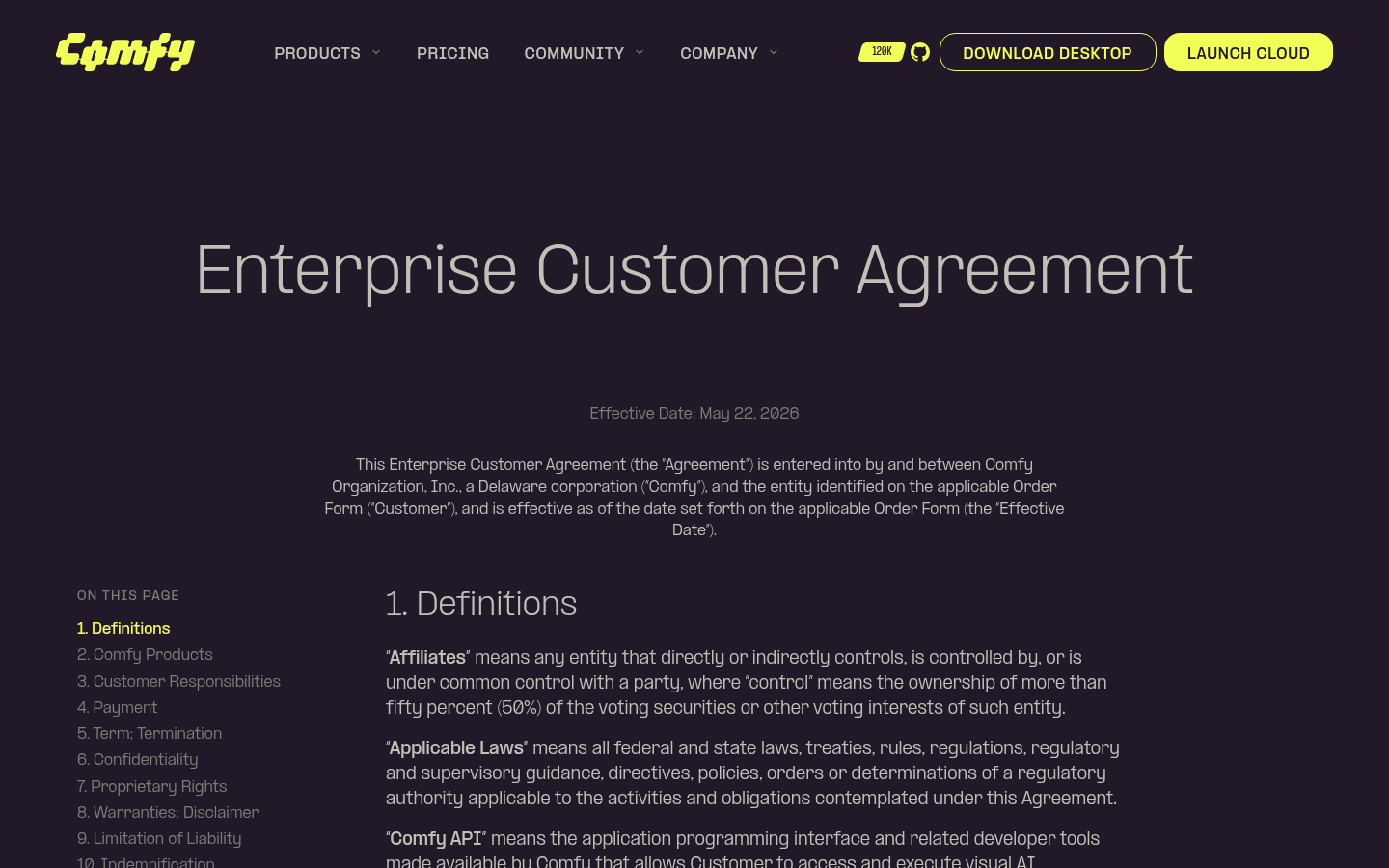
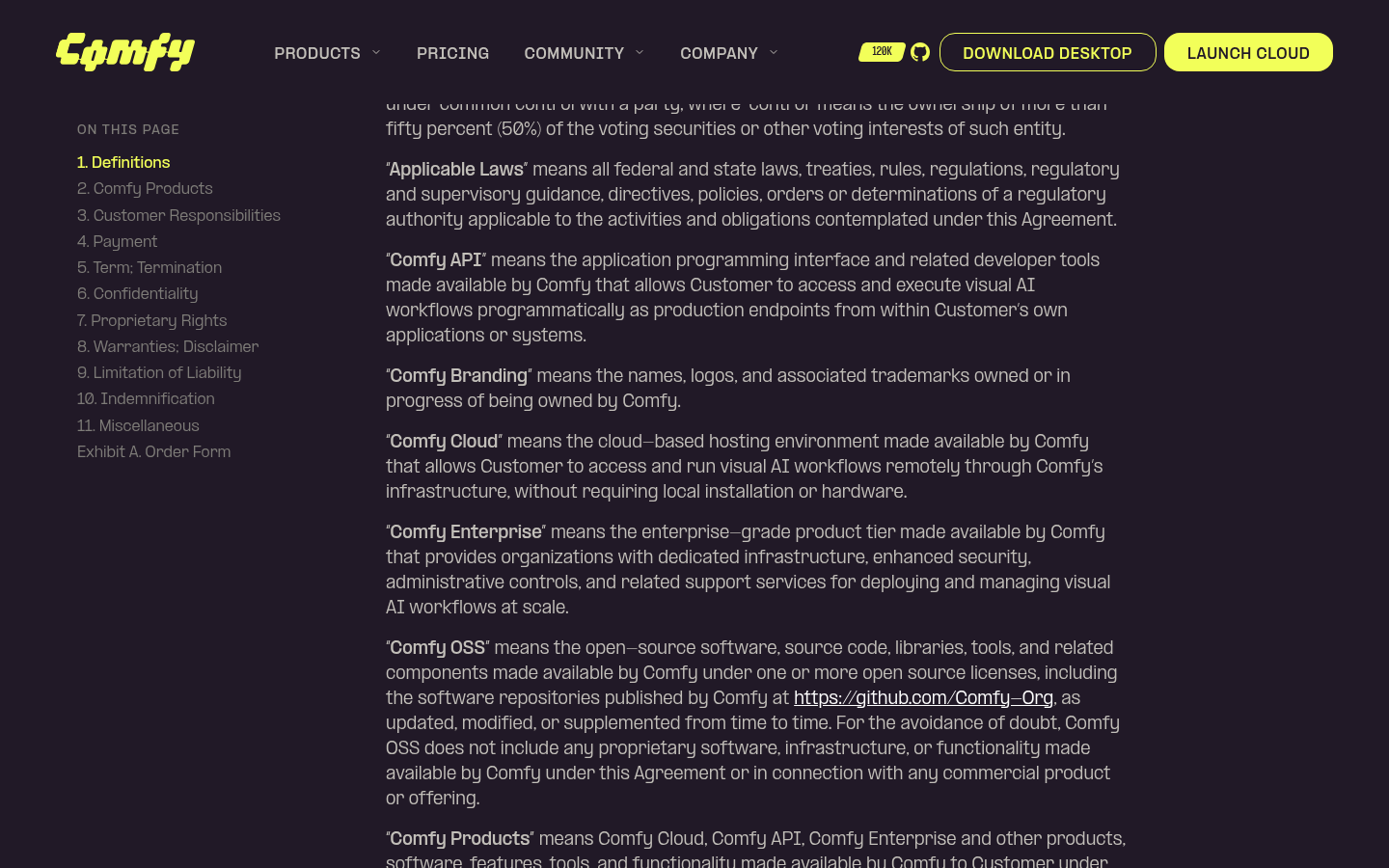
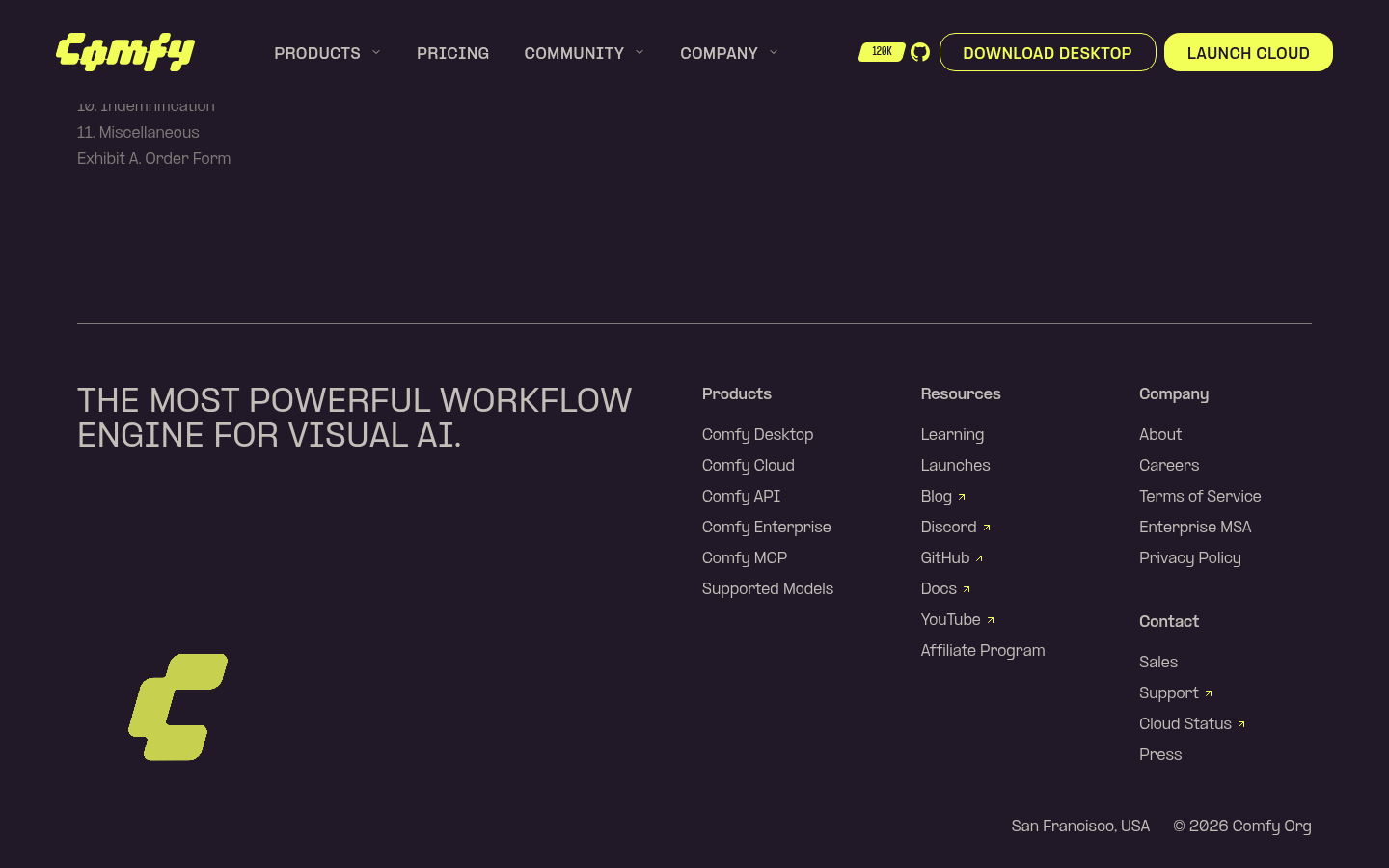
---------
Co-authored-by: Glary-Bot <glary-bot@users.noreply.github.com>
Co-authored-by: Michael B <michael@imick.io>
Add an optional highlight variant to plan features, rendered with a
BookOpen icon and yellow text. In education mode, edu-priced plans lead
with a "Educational savings – 10% off" row via a new pure planFeatures()
helper (unit-tested). status stays inclusion-only so sr-only labels are
unaffected.
Co-Authored-By: Claude Opus 4.8 (1M context) <noreply@anthropic.com>
- HeroBackdrop01: stack backdrop above content on mobile via
responsive absolute/relative; add optional mobileBackdrop asset
- edu HeroSection: use edu_hero-mobile.mp4 on mobile
- pricing toggle: shrink font/min-width on small screens to stop
overflow; add --text-2xs token
- edu pricing: "Monthly (Up to 15% off)" toggle label and edu
subtitle copy
Co-Authored-By: Claude Opus 4.8 (1M context) <noreply@anthropic.com>
## Summary
Adds a **sitewide announcement banner** to the website, rendered above
the navbar on every page. It has a two-layer visibility model:
- **Build-time gate** — a pure, unit-tested `evaluateBannerVisibility()`
decides whether the banner mounts at all (active flag + optional date
window + locale/section targeting), driven by a typed config
(`src/config/banner.ts`). No CMS; copy resolves through i18n.
- **Client-side dismissal** — persisted in `localStorage`, keyed by a
**content hash** so editing the copy re-shows the banner (per-locale, so
an en edit doesn't re-show it for zh-CN).
Current content points the CTA at **Comfy MCP** (`/mcp`).
## Highlights
- **Full-width branded bar** above a now-`sticky` navbar; reuses the
design system (`Button`, gradient tokens, new reusable `IconButton`).
- **Flash-free** on load: an inline pre-hydration script hides an
already-dismissed banner before paint (no pop-in, no layout shift);
`close()` sets the same signal after the leave animation to stay
flash-free across ClientRouter navigations.
- **Open/close transition**: grid-rows height collapse + fade,
respecting `prefers-reduced-motion`.
- **i18n**: copy in `en` + `zh-CN`.
## Where to edit later
- **Copy**: `apps/website/src/i18n/translations.ts` →
`launches.banner.text` / `launches.banner.cta`
- **Link / on-off / dates / targeting**:
`apps/website/src/config/banner.ts` (`bannerConfig`)
## Notes
- On a static site the `startsAt`/`endsAt` window is evaluated at
**build time** (documented in `banner.ts`).
- Changing the copy or link changes the content hash, so
previously-dismissed visitors will see the banner again — by design.
## Test plan
- `pnpm test:unit` — evaluator + version-hash unit tests pass.
- `pnpm typecheck` + lint clean.
- On the preview: banner shows on `/`, `/launches`, and a `zh-CN` page;
CTA -> `/mcp`; dismiss animates and stays dismissed on reload (no
flash); reduced-motion disables the animation.
🤖 Generated with [Claude Code](https://claude.com/claude-code)
---------
Co-authored-by: Claude Opus 4.8 (1M context) <noreply@anthropic.com>
## Problem
Filtering PostHog for the three product surfaces — **desktop local**,
**desktop cloud**, **web cloud** — currently requires a different hack
per pipe. For this repo's cloud build, the desktop-embedded frontend and
a plain browser are indistinguishable except by sniffing `Electron` in
`$raw_user_agent` (~124K desktop-cloud vs ~844K web-cloud execution
events/week get separated that way today).
## Change
Register the two standardized platform axes as PostHog super properties
at SDK init in `PostHogTelemetryProvider`:
- **`client`** — which surface emitted the event: `'desktop'` when the
desktop preload bridge (`window.__comfyDesktop2`) is present, else
`'web'`. The bridge is injected by Electron before any page script runs,
so detection is deterministic — unlike the existing utm-based
`source_app` attribution, which only covers sessions that *entered* via
a desktop link.
- **`deployment`** — which backend runs the work: pinned to `'cloud'`.
The register happens before the pre-init event queue flushes, so events
captured during the posthog-js dynamic-import window carry the axes too.
## Why pinning `deployment: 'cloud'` is safe (including
embedded-in-desktop)
The cloud bundle also runs **embedded in Comfy Desktop** — a cloud
install loads this same bundle in Electron, where `isCloud` and the host
bridge are both true. Two things happen there:
1. `main.ts` runs `initHostTelemetry()` *after* `initTelemetry()`, and
(when remote config `enable_telemetry` is on) it **replaces** the
registry with `HostTelemetrySink` — so tracked events
(`execution_start`, …) route through the desktop main process, bypassing
this provider. Those are tagged the same `client`/`deployment` values
main-side from the install's source category
([Comfy-Desktop#1229](https://github.com/Comfy-Org/Comfy-Desktop/pull/1229)).
2. posthog-js keeps capturing independently of the registry (pageviews,
web vitals, identify) — those are what these super properties cover in
the embedded case, and `deployment: 'cloud'` is correct for them because
the cloud bundle always talks to the cloud backend regardless of
embedding; the embedding itself is what `client: 'desktop'` captures.
The only way a cloud build runs against a non-cloud backend is a dev
setup, where `window.__CONFIG__.posthog_project_token` is absent
(injected by the cloud server) and the provider disables itself before
registering anything.
The locally-served frontend (desktop/localhost builds) never runs this
provider: `__DISTRIBUTION__` is a compile-time define, so the
`initTelemetry()` call folds away, with a runtime `IS_CLOUD_BUILD` guard
as backstop.
With both PRs, the three platforms become clean property filters:
| Surface | Filter |
|---|---|
| Desktop local | `client=desktop, deployment=local` |
| Desktop cloud | `client=desktop, deployment=cloud` |
| Web cloud | `client=web, deployment=cloud` |
## Testing
- `vitest run` on `PostHogTelemetryProvider.test.ts` — 45 passing,
including new coverage: web default, bridge-present → `client=desktop`,
and register-before-queue-flush ordering. The two desktop-entry tests
that asserted `register` is never called were narrowed to assert no
`source_app` register call.
- `pnpm typecheck` + eslint/oxlint on touched files — clean.
Ref
[MAR-51](https://linear.app/comfyorg/issue/MAR-51/foundation-desktop-sdk-dual-send-to-posthog-alongside-mixpanel)
---------
Co-authored-by: AustinMroz <austin@comfy.org>
## Summary
Fix the website-e2e job, red on main since 2026-07-07 15:19 UTC, by
updating the cloud model-card count test and regenerating stale visual
screenshot goldens.
## Context
website-e2e runs Playwright tests against the marketing site
(`apps/website`). It broke on main in two independent ways, so every PR
since — however unrelated — has shown a red website-e2e check:
1. **Model-card count.** #13431 added a sixth model card (GPT Image 2)
to the /cloud "AI models" section but didn't update the test that pins
the card count at 5. CI: `locator resolved to 6 elements`.
2. **Stale screenshot goldens.** #13431 also swapped the ProductCard CTA
to the shared `Button` (`whitespace-nowrap`, so e.g. "SEE ENTERPRISE
FEATURES" renders on one line instead of wrapping) and committed
matching `home-product-cards-*` goldens. Minutes later #13445 — a branch
cut from main *before* #13431 — ran the screenshot-regen workflow, which
checks out the raw PR branch, not the branch merged with main. Its
regenerated lg/xl goldens therefore depict the **old** pre-#13431 card
(wrapped label; pixel-identical layout to the pre-#13431 golden), and
overwrote #13431's correct ones at merge. #13445's own website-e2e was
red at merge time for exactly this reason. The sm/md goldens (last
captured by #13431, without #13445's `ppformula-text-center`
0.19em→0.1em nudge) went stale by ~900 px the moment #13445 landed.
## Changes
- **What**: `cloud.spec.ts` — model-card count assertion and test title
5 → 6 (verified against the 6 entries in `AIModelsSection.vue`; passes
locally).
- **What**: `ProductCard.vue` — `h-auto whitespace-normal` on the CTA
`Button`. The shared Button's `whitespace-nowrap` made long labels ("SEE
ENTERPRISE FEATURES") overflow past the card edge at lg/xl (live on prod
since #13431); labels now wrap inside the card as they did before
#13431.
- **What**: regenerated `home-product-cards-*` goldens via the `Update
Website Screenshots` workflow, run on this branch, so they capture the
fixed rendering rather than enshrining the overflow.
## Review Focus
- At lg, "SEE DESKTOP/CLOUD FEATURES" now also wrap to two lines: #13431
raised the CTA font from `text-xs` to `md:text-sm`, so those labels no
longer fit one line in the 200px content box either (pre-fix they
silently consumed the card padding). If design prefers one-liners,
shrinking the CTA font is a follow-up.
- Process gaps this incident exposed (follow-ups, not in this PR): the
regen workflow captures against the raw branch instead of the
main-merged result, and website-e2e was red on #13445 at merge without
blocking it.
---
*Six cards where five once stood,*
*a button's text sat where it should —*
*but pixels pinned in amber lied,*
*so Linux looked, and rectified.*
---------
Co-authored-by: github-actions <github-actions@github.com>
## Summary
- Shadow-mode Turnstile never blocked the signup Submit button on the
async Cloudflare challenge resolving, so most real submits raced ahead
of the widget and reached the backend with an empty token. This defeated
the point of shadow mode, which needs real tokens to measure the
false-positive rate before flipping to enforce.
- Submit is now blocked while the widget is enabled (shadow or enforce)
and has no token yet, in both modes.
- To keep a broken or slow Cloudflare load (network issue, ad-blocker,
CDN outage) from permanently blocking a legitimate signup,
`TurnstileWidget` now reports itself "unavailable" on a script-load
failure, a challenge error, or a 9s load timeout, and the form treats
that the same as shadow previously did: proceed without a token.
## Test plan
- [x] `vitest run` on `TurnstileWidget.test.ts` + `SignUpForm.test.ts`
(unit tests updated/added, all passing)
- [x] `pnpm typecheck` / eslint / oxlint / stylelint / oxfmt via
pre-commit hooks
- [ ] Manual click-through on staging to confirm no perceptible UX
regression during normal-latency challenge solves
- [ ] Confirm the 9s fallback timeout against real p95 Turnstile
challenge-solve latency
🤖 Generated with [Claude Code](https://claude.com/claude-code)
Clicking empty space in a workspace panel focuses the whole PrimeVue
SplitterPanel (tabindex=-1 makes it click-focusable), and any following
non-chord keypress (e.g. Shift) trips the browser focus-visible
heuristic, painting the default blue ring around the entire panel.
The wrappers are not Tab-reachable (Tab lands on the controls inside,
never the panel box) and nothing focuses them programmatically, so the
ring conveys nothing. `focus-visible:outline-hidden` suppresses it while
keeping a forced-colors (High Contrast) indicator. Confirmed as noise
with design (Alex Tov).
Covers every click-focusable panel in
`LiteGraphCanvasSplitterOverlay.vue`: the sidebar panel (both
locations), the properties-side panel (both branches), and the bottom
panel. The center and graph-canvas panels are left untouched - they
inherit `pointer-events-none`, so a click can never focus them.
## Repro / QA
Ring trigger: click an empty, non-interactive spot inside the panel,
then press solo Shift. On main the browser paints a blue ring around the
whole panel; on this PR nothing appears. (Ctrl+Shift only triggers when
Shift lands first, hence the original "sometimes".)
| Panel | How to open | Fixed |
| --- | --- | --- |
| Sidebar (left, default) | Any rail icon, e.g. Assets | yes |
| Sidebar (right) | Settings > Sidebar Location > right | yes |
| Properties-side panel | Toggle properties panel / builder mode | yes |
| Bottom panel | Toggle Logs/Terminal | yes |
| Canvas / center | n/a | untouched - pointer-events-none, cannot be
click-focused |
- [ ] Each fixed panel: click empty spot, press Shift, no ring
- [ ] Same steps on main/prod show the ring (before-state)
- [ ] Tab still reaches controls inside each panel and their own focus
rings still show
- [ ] Media Assets shortcuts unchanged (Ctrl/Cmd+A, marquee modifiers) -
PR is CSS-only
- Surfaced during design review of #13323
## Automated Ingest API Type Update
This PR updates the Ingest API TypeScript types and Zod schemas from the
latest cloud OpenAPI specification.
- Cloud commit: 421de6d
- Generated using @hey-api/openapi-ts with Zod plugin
These types cover cloud-only endpoints (workspaces, billing, secrets,
assets, tasks, etc.).
Overlapping endpoints shared with the local ComfyUI Python backend are
excluded.
---------
Co-authored-by: mattmillerai <7741082+mattmillerai@users.noreply.github.com>
Co-authored-by: Benjamin Lu <benjaminlu1107@gmail.com>
Co-authored-by: GitHub Action <action@github.com>
## Summary
Type-aware oxlint rejects `packages/ingest-types/tsconfig.json` and
`packages/object-info-parser/tsconfig.json` as invalid (TS6059): their
`include` lists a root-level config file (`openapi-ts.config.ts` /
`vitest.config.ts`) that sits outside `rootDir: "src"`. This fails the
lint-and-format job with "Invalid tsconfig" on any PR that touches those
packages' src files — currently blocking every auto-generated
ingest-types sync (e.g. #12777).
## Changes
- **What**: Drop the out-of-`rootDir` config-file entries from the two
package tsconfig `include` arrays, matching the other workspace
packages. Repro: `pnpm exec oxlint --type-aware
packages/ingest-types/src/index.ts` fails before, passes after; the
config files themselves still lint clean.
## Review Focus
Neither package emits a build, so `rootDir`/`outDir` are
editor/lint-only; excluding the config files from the project has no
runtime effect (vitest/openapi-ts load their configs directly).
Automatic SHA bump — `cursor-review.yml` was updated in
`Comfy-Org/github-workflows` at
[`df507e6`](df507e6bae).
_Opened by the `bump-cursor-review-callers` workflow._
Co-authored-by: cloud-code-bot[bot] <234529496+cloud-code-bot[bot]@users.noreply.github.com>
- Fix dead #plans anchor: pass id="plans" to PricingSection on /edu and
assert the target is attached in the e2e test
- Respect prefers-reduced-motion: gate autoplay on the HeroBackdrop01 and
StepsSplit01 backdrop videos, and add a poster to the edu hero video
- Fix Slider active-tick detection: map value to nearest tick index instead
of floating-point === (default team tier now highlights correctly)
- ScrollCarousel: type="button" on nav controls, aria-hidden on the
decorative progress bar, and i18n keys for the prev/next aria-labels
- PricingSection: derive per-plan display values via a planCards computed,
removing the duplicate displayPriceKey call and the non-null assertion
Co-Authored-By: Claude Opus 4.8 (1M context) <noreply@anthropic.com>
## Problem
`pr-backport.yaml` opens each backport PR (labelled `backport`) and
calls `gh pr merge --auto --squash`. GitHub's `--auto` only takes effect
when the repository's **"Allow auto-merge"** setting is enabled — it's
currently off, so that call is a silent no-op (swallowed by its `|| echo
"::warning::…"`). The result: every backport PR sits unmerged until
someone manually clicks merge, even when it's already approved with
green checks.
## What this does
Adds `.github/workflows/backport-auto-merge.yaml`, which completes the
merge directly — a plain `gh pr merge --squash` (which does **not**
depend on the "Allow auto-merge" setting) — once GitHub reports the PR
ready to merge.
Ready = `reviewDecision == APPROVED` **and** `mergeStateStatus` is
`CLEAN` or `UNSTABLE`. `UNSTABLE` means the required checks passed but a
*non-required* check is still pending/failing — GitHub still permits
that merge, and gating on `CLEAN` alone would leave backports stuck
behind slow/flaky non-required checks (Socket, codecov, perf, storybook,
etc.).
**Branch protection stays the real gate.** The `core/**` / `cloud/**`
ruleset unconditionally requires an approval + the required checks and
can't be bypassed, and GitHub's merge API re-enforces it at merge time —
so this workflow can only ever finish a merge that already satisfies
those rules. The eligibility check just avoids pointless attempts.
## Design notes
- **Merges with `PR_GH_TOKEN`, not the default token**, on purpose: a
merge by the default `GITHUB_TOKEN` does not emit the `pull_request:
closed` event, which would silently starve `cloud-backport-tag.yaml` (it
creates the `cloud/vX.Y.Z` tag on that event).
- **Triggers:** review submission + check-suite completion (low
latency), plus a 30-min sweep as a backstop for cases the events miss.
- **Never checks out PR code** (no untrusted-code path); only reads PR
metadata via the API. `permissions` on the default token are read-only.
- **Idempotent, bounded merge loop:** treats an already-merged PR (e.g.
a concurrent run or a human) as success, so it won't post a false
failure comment.
- Leaves the existing conflict path in `pr-backport.yaml` untouched
(conflicts never create a PR, so there's nothing here to act on).
## Validation
YAML parses; `actionlint` (with shellcheck) and `zizmor` both clean (0
findings).
## Before relying on it
- Confirm the org allows this workflow to run/merge (Actions policy) —
the merge uses a PAT so it shouldn't depend on the "Actions can approve
PRs" toggle, but worth verifying.
- First real backport: confirm it merges on ready and that
`cloud-backport-tag.yaml` then fires and creates the tag.
Keep the thin-band padding only on desktop (lg:py-3) so the stacked
mobile layout uses the normal card padding, switch inline-flex to flex
so it fills the card width, and constrain it to max-w-lg (matching the
pricing grid) so it aligns with the Creative Campus card above.
Co-Authored-By: Claude Opus 4.8 (1M context) <noreply@anthropic.com>
Extract the carousel shell from FeedbackSection into a reusable
ui/ScrollCarousel and the story card from StorySection into StoryCard,
then compose both in a CustomerStories01 block + education template.
The /edu pages load the Creative Campus stories (selected by slug so the
set is stable across locales) and render the section only when stories
exist.
Co-Authored-By: Claude Opus 4.8 (1M context) <noreply@anthropic.com>
## Summary
Vertically center button/badge/nav labels by tuning the shared
`ppformula-text-center` utility from `top: 0.19em` to `top: 0.1em`.
## The alignment issue
PP Formula (our brand font) has asymmetric vertical metrics: its caps
sit high in the line box, so a naively centered label looks too high.
`ppformula-text-center` compensates by nudging the label down with
`position: relative; top: <em>` (a purely visual shift, it does not
change the element's box, so button/badge sizes are unaffected).
The value was `0.19em`, which **over-corrected**: the glyph ink ended up
~1.4px **below** center on every button, so labels read slightly low.
Measuring the actual glyph ink (canvas `measureText`
`actualBoundingBox*`) showed ~**0.09-0.10em** centers uppercase labels;
`0.1em` lands the ink within ~0.1px of center.
## Why it's safe (verified)
This utility is used site-wide (Button, Badge, ButtonPill, ButtonMask,
BrandButton, nav triggers, section labels). Because it's a
`position:relative` nudge, there is **no layout/box-size change**
anywhere. I measured glyph-ink centering across **12 pages** (home,
cloud, cloud/pricing, download, careers, customers, demos, enterprise,
api, mcp, gallery, learning):
- Buttons/badges/pills went from ~1.37px low to **~0.11px** (centered).
- **Nothing regressed** (no element pushed too high).
- The handful of numeric "outliers" were `text-transform: uppercase`
measurement artifacts (source text with descenders that don't render);
confirmed visually as centered.
## Changes
- **What**: `apps/website/src/styles/global.css` —
`ppformula-text-center` `top: 0.19em` → `0.1em` (one line).
---------
Co-authored-by: github-actions <github-actions@github.com>
## Summary
Add GPT Image 2 to the `/cloud` "AI models" section, and apply the
design review polish from Bert and June on the same section and the
neighbouring cloud-page cards.
## Changes
- **GPT Image 2 card**: 6th card in `AIModelsSection` (workflow video on
`media.comfy.org`, OpenAI badge reused from `packages/design-system`),
new `cloud.aiModels.card.gptImage2` i18n key (en + zh-CN), and GPT Image
2 added to the `cloud.reason.2.description` partner-model list.
- **AI models layout**: the six cards are now equal 1:1 squares in one
shared grey container (was a per-card treatment, then simplified to a
single container per design), with a corner arrow affordance on each.
- **Audience cards** (`AudienceSection`): the creators / teams cards now
link to `cloud.comfy.org` with the same corner arrow (highlights on card
hover).
- **Reusable `CardArrow`**: extracted the corner arrow into a shared,
decorative (`aria-hidden`) component used by both sections;
`hover="group"` (card hover) for audience, self-hover for the model
cards so it doesn't double up with the provider badge.
- **`ProductCard` CTA**: swapped the hand-rolled pill `<span>` for the
shared `Button` (`as="span"`) so the label is vertically centered (fixes
Bert's off-centre text) without nesting an anchor inside the card link.
## Split out of this PR
- **Button label centering** (the global `ppformula-text-center` tweak)
→ separate PR #13445, so the site-wide change is reviewed in isolation.
- **Pricing banner frame fix** reverted here; it belongs in Michael's
upcoming pricing PR (team tier, edu billing, FAQ). `PricingSection.vue`
shows only an automatic Tailwind class-order reformat from the
pre-commit hook, no behaviour change.
## Review focus
- The single-container AI models layout and the `CardArrow` hover
behaviour (group vs self).
- `Button as="span"` inside the `ProductCard` link (avoids nested
`<a>`).
Linear: FE-423
---------
Co-authored-by: github-actions <github-actions@github.com>
## Summary
Standardize the marketing-site favicons to the square, full-bleed brand
mark (ink background, yellow C) so each platform applies its own corner
mask instead of double-rounding a pre-rounded asset.
## Changes
- **What**: Replace three files in `apps/website/public/`:
- `favicon.svg` — was a 57 KB RealFaviconGenerator wrapper around an
embedded PNG; now a 1.2 KB vector of the square mark.
- `favicon-96x96.png` and `apple-touch-icon.png` — regenerated square.
The apple-touch icon previously had transparent rounded corners, which
iOS composites onto a white tile; it is now full-bleed.
- `favicon.ico` and the `web-app-manifest-*.png` files were already the
square mark, so they are left unchanged.
## Review Focus
- Favicons cache aggressively (browser + CDN, and these paths are marked
`immutable` in `vercel.json`), so verify the preview with a hard refresh
or a fresh profile.
- Part of the org-wide favicon standardization (FE-705). Companion PRs
update the workflows hub, docs, and registry favicons to the same mark.
Design direction (square, not rounded) confirmed by Bert.
## Screenshots
The before/after for each binary is visible inline in the Files changed
tab. Square ink + yellow C, no transparency, sharp corners.
Stop passing the education savings label to the standard, creator, and
pro cards; PricingPrice now renders the discount only when discount text
is provided (dropping the showDiscount prop and layout placeholder). Also
swap the Student Ambassador CTA to the design-system Button and apply
minor pricing band/label styling tweaks.
Co-Authored-By: Claude Opus 4.8 (1M context) <noreply@anthropic.com>
## What
- `installPreservedQueryTracker` definitions accept an opt-in
`stripAfterCapture` flag: the marked keys are captured into the
sessionStorage stash and removed from the URL before the navigation
completes (single guard redirect at the decoded query-object level;
push/replace semantics are inherited from the original navigation, and
vue-router force-replaces the initial one).
- `preservedQueryManager` now captures the first non-empty string
element of repeated (array-valued) params instead of silently dropping
them.
- New real-router test suite for the tracker (createRouter +
createMemoryHistory, no router mocks), including a history-depth test
pinning the push/replace inheritance; manager tests extended for the
array/junk-value cases.
## Why
One-time secrets in query params (first consumer: desktop login codes,
GTM-93) must not linger in the visible URL, browser history,
`previousFullPath` redirects, or telemetry. Stripping after navigation —
what each loader does ad hoc today — leaves a window and forces
per-feature URL scrubbing; #13418 originally needed a hand-rolled
encoding-aware string parser in three places. Stripping at capture time,
at the decoded query-object level, makes the stash the only carrier and
lets vue-router round-trip the surviving params' encoding itself.
Capability only — no existing namespace opts in; behavior is unchanged
for all current definitions. `stripAfterCapture`'s contract is
documented on the option: strip-marked keys must never be read from
`route.query` by later guards or views; the stash is the only
post-capture source.
## Landing order
Independent of everything else; #13418 stacks on this branch.
## Summary
Small cleanup in `useSlotLinkInteraction.ts`, no behavior change:
- Removed a duplicated `raf.flush()` in `finishInteraction` (it was
called twice back-to-back).
- Collapsed four single-line `attempt*` alias closures in
`connectByPriority` into a direct short-circuit chain, preserving the
same evaluation order:
```ts
return (
tryConnectToCandidate(snappedCandidate) ||
tryConnectToCandidate(domSlotCandidate) ||
tryConnectToCandidate(nodeSurfaceSlotCandidate) ||
tryConnectViaRerouteAtPointer()
)
```
The closures added no behavior beyond renaming the calls (AGENTS.md rule
26), and `||` gives the same first-truthy-wins semantics as the previous
`if (attempt()) return true` ladder.
Verification not rerun after rebasing onto `Comfy-Org/main`; original
branch reported `pnpm typecheck`, `pnpm lint`, `pnpm format:check`,
`pnpm knip`, and the existing `useSlotLinkInteraction` unit tests
passing.
Link to Devin session:
https://app.devin.ai/sessions/1351ff5174494106a7a688777554f387
Requested by: @benceruleanlu
Co-authored-by: Devin AI <158243242+devin-ai-integration[bot]@users.noreply.github.com>
## Summary
Update CLA workflow to build a dynamic `allowlist` that includes
everyone except the author of the PR. This relaxes the CLA signature
requirement so that it is limited to the PR author only. By signing, the
author confirms he gots approval from other contributors.
## Changes
- **What**: `cla.yml`
## Screenshots (if applicable)
<img width="1831" height="756"
alt="{B6F6C23D-EC2E-4BB3-A288-99B6087F4CAC}"
src="https://github.com/user-attachments/assets/62c04465-d1a3-4ddb-bfe7-950a29a802c4"
/>
## Summary
Adds the five Creative Campus (education) customer stories into the
education launch bundle (`feat/edu-page`), so pricing, the customer
stories, and the education page can go live together.
These stories were originally merged to `main` in #13370, then reverted
(#13407) because they went public before the education page was ready.
This re-lands the exact same reviewed work on top of the bundle branch
instead of `main`. Base is `feat/edu-page`, not `main`.
## Changes
- **What**: The 5 English MDX stories (Xindi Zhang, Ina Conradi, Golan
Levin, Kathy Smith, UAL CCI) plus the reusable article blocks they use
(`Embed`, `Video`, `Download`, `AuthorBio`, `EducationCta`, `AtAGlance`,
`Link`, `Heading4`), the `CustomerArticle` element map, the
`bg-site-bg-soft` theme utility, the article `max-w-9xl` cap, and the
customer content/e2e tests. Identical to the reverted #13370.
- **Breaking**: none. Existing stories and pages are untouched.
- **Dependencies**: none.
## Review Focus
- This is a clean cherry-pick of the squashed #13370; it applies with
zero conflicts on the current bundle.
- All prior review feedback (CodeRabbit + Michael + design) was already
addressed in #13370 before it was merged and reverted, so this content
is final.
## Verification
- Cherry-pick: zero conflicts. Build: 504 pages. Unit: 176/176.
Typecheck: 0 errors. format:check and knip clean.
- Nav featured card and both `/customers` locales verified in-browser
previously; unchanged here.
## Notes
- JSON-LD structured data for these pages will follow as a separate PR
onto this same bundle (superseding the on-hold #13404).
## Screenshots
**/customers listing**
_Desktop:_
_Mobile:_
**Story detail (example: Xindi Zhang)**
_Desktop:_
_Mobile:_
Preview: https://comfy-website-preview-pr-13409.vercel.app/customers
Render a new full-width Student Ambassador band inside PricingSection in
education mode only, below the Creative Campus band. It shows a clock +
"Coming Soon" tag, a "Student Ambassador" label, a short description, and
an active "Register Interest" text-link that opens the external interest
form in a new tab. The band does not appear on /cloud/pricing.
Add externalLinks.studentAmbassadorForm, band copy keys (en + drafted
zh-CN), and extend education.spec.ts to assert the band and its CTA;
pricing.spec.ts guards the band's absence on /cloud/pricing.
Also harden the two billing-toggle e2e tests with a hydration-safe
switchToMonthly helper: the pricing island is client:visible, so a
toggle click could land before hydration and intermittently fail. The
helper retries the click (deselection-safe) until the target price shows.
Co-Authored-By: Claude Opus 4.8 (1M context) <noreply@anthropic.com>
In education mode, PricingEnterpriseBand renders a "Creative Campus"
partnership label and description instead of the "Enterprise" copy. The
component, layout, Contact Us CTA, and /contact destination are shared
across both modes; only the label/description keys swap on the education
prop. /cloud/pricing stays "Enterprise".
Add pricing.creativeCampus.label and .description (en + drafted zh-CN),
thread the education prop from PricingSection, extend education.spec.ts
to assert the Creative Campus copy and Contact Us -> /contact CTA, and
guard in pricing.spec.ts that /cloud/pricing shows no Creative Campus.
Co-Authored-By: Claude Opus 4.8 (1M context) <noreply@anthropic.com>
Extend education mode to the Team plan card on /edu. When education is
set, the team card headline shows the tier's education price with the
monthly basePrice struck through, plus an inline
"Educational saving ~{pct}% ({amount})" label (singular form, distinct
from the individual cards' "– {pct}% off"). The price and label react to
both the credit-tier slider and the billing toggle.
Add eduMonthlyPrice/eduYearlyPrice to every TeamCreditTier (monthly
$190/$370/$630/$1,225/$2,125; yearly $190/$360/$595/$1,120/$1,875) and a
pricing.team.educationalSaving key (en + drafted zh-CN). The saving
percentage/amount reuse the existing one-decimal team-saving math.
Extend education.spec.ts to assert the team education price,
strikethrough, and inline saving label, including a slider tier change
and a billing-period change. /cloud/pricing stays in standard mode.
Co-Authored-By: Claude Opus 4.8 (1M context) <noreply@anthropic.com>
Introduce an `education` prop on the shared PricingSection and render
education prices on the individual plan cards (Standard/Creator/Pro) on
/edu only. Cards show the education headline price with the monthly list
price struck through, an "Educational savings – {pct}% off" label that
flips 10% (monthly) to 25% (yearly) with the billing toggle, and a
"Yearly (Up to 25% off)" toggle label. /cloud/pricing passes nothing and
is unchanged.
Education prices are stored as explicit i18n keys (en + drafted zh-CN):
Standard $18/$15, Creator $31.50/$26.25, Pro $90/$75.
Extend education.spec.ts to assert the education prices, strikethrough,
savings labels, and 25%-off toggle; add a regression guard to
pricing.spec.ts proving /cloud/pricing stays in standard mode.
Co-Authored-By: Claude Opus 4.8 (1M context) <noreply@anthropic.com>
## Summary
Replaces the Additional credits tooltip trigger with the shared Button
component so the icon renders with the neutral muted treatment used by
the rest of the UI.
## Changes
- **What**: Uses the shared Button component for the Additional credits
info action while preserving the existing tooltip and aria label.
- **Dependencies**: None.
## Review Focus
Confirm this remains a visual-only change scoped to the Plan & Credits
credits tile.
## Screenshots (if applicable)
Before
<img width="397" height="368" alt="스크린샷 2026-07-06 오후 11 30 38"
src="https://github.com/user-attachments/assets/9cda1aee-4dc2-4ce1-b001-29d0e09fc07d"
/>
After
<img width="374" height="355" alt="스크린샷 2026-07-06 오후 11 31 00"
src="https://github.com/user-attachments/assets/64d0b726-6031-42d4-84d7-35405150698c"
/>
## Testing
- `pnpm format`
- `pnpm lint`
- pre-commit hook: stylelint, oxfmt, oxlint, eslint, typecheck
- `pnpm test:unit
src/platform/cloud/subscription/components/CreditsTile.test.ts`
## Summary
Surface the supported-models catalog (`/p/supported-models`) from the
home page by adding a "Supported Models" link to the Products dropdown
and the footer.
## Changes
- **What**: Add a `nav.supportedModels` i18n entry (en `Supported
Models`, zh-CN `支持的模型`) and link it to the existing `routes.models`
constant in two places: the Products mega-menu Features column (between
Launches and Docs) and the footer Products column (after Comfy MCP).
Locale handling comes from `getRoutes`, so zh-CN resolves to
`/zh-CN/p/supported-models` automatically.
## Review Focus
- Placement is intentionally in **both** the nav and the footer (per
FE-1190). Fine to drop either, happy to adjust after review.
- Reuses the existing nav/footer link pattern, no new components or
styles, and no `new` badge (the page is not newly launched).
- Consumes `routes.models`, which was already defined but previously
unused.
FE-1190
## Screenshots
**Nav — Products dropdown, Features column**
_Desktop:_
_Mobile:_
**Footer — Products column**
_Desktop:_
_Mobile:_
Preview: https://comfy-website-preview-pr-13432.vercel.app
Remove `embed=true`, so PostHog applies the survey's own dark appearance
and it renders correctly.
Verified live on testcloud that removing the flag fixes the styling;
`distinct_id` user linkage is unaffected.
- Adds support for forcing an icon to display as a mask or image with
`icon-mask` and `icon-image`.
- Updated the logic so that svg of a solid color (like the claude logo)
display as an image by default
- Update many svg to consistently use `currentColor` so that they still
function as masks by default
## Summary
Follow-up draft PR for the CodeRabbit issues created from the #12999
review. This keeps the original stabilization PR merged as-is and moves
the non-functional TemplateHelper cleanup into its own small branch.
## Changes
- Extracted TemplateHelper route patterns into named module-scope
constants.
- Normalized the TemplateHelper route patterns to anchored regexes with
optional query-string handling.
- Extracted `mockCustomTemplates()` from `mockIndex()` and made `mock()`
register custom templates, core index, and thumbnails together.
- Added a private `registerRoute()` helper so every mocked route is
registered for teardown consistently.
- Simplified the fixed empty custom-template response to `body: '{}'`.
- Updated the cloud template filtering spec to use `templateApi.mock()`
instead of manually combining thumbnail and index mocks.
## Issues
- Closes#13014
- Closes#13016
- Closes#13017
- Closes#13018
- Related #13015: this PR normalizes the TemplateHelper route patterns
only. The broader fixture-wide route pattern convention cleanup remains
intentionally separate.
## Validation
- `pnpm exec oxfmt --check
browser_tests/fixtures/helpers/TemplateHelper.ts
browser_tests/tests/templateFilteringCount.spec.ts`
- `pnpm exec eslint browser_tests/fixtures/helpers/TemplateHelper.ts
browser_tests/tests/templateFilteringCount.spec.ts`
- `pnpm typecheck:browser`
- Pre-commit hook also ran `oxfmt`, `oxlint`, `eslint`, `pnpm
typecheck`, and `pnpm typecheck:browser` successfully.
Note: I attempted the targeted cloud Playwright spec locally with
`PLAYWRIGHT_LOCAL=1 PLAYWRIGHT_TEST_URL=http://localhost:5173 pnpm exec
playwright test browser_tests/tests/templateFilteringCount.spec.ts
--project=cloud`, but the local 5173 app was not running with the cloud
distribution configuration, so the distribution-filter assertions failed
in the expected local/cloud mismatch way. This should be verified by
CI's cloud project.
## Summary
On Comfy Cloud, show the Manager button and open a hosted survey in the
manager modal (in place of the local node manager) so we can gauge
demand for custom nodes on Cloud.
## Changes
- **What**: `TopMenuSection` shows the Manager button when `isCloud`;
clicking it opens `ManagerSurveyDialog`, which embeds a PostHog hosted
survey via iframe. The survey URL comes per-environment from cloud
config (`manager_survey_url`), with the logged-in user's `distinct_id`
appended so responses link to the user. Includes loading/error states
and PostHog's `posthog:survey:height` iframe auto-resize.
- **Dependencies**: none
## Review Focus
- Survey URL is sourced from `remoteConfig.manager_survey_url` (must be
set per environment in cloud config); falls back to an error state when
unset or malformed.
- iframe embedding requires the PostHog survey to be `external_survey`
type with embedding enabled.
## Summary
Removes the Claude Code PreToolUse hooks added in #11201. Their `if`
patterns blocked any bash command the static pattern parser could not
fully resolve — loop variables, `$(...)`/backtick substitution,
heredocs, `${...}` expansions — with a misleading error naming a random
unrelated tool. Transcript analysis across a month of sessions found 37
hook firings: 1 true positive, 36 false positives (~97%), including
blocking `pnpm typecheck ... | tail` itself.
## Changes
- **What**: Delete `.claude/settings.json` (it contained only the hook
config) and the script-based replacement from earlier revisions of this
PR.
- Earlier revisions replaced the hooks with a stdin-inspecting matcher
script, but the hooks' original rationale — protecting Nx task
orchestration back when `test:unit` was `nx run test` — disappeared when
Nx was removed in #12355 and the pnpm scripts became direct tool
invocations. The remaining value (nudging agents toward pnpm scripts)
does not justify maintaining a bash-parsing matcher with its own edge
cases.
## Review Focus
- Agents can now run `npx tsc` / `npx vitest` etc. without being
redirected; the pnpm-script convention remains documented in AGENTS.md,
which is what agents follow in practice.
## Summary
Stop running the full Vitest suite twice in unit CI. The critical
coverage gate is now a glob-keyed `coverage.thresholds` entry enforced
during the single `pnpm test:coverage` run, instead of a second
`COVERAGE_CRITICAL=true vitest run --coverage` pass.
## Changes
- **What**: All critical directories form one brace-expanded glob key in
`coverage.thresholds`; Vitest aggregates the matching files into a
single bucket and checks the existing thresholds (69/60/67/70) against
it during the normal coverage run. Untested files matching
`coverage.include` are counted at 0%, preserving the previous gate's
semantics.
- **What**: Narrows the litegraph coverage exclusion from a blanket
`src/lib/litegraph/**` to the non-critical subfolders, so the critical
litegraph folders (`node`, `subgraph`, `utils`) are present in the
coverage report the thresholds read.
- **What**: Removes the `test:coverage:critical` script, the
`COVERAGE_CRITICAL` env branch in `vite.config.mts`, and the separate CI
gate step.
## Notes
- The normal coverage report now includes the critical litegraph
folders, so the Codecov `unit` flag and the coverage Slack baseline will
show a one-time shift.
- Filtered local runs (`pnpm test:coverage <file>`) fail the gate since
most critical files are uncovered; a full `pnpm test:coverage`
reproduces CI exactly.
Validation:
- `pnpm typecheck`, `pnpm exec eslint vite.config.mts`, `pnpm
format:check`, `pnpm knip` (pre-push)
- Smoke: `pnpm vitest run --coverage src/utils/colorUtil.test.ts` —
tests pass, then the gate fails all four metrics against the critical
bucket and exits 1, confirming enforcement happens inside the single run
- Full-suite gate numbers should be confirmed in CI
## Summary
Identifies Cloud auth users to Syft via the required `identify(email, {
source })` handoff so Syft enrichment reliably attaches to signup/login
users instead of relying only on GTM page-load capture.
## Changes
- **What**: Adds a cloud-only Syft telemetry provider that reads
`syftdata_source_id` from `remoteConfig`, lazy-loads the Syft SDK
(reusing an already-loaded GTM Syft client when present), and calls
`identify` with `source: 'signup'` or `source: 'login'` on auth and on
session restore. `trackUserLoggedIn()` dedupes against the email already
handled by `trackAuth()` so a fresh login is not identified twice.
- **Dependencies**: None.
## Review Focus
- Preserves the FE-945 startup-blocker fix: the constructor reads only
the `remoteConfig` ref (a plain reactive ref, not Pinia) and never
touches current-user state; the user-email lookup happens only in
`trackUserLoggedIn()`, after app/auth setup. The source id is present at
construction because `main.ts` awaits the anonymous
`refreshRemoteConfig` before `initTelemetry`, and a later authenticated
refresh is picked up reactively on the next `ensureSyftClient()` call.
- SDK loader is idempotent with the current GTM Syft tag during rollout
(one script per `SYFT_SRC`). On load failure it clears its own stub —
guarded by an identity check so it never evicts a real client another
loader installed — letting a subsequent call retry. Long-term cleanup is
to keep one loader path per surface.
- Acceptance should include staging Network verification for
`https://e2.sy-d.io/events` payloads containing an `identify` event for
Google, GitHub, and email auth.
Linear: GTM-168
## Summary
Repurpose the Products dropdown featured card to promote Comfy MCP.
## Changes
- **What**: Update the nav featured card title ("NEW: COMFY MCP"), alt
text, image asset (`mcp-card.webp`), and CTA ("GET STARTED") in
`mainNavigation.ts`; route the CTA to the localized `/mcp` page via
`routes.mcp`. All copy is i18n'd (en + zh-CN) in `translations.ts`,
adding a reusable `cta.getStarted` key.
## Review Focus
- CTA uses a new reusable `cta.getStarted` key rather than the
section-scoped `mcp.setup.label`, and routes to the internal
`routes.mcp` so non-en locales resolve to `/{locale}/mcp`.
🤖 Generated with [Claude Code](https://claude.com/claude-code)
---------
Co-authored-by: Claude Opus 4.8 (1M context) <noreply@anthropic.com>
## Summary
Add direct tests for queue job display formatting.
Base: `main`
## Changes
- Covers state icons, pending/initializing labels, running progress,
completed local/cloud output, fallback completed titles, and failed
display.
## Test Results
| | before | after |
| -- | -- | -- |
| `pnpm test:unit src/utils/queueDisplay.test.ts --run` | no direct
queue display test file | ✅ 13 passed |
## Coverage
Superseded by #13332. Historical pre-#13313 branch coverage:
`src/utils/queueDisplay.ts` 22.72% -> 79.54% (+56.82%); overall branches
52.95% -> 53.03% (+0.08%).
Codecov project coverage is intentionally omitted here because it is not
the branch-ratchet metric.
<!-- CURSOR_SUMMARY -->
---
> [!NOTE]
> **Low Risk**
> Test-only change; no runtime or production code modified.
>
> **Overview**
> Adds **`src/utils/queueDisplay.test.ts`**, a Vitest suite that
exercises **`iconForJobState`** and **`buildJobDisplay`** from
`queueDisplay.ts` without touching UI or production logic.
>
> Tests use small **`createJob` / `createTask` / `createCtx`** helpers
with a stub **`t`** and clock formatter so expectations assert i18n keys
and formatted values. Coverage includes pending “added to queue” hint,
queued/initializing labels, active vs inactive running progress,
completed local preview vs cloud duration, completed title fallback, and
failed rows with **`showClear`** behavior.
>
> <sup>Reviewed by [Cursor Bugbot](https://cursor.com/bugbot) for commit
6260c101e5. Bugbot is set up for automated
code reviews on this repo. Configure
[here](https://www.cursor.com/dashboard/bugbot).</sup>
<!-- /CURSOR_SUMMARY -->
Co-authored-by: huang47 <157390+huang47@users.noreply.github.com>
## Summary
Skip the website e2e report/deploy step for fork PRs, which lack the
deploy secrets and otherwise fail the job.
## Changes
- **What**: Guard the report/deploy step's `if:` in
`ci-website-e2e.yaml` so it runs only when the event is not a fork pull
request.
- **Breaking**: none. CI-config only.
## Review Focus
CI-config only — no test or coverage change. Confirms fork PRs no longer
fail on the deploy step.
<!-- CURSOR_SUMMARY -->
---
> [!NOTE]
> **Low Risk**
> CI workflow condition only; no application or test logic changes.
>
> **Overview**
> **Website E2E CI** no longer runs the **Deploy report to Cloudflare**
step on pull requests from forks.
>
> The step’s `if:` still requires `always()` and `!cancelled()`, and now
also requires either a non–pull-request event or a PR whose head repo is
**not** a fork. Playwright tests and artifact upload are unchanged; only
the wrangler deploy (which needs `CLOUDFLARE_*` secrets) is skipped for
fork PRs so those runs don’t fail when secrets aren’t available.
>
> <sup>Reviewed by [Cursor Bugbot](https://cursor.com/bugbot) for commit
02a4ab0769. Bugbot is set up for automated
code reviews on this repo. Configure
[here](https://www.cursor.com/dashboard/bugbot).</sup>
<!-- /CURSOR_SUMMARY -->
Co-authored-by: huang47 <157390+huang47@users.noreply.github.com>
## Summary
Skip secret-backed CI deploy and dispatch work for fork PRs so missing
repo secrets do not fail otherwise valid checks.
## Changes
- **What**: Guard Website E2E report deploy, Vercel website preview
deploy, cloud build dispatch, cloud cleanup dispatch, and Storybook
Chromatic deploy so PR paths only run for same-repo PRs.
- **Dependencies**: None
## Why
Fork `pull_request` runs do not receive repository secrets. Several CI
jobs already separated normal validation from privileged follow-up work,
but some deploy or dispatch steps could still run on fork PRs and fail
only because their secret-backed integration token was empty.
The existing Website E2E fork guard only protected the PR comment job.
It did not protect the earlier Cloudflare report deploy step inside
`website-e2e`, which uses `CLOUDFLARE_API_TOKEN` and
`CLOUDFLARE_ACCOUNT_ID`.
The same failure mode existed in these CI jobs:
- `ci-vercel-website-preview.yaml`: preview deploy uses Vercel and
website API secrets.
- `cloud-dispatch-build.yaml`: preview dispatch uses
`CLOUD_DISPATCH_TOKEN` to call `Comfy-Org/cloud`.
- `cloud-dispatch-cleanup.yaml`: preview cleanup dispatch uses
`CLOUD_DISPATCH_TOKEN`.
- `ci-tests-storybook.yaml`: Chromatic deploy uses
`CHROMATIC_PROJECT_TOKEN`.
`ci-website-build.yaml` was left unchanged. Its Ashby and Cloud nodes
integrations intentionally fall back to committed snapshots when secrets
are missing for preview/local builds, so it is not the same class of
fork-secret failure.
## Review Focus
Confirm fork PRs still run the unprivileged validation/build paths,
while same-repo PRs and non-PR events keep the existing deploy or
dispatch behavior.
## Validation PRs
Both validation PRs compare against `main`.
- Fork PR from `shihchi`:
[#13309](https://github.com/Comfy-Org/ComfyUI_frontend/pull/13309)
- Same-repo PR from `origin`:
[#13310](https://github.com/Comfy-Org/ComfyUI_frontend/pull/13310)
| Workflow | Guarded job or step | Fork #13309 | Same-repo #13310 |
| --- | --- | --- | --- |
| CI: Website E2E | `Upload test report` | success ✅ | success ✅ |
| CI: Website E2E | `Deploy report to Cloudflare` | skipped ❌ | success
✅ |
| CI: Vercel Website Preview | `deploy-preview` | skipped ❌ | success ✅
|
| Cloud Frontend Build Dispatch | `dispatch` | skipped ❌ | success ✅ |
| CI: Tests Storybook | `chromatic-deployment` | skipped ❌ | success ✅ |
Expected result: fork PRs still keep the useful validation artifact
path, but skip secret-backed deploy and dispatch work. Same-repo PRs
keep the privileged behavior.
## Screenshots (if applicable)
N/A, CI-only.
Created by Codex
<!-- CURSOR_SUMMARY -->
---
> [!NOTE]
> **Low Risk**
> Workflow `if` condition changes only; no application code. Same-repo
PR behavior is unchanged when secrets are available.
>
> **Overview**
> Adds **`github.event.pull_request.head.repo.fork == false`** guards so
fork PRs no longer run steps that need repo secrets or trigger external
deploys.
>
> **Website E2E** — the Cloudflare Playwright report deploy step now
runs only on non-PR events or same-repo PRs, so fork runs can still pass
tests and upload artifacts without failing on missing `CLOUDFLARE_*`
secrets.
>
> **Vercel website preview** — the preview deploy job is skipped
entirely for fork PRs (Vercel tokens).
>
> **Storybook Chromatic** — Chromatic deployment on `version-bump-*` PRs
is limited to non-fork PRs (`CHROMATIC_PROJECT_TOKEN`).
>
> **Cloud dispatch** — build and cleanup dispatches to the cloud repo
for preview labels no longer run for fork PRs, aligning with the
existing fork-guard comment in those workflows.
>
> <sup>Reviewed by [Cursor Bugbot](https://cursor.com/bugbot) for commit
027aabc9e3. Bugbot is set up for automated
code reviews on this repo. Configure
[here](https://www.cursor.com/dashboard/bugbot).</sup>
<!-- /CURSOR_SUMMARY -->
---------
Co-authored-by: huang47 <157390+huang47@users.noreply.github.com>
## Summary
Instruments the churn funnel: cancellation intent, attempt, abandonment,
and request failure, plus resubscribe clicks — all client-observed from
existing request/response flows, no watchers or polling added. Covers
both billing paths: the mainline (`/customers/*` + Stripe portal) path
via the "Manage subscription" click, and the workspace path via its
in-app cancel dialog.
## Changes
- **What**:
- New events: `app:subscription_cancel_flow_opened` / `_confirmed` /
`_abandoned` / `_failed` and `app:resubscribe_button_clicked`, via
`trackSubscriptionCancellation(stage, metadata)` and
`trackResubscribeClicked` (registry, PostHog, host sink)
- All cancellation events carry a `source` discriminator:
- `manage_subscription_button` — the mainline path. Legacy users can
only cancel inside the Stripe billing portal, and in-app UI already
covers plan changes, so this click is the closest observable
cancel-intent signal for ~all production users. Only `flow_opened` fires
here (everything past the click happens in Stripe's UI). Probable, not
certain, intent — the portal also serves card updates/invoices.
- `cancel_plan_menu` — the workspace in-app dialog (allowlist-gated
pilot): `flow_opened` on mount, `confirmed` before the API call (failed
attempts still register), `failed` with the error message, `abandoned`
on "Keep subscription"/close. Successful cancels close via a different
path and never emit `abandoned`.
- Metadata carries `current_tier`, billing `cycle`, and (dialog path)
the `end_date` shown to the user
- Resubscribe clicks tracked at both call sites with `source`:
`pricing_dialog` (`useSubscriptionCheckout`, also carrying the dialog's
`payment_intent_source` from #13363) and `settings_billing_panel`
(`useResubscribe`)
- Not instrumented on purpose: the workspace "Manage billing" button and
the "Invoice history" footer link (portal opens without cancel
connotation)
## Review Focus
- Deliberately **no** client-side "cancel succeeded" event: outcome
truth is server-side. Mainline already has it
(`billing:subscription_deleted` from the Stripe webhook in comfy-api);
the workspace path needs a `subscription_cancelled` billing event type
(separate cloud-repo change). The legacy
`useSubscriptionCancellationWatcher` poller emits an undercounted
`app:monthly_subscription_cancelled`; analysis should prefer the server
event.
- `confirmed` fires before the request; growth can join
`flow_opened`/`confirmed` → server-side cancelled events by user +
timestamp.
## Summary
Comprehensive iteration of the `/cloud/pricing` page: adds a Team plan
with an interactive credit-pool slider, a monthly/yearly billing toggle
with per-plan savings, and refactors the page into focused
presentational components fed by data modules.
## Changes
- **What**:
- **New Team plan** rendered as a full-width card between the standard
tiers and the enterprise band, with a 5-stop credit slider (42.2K →
528K), reactive price/savings/billing-note based on the selected tier +
billing period.
- **Monthly/Yearly billing toggle** (default: Yearly). Standard tiers
show the discounted yearly-equivalent price with the original monthly
struck through; team card additionally shows a yellow `Save N% ($X)`
chip when a discount applies.
- **Pricing component extraction**: `PricingTeamCard.vue`,
`PricingEnterpriseBand.vue`, `PricingPrice.vue`, `PricingCredits.vue`,
`PricingPlanLabel.vue`, `PricingCard.vue`. `PricingSection.vue` shrank
from ~445 → ~140 lines and now just orchestrates.
- **Data extracted** to `src/data/pricingPlans.ts` (standard tier config
+ `SHOW_FREE_TIER` gate) and `src/data/teamCreditTiers.ts` (5 numeric
tiers with monthly/yearly/base prices and video estimates), following
the existing `mainNavigation.ts`/`learningTutorials.ts` conventions.
- **New shadcn primitives**: `Slider.vue` (with `ticks` prop that paints
inset dots aligned to thumb positions, in-range dots adopt the range
color), `ToggleGroup.vue`, `ToggleGroupItem.vue`. `Button.vue` defaults
`as` to `<a>` when `href` is passed.
- **WhatsIncludedSection** copy refresh: dropped the "Run Workflows via
API" row, rewrote feature2/5/8 copy, added two inline yellow links in
feature7, and rendered a yellow `(coming soon)` badge under the Parallel
job execution title.
- **Enterprise band** redesigned with new description copy and a
"Contact Us" CTA.
- **i18n**: ~30 new/updated keys (en + zh-CN) for billing periods,
billed-yearly/monthly notes, save-percent template, team-specific copy,
and the refreshed What's Included content.
- **Responsive**: team card stacks vertically below `lg:`, hides tick
icons on narrow widths so the credit labels fit, stacks
label+description.
## Review Focus
- The team `PricingTeamCard` owns its full state surface (slider index,
computeds, `fmtPrice`) — parent passes only `billingPeriod` + `locale`.
Discounts are derived per-tier from `basePrice` −
`monthlyPrice`/`yearlyPrice`.
- `PricingPrice` and `PricingCredits` own their own `t()` calls for the
parts that need interpolation (billing note, savings chip, video
estimate); leaf props for static text stay pre-translated. This split is
intentional — pre-translation for the easy cases, internal translation
for templated cases.
- Two `href="#"` placeholders in `pricing.included.feature7.description`
("Check out which nodes we support currently" / "See which nodes we're
working on adding") — need real URLs before merge.
- The legacy
`apps/website/src/components/product/cloud/PricingSection.vue` (used by
`/cloud` landing page) is **untouched** — only `components/pricing/` was
refactored.
## Screenshots
Verified at 1440 / 1024 / 1023 / 768 / 375 widths during development.
🤖 Generated with [Claude Code](https://claude.com/claude-code)
---------
Co-authored-by: Claude Opus 4.7 <noreply@anthropic.com>
Co-authored-by: GitHub Action <action@github.com>
Co-authored-by: github-actions <github-actions@github.com>
Add StepsSplit01, a numbered-steps list paired with a full-height
cover-media panel (image or video) inside a GlassCard, with an optional
heading. Wire it into /edu and /zh-CN/edu between the hero and Q&A with
en + zh-CN step copy.
Co-Authored-By: Claude Opus 4.8 (1M context) <noreply@anthropic.com>
Add HeroBackdrop01, a full-bleed hero block whose background can be an
image or video, with an overlaid text-width light gradient plus
backdrop-blur scrim so the copy stays legible over busy media. Wire it
into /edu and /zh-CN/edu above the Q&A section with en + zh-CN copy, and
cover the badge/headline with a smoke test.
Co-Authored-By: Claude Opus 4.8 (1M context) <noreply@anthropic.com>
Add the /edu page (and zh-CN/edu) wired with the existing FAQSplit01
and CtaCenter01 blocks, following the affiliates page pattern.
Includes educationFaq data (en + zh-CN), education.* i18n keys, the
education route, FAQ JSON-LD, and e2e coverage.
Co-Authored-By: Claude Opus 4.8 (1M context) <noreply@anthropic.com>
## Summary
Reverts #13370 (the five Creative Campus customer stories) from `main`.
These are education-tied stories, and the "Education Program is live"
CTA links to the education page, which is not live yet, so they should
not be public before the education launch.
This is a clean `git revert` of the squash commit `49a90d4e2` (no
history rewrite, no force-push). No work is lost: the story branch
(`feat/website-customer-stories-education`) is intact, and the stories
will relaunch together with pricing and the education page via #13406.
## Changes
- **What**: Reverts the 5 new story MDX files, the new article block
components, and the related changes to `CustomerArticle.astro`,
`global.css`, `Figure`/`Quote`/`Contributors`, the content test, and the
e2e spec. The existing five stories and the customers pages are
unaffected.
- **Breaking**: none.
## Review Focus
- Pure inverse of #13370; the diff is `-858/+11` mirroring the original
merge.
- Files touched by #13370 are disjoint from the education-page work in
#13406, so this does not conflict with that branch.
## Verification
- Build: 497 pages (down 5 en story pages). Unit: 156/156. Typecheck: 0
errors. format:check and knip clean.
## Next steps
- Stories move into the education bundle (#13406) via a separate PR.
- When the education page and its auth (FE-1174) are ready, pricing +
customer stories + education launch together.
## Summary
- `CI: E2E Coverage`'s `Generate HTML coverage report` step fails on
every run with `genhtml: ERROR: unknown argument for --ignore-errors:
'range'`
- The runner's `apt-get install lcov` resolves to lcov 2.0-4ubuntu2
(Ubuntu 24.04/noble), but the `range` ignore-errors category was only
added in lcov 2.1
- lcov 2.0 already reports the out-of-range-line condition under the
`source` category, which is already in the ignore list, so `range` was
both unsupported and redundant on this runner
## Test plan
- [x] Confirmed lcov 2.0-4ubuntu2 is what `apt-get install lcov`
resolves to on `ubuntu-latest`
- [x] Confirmed via lcov's `lcovutil.pm` source that `range`
(`$ERROR_RANGE`) is only registered as of v2.1, and in v2.0 the
equivalent out-of-range case falls under `$ERROR_SOURCE`
- [ ] CI: E2E Coverage run on this branch's merge should pass the
"Generate HTML coverage report" step
## Summary
Add the five new Comfy Education Initiative (Creative Campus) customer
stories to `/customers`, each with its own detail page, reusing the
existing Astro content-collection pattern. Brings the listing to ten
stories. Linear: FE-1161.
## Changes
- **What**: Five new English MDX stories (Xindi Zhang, Ina Conradi,
Golan Levin, Kathy Smith, and the UAL CCI partnership) added to the
customers collection, ordered after the existing five. Adds a small set
of reusable article blocks these stories need: `Embed` (Vimeo), `Video`
(wraps the existing `VideoPlayer`), `Download` (workflow JSON),
`AuthorBio`, `EducationCta`, `AtAGlance`, a styled inline `Link`, and
`Heading4`. `Quote`'s `name` is now optional for unattributed
pull-quotes; `Figure` gained an optional rich-caption slot (for captions
that contain links); `AuthorBio` supports a single-author bio via slot.
- **Breaking**: none. All additions are backward compatible; the
existing five stories and their pages are untouched.
- **Dependencies**: none.
## Review Focus
- The logic to review is small and isolated: the new block components in
`components/customers/content/` and their registration in
`CustomerArticle.astro`. The rest of the diff is MDX content.
- **Story copy is transcribed verbatim from the source docs**;
punctuation (em/en dashes, curly quotes) is preserved as written and is
intentional, not a formatting slip.
- **Downloads (cross-origin):** the workflow JSON files are on
media.comfy.org, so the HTML `download` attribute is ignored by
browsers. The real download is forced server-side with
`Content-Disposition: attachment` on the storage objects. Xindi's two
workflow files are served from a cache-fresh `.../workflows/` path (with
an explicit `filename=`) so the CDN serves the attachment header
immediately.
- **Embed hardening:** the Vimeo `Embed` iframe carries
`referrerpolicy="strict-origin-when-cross-origin"` and a scoped
`sandbox` (`allow-scripts allow-same-origin allow-presentation
allow-popups`); the player was verified to still load and play.
- All media (card covers, inline images, one video with a poster frame,
workflow JSON/PNG downloads) is hosted on media.comfy.org. No local
assets are committed. Golan's workflow files are re-hosted there; his
lesson-plan and demo-project links intentionally stay on GitHub/p5.js as
view-only.
- English-first: Chinese versions will be added later through a separate
translation service. The listing and detail pages already handle a
locale that only has English entries, so no page-code changes were
needed.
- Tags: "Creative Campus Showcase" for the four teaching stories, and
"Creative Campus Partnership" for the UAL announcement.
## Verification
- Unit `176/176`, typecheck (astro check) `0 errors`, build `502 pages`,
`format:check`, `knip`, and `eslint` all pass.
- e2e customer specs `6/6` pass (includes a new test asserting the
Creative Campus education blocks render).
- Visual pass on all ten stories at desktop (1440) and mobile (390): no
horizontal overflow, the Vimeo player plays, and all downloads resolve
to media.comfy.org.
## Screenshots (if applicable)
Easiest way to review is the Vercel preview:
https://comfy-website-preview-pr-13370.vercel.app/customers then open
the five new stories. Verified on desktop (1440) and mobile (390).
## Summary
Shields personal-workspace billing code paths behind the new
`consolidated_billing_enabled` feature flag so they fall back to the
**legacy** billing flow while the flag is `false`. Team workspaces are
unaffected and continue to use the workspace-scoped billing flow.
## Changes
- Add `consolidatedBillingEnabled` to `useFeatureFlags` (reads the
`consolidated_billing_enabled` server flag / remote config, defaults to
`false`) and to the `RemoteConfig` type.
- New `useBillingRouting` composable — a single source of truth for
whether the active workspace uses the workspace vs. legacy billing flow:
- team workspaces disabled → legacy
- personal workspace + consolidated billing off/missing → legacy
- personal workspace + consolidated billing on → workspace
- team workspace → workspace
- workspace not loaded yet → legacy
- Route `useBillingContext` and the affected UI sites
(`SubscriptionPanel`, `useSubscriptionDialog`, `UsageLogsTable`,
`TopUpCreditsDialogContentLegacy`) through `useBillingRouting` instead
of keying on `teamWorkspacesEnabled` directly.
- Update the storybook `useFeatureFlags` mock to stay in sync.
## Testing
- `pnpm test:unit` for `useBillingRouting`, `useBillingContext`,
`useSubscriptionDialog`, and `UsageLogsTable` (new + updated coverage
for the routing matrix). Remaining quality gates (`typecheck`, `lint`)
are being verified in CI.
## Related
Requires the backend PR that adds the `consolidated_billing_enabled`
flag to `/api/features`.
---------
Co-authored-by: Amp <amp@ampcode.com>
## Summary
Restore the original `node-link.svg` asset, which PR #13095 accidentally
overwrote with a stretch-to-fill Figma export, breaking the node
connector across the marketing site.
## Changes
- **What**: Revert `apps/website/public/icons/node-link.svg` to its
intrinsic **20×32** form (`fill="#F2FF59"`). PR #13283 had replaced it
with a raw Figma export (`preserveAspectRatio="none"`, `width="100%"
height="100%"`, `fill="var(--fill-0, …)"`). Every consumer loads it as a
bare `<img src>` and relies on the intrinsic size plus
`scale-*`/`rotate` classes — with no intrinsic dimensions the connector
expanded to fill its container and distorted.
## Review Focus
- The overwrite originated in the first commit of #13283's stack and
rode through the squash merge; nothing in that PR actually referenced
this file (the MCP page uses the separate `NodeUnionIcon.vue`), so
restoring the shared asset fixes all consumers (`BuildWhatSection`,
`ProductShowcaseSection`, `OurValuesSection`, `GalleryDetailModal`)
without touching the MCP page.
- `apps/website/dist/icons/node-link.svg` is stale build output and
regenerates on the next `pnpm build`.
---------
Co-authored-by: Claude Opus 4.8 (1M context) <noreply@anthropic.com>
Co-authored-by: github-actions <github-actions@github.com>
## Summary
Answers "why did this user want to pay?" by capturing the triggering
product moment at every paywall/upsell entry point and carrying it
through checkout and success telemetry.
## Changes
- **What**:
- Widen `SubscriptionDialogReason` from 4 coarse values to 13 grounded
intent sources (`subscribe_to_run`, `upgrade_to_add_credits`,
`invite_member_upsell`, `settings_billing_panel`, etc.)
- Fire `app:subscription_required_modal_opened` from
`useSubscriptionDialog` (the choke point all dialog variants pass
through) — the workspace/unified path previously emitted nothing; remove
the now-duplicate emitters in `useSubscription` and
`usePricingTableUrlLoader`
- Add `payment_intent_source` to
`BeginCheckoutMetadata`/`SubscriptionSuccessMetadata`, threaded via the
existing `reason` prop: dialog → `PricingTable` →
`performSubscriptionCheckout` → pending-attempt record, so legacy
`app:monthly_subscription_succeeded` carries intent alongside
`checkout_attempt_id`
- Fire `begin_checkout` on the workspace checkout path
(`useSubscriptionCheckout`, personal + team confirm) and the team
deep-link util — both previously emitted nothing; `tier` widened to
`TierKey | 'team'`
- Implement `trackBeginCheckout` in `PostHogTelemetryProvider` (was
GTM/host-only, so `begin_checkout` never reached PostHog)
- Thread `showSubscriptionDialog(options)` through the billing-context
adapters and pass a reason at ~14 call sites; add `source` to
`app:add_api_credit_button_clicked`
## Review Focus
- `modal_opened` now fires once per dialog actually shown, so a
free-tier user clicking Upgrade emits two events (free-tier dialog, then
pricing table) where the legacy path emitted one
- Intent is threaded explicitly via props/params rather than shared
state; `useSubscriptionCheckout` gained an optional second parameter
## Summary
Small follow-up to #13289 applying two non-blocking review nits from
Alex's review.
## Changes
- **What**: drop the redundant `before:content-['']` on the
customer-story list bullet (Tailwind emits the empty `content`
automatically once another `before:` utility is present), and rename
`HEADER_OFFSET` to `HEADER_OFFSET_PX` in `ArticleNav` so the scroll
constants use consistent unit suffixes.
## Review Focus
Both changes are cosmetic with no behavior change. Confirmed in the
browser that the list bullet still renders identically (6px yellow dot)
without the explicit `content` utility.
## Notes from the #13289 review (left as-is here, open to discussion)
Three other comments from the review are intentionally not changed in
this PR; reasoning below so the decisions are on record:
- **`Category` type in `ArticleNav`**: kept the `ComponentProps<typeof
CategoryNav>` derivation. AGENTS.md says to derive component types via
`vue-component-type-helpers` rather than redefining them, so the current
form follows the styleguide. Happy to switch to a plain named type if
preferred.
- **Section ids in frontmatter vs the body `<Section>`**: kept the
`customers.content.test.ts` parity test. The short TOC labels live only
in frontmatter and Astro can't introspect the rendered MDX body to build
the nav, so the frontmatter `sections` list and the body anchor ids
can't be trivially deduplicated. A real fix would need a remark plugin
(larger, separate change). The test guards against silent drift in the
meantime.
- **`nextStory` throw**: left as a fail-loud, build-time invariant. The
slug always comes from the same `getStaticPaths` collection, so the
throw is effectively unreachable; it surfaces a future-refactor bug
loudly instead of linking to the wrong story.
## Summary
Adds an app mode validation warning so users can see when a workflow has
errors before running and jump directly back to graph mode to review
them.
## Changes
- **What**: Adds a reusable app mode warning banner above the Run button
when the execution error store reports workflow errors, including
validation and missing asset states.
- **What**: Reuses the existing graph-error navigation flow so the
warning action switches out of app mode and opens the Errors panel in
graph mode.
- **What**: Updates the app mode Run button icon and accessible label in
the warning state while keeping the Run action non-blocking.
- **What**: Adds unit coverage for the warning render/accessibility
state and an E2E flow that triggers a validation failure, dismisses the
overlay, and opens graph errors from the app mode warning.
- **Breaking**: None.
- **Dependencies**: None.
## Review Focus
The warning intentionally mirrors graph mode behavior: it surfaces the
error state but does not prevent the user from clicking Run. This avoids
turning display-level validation signals into hard execution blockers.
The warning is driven by the existing `hasAnyError` aggregate, so
missing nodes, missing models, and missing media are included alongside
prompt/node/execution errors.
## Tests
- `pnpm format`
- `pnpm lint`
- `pnpm typecheck`
- `pnpm test:unit`
- `pnpm knip`
- `pnpm test:browser:local
browser_tests/tests/appModeValidationWarning.spec.ts`
## Screenshots
<img width="461" height="994" alt="스크린샷 2026-06-25 오후 7 00 55"
src="https://github.com/user-attachments/assets/f8fc20bf-d572-46b5-9fa4-312e7c4c8076"
/>
2026-07-01 15:24:45 +09:00
596 changed files with 23671 additions and 9421 deletions
Pass if none of these patterns are found in the diff.
When warning, reference the specific ADR by number and link to `docs/adr/` for context. Frame findings as directional guidance since ADR 0003 and 0008 are in Proposed status.
path_instructions:
- path:'**/*.test.ts'
instructions:|
Treat `.agents/checks/test-quality.md`, `docs/testing/README.md`, and `docs/guidance/vitest.md` as required review context for every changed Vitest test file.
- path:'src/lib/litegraph/**/*.test.ts'
instructions:|
Treat `.agents/checks/test-quality.md`, `docs/testing/README.md`, `docs/guidance/vitest.md`, and `docs/testing/litegraph-testing.md` as required review context for every changed litegraph Vitest test file.
Treat `.agents/checks/test-quality.md`, `docs/testing/README.md`, and `docs/guidance/playwright.md` as required review context for every changed Playwright test file.
"This backport PR is approved and its required checks are green, but automatic merge failed after ${max} attempts. Please merge manually or investigate (possible branch-protection mismatch)." \
Some files were not shown because too many files have changed in this diff
Show More
Reference in New Issue
Block a user
Blocking a user prevents them from interacting with repositories, such as opening or commenting on pull requests or issues. Learn more about blocking a user.